


9,99 €
Mehr erfahren.
- Herausgeber: 50Minutes.com
- Kategorie: Bildung
- Serie: History
- Sprache: Englisch
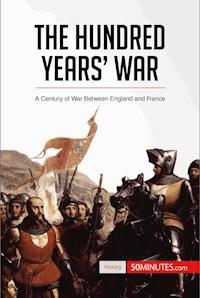
Keen to learn but short on time? Get to grips with the events of the Hundred Years’ War in next to no time with this concise guide.
50Minutes.com provides a clear and engaging analysis of the Hundred Years’ War. One of the longest direct conflicts between two countries, the Hundred Years’ War marked the culmination of tensions between the French and English over territory and the claim to the throne in France. The war, which saw the appearance of new military tactics and led to the development of strong national identities in both countries, is widely considered to be one of the most important conflicts of the Middle Ages.
In just 50 minutes you will:
• Learn about the main rulers and commanders involved in the Hundred Years’ War, on both the French and English sides
• Understand the principal events and turning points of the conflict, including the Battle of Agincourt and the Battle of Castillon
• Find out about the political, economic and social upheaval resulting from the war
ABOUT 50MINUTES.COM | History & Culture
50MINUTES.COM will enable you to quickly understand the main events, people, conflicts and discoveries from world history that have shaped the world we live in today. Our publications present the key information on a wide variety of topics in a quick and accessible way that is guaranteed to save you time on your journey of discovery.
Das E-Book können Sie in Legimi-Apps oder einer beliebigen App lesen, die das folgende Format unterstützen:
Seitenzahl: 47
Veröffentlichungsjahr: 2017
Ähnliche










The Hundred Years’ War
Key information
When: 1337-1453.Where: France.Context: the King of France died without a direct heir, leaving the throne vacant. There followed a series of conflicts over the space of around a hundred years which pitted England against France in order to obtain political and economic domination over Western Europe.Countries involved: France versus England.Key protagonists:Edward III, King of England and Duke of Aquitaine (1312-1377).Bertrand du Guesclin, constable of France (c. 1320-1380).Charles VII, King of France (1403-1461).Outcome: French victory.Victims: the number of victims, both direct and indirect, is difficult to estimate.Introduction
The Hundred Years’ War is one of the most famous conflicts of the Middle Ages and one of the longest direct clashes between two major powers. Between 1337 and 1453, it set the two most important monarchies of the Medieval West, France and England, against one another. When the King of England Edward III claimed his right to the French throne in 1337, he stepped right into the dynastic conflicts between the House of Plantagenet and the House of Valois. However, the real aim of the conflict proved much more important than that: it involved nothing more or less than obtaining political and economic domination over Western Europe. More than a century later, when the English were defeated at the Battle of Castillon in 1453, this rivalry had turned into a full-scale war between the two nations. Nonetheless, their armies had not fought without interruption for 116 years, as battles were interspersed with many periods of truce.
Although the previous centuries had been prosperous, misfortunes seemed to overwhelm the medieval world in the early 14th century. In 1347, the Black Death and famine decimated the population, as did the many campaigns which took place during the Hundred Years’ War, which proved to be particularly deadly and devastating.
At first glance, the forces of the countries at war do not seem to be evenly matched. France was enjoying great economic, cultural and demographic standing (it had 15 million inhabitants at the start of the century), while England had a lower population (under 5 million inhabitants) and was already embroiled in a war with Scotland. Even so, it was England that had the advantage between 1337 and 1360. France then reconquered its territories until 1415, when England regained the upper hand. The arrival of Joan of Arc (French heroine, 1412-1431), the alliance with Burgundy and the reform of the army finally gave the advantage to France, which won the war in 1453. The English then had no territory left on the continent, apart from Calais.
The Hundred Years’ War was of vital importance on a number of levels. It brought the European monarchies into the age of modernity and gave rise to a national feeling that did not exist before, thus marking a turning point in the history and development of Europe.
Context
The English king as a vassal of the French king
The bonds linking the kingdoms of France and England date back to the 11th century. In 1066, William the Conqueror (c. 1028-1087) seized power in England at the Battle of Hastings, in this way connecting the destinies of the two countries.
It was not until the next century that one of the main causes of tension between the two countries emerged: the seizure of the Duchy of Aquitaine by the English kings. In 1137, Eleanor of Aquitaine, Duchess of Aquitaine and Countess of Poitiers (c. 1122-1204), married King Louis VII of France (1120-1180). However, relations between the couple quickly deteriorated and Louis the Younger, as much to save his honour as to remedy the lack of a male heir, sought an annulment on the grounds that the couple were too closely related in the eyes of the Church. A few months later, Eleanor married Henry Plantagenet (1133-1189), the heir to the English throne. She became queen of England in 1154. The Duchy of Aquitaine, which belonged to her, therefore escaped French domination. From then on, the French kings tried to recover the territories under Plantagenet control by any means possible. King Philip II of France (1165-1223) managed to recover the majority of these lands through arms and diplomacy, with the exception of Guyenne (a variant of Aquitaine). It was not until 1259 that the Treaty of Paris between King Louis IX of France (1214-1270) and King Henry III of England (1207-1272) temporarily resolved the status of the duchy. Although Henry III kept the title Duke of Aquitaine, in return he had to pay homage to the king of France. Immediately prior to the Hundred Years’ War, the situation was therefore particularly ambiguous: the king of England was both sovereign of his kingdom and vassal of the king of France because of Aquitaine, which he found difficult to accept.
Feudal power relationships
During the Middle Ages, personal bonds joined lords and their vassals. In the ceremony of homage, the vassal pledged fealty to his lord and promised to serve him through advice and military support. In exchange, the lord promised to provide protection and deliver justice to his vassal. The homage was personal and therefore had to be renewed every time one of the two parties was replaced.
This submissive relationship to the new king of France, Philip VI (1293-1350) was especially difficult for Edward III to accept because Philip was only the son of a count, whereas he was the son of a king.




