


5,99 €
Mehr erfahren.
- Herausgeber: Rupert Colley
- Kategorie: Geisteswissenschaft
- Sprache: Englisch
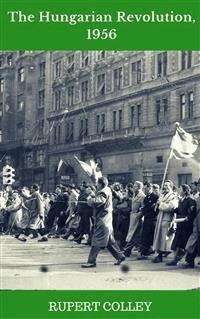
Sixty years ago, the people of Hungary stood up to Soviet tyranny. In Budapest and throughout the nation, civilians demanded freedom from Soviet oppression and their country’s communist government. It was one of the defining moments of the Cold War.The Hungarian Revolution of 1956 constituted the most serious threat to the USSR’s hegemony throughout the Cold War years. It is a story of extraordinary bravery in a fight for autonomy against a ruthless superpower.Rupert Colley, founder of the bestselling ‘History In An Hour’ series, recounts the years leading up to the days of October 1956, from the post-First World War years, the Second World War and Nazi Germany’s occupation of Hungary, to the post-war Stalinist years. He recounts the days of the uprising from its heroic beginnings to its tragic end; and finishes with an account of the immediate post-revolution years and the subsequent downfall of communism in Hungary in 1989.Illustrated with over 30 contemporary photographs, The Hungarian Revolution, 1956 provides a perfect introduction to one of the momentous occasions in 20th century history.
Das E-Book können Sie in Legimi-Apps oder einer beliebigen App lesen, die das folgende Format unterstützen:
Veröffentlichungsjahr: 2017
Ähnliche


















The Hungarian Revolution,
1956
Rupert Colley
––––––––
Ebook edition
@2016 Rupert Colley
––––––––
Rupertcolley.com
‘October 23, 1956, is a day that will live forever in the annals of free men and nations. It was a day of courage, conscience and triumph. No other day since history began has shown more clearly the eternal unquenchability of man’s desire to be free, whatever the odds against success, whatever the sacrifice required.’
John F. Kennedy
Table of Contents
Introduction
Hungary, 1914 to 1919
The Horthy Years
Post-War
Post-Stalin
Uprising
Post-1956
Blood in the Water
1989
Anastasia
Other Works by Rupert Colley
Get in Touch
Introduction
On 22 October 1956, a large group of students gathered in a Budapest university hall and, after much discussion, drew-up a 16-point manifesto. Amongst other demands, they called for freedom of speech and freedom of expression; they called for open, multi-party elections and the removal of Soviet troops from Hungarian soil. It was, in the context of the time, an incredibly brave and daring undertaking. The following day, they posted-up copies of their manifesto on trees and lampposts across the city before starting out on a march. Thousands joined the procession, gathering in front of the parliament building, shouting their demands. Without really having planned it, the students of Budapest had unleashed an uprising that quickly spread across the capital and the whole country.
The Hungarian Revolution of 1956 constituted the most serious threat to Soviet hegemony throughout the Cold War years. It was ultimately unsuccessful. Anger and the justice of the cause can only take you so far when faced with the might of a professional, organised army.
But 33 years’ later, with the memories of the uprising still fresh in the mind, it spurred-on those who sought once again to end communist rule in Hungary. One by one, the communist regimes fell throughout Eastern Europe during 1989, including Hungary’s. Finally, after 40 years of totalitarian rule, Hungary was free.
Hungary, 1914 to 1919
Hungary had been part of the Austro-Hungarian empire, the ‘Dual Monarchy’, since 1867, ruled by the House of Habsburg, in the person of Franz Joseph. The empire consisted of several nationalities, who, on occasions, sought greater autonomy. The empire resisted all such calls – for fear even the smallest of concessions would only lead to demands for more. Indeed, in the Hungarian half of the empire, its rulers enforced a policy of ‘Magyarization’, an attempt to make its people more ‘Hungarian’. Amongst the many nationalities causing the empire difficulty were the Serbs of Bosnia who wished to be incorporated into the nation of Serbia. On 28 June 1914, in Sarajevo, a Bosnian Serb called Gavrilo Princip assassinated the heir to the Austro-Hungarian throne, Franz Ferdinand. The assassination proved to be the spark that rapidly led to war.
Lesen Sie weiter in der vollständigen Ausgabe!
Lesen Sie weiter in der vollständigen Ausgabe!
Lesen Sie weiter in der vollständigen Ausgabe!
Lesen Sie weiter in der vollständigen Ausgabe!
Lesen Sie weiter in der vollständigen Ausgabe!
Lesen Sie weiter in der vollständigen Ausgabe!
Lesen Sie weiter in der vollständigen Ausgabe!
Lesen Sie weiter in der vollständigen Ausgabe!
Lesen Sie weiter in der vollständigen Ausgabe!
Lesen Sie weiter in der vollständigen Ausgabe!
Lesen Sie weiter in der vollständigen Ausgabe!




