


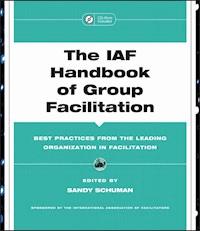
The IAF Handbook of Group Facilitation E-Book
85,99 €
Mehr erfahren.
- Herausgeber: John Wiley & Sons
- Kategorie: Fachliteratur
- Serie: J-B International Association of Facilitators
- Sprache: Englisch
Sponsored by the International Association of Facilitators, The IAF Handbook of Group Facilitation offers the need-to-know basics in the field brought together by fifty leading practitioners and scholars. This indispensable resource includes successful strategies and methods, foundations, and resources for anyone who works with groups. The IAF Handbook of Group Facilitation provides an overview of the field for new and aspiring practitioners and a reliable reference for experienced group facilitators, including chapters on * Creating positive ongoing client relationships * Building trust and improving communications * Facilitating group brainstorming sessions * Drawing out the best in people * Developing a collaborative environment * Designing and facilitating dialogue * Managing conflicting agendas * Working with multicultural groups * Using improvisation * Understanding virtual meetings * Facilitating team start-up * Assessing group decision processes * Building expertise in facilitation * Reviewing core facilitation competencies * Modeling positive professional attitudes
Sie lesen das E-Book in den Legimi-Apps auf:
Seitenzahl: 1040
Veröffentlichungsjahr: 2005
Ähnliche




















CONTENTS
Preface
About the Contributors
A Superlative Task
Part One: Create Collaborative Client Relationships
Chapter One: The Big Picture: Creating an Ongoing Client Relationship
Creating The Big Picture
Be Prepared
Interview Effectively
Gain Trust
Practice Empathetic Listening
Invest in Quality
Communicate Intentionally
Think About Clients
Understand Needs
Recognize Challenges
Evaluate Satisfaction
Conclusion
Chapter Two: The Skilled Facilitator Approach
What is Group Facilitation?
Key Elements of The Skilled Facilitator Approach
The Experience of Facilitation
Conclusion
Chapter Three: Facilitation: Beyond Methods
Historical Overview
Applications
Conclusion
Appendix 3A: Four Seasons Personality Profile
Part Two: Plan Appropriate Group Processes
Chapter Four: Eight Ps of Effective Facilitation Planning and Preparation
Perspective
Purpose
People
Product
Place
Process
Practice
Personal Preparation
Conclusion
Chapter Five: The Architecture of Participation
Feng Shui: Ancient Chinese Wisdom About Space
The Changing Form of Meetings
Meeting Room Arrangements That Beckon Participation
Assessing and Adapting Space
Conclusion
Chapter Six: Building Trust: The Great Enabler
Trust Between The Facilitator and Client
Trust Between The Facilitator and The Group
Trust Within and Between Groups
Measuring Trust
Keys to Understanding The Level of Trust in An Organization
Trust and Empowerment
Covey’s Emotional Bank Account
Techniques for Building Trust
The Bottom Line
Chapter Seven: Facilitation of Group Brainstorming
Factors That Hinder Effective Group Functioning
Factors That Improve Effective Group Functioning
Theory Versus Practice
Chapter Eight: Promoting Mutual Understanding for Effective Collaboration in Cross-Functional Groups with Multiple Stakeholders
Introduction to Case Study
Dynamics of Group Decision Making
A Typical Group Discussion in The Groan Zone
Building Mutual Understanding Through Effective Listening
Subsequent Developments
Integration of Theory and Practice
Conclusion
Chapter Nine: A Procedural Analysis of Group Facilitation: A Communication Perspective
Communication: The Heart of Group Decision Making
Messages and Their Dimensions
Procedures and The Functions of Group Communication
Levels of Analysis For Group Communication
Procedural Communication Analysis of Process Designs: Three Examples
Enhancing Facilitation Effectiveness
Part Three: Create and Sustain a Participatory Environment
Chapter Ten: Graphic Facilitation: The Art of Drawing Out the Best in People
Understanding Sustainability: A Visionary Challenge
Results Beginners Can Expect
A Brief History of Graphic Facilitation
Types of Processes Benefiting From Graphic Facilitation
The Four Flows of Facilitation
Putting it All Together
Conclusion
Chapter Eleven: Creating a Positive Participatory Climate: A Meaning-Centered Counseling Perspective
An Illustrative Story
Development of Theoretical Framework
Creating A Positive Participatory Climate
Competencies Needed To Create A Positive Participatory Climate
Characteristics of Effective Group Facilitators
Conditions for Success
Chapter Twelve: How to Build a Collaborative Environment
Collaborative Organizations and Communities
Conditions for Success
The Challenges of Systemic Change
A Five-Pronged Approach to Building A Collaborative Environment
Conclusion
Chapter Thirteen: Effective Strategies for Designing and Facilitating Dialogue
What is Dialogue?
Designing The Dialogue: An Example
Dialogue Processes: General Characteristics and Protocols
Dialogue Using The Conversation CAFé Process
Dialogic Conversation Starters
Conclusion
Resources
Chapter Fourteen: Dynamic Facilitation: Design Principles from the New Science of Complexity
Characteristics of Complex Adaptive Systems
Design Principles for Facilitating Dynamic Meetings
One Facilitator’s Experience
Conclusion
Resources
Chapter Fifteen: Facilitating the Whole System in the Room: A Theory, Philosophy, and Practice for Managing Conflicting Agendas, Diverse Needs, and Polarized Views
Why A Philosophy and Theory?
Practical Uses of D/I Theory
Managing Ourselves
Chapter Sixteen: Successfully Facilitating Multicultural Groups
Diversity Checklist for Workshop Design
Warm-Ups and Energizers
Creating Value with Diverse Teams: The Mapping, Bridging, and Integrating Model
Processes and Strategies to Map Differences
Conclusion
Chapter Seventeen: Improvisation in Facilitation
The Four Steps to Successful Improv
The Cornerstone of Successful Improvisation
Debriefing Improvisational Games
Facilitating in Liminal Space
The Facilitator As Energy Director
Three Paradoxes of Improv
Conclusion
Resources
Chapter Eighteen: Facilitation of the Future: How Virtual Meetings Are Changing the Work of the Facilitator
Best Practices
Conclusion
Part Four: Guide Group to Appropriate and Useful Outcomes
Chapter Nineteen: The Team Start-Up: A Scripted Approach to Facilitating the Start of an Effective Work Team
Planning The Start-Up Meeting
Conducting The Team Start-Up Meeting
Conclusion
Chapter Twenty: Facilitating Large Group Meetings That Get Results Every Time
The Planning Team Process
Ten Principles and Their Practice
Conclusion
Chapter Twenty-One: Facilitating Communication in Group Decision-Making Discussions
The Functional Theory of Communication in Decision Making
Obstacles to Appropriate Choice Making and Facilitative Responses
Knowledge and Skills to Enhance Facilitation
Conclusion
Chapter Twenty-Two: Consensus Building: Strategies for Resolving Disagreement
Underlying Principles: Why People Disagree
Building A Tool Box of Consensus Techniques
Conclusion
Chapter Twenty-Three: Quality Without a Name
An Illustrative Story
Overview
History Mapping
Business World Mapping
Verbal and Visual Facilitators
Our Work Base
Quality Mapping
Case Studies
How to Learn
Conclusion
Key Terms and Definitions
Resources
Chapter Twenty-Four: Facilitating Participatory Evaluation Through Stories of Change
An Overview of Participatory Evaluation
Participatory Evaluation Through Stories of Change
Appendix 24A: PM&E in The Community Empowerment Programme, Ethiopia
Appendix 24B: An Example of Stories of Change from The Philippines
Appendix 24C: Facilitating Groups and Documenting Stories of Change
Chapter Twenty-Five: Assessing the Effectiveness of Group Decision Processes
Group Performance Measurement
Organizational Conditions That Affect Group Decision Processes
Conclusion
Part Five: Build and Maintain Professional Knowledge
Chapter Twenty-Six: Facilitator Core Competencies as Defined by the International Association of Facilitators
Defining Competencies
The Competencies
Certification Process
Next Steps
Appendix 26A: IAF Facilitator Core Competencies
Chapter Twenty-Seven: Operational Dimensions of the Profession of Facilitation
Change
Spectra of Facilitation
Conclusion
Chapter Twenty-Eight: How to Build Your Expertise in Facilitation
Training
Reference Materials
Internet Learning
Observation of Others
Application
Feedback
Teach Others
Be A Thought Leader
Professional Standing
The Intentional Plan
Conclusion
Appendix 28A: Survey of Group Facilitators: How to Build Your Expertise
Chapter Twenty-Nine: Dimensions of Facilitator Education
The Demand for Facilitator Education in Organization Development
Approaches to Facilitator Education
Limitations of The Model and Issues for Facilitator Education
Conclusion
Part Six: Model Positive Professional Attitude
Chapter Thirty: Facilitator Values and Ethics
IAF Values and Competencies
Development of The Code
Key Issues
Emerging Issues
Conclusion
Appendix 30A: Statement of Values and Code of Ethics For Group Facilitators
Chapter Thirty-One: Facilitation from the Inside Out
What Facilitators Know
What Facilitators Do
What Facilitators Are
Conclusion
Chapter Thirty-Two: The Gift of Self: The Art of Transparent Facilitation
Transparency and Neutrality
Conditions for Success: Know The Moment
The Nuts and Bolts of Transparency
Conclusion
Chapter Thirty-Three: Affirmative Facilitation: An Asset-Based Approach to Process Consultation
Background of Affirmative Facilitation
Affirmative Facilitation: Empowering The People
Affirmative System Development in Other Disciplines
Affirmative Facilitation: Releasing Freedom
The Distinctive Character of Affirmative Facilitation
Facilitating Affirmatively
Conclusion
References
Name Index
Subject Index
How to Use the CD-ROM
Download CD/DVD content
Copyright © 2005 by the International Association of Facilitators (IAF).
Pages 663–664 constitute a continuation of the copyright page.
Published by Jossey-Bass
A Wiley Imprint
989 Market Street, San Francisco, CA 94103-1741 www.josseybass.com
No part of this publication may be reproduced, stored in a retrieval system, or transmitted in any form or by any means, electronic, mechanical, photocopying, recording, scanning, or otherwise, except as permitted under Section 107 or 108 of the 1976 United States Copyright Act, without either the prior written permission of the Publisher, or authorization through payment of the appropriate per-copy fee to the Copyright Clearance Center, Inc., 222 Rosewood Drive, Danvers, MA 01923, 978-750-8400, fax 978-750-4470, or on the web at www.copyright.com. Requests to the Publisher for permission should be addressed to the Permissions Department, John Wiley & Sons, Inc., 111 River Street, Hoboken, NJ 07030, 201-748-6011, fax 201-748-6008, e-mail: [email protected].
Jossey-Bass books and products are available through most bookstores. To contact Jossey-Bass directly call our Customer Care Department within the U.S. at 800-956-7739, outside the U.S. at 317-572-399386 or fax 317-572-4002.
Jossey-Bass also publishes its books in a variety of electronic formats. Some content that appears in print may not be available in electronic books.
Library of Congress Cataloging-in-Publication Data
The IAF handbook of group facilitation : best practices from the leading organization in facilitation / Sandy Schuman, editor.
p. cm.—(The Jossey-Bass business & management series)
Includes bibliographical references and index.
ISBN 0-7879-7160-X (alk. paper)
1. Group facilitation—Handbooks, manuals, etc. 2. Group decision-making—Handbooks, manuals, etc. 3. Consensus (Social sciences)—Handbooks, manuals, etc. 4. Conflict management—Handbooks, manuals, etc. 5. Management—Employee participation—Handbooks, manuals, etc. I. Title: International Association of Facilitators handbook of group facilitation. II. Title: Handbook of group facilitation. III. Schuman, Sandy, 1951- IV. International Association of Facilitators. V. Series.
HM751.I24 2005
302.3′5—dc22
2004026722
The Jossey-Bass Business & Management Series
PREFACE
What is group facilitation? A short answer: Helping groups do better. A long answer: Read this book! Many views are represented in this book. Although most of them are consistent with each other, they emphasize different aspects of group facilitation, and some present interesting differences. We have not attempted to present a singular view but rather a diversity of credible perspectives.
For a midrange answer, start with Chapters Twenty-Six and Thirty, “Facilitator Core Competencies as Defined by the International Association of Facilitators,” by Lynda Lieberman Baker and Cameron Fraser, and “Facilitator Values and Ethics,” by Dale Hunter and Stephen Thorpe. Together these two chapters convey a sound foundation for understanding group facilitation.
While you may choose to read this book cover to cover, it was designed as a handbook or desktop reference to which you might refer as needed. Each part corresponds to one of the major areas of facilitator competencies, and each chapter was placed in the part to which it most closely relates. Nevertheless, recognizing that each chapter addresses more than one competency, we have provided a Matrix of Contents to help you find chapters pertinent to your needs. The matrix, which follows this Preface, shows each chapter and the competencies it substantially addresses.
One hundred fifteen authors contributed to this book and CD. This is an extraordinary demonstration of the willingness of practitioners and scholars to contribute to the expanding practice and developing theory of group facilitation. Another sixty people were engaged in reviewing the articles contributed to Group Facilitation: A Research and Applications Journal, the first five issues of which appear on the CD, and in reviewing the chapter proposals for this book. Furthermore, references are made to the work of authors—more numerous than I would like to tally—on which the current work builds and expands. To these many hundreds of individuals who have graciously shared their knowledge and wisdom, we owe our gratitude and respect.
Without the long-term determination and support of the volunteer leaders and professional staff of IAF, the Journal and Handbook never would have been conceived, much less implemented. Mark Adkins, Robin Bailey, Lynda Baker, Mark Fuller, Beret Griffith, Laura Hayter, Dale Hunter, Jon Jenkins, Kerri McBride, Dan Mittleman, Cookie Murphy/Pettee, Jo Nelson, Wayne Nelson, Ned Ruete, Peggy Runchey, Marieann Shovlin, Jim Spee, Bill Staples, David Vukovic, Sunny Walker, Jean Watts, and Vicki Wharton all played critical roles. So, too, our thanks go to the editorial and production professionals at Jossey-Bass who have made this book possible: Rob Brandt, Mary Garrett, Tamara Keller, Beverly Miller, Carolyn Miller, Debbie Notkin, Kathe Sweeney, Akemi Yamaguchi, and others yet to be involved as of this date, as the book enters its final stages of production. In addition, thanks to Reinhard Kuchenmüller, who graciously provided illustrations for each part of the book, and Kevin Kuhne, whose illustrations complement this Preface.
My hope is that writing these chapters and articles was worthwhile for the authors, and reading them will be valuable to you, but it has been no more beneficial to anyone than me. My personal thanks to all who contributed, and my apologies for any omissions or errors.
The work of this book is not done. Your reactions, questions, and suggestions will add value and contribute to the growth and development of group facilitation. Please feel free to contact me as indicated below.
January 2005
Sandy Schuman
Center for Policy Research
University at Albany, SUNY
Albany, New York
MATRIX OF CONTENTS
This matrix identifies which chapters provide information related to the IAF Foundational Facilitator Competencies.
ABOUT THE CONTRIBUTORS
Sandy Schuman has been helping organizations work more effectively to solve complex problems and make critical decisions for more than thirty years. He facilitates problem-solving and decision-making processes for a wide variety of public management and policy issues; works with organizations to develop a more collaborative culture; and provides training in group facilitation, decision making, communication, systems thinking, conflict management systems, public involvement, and information management. He is qualified on the National Roster of Environmental Dispute Resolution and Consensus Building Professionals and Sub-Roster of Transportation Mediators and Facilitators of the U.S. Institute for Environmental Conflict Resolution and the Roster of REDRESS Mediators of the U.S. Postal Service.
Schuman is a research associate of the Center for Policy Research, University at Albany, SUNY, and president of Executive Decision Services LLC, a consulting firm in Albany, New York. He moderates the Electronic Discussion on Group Facilitation and is the editor of Group Facilitation: A Research and Applications Journal. He helped found the International Decision Conferencing Forum and the New York State Forum on Conflict and Consensus and is cochair of the Ethics and Values Think Tank of the International Association of Facilitators.
He holds a Ph.D. in organization behavior from the University at Albany, SUNY, where he also earned his M.P.A., and a B.S. in natural resources management from Cornell University. His work has been published in Interfaces, Information and Management, Journal of Policy Analysis and Management, Quality Progress, Government Technology, Fisheries, Journal of Extension, The Search for Collaborative Advantage (Sage Publications), Organizational Decision Support Systems (North-Holland Press), and New York State in the Year 2000 (SUNY Press).
Kristin J. Arnold, president of Quality Process Consultants, specializes in facilitating executives and their leadership, management, and employee teams as well as training others to facilitate teams to higher levels of performance. She is the author of several professional articles and books, as well as a featured columnist in the Daily Press. She earned her M.B.A. from St. Mary’s College in California.
Lynda Lieberman Baker is founder and president of MeetingSolution, an organization development consulting practice based in Austin, Texas. She specializes in values-based facilitation, strategic organizational planning and alignment, and personal strengths and styles assessments. Prior to founding the firm in 1994, she worked with the internationally recognized technology business incubator for technology businesses and at the Graduate School of Business at the University of Texas at Austin. She is an accredited assessor for the International Association of Facilitators’ Certified Professional Facilitator programs and a member of the association’s coordinating team (its board of directors). MeetingSolution’s clients are primarily corporate, professional, and trade associations and nongovernmental social service agencies.
Nadine Bell has over twenty years of experience in working with clients in the private and public sectors and the United Nations Development Program. She facilitates them to plan strategically, communicate effectively, and work collaboratively to achieve their goals. Bell builds her customized facilitations around participative processes that are designed to promote dialogue, transform conflict, develop consensus, expand creative problem solving, and enhance productivity. A mentor trainer of several facilitation courses and founding member of the International Association of Facilitators (IAF), Bell is a member of the Southwest Facilitators Network and the Dallas–Fort Worth Organization Development Network. The first North American to become a Certified Professional Facilitator and one of the first four Certified Master Facilitators, Bell, an assessor and a process manager, has assessed facilitator candidates globally. A past chair of IAF and coordinator of Conference 2002 Texas, she has also served as a cochair of IAF’s 1996 Conference in Dallas and IAF’s Professional Development Task Force.
Terry D. Bergdall is a founding member of IAF with extensive international experience. In the early 1980s, he facilitated planning events with dozens of municipal governments and public agencies in suburban Chicago. In the late 1980s, as country director of an international nongovernmental organization in Kenya, he initiated and facilitated a highly participatory process of internal restructuring and “indigenization.” He has designed facilitation processes and trained numerous facilitators in Kenya, Tanzania, Zambia, and Ethiopia. Facilitation work has taken him to the Balkans, the Caucasus, the Middle East, Southeast Asia, and East Africa. He is the author of Methods for Active Participation. He earned his Ph.D. at the University of Wales.
Michael Beyerlein is director of the Center for Collaborative Organizations and professor of industrial/organizational psychology at the University of North Texas. His research interests include all aspects of collaborative work systems, organization transformation, work stress, creativity and innovation, knowledge management and the learning organization, and complex adaptive systems. He has published in a number of research journals and has been a member of the editorial boards for TEAM Magazine, Team Performance Management Journal, and Quality Management Journal. Currently, he is senior editor of the Elsevier series Advances in Interdisciplinary Studies of Work Teams and the Jossey-Bass/Pfeiffer Collaborative Work Systems series. He has authored or edited fifteen books. His most recent are Guiding the Journey to Collaborative Work Systems: A Strategic Design Workbook (2003), The Collaborative Work System Fieldbook (2003), and Team-Based Organizing (2003).
Jeff Bracken is an organizational effectiveness consultant specializing in organizational survey-feedback-action planning processes, group facilitation, change management consulting, and leadership development and coaching. Since founding Bracken and Associates in 1993, he has served over 250 client organizations in diverse industries. Prior to that, he held key human resource management positions with Fortune 500 corporations and other leading organizations. He is a past examiner, senior examiner, and process observer for the Texas Award for Performance Excellence and has been a member of the board of overseers with the Quality Texas Foundation since 2001. Bracken was named a member of the board of examiners for the Malcolm Baldrige National Quality Award in 2003 and 2004. He is a member of the International Association of Facilitators, the Southwest Facilitators Network, and the Dallas–Fort Worth Chapter of the International Society for Performance Improvement, and is a founding member of the Dallas–Fort Worth Organization Development Network. He earned a B.B.A. in general business and an M.S. in manpower and industrial relations at the University of North Texas, and is a mentor trainer of the Technology of Participation Group Facilitation Methods of the Institute of Cultural Affairs.
Lori Bradley recently completed doctoral course work in industrial/organizational psychology at the University of North Texas and is researching a dissertation on virtual collaboration and virtual leadership. She is currently a strategic learning principal with Raytheon Learning Institutes and a current and founding member of the Virtual Collaboration Research Group at the Center for Collaborative Organizations. Her research and practice areas include virtual collaborative systems and technology, leadership development, and strategic learning solutions. She has worked as a consultant in the medical, banking, real estate, aviation, and information services industries.
Joe Chilberg is a professor of communication at the State University of New York at Fredonia whose work emphasizes helping others understand and excel as human communicators. His work ranges from the classroom to the boardroom as a consultant, trainer, meeting facilitator, and researcher for communication assessments in educational and corporate settings. He has contributed several publications and presentations on group communication, group process designs, and creative problem solving. His current work emphasizes the use of dialogue and appreciative inquiry as approaches for creating participatory, change-responsive cultures.
Mary Eggers is a consultant with Dannemiller Tyson Associates. She has worked in education, government, health care, information technology, banking, and manufacturing, helping her clients tap the wisdom, heart, and energy of those in the organization to achieve desired results. Her work has focused on team development strategic planning, culture change, and redesigning business processes and organization structures. She earned her M.S. in organization development from American University. She is a member of the National Training Labs and the Organization Development Network.
John Epps has conducted seminars and consultations on an in-house basis for organizations in Southeast Asia, the United States, and Europe. As director of LENS International in Malaysia and Singapore, he consults with groups on the subjects of strategic thinking, facilitation methods, customer service, and leadership development. Clients include companies in banking, insurance, manufacturing, and petroleum industries. Epps is a contributing author of the book, Participation Works: Business Cases from Around the World. He has published articles in IMAGE, the Journal of Personal and Organisation Transformation, the Journal of Quality and Participation, and Facilitator. He is a founding member of the International Association of Facilitators and is currently an adjunct professor at the University of Maryland University College. Epps received his B.A. from the Citadel and his Ph.D. from Southern Methodist University.
Cameron Fraser has worked as a facilitator and trainer for clients throughout North America and in Europe since 1993. His facilitation and consulting services include custom process design in strategic and operational planning and stakeholder consultations. He has facilitated large and small group workshops at and across all organizational levels, designed and installed the delivery structure for organizations, and designed and implemented facilitated processes for team building. He serves as president and CEO of RANA International, based in Ottawa, Ontario, Canada, and is director of operations for the International Association of Facilitators Certified Professional Facilitator Program.
Kathy Free has over thirteen years facilitating experience and seven years teaching and mentoring facilitators by employing her self-developed twenty-week instructional program. She serves as a senior examiner for the Malcolm Baldrige National Quality Award Program and has been appointed to the Executive Guidance Board of the U.S. Senate Productivity and Maryland Excellence Awards. Free is a featured speaker for professional organizations, conferences, and colleges and universities on a variety of topics, including facilitation techniques and performance excellence. She is currently employed at the U.S. Social Security Administration.
Izzy Gesell has a B.A. in psychology and an M.S. in education. He began facilitating while teaching in the graduate school of education at Hunter College in New York. Since then, his facilitation clients have included NASA, Hewlett-Packard, Microsoft, and the Internal Revenue Service. He has run training workshops in improvisation at regional and national gatherings of, among other groups, the International Association of Facilitators, Organizational Development Network, National Speakers Association, and American Society for Training and Development. He is the author of Playing Along: Group Learning Activities Borrowed from Improvisation Theater, numerous articles, and a training video, Humor Works with Izzy Gesell.
Dennis S. Gouran is professor of communication arts and sciences and labor studies and industrial relations at the Pennsylvania State University. He is the author or coauthor of numerous books and articles dealing with communication in decision-making and problem-solving groups, has served as editor of both Communication Monographs and Communication Studies, and has been president of both the National Communication Association and the Central States Communication Association. He received his Ph.D. from the University of Iowa.
Randy Y. Hirokawa is dean of the College or Arts and Sciences at the University of Hawaii at Hilo. A specialist in the study of communication in decision-making and problem-solving groups, as well as former editor of Communication Studies, he has published extensively in the area. He is chair of the of Group Communication Division of the National Communication Association. Hirokawa received his Ph.D. from the University of Washington.
Christine Hogan is a professional facilitator and educator. She is committed to helping people to learn how to facilitate and to fostering innovations in facilitation through reflective practice, networking and research. Her extensive consultancy work (Bhutan, Lao PDR, Malaysia, Hong Kong, Nepal, Mongolia, the United Kingdom, and Australia) focuses on personal, organization, and community development. Previously, she taught as a senior lecturer in human resource development at Curtin University of Technology, Perth, Australia. She specialized in the education of facilitators and supervision of student research into the field. She is now an adjunct associate professor with the Centre for Research and Graduate Studies in the Division of Humanities at Curtin University. She has published four books and over thirty journal articles and conference papers. She has facilitated workshops in the United States, Canada, Malaysia, Mongolia, and Laos. She has recently been working with SNV Netherlands in the Kingdom of Bhutan in the Himalayas as a training and decentralization adviser.
Marsha Hughes-Rease has over twenty years of leadership experience and worked nine years as an internal consultant prior to joining Dannemiller Tyson Associates. She has provided consultative services, facilitation, and training in diverse organizational settings, including the government, military, health care, education, and manufacturing. Consultative services have included strategic planning and management, organizational restructuring, work process redesign and improvement, conflict management, team development, and leader succession planning. She is also an adjunct faculty member at George Mason University in Fairfax, Virginia. She has graduate degrees in nursing administration and organization development. Her professional affiliations include the American College of Healthcare Executives, American Society for Quality, the Society for Organizational Learning, Chesapeake Bay Organization Development Network, and the Mid-Atlantic Facilitators Network.
Dale Hunter is a group facilitator and author in the field of facilitation. She is a director of Zenergy Ltd. a New Zealand–based company providing facilitation, mediation, and coaching services. The Zenergy Diploma of Facilitation, codesigned by Hunter, has taken more than twelve hundred people to various levels of its eight-module program. She is the principal coauthor (with Anne Bailey and Bill Taylor) of The Art of Facilitation, The Zen of Groups, Co-operacy—A New Way of Being at Work, and The Essence of Facilitation (also published under the title Handling Groups in Action: The Use of Distinctions in Facilitation). Hunter’s doctoral thesis, “Facilitation of Sustainable Co-Operative Processes in Organisations,” includes a survey of facilitator values and ethics and the monitoring of the IAF code of ethics process. She is vice chair international on the board of directors of the International Association of Facilitators.
Sylvia James has twenty years of experience using whole system, large-scale change methods in high-tech, service, manufacturing, government, and education systems around the world She has designed and facilitated large group interactive meetings involving over a thousand participants in creating and implementing strategy, redesigning work processes and organizational structures, integrating diverse cultures, building multicontractor teams, and planning and launching major programs. She is a partner in Dannemiller Tyson Associates and in the mid-1980s pioneered Whole-Scale Change processes in aerospace. She is coauthor of Whole-Scale Change: Unleashing the Magic in Organizations and The Whole-Scale Change Toolkit and a chapter contributor to Flawless Consulting Fieldbook and The Change Handbook. She has also written a number of articles and presented at conferences and workshops around the world. James approaches all her work with a passion for enabling individuals and groups to realize their hopes.
Sandra Janoff worked in public education from 1974 to 1984, helping organize one of the first team-based high schools in the United States. Her research on relationships among organization structure, behavior, and gender led to her doctoral dissertation, “The Influence of Legal Education on Moral Reasoning,” published in the Minnesota Law Review and in Feminist Jurisprudence: Taking Women Seriously—Cases and Materials. She consults with Fortune 500 companies, small businesses, communities, and nonprofits on whole systems redesign and leadership coaching. She also has run training workshops on systems-oriented group dynamics and is coauthor of “Systems Thinking and Small Groups” for the Comprehensive Textbook of Group Psychotherapy (1993). She codirects Future Search Network, a worldwide voluntary nonprofit service organization and is a member of the European Institute for Transnational Studies. Together with Marvin Weisbord, she has facilitated future searches in many countries and given seminars in facilitation and future search.
Jon Jenkins has more than thirty-five years of experience in facilitating social and organizational change in developing and developed countries and in training in the fields of short- and midterm planning, community development, team building, motivation, and methods of education. He facilitated or helped facilitate participative month-long consultations in nineteen comprehensive community development projects in eleven countries. He was project director or assistant project director involving one- to two-year on-site residencies in three communities. He has taught over one hundred two- to three-day modules on individual and social change, community development, facilitation, and training methods. He has designed and facilitated a wide variety of events for Shell International Exploration and Production, KPN Telecom, Netherlands, the Community Revitalization through Democratic Action project in Western Serbia, and the Institute of Cultural Affairs, among many others. He has written or edited a number of articles and books on facilitation, training, and social problems. He is on the International Association of Facilitators’ ACT, the board of directors, with responsibility for communications and publications. Also, he serves on the board of directors for the Union of International Associations, Brussels. He is one of the co-owners of Imaginal Training, a Netherlands-based international training and facilitation company.
Sam Kaner has been writing and practicing in the field of organization development since the early 1980s. He is the senior author of Facilitator’s Guide to Participatory Decision-Making. He has made presentations on his concepts and models at the annual conferences of several professional associations, including the International Association of Facilitators, the National Organization Development Network, the American Society for Quality, and the Association for Quality and Participation. His corporate clients have included Hewlett-Packard, VISA International, Charles Schwab, PricewaterhouseCoopers, and many other Fortune 500 companies. His public service clients have included the California Supreme Court, March of Dimes, Special Olympics, Omidyar Foundation, and many community-based organizations and government agencies. Since 1986, he has been executive director of Community At Work, a San Francisco-based consulting firm that specializes in designing and facilitating cross-sector, multistakeholder collaboration.
Miki Kashtan conducts public workshops in nonviolent communication (NVC) and offers mediation, meeting facilitation, coaching, and training for organizations and businesses throughout the United States. She directs the Social Change Project for the Center for Nonviolent Communication (CNVC), a global organization offering NVC training and materials worldwide. In 2002, she cofounded Bay Area Nonviolent Communication (BayNVC). BayNVC is part of CNVC’s international network of trainers and local organizations committed to the creation of a world where everyone’s needs are met peacefully through compassionate giving and receiving. She holds a doctorate in sociology from the University of California in Berkeley. She has published articles on the theory and applications of nonviolent communication in Tikkun, Encounter, and Communities magazines.
Lisa Kimball is the founder and executive producer of Group Jazz, a consulting and services company that supports the work of purposeful groups—teams, communities, task forces, organizations—that meet face-to-face or on-line or both. Clients have included Pfizer, Merck, IBM, USDA, NTL, California Institute of Integral Studies, and City University of New York. She serves on the board of the Plexus Institute, an organization dedicated to promoting organizational and community health through the applications of ideas from complexity science. She has deep experience in facilitating on-line groups and training moderators on multiple networks. She also coaches facilitators and team leaders. Prior to founding Group Jazz, she was a principal consultant in Metasystems Design Group and a cofounder of Caucus Systems. She received her Ph.D. in educational psychology, cognition, and learning from the Catholic University, a master’s in social science from Wesleyan University, and a B.A. from Sarah Lawrence College.
Reinhard Kuchenmüller: Having worked as an architect for thirty-five years, my main theme was facility programming, that is, detecting, developing, and communicating human needs as a basis for the design process, including research and consultancy in this field. In 1992, I was fortunate enough to come across a method using hand-drawn pictures to visualize people’s statements, originally developed by the architectural firm CRSS from Houston, Texas. This method of visualization soon revolutionized my work. The method matured and became the source of a new profession, visual facilitation, which spread into all fields of business. In 1998, I founded VISUELLE PROTOKOLLE in Munich, Germany, a company that offers visual facilitation using hand-drawn images. My holistic approach integrated all my professional, emotional, and spiritual dimensions and brought me into contact with the same dimensions in organizations.
Roland Loup has engaged in whole system consulting with a variety of profit and nonprofit organizations, state and national governments, and universities in the United States, Canada, Europe, India, and Australia for the past twenty years. Specific applications include strategy development and implementation, mergers and acquisitions, culture change, and quality systems implementation. He has codesigned and cofacilitated workshops on the Whole-Scale change process in the United States, Europe, Canada, and India and is cofounder and copresenter of “Intentional Interventions—Diagnosis and Design for Consultants and Trainers” and “The Whole Systems Practicum—An Experience in Laboratory Learning.” He has written numerous articles on the practice of organization development and is coauthor of Whole-Scale Change: Unleashing the Magic in Organizations and Whole-Scale Change Toolkit. He is now partner emeritus of Dannemiller Tyson Associates after serving as partner for over fifteen years. He holds a master’s in mathematics and a doctorate in statistics.
Larry Meeker is a founder and president of Advanced Team Concepts, which specializes in training and support for organizations that are working to improve the human dynamics within their groups. An area of specialty is leadership development programs. He has been involved in the development and delivery of training courses and workshops for Christian-based organizations including World Vision, Habitat for Humanity, federal government agencies, and many private sector organizations such as Dell Computer, Texas Instruments, Ericsson, and Motorola. Previously he was a manager at Texas Instruments. He is a graduate of the University of Arkansas and author of two books on training.
Toshihiko Nakui is a doctoral candidate in the Department of Psychology at the University of Texas at Arlington. He graduated from Kanto Gakuin University in Yokohama, Japan, and received a master of counseling psychology degree from the College of Notre Dame, California. He has been studying group creativity and decision making in collaboration for four years. His primary interest is in the influence of group composition and type of communication system on group work.
Fred Niziol is a full-time facilitator specializing in collaborative Joint Application Development and other information technology–specific sessions, as well as interest-based bargaining negotiations. He is a member of the International Association of Facilitators and the Mid-Atlantic Facilitators Network. Niziol is currently employed by the U.S. Social Security Administration, working in the information technology area.
Susan Nurre, a Certified Professional Facilitator and Certified Master Facilitator, has designed and facilitated sessions for over fifteen years. In 1993, she created and continues to publish The Facilitator, a quarterly professional publication with international readership. Nurre has worked with a variety of clients to determine and satisfy their needs from systems requirements to organizational change readiness. In addition to facilitation, Nurre has experience in assessing organizational culture, soliciting customer feedback, developing and implementing communication strategies, managing projects and team members, and the development and delivery of training, including several facilitation courses. Prior to starting her own practice, Nurre worked for Arthur Andersen, American Airlines, and Computer Sciences Corporation. She is a member of the Southwest Facilitators Network and has been a member of the International Association of Facilitators for nine years. She served as program chair for the 1996 IAF Conference and the logistics chair for the 2002 IAF Conference.
Paul B. Paulus is professor of psychology and interim dean of the College of Science at the University of Texas at Arlington. He has published in the area of group dynamics for over thirty years, including publication of five scholarly books and a textbook devoted to effectiveness in the workplace. For the past fifteen years, he has been studying group creativity employing the brainstorming paradigm and has published over thirty papers and chapters on this topic. He edited Group Creativity: Innovation Through Collaboration, which was published in 2003. His research has uncovered many factors that influence the effectiveness of brainstorming that are relevant facilitator practice.
Steven N. Pyser is a principal in a consulting firm that provides dialogue, strategic planning, conflict management, and synergy services to educational institutions, corporations, and nonprofit organizations. He is a member of the faculty at the University of Phoenix, Greater Philadelphia (Pennsylvania) Campuses, where he teaches undergraduate, graduate business, and management courses. Pyser facilitates public conversations and dialogues and conducts workshops on diversity, issues of public importance, group facilitation skills, and conflict management. He serves on the editorial board for Conflict Resolution Quarterly and as a staff editor for Journal of Legal Studies Education. He received his J.D. from Temple University School of Law.
Maria Begoña Rodas-Meeker has been a facilitator and trainer for the past eight years. She is a founder and principal of Amauta International, which specializes in training and mentoring leaders and facilitators for organizational and social change. She has been involved in the development and delivery of training courses and workshops for groups in corporate settings, government agencies, and a wide range of nonprofit organizations, including Christian-based organizations such as World Vision International, Habitat for Humanity, and Lutheran Church of Colombia. Previously, she was organization development director at Alpina, headquartered in Bogotá, Colombia. She is a graduate of Pontificia Universidad Javeriana, Bogotá, Colombia, and a Certified Professional Facilitator.
John Rohrbaugh earned his Ph.D. in social psychology at the University of Colorado and currently serves as full professor in the Department of Public Administration and Policy and director of the Office of International Education, University at Albany (SUNY). His research has focused on the problem-solving processes of management groups, executive teams, and expert task forces in an effort to identify methods that would improve both the efficiency and effectiveness of organizational decision making. His work, ranging from brief laboratory studies to a ten-year demonstration project in a field setting, has been published as articles in more than twenty journals and as chapters in nearly as many books. As a consultant and facilitator, he has worked with over thirty agencies of federal and state government in the United States, as well as participating on project teams working with governments in Chile, Egypt, Somalia, Lebanon, and Hungary.
Roger Schwarz is an organizational psychologist and president of Roger Schwarz & Associates, a consulting firm that helps people think and act differently so that they can create powerful results and productive relationships in ways they did not think possible. Since 1980, he has served as facilitator, consultant, trainer, and coach to Fortune 500 corporations, governments, and nonprofit organizations, helping them develop effective work groups and facilitative leaders, and create organizational change. He is the author of The Skilled Facilitator: A Comprehensive Resource for Consultants, Facilitators, Managers, Trainers and Coaches, New and Revised Edition (Jossey-Bass, 2002), considered a standard reference on facilitation. He is coauthor of The Skilled Facilitator Fieldbook (Jossey-Bass, 2005). Formerly an associate professor of public management and government at the University of North Carolina at Chapel Hill, in 1996 he founded Roger Schwarz and Associates. He earned his B.S. degree from Tufts University, an M.Ed. from Harvard University, and an A.M. and Ph.D. in organizational psychology from the University of Michigan.
Beverly Seiford has over twenty-five years of experience as an organization development consultant, project director, and educator. She has facilitated strategic planning, process improvement, leadership development, conflict resolution, and team-building initiatives for Fortune 100 corporations, federal and state governments, medical centers, educational institutions, and nonprofit agencies. The focus of her work is helping clients create a culture that supports superior organizational performance, ongoing individual employee development, and the effective use of available resources in the context of a constantly changing environment. She is a partner in Dannemiller Tyson Associates. She has a master’s degree and an advanced graduate studies certificate in foundations of management from the University of Massachusetts. In addition, she is a certified administrator and trainer for the Myers-Briggs Type Indicator.
David Sibbet is a facilitator, organizational consultant, and communications designer. He is founder and president of the Grove Consultants International, a full-service organization development consulting firm and publishing company located in San Francisco. He and his team design and lead strategy, visioning, creativity, future-forces, leadership development, and large-scale system change processes for clients throughout the world. In addition, he and the Grove’s Design Solutions Group provide documentation and communication design services that help move insight to action. He is the author and designer of many of the Grove’s process consulting tools and guides. Sibbet received a master’s degree in journalism from Northwestern University and a B.A. in English from Occidental College. He is a long-time affiliate with the Institute for the Future in Menlo Park and a member of the Global Business Network in Emeryville.
Trish Silber is president of Aliniad Consulting Partners, a consulting firm focused on leadership, team, and organization development. She works with clients in executive coaching, strategic alignment, and corporate learning in leadership, productive reasoning, and communication. Prior to forming Aliniad, she was a senior partner with Catalyst Consulting Team, a national consulting firm known for its work in strategic alignment, leadership development, and experiential learning and served on its board of directors from 1996 through 2002. Prior to joining Catalyst, she held several internal human resource positions at Apple Computer. She earned a master’s degree in business from the University of Santa Clara and a bachelor’s degree in behavioral psychology from Connecticut College, and has done graduate work in organizational behavior at George Washington University. She has completed numerous certificate programs in the fields of human resources, organization development, and coaching. She is an assistant professor at George Washington University in Washington, D.C., where she teaches in the Leadership Coaching graduate program.
Marianne Stifel: People have always interested and fascinated me. For this reason, I studied medicine and, after receiving my doctorate, specialized in family practice. I pursued further education in psychotherapy and systemic organization and team development. My professional background consists of twenty years of medical experience and knowledge, with a special focus on psychosomatic medicine, psychotherapy, and art therapy. For a long time, the fine and performing arts have been a personal source of inspiration, regeneration, and intense encounters for me. Art therapy has been particularly fascinating in offering me the possibility of healing by means of creative media. Working with images presents a wonderful opportunity of comprehending people and their needs, their sensitivities and interwoven relationships, and communicating with them on this basis. Since 2000, I have been dedicated to the continued development of this field of work as a partner in VISUELLE PROTOKOLLE.
David Straus founded Interaction Associates in 1969 and over the years has served as president, CEO, and chairman of the board. Interaction Associates works in the areas of organization development, group process facilitation, training, and consulting. He guided the development of Interaction Associates’ consulting practice and training programs. He was also responsible for major change efforts in a variety of organizations, including the health care and service industries, and has worked with social action partnerships in Newark, New Jersey, and Palm Beach County, Florida. Straus earned a bachelor’s degree from Harvard University and a master’s degree in architecture from Harvard’s Graduate School of Design. Under grants from the National Institute of Mental Health and the Carnegie Corporation, he conducted research in creativity and developed training programs in problem solving. Straus coauthored How to Make Meetings Work (1976) and is the author of How to Make Collaboration Work: Powerful Ways to Build Consensus, Solve Problems, and Make Decisions (2002).
Glyn Thomas is a lecturer at La Trobe University, Bendigo, Australia. He teaches in the area of outdoor leadership with a particular focus on facilitation, and his research interests lie in the area of facilitator education. He has eighteen years of experience facilitating groups in a broad range of educational and organizational contexts and seeks to help individuals and groups with their development.
Stephen Thorpe works with Zenergy, a New Zealand-based company providing facilitation, mediation, and coaching services. He is an information technology consultant and researcher and a part-time lecturer at the Auckland University of Technology, New Zealand. He holds a bachelor of business degree in information technology from the Auckland University of Technology and is currently undertaking doctoral work on the opening of cross-cultural vistas through on-line storytelling.
James P. Troxel is a founder and partner in Millennia Consulting in Chicago and serves on the adjunct faculty for DePaul University’s School for New Learning. His career in community and organization development and leadership training spans thirty years and a dozen countries. He is a facilitation and training expert with specialties in the field of citizen and employee participation, strategic planning, change management, organizational learning, and long-term systemic change. He has published and lectured widely. He edited Participation Works: Business Cases Around the World and Government Works: Profiles of People Making a Difference and contributed a chapter to Beyond Prince and Merchant: Citizen Participation and the Rise of Civil Society (edited by John Burbidge). He is a founding member of the International Association of Facilitators.
Patricia Tuecke, an international facilitator and trainer, has over twenty years of experience in organization and community development, meeting facilitation, and multisector collaboration in the United States, Europe, and Asia. President of Sierra Circle Consulting in Reno, Nevada, she specializes in strategic planning and facilitative leadership development of skills required in participatory organizational cultures and collaborative projects. She works with business, government, education, nonprofit, and community groups to deliver solutions and skills in organizational effectiveness. She is an editor, curriculum designer, published author on facilitative leadership and planning, and a founding member of the International Association of Facilitators.
David Wayne has been involved in facilitation and organization development efforts for over twenty-five years, working in the United States and Canada, as well as internationally through TAPESTRIES International Communications, where he is one of two principals working with a team of one hundred contracted consultants around the world. He has a Ph.D. in psychology, master’s degrees in sociology and counseling, and a postgraduate diploma in psychiatry. He has coauthored books on leadership, special education, and peer helping, plus countless journal articles and received the top writing/research award in Canada from the Hilroy Foundation. He is currently incoming chair of the board of the International Association of Facilitators. He teaches part time at Arizona State University and was formerly associate clinical professor of psychiatry at McMaster University in Canada.
Nedra Weinstein is a principal with Arden Consulting, an organization development consulting firm specializing in strategic planning and implementation, leadership and team development, and small and large group facilitation. As an internal consultant working within organizations for seventeen years, as well as an external consultant for the past ten years, she is sensitive to the realities of organizational life and the challenge of instituting meaningful, productive, and lasting changes. Past clients have included Fleishman-Hillard, Maryland-National Capital Park and Planning Commission, WashingtonPostNewsweek Interactive, T.RowePrice, NASA, the Department of Defense, and the Environmental Protection Agency. She is a frequent presenter in professional programs as well as an adjunct professor for American University and George Washington University. She has an M.S. in organization development from American University, an M.S. in administration of justice from Southern Illinois University, and a B.A. in philosophy from the University of Connecticut.
Marvin Weisbord was a business executive and author for many years before becoming an organization development consultant in 1969. Until 1992, he worked with business firms and medical schools as a partner in the consulting firm Block Petrella Weisbord. For many years, he was an associate editor of the Journal of Applied Behavioral Science and a member of NTL Institute. He is a fellow of the World Academy of Productivity Science and honorary lifetime member of the Organization Development Network. He also is author of Organizational Diagnosis (1978), Discovering Common Ground (1992), Productive Workplaces (1987), and Productive WorkplacesRevisited (2004) and the coauthor of Future Search: An Action Guide to Finding Common Ground in Organizations and Communities (2000). He codirects Future Search Network, a worldwide voluntary nonprofit service organization, and is a member of the European Institute for Transnational Studies. Together with Sandra Janoff, he has facilitated future searches in many countries and given seminars in facilitation and future search in Africa, Asia, Australia, Europe and North America. He has coauthored Future Search: An Action Guide to Finding Common Ground in Organizations and Communities (2000).
Michael Wilkinson is the managing director of Leadership Strategies, which specializes in facilitating executive meetings and providing training in facilitation skills. He is the primary author of the firm’s course, “The Effective Facilitator,” which teaches the ten fundamental principles of facilitation from preparing for success to consensus building and managing disruptive behavior. Wilkinson is one of the nation’s leaders in the facilitation industry. He is a board member of the National Institute for Facilitation, past president of the Southeast Association of Facilitators, and founder of the National Facilitator Database. He is a Certified Master Facilitator and one of the first five people in North America granted the Certified Professional Facilitator designation by the International Association of Facilitators. In the past decade, he has directed hundreds of facilitated sessions around the world. His first book, The Secrets of Facilitation, was recently published.
Paul T. P. Wong received his doctorate in psychology from the University of Toronto. His research ranges from psychology to management, with more than one hundred publications. He has expanded Frankl’s logotherapy into meaning-centered counseling and narrative therapy. His current interest is to apply the meaning-centered approach to several cognate disciplines, such as management, leadership, education, occupational therapy, nursing and medicine. He is the founding director of the graduate program in counseling psychology of Trinity Western University. He is also the founding president of the International Network on Personal Meaning, the International Society for Existential Psychology and Psychotherapy, and editor-in-chief of the International Journal of Existential Psychology and Psychotherapy. He has extensive experience in group work, from life review groups, to seminars, to board meetings. As a registered clinical psychologist in Ontario, he has many years of experience in counseling individuals and couples.
A Superlative Task1
Sandy Schuman
One can hardly contemplate the passing scene of civilized society without a sense that the need of balanced minds is real and that a superlative task is how socially to make mind more effective.
Lesen Sie weiter in der vollständigen Ausgabe!
Lesen Sie weiter in der vollständigen Ausgabe!
Lesen Sie weiter in der vollständigen Ausgabe!
Lesen Sie weiter in der vollständigen Ausgabe!
Lesen Sie weiter in der vollständigen Ausgabe!
Lesen Sie weiter in der vollständigen Ausgabe!
Lesen Sie weiter in der vollständigen Ausgabe!
Lesen Sie weiter in der vollständigen Ausgabe!
Lesen Sie weiter in der vollständigen Ausgabe!
Lesen Sie weiter in der vollständigen Ausgabe!
Lesen Sie weiter in der vollständigen Ausgabe!
Lesen Sie weiter in der vollständigen Ausgabe!
Lesen Sie weiter in der vollständigen Ausgabe!
Lesen Sie weiter in der vollständigen Ausgabe!
Lesen Sie weiter in der vollständigen Ausgabe!
Lesen Sie weiter in der vollständigen Ausgabe!
Lesen Sie weiter in der vollständigen Ausgabe!
Lesen Sie weiter in der vollständigen Ausgabe!
Lesen Sie weiter in der vollständigen Ausgabe!
Lesen Sie weiter in der vollständigen Ausgabe!
Lesen Sie weiter in der vollständigen Ausgabe!
Lesen Sie weiter in der vollständigen Ausgabe!
Lesen Sie weiter in der vollständigen Ausgabe!
Lesen Sie weiter in der vollständigen Ausgabe!
Lesen Sie weiter in der vollständigen Ausgabe!
Lesen Sie weiter in der vollständigen Ausgabe!
Lesen Sie weiter in der vollständigen Ausgabe!
Lesen Sie weiter in der vollständigen Ausgabe!
Lesen Sie weiter in der vollständigen Ausgabe!
Lesen Sie weiter in der vollständigen Ausgabe!
Lesen Sie weiter in der vollständigen Ausgabe!
Lesen Sie weiter in der vollständigen Ausgabe!
Lesen Sie weiter in der vollständigen Ausgabe!
Lesen Sie weiter in der vollständigen Ausgabe!
Lesen Sie weiter in der vollständigen Ausgabe!
Lesen Sie weiter in der vollständigen Ausgabe!
Lesen Sie weiter in der vollständigen Ausgabe!
Lesen Sie weiter in der vollständigen Ausgabe!
Lesen Sie weiter in der vollständigen Ausgabe!
Lesen Sie weiter in der vollständigen Ausgabe!
Lesen Sie weiter in der vollständigen Ausgabe!
Lesen Sie weiter in der vollständigen Ausgabe!
Lesen Sie weiter in der vollständigen Ausgabe!
Lesen Sie weiter in der vollständigen Ausgabe!
Lesen Sie weiter in der vollständigen Ausgabe!




