


9,99 €
Mehr erfahren.
- Herausgeber: 50Minutes.com
- Kategorie: Bildung
- Serie: History
- Sprache: Englisch
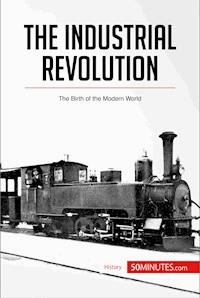
Keen to learn but short on time? Get to grips with the history of the Industrial Revolution in next to no time with this concise guide.
50Minutes.com provides a clear and engaging analysis of the Industrial Revolution. In the second half of the 18th century, industrial production in Britain skyrocketed, resulting in profound economic and social changes. The technical developments responsible for this dizzying progress soon spread across Europe and the USA, changing the face of society in these countries. The Industrial Revolution shaped the modern world, and continues to have a major impact on our lives today.
In just 50 minutes you will:
• Learn about key figures in the Industrial Revolution, including James Watt and Thomas Edison
• Find out about the main developments that took place in this period and their impact on industrial production
• Analyse the economic and social consequences of the Industrial Revolution, including urban poverty and a rising birth rate
ABOUT 50MINUTES.COM | History & Culture
50MINUTES.COM will enable you to quickly understand the main events, people, conflicts and discoveries from world history that have shaped the world we live in today. Our publications present the key information on a wide variety of topics in a quick and accessible way that is guaranteed to save you time on your journey of discovery.
Das E-Book können Sie in Legimi-Apps oder einer beliebigen App lesen, die das folgende Format unterstützen:
Seitenzahl: 36
Veröffentlichungsjahr: 2017
Ähnliche

















The Industrial Revolution
Key information
When:The First Industrial Revolution began around 1750 and ended in 1850. The Second Industrial Revolution began around 1870 and ended in 1914.Where: Europe and the USA.Context: The increase in population and demand required a higher production rate. To achieve this, improvements had to be made across several sectors, which gradually became mechanised.Key protagonists:John Kay, British inventor (1704-c. 1780).James Watt, Scottish mechanical engineer (1736-1819).Karl Benz, German engineer (1844-1929).Thomas Edison, American inventor (1847-1931).Impact: Unprecedented economic changes.Acceleration of demographic growth.The emergence of new social classes.The Third Industrial Revolution.Introduction
Since the late 15th century, Europe had been experiencing slow economic growth punctuated by constant crises. However, in England this growth accelerated in the second half of the 18th century thanks to a demographic explosion which would require a higher rate of production. The textile sector was the first to become mechanised, followed by the metallurgy and mining sectors. The changes that took place were so significant that the period is referred to as the Industrial Revolution.
However, the events that took place between this time and the 21st century were not a complete break with the old order. It would be more correct to talk about a phenomenon of industrialisation which had an undeniable impact on human history. For the first time, the means of production of material goods developed across all sectors, profoundly changing the day-to-day lives of individuals.
An essentially agricultural Western society defined by weak growth became an industrial and commercial society characterised by the constant search for improvement with the aim of increasing production capacity. These changes obviously had economic, social, environmental and political consequences. However, far from being a unique and repetitive process, the history of the Industrial Revolution spans several centuries and is still being written today.
Context
Britain and the start of the industrial era
Since the end of the 17th century, the British population had been growing spectacularly. Unlike in previous centuries, when spikes in the birth rate were accompanied by a high mortality rate, the mortality rate was now gradually decreasing. The population rose from 6 million inhabitants in 1760 to 12 million in 1820. Although this growth provided the agricultural sector with a considerable workforce, there were also more mouths to feed, and this number was rising much more quickly.
With this in mind, and with favourable circumstances on its side, Britain was the first European country to enter the era of industrialisation. This head start on the rest of the continent can be explained by a range of economic, political and societal factors.
A thriving market
Britain’s markets, both domestic and foreign, were sizeable and flourishing. Unlike most European countries, Britain had lifted customs duties at the start of the 18th century, which meant that the price of imported products had not increased. This was not an insignificant factor for a country with many colonies from which it could draw the resources needed to produce its goods. Furthermore, British subsoil was rich in raw materials that could easily be exploited. These included coal and iron, which are indispensable for industry to function effectively. A very developed communication network for the time and the many waterways in the country made it easier to transport them. These waterways were of vital importance: not only did they allow raw materials and products to circulate, but they also made it easier to work the machines.
The country’s economy was just as strong. Britain’s currency (the pound sterling) could be found on every continent and, in the 19th century, would become the currency of international trade. Finally, the financial and banking networks were concentrated in the heart of London, in the City, further strengthening the economy.
Policies to encourage industrial development
The state would also play an important role in the coming revolution. The British government was responsible for a series of laws encouraging scientific education and industry. Furthermore, it granted a certain degree of autonomy to local decision-makers, who were more aware of the realities and economic needs of their region, which allowed them to take a certain number of decisions to facilitate industrial development.




