


16,99 €
Mehr erfahren.
- Herausgeber: John Wiley & Sons
- Kategorie: Fachliteratur
- Sprache: Englisch
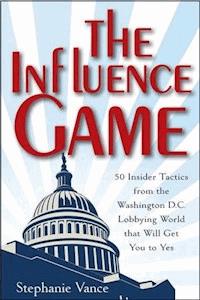
Get what you want, every time! Imagine a world where you are offered every job you seek; every business venture you undertake is successful; and every potential customer you approach buys your product. Now imagine that all of this can be achieved--ethically and honestly. All you need is the help of one battle-tested guide, The Influence Game. Former Washington, D.C. lobbyist Stephanie Vance dispenses everything she's learned about effective (and, believe it or not, honest) persuasion. Learn how to apply this power to any situation by using D.C. insider influence strategies and applying a step-by-step, easy-to-understand process for success. * Learn how to develop and articulate effective goals * Structure both long and short-term persuasion efforts * Identify and research primary and secondary audiences * Crafting those all important personal stories Stephanie Vance has seen the influence game from every angle. Follow her lead to get past being heard to the real goal of being agreed with.
Sie lesen das E-Book in den Legimi-Apps auf:
Seitenzahl: 262
Veröffentlichungsjahr: 2012
Ähnliche



















Contents
Acknowledgments
Introduction
Chapter 1: Principles of Influence
What Influence is Not About
What Influence is About
Know the Difference Between a Good Cause and a Special Interest
Chapter 2: Know What you Want
Tactic 1: Your Effort is a Cause
Tactic 2: Know the Nature of What You’re Selling
Tactic 3: Set a SMART Goal
Tactic 4: Know Why you Want What you Want (and Why Your Audience Might Want What you Want)
Tactic 5: Know What You’re Talking About
Applying the Know What you Want Rule in the Real World
Chapter 3: Know the Competition
Tactic 6: Identify the Competition
Tactic 7: Know What You’re Competing For
Tactic 8: Research the Opposition
Tactic 9: Research Yourself as if you Were the Opposition
Tactic 10: Divide and Conquer
Tactic 11: Circle the Wagons
Applying the Know the Competition Rule in the Real World
Chapter 4: Know the Arena
Tactic 12: Find Your Decision Maker
Tactic 13: Find Your Plan B (and Plan C and Plan D) Decision Maker
Tactic 14: Ask the and Next Question
Tactic 15: Know the Rules of the Game
Applying the Know the Arena Rule in the Real World
Chapter 5: Know Your Primary Audience—The “Influencees”
Tactic 16: Know What Gets Them Up in the Morning—and Keeps Them Up at Night
Tactic 17: Know What They Need from You, Not What you Want to Give Them
Tactic 18: Categorize Your Primary Audience into Champions, Supporters, and the Rank and File
Applying the Know Your Primary Audience Rule in the Real World
Chapter 6: Find Your Surrogates—The “Influentials”
Tactic 19: Know Who Will Be Positively Impacted
Tactic 20: Know Who Influences Your Decision Maker
Tactic 21: Don’t Network—Netplay
Tactic 22: Partner with Polar Opposites
Tactic 23: Remain Civil, Even with Those you Really Don’t Like
Applying the Find Your Surrogates Rule in the Real World
Chapter 7: The Campaign Plan
Tactic 24: Don’t Bring a Knife to a Gunfight (or a Screwdriver to a Nut and Bolt)
Tactic 25: Create an Influence Reserve
Tactic 26: Don’t Be a Nigerian Prince
Tactic 27: Numbers Don’t Always Matter
Tactic 28: Do Not Start with Your Compromise Position
Tactic 29: Trade for Votes
Tactic 30: Know the Walk-Away Points
Tactic 31: Keep Track
Tactic 32: Strategize around the Risks
Applying the “Develop the Campaign Plan Rule” in the Real World
Chapter 8: Crafting a Winning Message
Tactic 33: Don’t Rest on the Power of Your Position
Tactic 34: Connect to the Issue du Jour
Tactic 35: Do Not Be Insulting—Whether on Purpose, in Secret or by Accident
Tactic 36: Find the Common Ground
Tactic 37: Remember the Puppies and Children Rule
Tactic 38: Use the SPIT Formula
Applying the Crafting the Message Rule in the Real World
Chapter 9: Delivering the Message
Tactic 39: Pick the Delivery Method That Works for Your Audience, Not You
Tactic 40: Have the Proper Materials
Tactic 41: Turn Lemons into Lemonade
Tactic 42: No Astroturf
Applying the Delivering the Message Rule in the Real World: Lather, Rinse, Repeat
Chapter 10: The End Game
Tactic 43: Know the Difference between Persistence and Stalking
Tactic 44: Control the Uncontrollable
Tactic 45: What to Do if you Succeed
Tactic 46: Don’t Take Credit— Even if you Deserve It
Tactic 47: Say Thank You
Tactic 48: Avoid Failure by Redefining Success
Tactic 49: Really Don’t Do These Five Things
Tactic 50: Have Fun
Index
Copyright © 2012 by Stephanie Vance. All rights reserved.
Published by John Wiley & Sons, Inc., Hoboken, New Jersey.
Published simultaneously in Canada.
No part of this publication may be reproduced, stored in a retrieval system, or transmitted in any form or by any means, electronic, mechanical, photocopying, recording, scanning, or otherwise, except as permitted under Section 107 or 108 of the 1976 United States Copyright Act, without either the prior written permission of the Publisher, or authorization through payment of the appropriate per-copy fee to the Copyright Clearance Center, Inc., 222 Rosewood Drive, Danvers, MA 01923, (978) 750-8400, fax (978) 646-8600, or on the Web at www.copyright.com. Requests to the Publisher for permission should be addressed to the Permissions Department, John Wiley & Sons, Inc., 111 River Street, Hoboken, NJ 07030, (201) 748-6011, fax (201) 748-6008, or online at http://www.wiley.com/go/permissions.
Limit of Liability/Disclaimer of Warranty: While the publisher and author have used their best efforts in preparing this book, they make no representations or warranties with respect to the accuracy or completeness of the contents of this book and specifically disclaim any implied warranties of merchantability or fitness for a particular purpose. No warranty may be created or extended by sales representatives or written sales materials. The advice and strategies contained herein may not be suitable for your situation. You should consult with a professional where appropriate. Neither the publisher nor author shall be liable for any loss of profit or any other commercial damages, including but not limited to special, incidental, consequential, or other damages.
For general information on our other products and services or for technical support, please contact our Customer Care Department within the United States at (800) 762-2974, outside the United States at (317) 572-3993 or fax (317) 572-4002.
Wiley publishes in a variety of print and electronic formats and by print-on-demand. Some material included with standard print versions of this book may not be included in e-books or in print-on-demand. If this book refers to media such as a CD or DVD that is not included in the version you purchased, you may download this material at http://booksupport.wiley.com. For more information about Wiley products, visit www.wiley.com.
Library of Congress Cataloging-in-Publication Data:
Vance, Stephanie, 1966-
The influence game : 50 insider tactics from the Washington, D.C. lobbying world that will get you to yes / Stephanie Vance.
p. cm.
Includes index.
ISBN: 978-1-118-27159-9 (cloth)
ISBN: 978-1-118-28359-2 (ebk)
ISBN: 978-1-118-28497-1 (ebk)
ISBN: 978-1-118-28727-9 (ebk)
1. Lobbying—United States. I. Title.
JK1118.V36 2012
324’.40973—dc23
2012004736
Acknowledgments
It’s cliche to say that many, many people made this book possible, but it’s true so I’ll say it anyway. Thousands of citizen advocates, lobbyists, legislators, colleagues, professors, friends, family and general observers of the political scene have taught me everything I know about ethical influence. They’ve also been incredibly patient with me as I’ve learned and worked to find the words to express these strategies to others.
I continue to be surprised and encouraged by the number of thoughtful and caring people—yes, even in Washington, D.C.—who have used these tactics to change the world, even where I don’t agree with the change they seek to achieve. In fact, I often learn the most from those I agree with the least. It’s heartening to know that people from opposite ends of the political spectrum can agree on a principled process for persuasion that works. This gives me hope, not just for governance, but for everyone’s ability (including yours!) to influence others honestly and without malice.
Those who observe life know that you won’t get very far if you don’t know with certainty the lines you won’t cross, the principles you hold dear and the steps you are willing to take to achieve your goals. You also won’t get far if you sit back, relax and let others do the work. As Robert Kennedy said (far more eloquently than I), “[i]t is not enough to understand, or to see clearly. The future will be shaped in the arena of human activity, by those willing to commit their minds and their bodies to the task.” I can honestly say that almost everyone I meet “commits their minds and their bodies to the task.” Thank you for showing me how to do so as well.
Don’t just be along for the ride. Go forth—and influence.
Introduction
You have to know the rules of the game. And then you have to play it better than anyone else.
—Albert Einstein
Being Heard versus Being Agreed With
In August 2010 citizens stormed congressional town hall meetings, district offices, and even camped out on Capitol Hill, demanding to be heard on the topic of health care. You may recall the whole health care reform debate. The bill being considered was called the “Health Care Affordability and Accessibility for All Act” by those who liked it and “The Job-Killing Health Care Reform Act” or “Obama-Care” by those who didn’t.
Regardless of their position, ardent activists put a premium on making their views known. They wrote letters and e-mails, attended town hall meetings, and held large rallies. They shouted through bullhorns, yelled, made threats and, on the positive side, delivered honest heartfelt stories.
Meanwhile, lobbyists from all walks of life (health insurers, medical professionals, patient groups, and the like) walked the halls of Congress seeking to influence the details of the legislation (sometimes in coordination with those storming town hall meetings). For example, tucked into the bill’s almost 2,000 pages of new programs and changes to laws was a 12-year exclusivity provision for the biologic drug industry for the manufacture and sale of their drugs. The medical device industry won increased coverage for their products. And lest you think it’s all about corporate finagling, one of the biggest winners in the debate was an organization called the Trust for America’s Health (TFAH). A relative newcomer, TFAH won significant battles in promoting coverage for services (dubbed “preventive care”) designed to limit the onset of chronic diseases, like heart disease and obesity. They achieved this despite their foundation-based funding (not “well-heeled” interests) and, according to lobbying disclosure reports, with just three to four staffers who spent part of their time “lobbying.”
Lesen Sie weiter in der vollständigen Ausgabe!
Lesen Sie weiter in der vollständigen Ausgabe!
Lesen Sie weiter in der vollständigen Ausgabe!
Lesen Sie weiter in der vollständigen Ausgabe!
Lesen Sie weiter in der vollständigen Ausgabe!
Lesen Sie weiter in der vollständigen Ausgabe!
Lesen Sie weiter in der vollständigen Ausgabe!
Lesen Sie weiter in der vollständigen Ausgabe!
Lesen Sie weiter in der vollständigen Ausgabe!
Lesen Sie weiter in der vollständigen Ausgabe!
Lesen Sie weiter in der vollständigen Ausgabe!




