


Erhalten Sie Zugang zu diesem und mehr als 300000 Büchern ab EUR 5,99 monatlich.
- Herausgeber: Mercier Press
- Kategorie: Geisteswissenschaft
- Sprache: Englisch
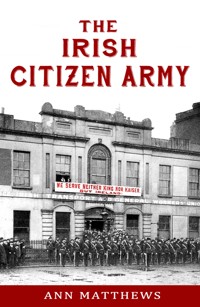
The Irish Citizen Army was originally established as a defence corps during the 1913 Lockout, but under the leadership of James Connolly its aims became more Republican and the IRB, fearing Connolly would pre-empt their plans for the Easter Rising, convinced him to join his force with the Irish Volunteers. During the Rising the ICA was active in three garrisons and the book describes for the first time in depth its involvement at St Stephen's Green and the Royal College of Surgeons, at City Hall and its environs and, using the first-hand account of journalist J.J. O'Leary who was on the scene, in the battle around the GPO. The author questions the much-vaunted myth of the equality of men and women in the ICA and scrutinises the credentials of Larkin and Connolly as champions of both sexes. She also asserts that the Proclamation was not read by Patrick Pearse from the steps of the GPO, but by Tom Clarke from Nelson's Pillar. She provides sources to suggest that the Proclamation was not, as has always been believed, printed in Liberty Hall, and that the final headquarters of the rebels was not at number 16 Moore Street, but somewhere between numbers 21 and 26.
Sie lesen das E-Book in den Legimi-Apps auf:
Seitenzahl: 237
Veröffentlichungsjahr: 2014
Das E-Book (TTS) können Sie hören im Abo „Legimi Premium” in Legimi-Apps auf:
Ähnliche


















MERCIER PRESS
3B Oak House, Bessboro Rd
Blackrock, Cork, Ireland.
www.mercierpress.ie
http://twitter.com/IrishPublisher
http://www.facebook.com/mercier.press
© Ann Matthews, 2014
ISBN: 978 1 78117 159 2
Epub ISBN: 978 1 78117 308 4
Mobi ISBN: 978 1 78117 309 1
This eBook is copyright material and must not be copied, reproduced, transferred, distributed, leased, licensed or publicly performed or used in any way except as specifically permitted in writing by the publishers, as allowed under the terms and conditions under which it was purchased or as strictly permitted by applicable copyright law. Any unauthorised distribution or use of this text may be a direct infringement of the author’s and publisher’s rights and those responsible may be liable in law accordingly.
For my late brother, Seán (J. D.) Matthews 1945–2012
Acknowledgements
When I started research for this work the sources appeared scant. Even the Bureau of Military History, a rich source for the revolutionary period from 1913 to 1923, holds relatively little on the Irish Citizen Army (ICA). Sources for the ICA are rather limited, mainly because none of its leaders appear to have kept any paperwork with reference to its activities, though The Irish Worker and TheWorkers’ Republic newspapers were useful in tracing an outline history of the army. The earliest work on the army, post-revolution, was The History of the Irish Citizen Army by R. M. Fox, and it was not published until 1943. However, the discovery of the John (Jack) Hanratty papers in Kilmainham Gaol Museum has provided a wider view on the story of the organisation. I would like to thank Niall Bergin for allowing me to read this as yet uncatalogued material; otherwise, the story of the ICA would still languish in much speculation and hearsay. I would also like to express my appreciation of the staff at the National Library of Ireland for their continuing courtesy and help, and of R. V. Comerford for his ongoing interest in my endeavours. Rita Edwards, who I met when we studied together as mature student undergraduates, has been a tower of strength and kindness, both professionally and personally, and my appreciation for her support is immense. Others who listened and on occasion explained the esoteric language, thank you. They include Christy Donovan, Enda Fahy, Anthony Fox, Brian Hanley, Mícheál Mac Aonghusa, Joe Scanlon and Pádraig Yeates. My appreciation also to the staff of Mercier Press, who as usual have been encouraging and supportive, especially editor Wendy Logue.
Finally, on a personal level, thanks to my daughter Alyson and my grandson Ben who keep me balanced; and friends Nora Purcell, Fifi Smith, and Rita and Tony Donnelly, who help more than they know.
Abbreviations
BMH Bureau of Military History
BTUC British Trades Union Congress
CID Criminal Investigation Department
DBC Dublin Bread Company
DMP Dublin Metropolitan Police
DORA Defence of the Realm Act
GRO General Register Office
ICA Irish Citizen Army
INAAVDF Irish National Aid Association and Volunteer Dependants’ Fund
INE Inghinidhe na hÉireann
IRA Irish Republican Army
IRB Irish Republican Brotherhood
ITGWU Irish Transport and General Workers’ Union
ITUC Irish Trades Union Congress
IVDF Irish Volunteer Dependants’ Fund
IWWU Irish Women Workers’ Union
LDC Ladies’ Distribution Committee
NLI National Library of Ireland
NSFU National Sailors’ and Firemen’s Union
PRO Public Record Office, London
UVF Ulster Volunteer Force
Introduction
Over the last few decades the Irish revolutionary years 1913–23 have become the subject of a significant number of books, both scholarly and popular, and yet within this large body of work there is yet to emerge a significant study of one of the most interesting organisations that emerged during those years – the Irish Citizen Army (ICA). Perhaps because of the lack of sources, historians have tended to relegate the ICA to a mere footnote in the Irish revolutionary story and focus instead on its most famous member, James Connolly. However, with the emergence of new sources, including the Military Service Pensions made available in early 2014, it is time to reevaluate the ICA’s role in Ireland’s revolution and re-examine some of the prevailing myths about the organisation.
The origin of the ICA lies with the Irish Transport and General Workers’ Union (ITGWU) and its struggle for workers’ rights in the early twentieth century. The union was founded on 4 January 1909, with its first head office at 10 Beresford Place, Dublin, and James Larkin was elected General Secretary. Over the following four years it took on the employers of Dublin, winning many improvements for workers in mills, factories and builders’ providers. However, it was not only urban workers that were targeted by the union – in rural County Dublin it also worked towards organising agricultural labourers. During this time Larkin’s profile within the movement continued to grow, especially through his work on The Irish Worker, the union’s newspaper. Larkin wrote most of the front-page material, thus giving him a high profile among the workers.
The union quickly grew in size and by 1911 it had a membership of over 18,000 male workers. However, women were excluded from joining the ITGWU. It is notable that in much of the historiography of the labour movement of this time, there has been a tendency to present a rose-tinted image of men and women working in equality, side by side, but the inability of women to become members of the ITGWU would seem to argue against this ideal image. Instead, rather than open the ITGWU to all, in September 1911 Larkin formed a separate union for women, the Irish Women Workers’ Union (IWWU). His surprisingly traditional attitude towards women, that they were at the root of man’s problems, was made clear at the new union’s launch when he announced:
Women are the basis of a nation’s wealth. On them principally depends the efficiency and welfare of the race. Good or bad, the men are what women made them. If the women are not healthy, the men will be degenerate. If the women are ignorant, the men will be beasts. Join the Women Workers’ Union and make it the success is should be.1
Larkin was joined on the speakers’ platform by Countess de Markievicz and Hanna Sheehy-Skeffington, in an effort to encourage women to join the new organisation. The countess had met Larkin a mere two months previously, at an event in Beresford Place. However, she had been involved in the nationalist movement since 1908, when Helena Molony, editor of the newspaper Bean na hÉireann (‘Irish Woman’), had introduced her to the executive of Inghinidhe na hÉireann (‘Daughters of Ireland’), a women’s nationalist organisation founded in 1900. Neither de Markievicz nor Sheehy-Skeffington, who spoke after Larkin, challenged what he had said. Hanna Sheehy-Skeffington chose instead to focus on co-operation between the two unions, stating:
The men are organised and have succeeded to a great extent … We as women have a good deal to learn from the men, who are experienced in the practice of trades unionism, and it is desirable that we should work together for the welfare of both sexes.2
Delia Larkin, James’ sister, was appointed secretary to the IWWU, while her brother became the first president of the new union. This meant that James Larkin now occupied a position of power and control within both unions.
In February 1912 the ITGWU took over the old Northumberland Hotel at 18 Beresford Place, renaming it Liberty Hall, and the IWWU, along with the National Sailors’ and Firemen’s Union (NSFU), was allocated offices in the building. As well as union work, a plethora of societies were set up at Liberty Hall to enable workers to develop a social life. Every Sunday night a concert and social evening was held which had ‘a cosmopolitan character, with music songs that had no rebel or nationalist significance’.3 These societies included several pipe bands, such as the Fintan Lalor Pipers’ Band set up in 1912 by Robert (Bob) de Coeur, who was secretary of the No. 16 Branch ITGWU at Aungier Street.
In August 1913 the ITGWU took out a lease on Croydon Park in Clontarf, to further develop the social aspects of the union. Croydon Park was a good-sized house with large grounds and became a social centre for the membership and their families. It soon became central to the development of camaraderie within the union and it was a haven away from the crowded world of the squalid tenements.4
By 1913 the ITGWU had ‘20,000 members in Ireland with 12,000 in Dublin, and it was having an impact on improving workers’ pay’.5 The success of the union led to a growing sense of unease amongst Dublin’s largest employers and a group of them organised under the leadership of William Martin Murphy to combat the growth of unionised labour. When 700 men who worked for the Dublin Tramway Company walked off their trams on 26 August 1913, in an attempt to force pay increases, direct conflict broke out between the ITGWU and employers.
On 31 August James Larkin addressed a crowd at a proclaimed meeting on Sackville (now O’Connell) Street. The police attacked those listening to Larkin’s speech and during the ensuing brutality hundreds were injured. James Nolan and John Byrne died from the beatings they received. This day subsequently became known as ‘Bloody Sunday’. On 3 September 1913 the situation escalated when employers, led by William Martin Murphy who owned the Tramway Company, demanded that all workers sign a document promising to leave the union or not join any other union. Most refused, and over the following days the employers locked out their workforce. It is estimated that by mid-September 20,000 workers were out of work.
It was the ongoing hostility of the police to any public protest that led to the workers devising a system of self-protection. Within a week of the start of the Dublin Lockout, some of the rank-and-file members of the ITGWU organised a disciplined group of men whose main role was to protect their members’ meetings from attacks by the police, effectively creating a defence corps.
Another task for this new corps was to help with the huge distribution of food parcels necessary to sustain 20,000 starving workers and their families, ensuring this was done in an orderly fashion. On 23 September 1913 the British Trades Union Congress (BTUC) had taken the decision to send aid to their comrades in Dublin. Within five days the SS Hare, the first of eleven food ships, arrived in Dublin carrying an estimated 60,000 food parcels for the members of the ITGWU and the other eight unions whose members were on strike. As well as sending food parcels, the BTUC donated money and food, which was used by Countess de Markievicz and other women to run a soup kitchen in Liberty Hall for a short time.6 After three weeks, James Connolly shut this down and a new breakfast scheme for the children was formed, which ran until February 1914. Connolly, who had been the organiser for the ITGWU in Belfast, was appointed General Secretary pro tem of the ITGWU at the end of October after James Larkin was tried on 27 October and sentenced to seven months’ imprisonment ‘for incitement and sedition’.7
The defence corps’ mandate to protect members of the unions meant that it would become the nucleus of a new workers’ Citizen Army, the formation of which was announced by James Connolly at Liberty Hall on 13 November 1913.
1 From Defence Corps to Citizen Army, 1913
In his witness statement to the Bureau of Military History, Thomas O’Donoghue, a member of the ITGWU, said that ‘when the 1913 lockout strike took place, the workers were really hopeless, and one means of keeping up their enthusiasm was through marches of the Pipers’ Band’.1 He recalled:
One Sunday (I think it was the first Sunday of the strike) we were coming from Liberty Hall to 77 Aungier St. and, on turning into South Great Georges Street, some commotion took place at the rere of the band and I gave the order to halt in a very loud voice, I called over the Superintendent of the police and asked him for his name. I told him I’d hold him responsible for any breach of the peace that took place; that we were merely marching, as we had a right to do, through the city, and we did not need police protection.2
Later that day, Bob de Coeur called a meeting of the members of the Aungier Street branch and proposed that men should be provided with hurleys to act ‘as a bodyguard for the band’.3Charles Armstrong, a reservist of the Royal Irish Rifles, was appointed to drill and train the members and was assisted by a man called Kearns, who was an ex-member of the Dublin Fusiliers.4 From that day a bodyguard was provided whenever necessary and they ‘had no more police interference’. The men were then trained to ‘act on whistle signals only’ and they operated by walking alongside the marchers, carrying hurleys and acting as a protective barrier.5
These men had effectively organised a defence corps that accompanied strike demonstrations and marches. On 28 September 1913, when the first of the food ships sent to Dublin by the BTUC docked, The Irish Times reported on the scene at Sir John Rogerson’s Quay and noted:
Quickly the food ship was made fast. And just at this moment a couple of hundred Transport workers, wearing picket badges and carrying sticks, marched down the quay under the command of Councillor (William) Partridge. They set about their function of maintaining order, and it must be admitted that they discharge it well.6
William Partridge, who commanded the bodyguard of men, was the secretary of the Inchicore Branch of the ITGWU.
In late October James Connolly wrote in TheIrish Worker:
We know our duties as we know our rights, we shall stand by one another, through thick and thin, prepared, if necessary, to arm and achieve by force our place in the world, and also to maintain it by force.7
While threatening to use force may seem provocative, a case could be made that when Connolly made this announcement, he did so in the context of the fast-evolving Volunteer movement, instigated in January 1913 by the formation of the Ulster Volunteer Force (UVF). This movement had its origins in the wake of the presentation of the Third Home Rule Bill for Ireland in 1912, by British Prime Minister Herbert H. Asquith. The Bill was passed by the House of Commons, and although it was rejected by the House of Lords, under the terms and conditions of the Parliament Act 1911, this would simply serve to delay its enactment by two years.
While nationalists greeted the prospect of Home Rule with enthusiasm, for unionists the Bill threatened disaster. Under the leadership of Edward Carson, their first call to action came in the form of a document entitled ‘Ulster’s Solemn League and Covenant’, in which they pledged to use all means necessary to defeat Home Rule, including physical opposition. The Ulster Unionist Council inaugurated the Ulster Solemn League and Covenant in September 1912, and approximately 200,000 men signed it. The UVF was subsequently established in January 1913 with membership limited to those men who had signed the Covenant, estimated at 100,000. The UVF was formed to convince the British people that Irish unionists were vehemently opposed to Home Rule, an idea further promoted in September when:
Upping the stakes, on 24 September 1913, 400 members of the Ulster Unionist Council met in Belfast, appointed a commission of Five headed by James Craig in consultation with Edward Carson to frame and submit a Constitution for a Provincial Government for Ulster … which would come into operation on the day of the passage of any Home Rule Bill.8
TheFreeman’s Journal reported:
It would be more correct to say that the members of the Ulster Unionist Council, having first constituted themselves the Central Authority of the Provisional Government, proceeded to delegate their powers to the standing committee of the Ulster Unionist Council.9
In response, Eoin MacNeill, a prominent Irish nationalist, published an article on 1 November 1913 entitled ‘The North Began’, in which he said that southern nationalists should form their own volunteer force to put pressure on the British to keep their promise of Home Rule.
On 10 November The Irish Times reported that the UVF had enrolled 2,000 members in Dublin. The following day a steering committee met to plan the setting up of the Irish Volunteers.
While all this was going on James Larkin successfully appealed his prison sentence and was released on 13 November. That evening a torchlit rally was held by the ITGWU at Liberty Hall to celebrate his release and it was at this rally that James Connolly instigated the creation of the Citizen Army. In his speech, he stated:
I am going to talk sedition. The next time we are out for a march I want to be accompanied by four battalions of trained men with their Corporals and Sergeants. Why should we not train our men in Dublin as they are doing in Ulster?10
Connolly continued, saying that ‘every man who was willing to enlist as a soldier in the Labour Army should give in his name when he drew his strike pay’, and he would then be informed ‘when and where to attend for drilling’.11
Four days later, Connolly announced that this new force had competent officers to instruct and lead it, because there ‘is a necessity of having trained battalions of men’, and he again asked that all who were willing to join the ‘Citizen Army’ would hand in their names for drilling and training.12 The Evening Telegraph reported that he said:
If we had a disciplined body of men there would be less danger of any of them falling against a policeman’s baton. He hoped to see them soon on their route marches with their pikes on their shoulders … they had been promised the services of a competent military officer, the son of the distinguished Irish general who defended Ladysmith in South Africa during the second Boer War.13
That distinguished Irish general was Field Marshal George White. The son of whom Connolly was speaking was Captain Jack White and he, too, was a hero of the Boer War, having been awarded a Distinguished Service Order (DSO) medal for his bravery in fighting the Boers. In all of the literature relating to the founding of the Citizen Army this information about Captain Jack White is generally omitted. This blind spot can perhaps be attributed to the fact that a mere thirteen years earlier the anti-Boer War Irish Brigade 1899–1902 had been supported by Arthur Griffith (the founder of Sinn Féin), Maud Gonne and James Connolly through the Irish Transvaal Committee. Tellingly, a memorial arch to Irishmen who died serving with the Dublin Fusiliers in South Africa, built in 1904 and located at St Stephen’s Green, was given the derisory name of ‘Traitors’ Arch’ by nationalists. Thus, pointing out that White had received a British military honour for his role in the war would have been a sensitive point.
How a man of impeccable unionist and British military background became involved in the cause of Irish Labour in 1913 is interesting. Captain White wrote his autobiography in 1934, calling it Misfit, a very apt title for a man with an eccentric personality. He was born James Robert White at Whitehall, Broughshane, County Antrim in 1879, into a family that was Church of Ireland, staunch unionists and members of the Anglo-Irish aristocracy. Jack was educated in England, first at Winchester public school and later at the Royal Military Academy, Sandhurst. At the age of eighteen he was serving with the 1st Gordon Highlanders and embarked with them from Edinburgh Castle for South Africa at the outbreak of the Boer War in 1899. His father was the colonel in charge of the defence of Ladysmith and succeeded in holding that town when it was besieged by the Boer Army. In 1901 the colonel was rewarded with the governorship of Gibraltar and his son Jack was appointed his aide-de-camp. Discontented with army life, however, Jack resigned his commission in 1907 and then drifted through several jobs and situations, appealing to his father for money when he needed it.
White returned to Antrim sometime in 1912 and was opposed to the sentiments of Edward Carson and the setting up of the ‘Provisional Government’ by the Ulster Council. A protest meeting was held at Ballymoney on 24 October 1913 to express opposition towards ‘the lawless policy of Carsonism’ and speakers were invited to express ‘their views freely and frankly’.14 White took this opportunity to do so, and other speakers on the platform included Sir Roger Casement and the historian Alice Stopford Green. Subsequently, White was invited to speak at the Literary and Historical Society at University College Dublin on 6 November 1913.
While in Dublin he witnessed the horror of the striking workers’ conditions and the misery of their lives. He decided to stay in the city and changed his political focus towards socialism. In Misfits he notes that his arrival in Dublin was during a time of seething sectarianism focused against a plan by Dora Montefiore and others to take the children of locked-out workers to England to be cared for until the strike was over. He witnessed the viciousness of the confrontations that stopped the plan and he wrote, ‘I saw red and when I see red I have got to get into the fight.’15 He offered his services at Liberty Hall, was accepted immediately and within days was invited to organise and train their new army.
This army was officially called the ‘Citizen Army’, and did not have a constitution or an executive. Consequently, Captain White was given full control of the new organisation, and the workers’ defence corps, in existence since September, was subsumed in it. Connolly made the announcement about the ‘Citizen Army’ twelve days before the Irish Volunteers were officially founded so that he could claim the Citizen Army was the first to organise, and the witness statements of the Military Bureau suggest he was successful in this claim. The meeting to form the Irish Volunteers was set to take place at 8 p.m. on 25 November at the Rotunda in Dublin, and meanwhile Connolly had organised ‘a meeting of Transport Workers at Croydon Park for earlier that day to enrol a “citizen army”’.16
At the inaugural meeting of the Irish Volunteers a rift was instigated with the new Citizen Army when members of the ITGWU interrupted Laurence Kettle, one of the leading speakers. The objections to Kettle arose because his father, who was a farmer in north County Dublin, was currently involved in a dispute with his workers. The Irish Volunteers’ steering committee had constructed a special ladies’ platform and Áine Ceannt noted from her vantage point there that when Laurence Kettle rose to speak, ‘some members of the Citizen Army who were present objected to him and shots were fired … Jack White went on to the platform, addressed the meeting, and calmed the situation’.17 Despite White’s actions, this protest alienated the Irish Volunteers from the Citizen Army and the relationship between the two organisations remained strained for some time.
On 28 November The Irish Times reported on the new Citizen Army:
Since Monday the drilling of the ‘Citizen Army’ has been carried on at Croydon Park. The recruits proceed to the grounds in detachments at various hours of the day. The squads that were exercising there yesterday were armed with hurling sticks, and were put through their drill by some army pensioners. The movements of the ‘troops’ were closely watched by the police.
The report continued:
Starting from Liberty Hall between 8 and 9 o’clock, there was a procession, headed by a fife and drum band, the rendezvous being Croydon Park. The processionists, who were in the charge of Captain White, presented quite a martial appearance. They carried no arms. It was evident from their step and general bearing that many of the men had previous experience in the Army.18
This report, published fifteen days after the announcement of the formation of the Citizen Army, is a strong indication that disciplined work had been ongoing for some time before the public launch of the army.
The following day TheIrish Worker announced a public meeting of the ‘Transport Union Citizen Army’ for Sunday 30 November, with Francis Sheehy-Skeffington chairing the meeting.19 In his address he claimed, ‘if this (“Citizen”) army were properly armed they would be the masters in Dublin’.20Francis was married to Hanna Sheehy-Skeffington, who founded the Irish Women’s Franchise League, a suffrage organisation, and he edited its paper, the Irish Citizen. At the meeting Captain White, who was apparently a tough taskmaster, said:
At first there might be some shouting and some cursing, and during their drilling he would probably use more damns than please … the result would bring out the strength of will and determination of all the men.21
White was assisted in training the men by some of the workers who had military backgrounds. Most of these men have left no information about their early lives, but a little of the stories of Jack Fitzpatrick and Christopher Poole are known.
Jack Fitzpatrick was born in 1884 at Cabinteely, Co. Dublin. His father died when he was an infant and his mother remarried. It was an unhappy marriage and when Jack was about fifteen, while trying to separate his mother and stepfather when they were fighting, he knocked his stepfather unconscious. Thinking he had killed him, Fitzpatrick ran away from home and enlisted in the Royal Irish Rifles on 20 June 1904. He was drafted to India in November 1905, where he suffered a bullet wound in his thigh, which, despite treatment, never healed properly. He developed TB of the hip. He was discharged from the British Army on 10 June 1910 and returned to Kingstown in County Dublin, where he began working as a carter and joined the ITGWU. He married Elizabeth Gaffney in April 1911.
In early 1913 James Larkin asked the Fitzpatricks to go and work in Scotland to help with fund-raising for the union, and as Elizabeth had friends in Glasgow, they agreed. Jack found work in a shipyard, where he began fund-raising. He sent food and money to Liberty Hall and in November 1913, with Elizabeth seven months pregnant, they returned to Dublin, where he gave assistance to Captain White in training the men of the newly formed Citizen Army.
Christopher Poole was born in Dublin in 1876, and in 1894 he joined the East Yorkshire Regiment in England. He served in India from 1895 to 1898, and then from 14 March 1900 to 19 October 1902 in South Africa during the Boer War; he was demobilised twelve days later to the British Army reserve. He was awarded one medal and two clasps for the South Africa campaign. When he returned to Dublin he worked as a labourer and, with his brother John, joined the ITGWU. Both men were locked out in October 1913.
The language and tone used by White when training the men caused problems. He treated them as he would British Army recruits, with insults and barracking. He appeared to forget that they were volunteers and his attitude alienated many of them. Nora Connolly recalled watching the men being drilled by the captain and said:
He was tireless in drilling them and the men responded as tirelessly … Once he stopped beside Connolly and he was in a rage. Some command he had given was misinterpreted. His hands were clenched and he was fairly gnashing his teeth. ‘Easy now Captain,’ warned Connolly. ‘Easy now. Remember they’re volunteers.’22
Elizabeth Fitzpatrick recalled of White, ‘he did not have the ready and affectionate co-operation his nature craved from the men; he was a gentleman of the British State and constitution and did not understand the working men under him’.23 Despite these problems, in TheHistory of th Irish Citizen Army, White is described as ‘a tall soldierly figure, with a habit of command and so was able to gather strikers together in spite of disappointment, confusion, and lack of a sense of military discipline on the part of the rank and file’.24
On 6 December 1913 an army notice in The Irish Worker announced:
After the Parade and Drilling of the Citizen Army at Croydon Park, a Great Procession will march through the streets to assure the delegates who will attend the British Trade Union Conference in London that Dublin is still determined to fight on. Men and girls must form up at Croydon Park.25




