


Erhalten Sie Zugang zu diesem und mehr als 300000 Büchern ab EUR 5,99 monatlich.
- Herausgeber: The Lilliput Press
- Kategorie: Geisteswissenschaft
- Sprache: Englisch
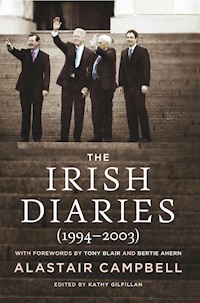
The four volumes of spokesman and strategist Alastair Campbell's diaries were a publishing sensation. As British Prime Minister Tony Blair's right-hand man, former journalist and political analyst Campbell played a critical role in every aspect of New Labour strategy. Charting the course of British government from July 1994 to August 2003, Campbell¹s relentlessly honest, often controversial, occasionally brutal, and always razor-sharp commentary has drawn critical acclaim from around the world. This newly edited one-volume edition focuses on one of the Blair government's biggest successes, the Northern Ireland peace process. From the high of the Good Friday agreement and devolution in Northern Ireland, to the deadly lows of the Manchester and Omagh bombings, The Irish Diaries explores the tensions, all-night talks, adrenalin-fuelled negotiations and heady personality clashes that are such an intrinsic part of democratic politics. Newly annotated and fully revised by Campbell and featuring commissioned material by key figures in the Irish peace process such as former Taoiseach Bertie Ahern,Tony Blair and Alastair Campbell himself, The Irish Diaries is invaluable for readers with an interest in Irish history.
Sie lesen das E-Book in den Legimi-Apps auf:
Seitenzahl: 806
Veröffentlichungsjahr: 2013
Das E-Book (TTS) können Sie hören im Abo „Legimi Premium” in Legimi-Apps auf:
Ähnliche




















The Irish Diaries[1994–2003]
Alastair Campbell
edited byKathy Gilfillan
THE LILLIPUT PRESS
DUBLIN
Editor’s Note
Alastair Campbell’s diaries were originally published in extract form and then in four unexpurgated volumes covering the years between 1994 and 2003. They catalogued Tony Blair’s leadership of the Labour Party and his premiership through many major foreign and domestic upheavals. The diaries encompassed the wars in Kosovo and Iraq as well as the domestic tragedy of foot-and-mouth disease and the constant sniping between Gordon Brown and Tony Blair for dominance within the Cabinet. Ireland was always on the political agenda and a problem that Tony Blair ached to solve.
Ireland was also a subject that, in Alastair Campbell’s own words, ‘got into the bones’, and that feeling for the place and its politics is what led to this book. He asked Ed Victor, his agent, if an Irish publisher would be interested in an Irish version of the diaries and Ed asked me if The Lilliput Press would publish it. I said yes instinctively, without having read all the diaries, because I knew that Campbell had had unprecedented access to Tony Blair throughout his premiership and that Tony Blair’s part in the peace process in Northern Ireland was clearly one of his successes. He was, in my opinion, the first UK prime minister to understand the Irish question and to engage with the politics sympathetically and patiently. I am from Northern Ireland so it was close to me. I understood the detail and the tribal undercurrents.
I like diaries and the best of them, from Boswell to Alan Clark, succeed because of honesty in the recording of events. Cambell reveals temper and tenderness, domestic and political turmoil and humour and hubris.
He writes up his diary either on the day or the next morning. For him I think it was cathartic – a way of defusing the enormous stress of the job. Not only was he working for Tony Blair but also his partner, Fiona Millar, was Cherie Blair’s special adviser so there is little separation between home and office. He was also aware, of course, that he was living through extraordinary times – what Roy Hattersley calls being an appendix to history. At the time of the Good Friday Agreement, for example, he wrote that he felt he was recording history.
When I finished reading the four volumes, each over 700 pages long, I realized that I had agreed to a mammoth task. It was not a simple job of distillation. The narrative had to flow as a separate entity. Major events, such as the death of Princess Diana, the conflict in Kosovo and the beginnings of the war in Iraq, I had to cut because they are not of Ireland and they had had a life in the previous volumes. To make sense of the world outside the Irish question without having it intrude too much was a delicate balancing act. I followed the format of the original diaries, extracting and including all Irish references. Additional material to the original text is in the form of expanded footnotes to explain particular incidents in more detail.
Alastair Campbell helped by revisiting the text specifically for this book and providing new bridging commentary on events, which are now history and can be viewed with the perspective that time brings. His fresh comments appear in italics throughout the text.
President Clinton lights up the pages whenever he appears. Campbell is fascinated by the Clinton administration and the modus operandi of a master communicator. When the talks in Belfast reach an impasse, the person to call is always Clinton, who was respected by all shades and sides; sometimes he succeeds in moving events forward. His advice to Tony Blair, at a time when the Monica Lewinsky scandal was raging, was always detailed and considered.
One must not forget – given his public reputation in 2013 – the important role played by former Taoiseach Bertie Ahern. It is obvious from the diaries that he was pivotal in the peace negotiations and valued by Tony Blair for his insight, patience and common sense. The two men, according to Campbell, became close both personally and politically. Their affection for each other along with their respect for Campbell and their admiration of the diaries is clear.
Bertie Ahern and Tony Blair readily agreed to write forewords for this text, for which I am very grateful.
Additional footnotes appear with kind permission from the University of Ulster’s Conflict Archive on the Internet (CAIN). My thanks also to Djinn von Noorden for her detailed copy-editing and to John Bowman for his wisdom and kindness.
Kathy Gilfillan
August 2013
Foreword by Bertie Ahern
I am delighted to be asked to add a foreword to Alastair Campbell’s Irish Diaries. To my mind, Alastair’s diaries are a hugely significant publication and a primary source for students of Anglo-Irish relations and historians but no mere academic tome. This book is a cracking good read, brilliantly written, and Alastair gives a compelling and exciting first-hand account of a critical period in Irish history when incredible steps were taken to build peace in Ireland and to end decades of violence.
As one of Tony Blair’s most trusted aides, Alastair Campbell not only witnessed history, but he also helped to shape events. Alastair had a gift for media management, but I think what Tony valued most was his strategic advice, his searing honesty and his common-sense approach to politics. His advice was often crucial and always to the point.
This diary captures the long and difficult journey towards peace in Ireland. When people ask me how we solved the problems in Northern Ireland and how we brought peace to somewhere that had for so long known only war and killing, my answer is invariably that it was not easy! It took patience – lots of it – and I would say it was 99 per cent perseverance and maybe 1 per cent inspiration. It also took a lot of stamina and reading this diary reminds me again of the late night meetings, the early morning summits and the sheer physical demands of peace-building. I must admit to being amazed when I heard that Alastair actually found the time to keep a detailed diary during his years working with Tony Blair. But then again, considering the amount of drive and energy he possesses, perhaps it is not so surprising.
Oscar Wilde famously once said: ‘I never travel without my diary. One should always have something sensational to read in the train.’ Alastair’s diary is very different. It is not designed to fuel the fires of scandal, but instead it gives an invaluable insight into how politics and diplomacy work at the highest level. It is a warts-and-all account and Alastair, with typical frankness, records his views on the ups and downs of the peace process, the difficulties and triumphs, and his assessment of real people dealing with real challenges under a relentless and often hostile spotlight.
Reading his diaries – especially on the lead-up to the Good Friday Agreement – reminded me of just how much we have achieved and just how often we were so very near, and yet so far from, a resolution. During my address to Westminster in 2007, I was delighted to be able to acknowledge Tony Blair’s exceptional contribution to the attainment of peace in Northern Ireland.
Alastair’s book documents how closely and intensely Tony Blair and I worked together to achieve peace. We had the closest relationship between any British prime minister and Taoiseach in the history of the Irish state.
We first met in the Gresham Hotel, in Dublin, when we were both in opposition and we developed a friendship that has lasted beyond leaving office. I spent weekends with Tony and his family at Chequers (the prime minister’s country residence) when we were in office. I was in and out of Downing Street and he came to see me in Drumcondra and met my friends. I went with him to watch Newcastle United, his favourite team, play. We would have the odd drink together. We always preferred to meet one to one rather than with large groups of officials.
During talks, we liked to go for walks in the grounds, and kick things around. When Peter Mandelson was in the North he would bring his big dog along, and we discussed things as the dog hared off into the bushes. I believe that this friendship between Tony and me was crucial in building an entirely new relationship between our countries. Albert Reynolds had been friendly with John Major for a short time when they were in office, but before that there was no strong bond between Taoisigh and prime ministers.
Alastair gives a good and detailed account of how the Good Friday Agreement unfolded. We were fortunate that in Tony Blair there was a British prime minister blessed in abundance with patience, wisdom and generosity.
The peace process also had many unsung heroes. As Taoiseach, on the journey towards peace, I was remarkably well served by a dedicated core of officials, including my programme manager, the late Gerry Hickey, my adviser Martin Mansergh, my speechwriter Brian Murphy, who could always be relied upon to produce an appropriate quote or phrase, and Alastair’s opposite number for so long, my press secretary Joe Lennon.
Tony Blair was equally served by a talented group that included Jonathan Powell, Sally Morgan, David Miliband and Peter Hyman. But at the heart of Tony’s team was Alastair Campbell. On one occasion, Tony even went so far as to describe Alastair as the ‘Roy Keane of his operation’. Alastair is a convinced Burnley fan so I am not sure he totally appreciated the analogy, but, as a Manchester United supporter, I want to assure him that this is a very high compliment indeed.
Alastair Campbell’s Irish Diaries is the consummate insider’s account of a momentous journey towards peace. If they highlight one thing it is that for any successful process of reconciliation to succeed following a long conflict, it is crucial to remember peace has to be built step by step. It is a gradual, very slow process and no one should think lasting reconciliation will happen instantaneously with the wave of a magic wand. It takes time and it takes courage but it is a prize worthy of perseverance. What, after all, is more important than peace and the prevention of conflict and killing?
Alastair Campbell played a huge role in stopping the murder and mayhem that had defined Northern Ireland for too long. For this, I will always be grateful.
Bertie Ahern
May 2013
Foreword by Tony Blair
Many books have already been written by and about the key people of the New Labour era, and doubtless there will be many more. What is remarkable about Alastair’s diaries is that they are written without the hindsight usually afforded to authors of political memoirs and biographies, and they offer the closest anyone will get to an actual day-to-day account of life at the centre of the team I led. As such, they are a hugely valuable source to anyone interested in the politics of our generation. They are, as anyone who knows Alastair would expect, full, frank and at times very sharp in their assessment of people and events. They spare nobody, including himself. But they do capture something of the essence of life under pressure in the political hothouse, the ups and downs, the clashes, the things going right, the things going wrong. Nowhere is that more the case than in relation to Northern Ireland. His entire diaries of his time working for me comprised four volumes. That a whole volume can now be made of those parts especially relevant to Ireland perhaps underlines what a priority it was, what a passion it became, and how much time and energy it consumed.
Alastair played a big part in the Northern Ireland peace process on his own account. Together with Jonathan Powell, my indefatigable Chief of Staff, who really was instrumental in the whole thing, Alastair was at my side in all the crucial meetings and negotiations up to his departure in 2003. He provided as he always did not just the media savvy, which was often important for keeping momentum going, but also creativity about the process itself, making suggestions for movement when things were stalled, and developing his own relationships with the central people.
The sheer amount of time devoted to Ireland was indeed remarkable. Rereading the diaries in this form, with Ireland the central focus, it is clear that if anything I underestimated just how often it came to the top of my agenda. We made it a priority very soon after our first election win, with the first big speech there one of the most delicate and significant of my entire Premiership, and it remained a priority throughout my time in Downing Street.
In 1997, the ceasefire had been rudely shattered. Shortly after I took office, two policemen were brutally murdered. Despite that, and despite the natural view of many that we should at that point have binned the whole idea of trying to resurrect the process, we managed to get the ceasefire back in place. We then went through the agonizing days leading up to the Good Friday Agreement, recorded here in minute detail; and that was only a beginning. Then came the truly Byzantine and tortuous process of the years of mini negotiations to clear each obstacle and proceed. There were many times when we thought it was over and the chance for peace was lost. On each occasion, we somehow kept it together and got back on track. Even today, there is fragility. But the benefit of peace is there for all to see. Northern Ireland still faces many challenges but it truly is a different place in so many ways, safer, stronger, more secure, more prosperous.
Even now, with the passage of time, it is hard to look back on the events that led up to the Good Friday Agreement, and the subsequent years, without a profound sense of amazement at how it all came together and how it was sustained. The diary gives the blow-by-blow account, and Alastair rightly says there was something mysterious, almost magical, about how things fell into place. What I want to do here is offer some reflections about the process but also about the broader lessons it revealed about politics.
Firstly, for those of us who in our youth flirted with the somewhat determinist branch of Marxist-oriented left-wing politics, the Northern Ireland peace process is a classic example of how individual people, in a certain place at a certain moment in time, can make the difference. There is little doubt in my mind that with a different cast of individuals, the outcome may well have been different and adverse. We were immensely fortunate to have an Irish leadership – in the form of Bertie Ahern and his key ministers – that was prepared to lay aside the grievances and attitudes of the past in the interests of the future. This is emphatically not to say that they didn’t feel those grievances or the pressure to deliver justice for the Irish people. But they rose above the burden of history, consigning it to its proper place – a spur to action, not a chain to anger.
The same was true of the Unionist leadership – at the beginning in the hands of David Trimble – and of course of the SDLP and Sinn Féin. It is easy to forget how simple and superficially alluring wallowing in the feeling of injustice or retribution for past hurt can be. There is a ready audience for it amongst large parts of any party’s activist base. The applause lines are familiar and well received. The alternative requires the development of a wholly new narrative, the challenging of old assumptions, the admission from time to time that the other side might have a point. So leaders have to replace a rhetorical formula that involves the statement of grievance and a denouncement of opponents with one that turns that on its head, and starts to speak of the possibility of reconciliation with those with whom the whole of the history up to that point has been about the utter unacceptability of such a reconciliation. This is real political leadership; and it takes real character to do it.
Gerry Adams and Martin McGuiness had spent their entire lives fighting the British and Unionism. They had made the speeches, led the protests, swelled the ranks of the disaffected and the defiant, been dismissed by many as terrorists pure and simple. Now they were speaking about how, despite all of that, arms should be laid down for the hope of peace and the prospect of justice: not for the actuality of either of those things, because that was to come, but for the chance of them. These were not easy steps, but they took them, and I believed in their sincerity. Alastair is on record as saying that he thinks the diaries risk being unfair to David Trimble. David, like many others in the process, could be difficult at times, but often he was merely expressing the huge political pressure he was under from his own side not to take the steps that ultimately he did take. When Ian Paisley finally pulled Unionism over the line, with the current First Minister Peter Robinson, he was obliged to put aside a career spanning half a century based on the notion that peace with Republicans was impossible, and that those who advocated it were naive or betraying the true interests of the people. For the moderates, like Seamus Mallon leading the SDLP, they had to sit there and watch as the party that had always accused him and John Hume of a sell-out then cut the deal to govern with the ancient enemy. And of course we were all of us hugely lucky to have a US administration led by Bill Clinton, and represented by George Mitchell, who were absolutely committed and matched that commitment with political skill of the highest order.
All of this took extraordinary political sacrifice and personal risks. Without the necessary character to do that, peace would not have happened. Different and lesser people would never have accomplished this. We got the right mix at the right time, not just with the big players listed above, but smaller parties and outside groupings too. When it comes to Northern Ireland, Alastair even has kind words to say about the media.
Secondly, the personal relationships that are built during the course of making peace matter enormously. Again this is obvious, but frequently missed. Part of the problem in these situations – which I witness continually in my work in the Middle East today – is that to bring people together you have to understand in a genuine sense why they feel as strongly as they do. This is not a matter of reason, but of emotion. In a conflict, there is suffering of a nature and on a scale that we, from the outside, can scarcely appreciate, because it is not within our experience. Each side has a sense of pain and of cruel consequence from the other side’s actions. They need to know that those mediating get this feeling, not at a rational but at an empathetic level. In getting it, the mediator is then able to pass something of the pain of each side to the other. Especially where there has been violence over a prolonged period, and in conflict the violence often either falls or is even directed at the innocent, being able to articulate the sense of hurt and know that the other side has been forced at least to confront it, is a powerful way of opening up the dialogue that can lead to peace.
Many of the hundreds of hours I spent in discussion with the parties were not simply about specific blockages or details of the negotiation, but rather about absorbing and trying to comprehend why they felt as they did, and communicating that feeling to the other side. In this way, they became my friends, because I then had inside me something of the passions they felt inside them. In addition, as the process wound its way, the parties got to know each other, and started to look upon each other as human beings with a different perspective, not as enemies mired in evil and incapable of good. We shouldn’t exaggerate, because there was still enormous suspicion and resentment that at times threatened to sink the whole thing. But it was counterbalanced by human interaction and that counterbalance was essential. Seeing Ian Paisley and Martin McGuinness work together, and attract headlines calling them ‘The Chuckle Brothers’, underlined how far we all came.
Thirdly, there had to be an intellectually credible core framework to govern and shape the process. I always say that at the top, in the leadership of any country, politics is a far more challenging intellectual business than is commonly assumed. People think of politicians making speeches, appearing in the media, engaging in intrigue and naturally taking the decisions that define their leadership. But I found that whatever the major issue being addressed, absolutely of the essence was the ability to frame a way forward in terms that were intellectually coherent. In designing a process for peace, this is especially so. At the heart of what we were doing in Northern Ireland was the idea that in exchange for just and fair treatment of the nationalist and Republican communities, the resolution of the issue of United Ireland vs United Kingdom would be left to the choice of the people of Northern Ireland. What flowed from that was a series of changes and advances; but all referable back to, and consistent with, that core deal. In other words, making peace cannot simply be a trade, even though of course it involves compromise; it must also be an accord based on principle. There has to be a shape and a design that has integrity. A lot of time in Northern Ireland was spent precisely trying to get the shape and design right. It was difficult, slow and frustrating, but it paid off in the end.
Fourthly, I am amazed when I look back on my time as a leader at how much the residue of that leadership is defined by the big things that really matter, and not by the myriad of mini-crises that don’t; all those supposedly Government-threatening events, many of which I literally have difficulty remembering now. I know of course that in theory leadership should be defined in this way; but somehow when you’re doing the job, the defining work is often being done quietly, sometimes almost insignificantly, whilst all around you is some tumult caused by an event that dominates the news and occasionally your thoughts. This is partly a reflection of the way the modern media operates, but it is also a product of the fact that the best work, the work that lasts, the work that really changes the world, is done by a steady and relentless determination that is often not marked by great bursts of action or punctuated by thunderous rhetoric, but by a patience derived from a sincere belief in the merit of a cause and the consequent will to achieve it.
Finally, never forget the absolute central importance of aligning the reality of life on the ground with the desire to find a formula for peace. The economy matters. Security matters. Giving the ordinary population the sense that they have a stake in the future and that this stake is intimately connected with peace is essential. In the end, a peace process is a curious symbiotic dance between leaders and led. The leaders have to give the hope to the people that change can come. But ultimately, especially as the leaders come under pressure from within their own ranks, they need to feel the support of the people, willing them on, giving them encouragement, empowering them to compromise and move forward. Never forget the people, never under-estimate them and never stop trusting them when finally you put the deal before them, to call it right. They normally do.
Bismarck famously said that there were two things the people should never be allowed to see: the making of sausages and the passing of laws. The spectacle of the process is too off-putting, the laying bare of the assembly of the finished product too unpleasant to delicate sensibilities. But here in Alastair’s Irish diaries, the transparency shows politics in the raw, but also at its best: the pursuit of something manifestly in the public interest, that requires leadership and perseverance and teamwork and whose outcome is always in doubt. If politics is, in the final analysis, about changing the world for the better, this is a pretty good example of politics at work. I am very proud of the story this book spells out, as should be so many others who played their part. It is remarkable that Alastair found time to keep such a diary, given the hours he worked, but reading this account of how peace was made, I think history should be grateful that he did.
Tony Blair
May 2013
Who’s Who
SHADOW CABINET/THE CABINET
Margaret Beckett: Shadow Health 1994–95, Trade and Industry 1995–97, Trade and Industry Secretary 1997–98, Leader of the Commons to June 2001, then Environment, Food and Rural Affairs Secretary
Tony Blair: Leader of the Opposition 1994–97, Prime Minister 1997 onwards
David Blunkett: Shadow Education, Education and Employment Secretary to 2001, then Home Secretary
Gordon Brown: Shadow Chancellor 1994–97, then Chancellor of the Exchequer
Nick Brown: Chief Whip 1997–98, Minister of Agriculture, Fisheries and Food to June 2001
Stephen Byers: Chief Secretary to the Treasury 1998, Trade and Industry Secretary 1998 to June 2001, then Transport, Local Government and the Regions Secretary 2001–03
Robin Cook: Shadow Foreign Affairs, Foreign Secretary to June 2001, then Leader of the Commons. Died 6 August 2005
Ron Davies: Welsh Secretary 1997–98
Donald Dewar: Shadow Social Security 1994–95, Labour Chief Whip 1995–97, Scottish Secretary 1997–99, First Minister of Scotland to 2000. Died 11 October 2000
Geoff Hoon: Defence Secretary from 1999
Lord (Derry) Irvine: Lord Chancellor from 1997–2003
Helen Liddell:Treasury Minister, Scottish Secretary from January 2001–03
Alun Michael:Welsh Secretary 1998–99, First Secretary of Wales 1999–2000
Alan Milburn: Chief Secretary to the Treasury to October 1999, Health Secretary 2001–03
John Prescott: Shadow Deputy Leader 1994–97, Deputy Prime Minister and Secretary of State to June 2001, then First Secretary of State
George Robertson: Shadow Scotland, Defence Secretary 1997–99, thenNATOSecretary General :
Clare Short: Shadow Transport 1994–96, Overseas Development 1996–97, International Development Secretary 1997–2003
Andrew Smith: Shadow Chief Secretary to the Treasury 1994–96, Transport 1996–97, Chief Secretary to the Treasury 2001–02, Work and Pensions Secretary from 2002
Jack Straw: Shadow Home Affairs, Home Secretary to June 2001, then Foreign Secretary
LEADER’S OFFICE / 10 DOWNING STREET
Alex Allan: Principal private secretary to August 1997
Tim Allan: Press officer, special adviser
Mark Bennett:AC’s researcher
Alison Blackshaw:AC’s senior personal assistant
Cherie Blair: Wife ofTB
Julian Braithwaite: Press officer, Foreign Affairs
Sir Robin Butler: Cabinet Secretary to 1998
Alastair Campbell: Chief press secretary and Prime Minister’s official spokesman, director of communications and strategy
Magi Cleaver: Press officer, overseas visits
Hilary Coffman: Special adviser, Press Office
Robert Hill: Policy adviser, political secretary from June 2001
John Holmes: Principal private secretary and Foreign Affairs adviser 1997–99
Anji Hunter: Head of office 1994–97, presentation and planning 1997–2001, later director of government relations
Peter Hyman: Strategist and speechwriter
Pat McFadden: Policy adviser, later deputy chief of staff
Sir David Manning: Chief foreign policy adviser 2001–03
Fiona Millar:AC’s partner, special adviser toCB
Sally Morgan: Political secretary, later director of political and government relations
Jonathan Powell: Chief of staff (JoP)
John Sawers: Foreign Affairs adviser to 2001
Godric Smith: Press officer, deputy press officer from 1998, later Prime Minister’s official spokesman (with Tom Kelly)
Sir Andrew Turnbull: Cabinet Secretary from 2002
Sir Richard Wilson: Cabinet secretary to 2002
GORDON BROWN‘S OFFICE / HM TREASURY
Ed Balls: Adviser
Geoffrey Robinson: Paymaster General
Charlie Whelan:GBspokesman
IRELAND
Gerry Adams: President Sinn Féin 1983–,MPBelfast West 1983–92,NIAssembly member 1998–2010
Bertie Ahern: Taoiseach 1997–2008
David Andrews: Minister for Foreign Affairs 1997–2000
John Bruton: Taoiseach 1994–97
John Chilcot: Permanent secretary Northern Ireland Office
General John de Chastelain: Chair Independent Commission on Decommissioning
Pat Doherty: Sinn FéinMPWest Tyrone, vice president of Sinn Féin 1988–2009,NIAssembly member to 2012
Mark Durkan: LeaderSDLP2001–10, Deputy First Minister 2001–02,NIAssembly member for Foyle to 2010
David Ervine:NIAssembly member for Belfast East 1998–2007, Leader, Progressive Unionist Party 2002–07
Martin Ferris: Sinn Féin negotiator on Good Friday Agreement,TDKerry North since 2002
Sir Ronnie Flanagan: Chief Constable,RUC
John Hume:Leader,SDLP1979–2001,NIAssembly member to 2000,Nobel Peace Prize October 1998, retired from politics on 4 February 2004
Tom Kelly: Northern Ireland Office spokesman from 1998, then Prime Minister’s official spokesman
Joe Lennon: Irish government press secretary
Martin McGuinness: Sinn Féin chief negotiator,NIAssembly member, Minister of Education 1999–2002,MPMid Ulster 1997–2013
Andrew MacKay: Shadow Northern Ireland Secretary 1997–2001
Gary McMichael: Leader of the loyalist Ulster Democratic Party 1994–2001
Ken Maginnis: Ulster UnionistMP, Fermanagh and South Tyrone, June 1983–June 2001. Stood down. Created life peer Baron Maginnis of Drumglass 2001
Seamus Mallon: Deputy Leader,SDLP1979–2001, Deputy First Minister 1998–2001,MPNewry and Armagh 1986–2005,NIAssembly member to 2003
Peter Mandelson: LabourMPfor Hartlepool, Minister without Portfolio1997–98, Trade and Industry Secretary July–December 1998, Northern Ireland Secretary, October 1999–January 2001
Senator George J. Mitchell:USspecial envoy for Northern Ireland
Mo Mowlam: Shadow Northern Ireland, Northern Ireland Secretary 1997–99, then Chancellor of the Duchy of Lancaster to June 2001. Died 19 August 2005
Paul Murphy: Welsh Secretary, July 1999–2002, Northern Ireland Secretary from October 2002
Siobhán O’Hanlon: Sinn Féin negotiator on Good Friday Agreement, Member, Sinn Féin Executive
Ian Paisley: Leader Democratic Unionist Party to 2008,MPfor North Antrim 1970–2010,NIAssembly member to 2011,MEPto 2004
Chris Patten: Conservative peer, chair of the Independent Commission on Policing for Northern Ireland
Ruairí Quinn: Minister for Finance 1994–97, Deputy Leader, Labour Party 1990–97, Leader of the Labour Party 1997–2002
John Reid: Northern Ireland Secretary from January 2001 to October 2002
Peter Robinson: Founding Member of the Democratic Unionist Party,MPBelfast East 1979–2010,NIAssembly member, Minister for Regional Development October 2001–October 2002
Mary Robinson: President of Ireland 1990–97
Dick Spring: Minister for Foreign Affairs, January 1993–November 1994 and December 1994–June 1997 and Tánaiste
Paddy Teahon: Head of the Department of Taoiseach 1993–2000
John Taylor: Deputy Leader, Ulster Unionist Party 1995–2001,MP, Strangford, June 1983–June 2001,NIAssembly member. 2001 created a life peer Baron Kilclooney of Armagh
David Trimble:MPfor Upper Bann 1990–2005, Leader Ulster Unionists 1995–2005, Nobel Peace Prize October 1998,NIAssembly member to 2007,First Minister 1998–2002
THE WHITE HOUSE
Sandy Berger: National security adviser to Bill Clinton
George W Bush: 43rd President of the United States
Bill Clinton: 42nd President of the United States
Hillary Clinton: First Lady, later Senator
Al Gore: Vice President toBC
Joe Lockhart: White House press secretary toBCfrom 1998
Mike McCurry: White House press secretary toBCto 1998
Colin Powell: Former chairman of the Joint Chiefs of Staff and later Secretary of State toGWB
Condoleezza Rice: National Security Adviser toGWB
Jim Steinberg: Deputy national security adviser toBC
THE LABOUR PARTY
James Callaghan: Labour Prime Minister 1976–79
Lord (Charlie) Falconer: Barrister, close friend ofTB, later Cabinet Office Minister and ‘Dome Secretary’
Philip Gould: Political pollster, strategist and close friend ofTBandAC
David Hill: Director of communications, Labour party spokesman
Glenys Kinnock:MEP, Wife of Neil Kinnock
Neil Kinnock:Labour Leader 1983–92, European Commissioner from 1995
John Smith: Labour Leader 1992–94
PARLIAMENT
Paddy Ashdown: Leader of the Liberal Democrat Party 1989–99
Betty Boothroyd: Speaker of the House of Commons to Oct 2000
Alan Clark: ConservativeMPfor Kensington and Chelsea, diarist, friend ofAC
Robert, Viscount Cranborne: Conservative Leader of the Lords
William Hague: Conservative leader of the Opposition 1997–2001
Michael Howard: Shadow Home Secretary 1994–97, Shadow Foreign Secretary 1997–99
John Major: Conservative Prime Minister 1990–97
Ann Taylor: Leader of the House of Commons 1997–98, Commons Chief Whip 1998–2001
Margaret Thatcher: Conservative Prime Minister 1979–90
THE MEDIA
Adam Boulton:Sky Newspolitical editor
Michael Brunson:ITNpolitical editor
Michael Cockerell:BBCpolitical documentary maker
Andrew Marr:Independentpolitical editor1992–96,editor 1996–98,BBCpolitical editor from 2000
David Montgomery: Chief Executive, Mirror Group newspapers
Piers Morgan:News of the Worldeditor 1994–95, thenDaily Mirror
Denis Murray:BBCIreland correspondent
Robin Oakley:BBCpolitical editor
Peter Riddell:Timespolitical editor
Paul Routledge:Mirrorcommentator
John Sergeant:BBCchief political correspondent to 2000, thenITNpolitical editor
Richard Stott:Todaynewspaper editor 1993–95
Rebekah Wade:Sundeputy editor,News of the Worldeditor from 2000
Philip Webster:Timespolitical editor
Michael White:Guardianpolitical correspondent and later political editor
David Yelland:Suneditor
FAMILY AND FRIENDS
Rory, Calum and Grace Campbell: Children ofACandFM
Carole Caplin: Friend and adviser to Cherie Blair
Alex Ferguson: Manager of Manchester United
Gail Rebuck: Publisher, wife of Philip Gouldz
[1994]
Wednesday, July 27
Tony Blair [Leader of the Opposition] called me and asked me to go and see him in the Shadow Cabinet room. I arrived at 1.30 and into the kind of turmoil you normally associate with moving house. Boxes and crates of John Smith’s[1] papers and possessions on the way out, TB’s on the way in, and nobody quite sure where everything should go, and all looking a bit stressed at the scale of the task. Anji Hunter [Head of Leader’s office] and Murray Elder [Former chief of staff to John Smith] were in the outer office, and I got the usual greeting from both, Anji all over-the-top kisses and hugs, Murray a rather distant and wary smile. He said Tony was running a bit late. He went in to tell him I was here. A couple of minutes later John Edmonds [general secretary of the GMB union] came out, and looked a bit miffed to see me. Tony’s own office was in even greater chaos than the outer office so he was working out of the Shadow Cabinet room. He turned on the full Bunsen burner smile, thanked me for all the help I’d given on his leadership acceptance speech, and then, still standing, perched his foot on a packing case and got to the point, rather more quickly than I’d anticipated. He was going on holiday the next day, and he still had a few key jobs to sort out. He was determined to get the best if he could. He needed a really good press secretary. He wanted someone who understood politics and understood the media, including the mass-market media. They don’t grow on trees. He said it had to be somebody tough, and confident, someone who could make decisions and stick to them. Historically the Labour Party has not been blessed with really talented people in this area of politics and political strategy but I think we can be different.
Gordon [Brown, Shadow Chancellor of the Exchequer] is exceptional, so is Peter [Mandelson, Labour MP for Hartlepool], so are you, and I really want you to do the job. It’s called press secretary but it’s much more than that. He’d assumed I didn’t want to do it because I was doing so much media now, and really branching out into broadcasting. He’d sounded out Andy Grice at the Sunday Times, who had said no. But really, he said, I would like to get the best I can and that has to be you. I know you’ve got reservations but I just ask you to think about it over the holiday. Even though I expected it, and had thought about it, I didn’t quite know how to react. I’d gone in there with a list of names to suggest, and a raft of arguments against the idea. I said I’m not sure I’m suited to it. I’ve got a big ego of my own and a ferocious temper. I can’t stand fools and I don’t suffer them. I’m hopeless at biting my tongue. He said, I’ve thought about that, but I still think you’re right for it. I said money might be a problem. I would be earning way into six figures this year, and it’s not easy to take a big cut. Also, I could do lots for you from the outside, like I did on your leadership speech. It’s not the same, he said. I agreed to think about it. Even as I left the office, though I’d raised all the reasons against, I had a feeling I would end up saying yes.
Ever since John Smith’s death, I had effectively become a member of theTBteam, even whilst continuing to work as a journalist, including interviewing him, and fellow leadership contenders John Prescott and Margaret Beckett for theBBC. This was the first timeTBhimself had asked me directly to work for him, previous approaches having come through others. I decided to take the summer holiday to make up my mind, and at one point had my partner Fiona, Neil and Glenys Kinnock in one room trying to talk me out of it while in the other, Tony and Cherie Blair, who had invited themselves as part of his continuing efforts to persuade me, were trying to talk me into it.
Thursday, August 11. On holiday, Flassan, France.
Neil Kinnock [Labour Leader 1983–92, European Commissioner from 1995] arrived with his wife Glenys. Glenys was in a different place to Neil on whether I should do it. She said Neil was totally opposed but she felt that I was dedicated to the Labour cause, we’d got a new leader, he’d asked me to do the job, he was obviously determined that I should do it, and it was hard to say no. Neil kept saying things like – why live your life at the beck and call of a bunch of shits (the press) when you could be the new [Brian] Walden [former Labour MP and TV presenter], the next Jeremy Paxman, the next Michael Parkinson, whatever you want? Cherie Blair’s mum [Gale] was due to leave and I had to drive her to Marseille airport. TB came along. Gale was clearly worried about the whole thing. She’d told me a while back she was scared for Cherie and the children. It was just such a big thing, one step from being prime minister, and then the family might as well say goodbye to normality. On the way back, I told Tony in graphic detail about my breakdown. I said I thought it was important he knew, because I had to assume that ultimately I had cracked because of pressure, and the pressure was as nothing compared to what we would face if I did the job. I said I was sure I was a stronger person than ever, but he needed to know there was a risk. He said he was happy to take it. By now, he had also let me know, and sworn me to secrecy, that he was minded to have a review of the constitution and scrap Clause 4.[2] I have never felt any great ideological attachment to Clause 4 one way or the other. If it made people happy, fine, but it didn’t actually set out what the party was about today. It wasn’t the politics or the ideology that appealed. It was the boldness. People had talked about it for years. Here was a new leader telling me that he was thinking about doing it in his first conference speech as leader. Bold. I said I hope you do, because it’s bold. I will, he said. And he had a real glint in his eye. He knew that in terms of the political substance, it didn’t actually mean that much. But as a symbol, as a vehicle to communicate change, and his determination to modernize the party, it was brilliant. He’d first mentioned it in our walk up the hill yesterday. On the drive back from Marseille, a hint became an intention, and he asked me to start thinking about how best to express it, and how best to plan the huge political and communications exercise that would follow. Whether it was deliberate or not, I don’t know, but he had found the way to persuade me, and I told him that I would do the job. I phoned Peter Mandelson in the US. It was obvious that Peter’s judgement was largely trusted by Tony and indeed it had been Peter who first sounded me out on his behalf, when he came round for dinner, spent a couple of hours skirting round the issue, finally blurted it out and I said no way. I told him Tony had talked me into it. He said he was pleased. It was the right thing for the party, and he was sure it was the right thing for me. He said I hope we don’t fall out, which I thought was a very odd thing to say, but on reflection maybe not. I suppose people working closely together often do end up falling out and there was bound to be tension from time to time in that we would often be advising Tony from different perspectives on the same issues. He said I should consider him as an extra mind I could call on whenever I wanted, but equally I could always tell him to get lost.
Monday, October 17
Finally started full time. Fiona [Millar, AC partner and latterly special adviser to Number 10] drove me in, and I said TB’s a lovely bloke, but he is so relentlessly modernizing I feel myself getting more traditional by the day. I didn’t feel at all like I was going in for the first day at a new job. Bumped into TB on the stairs as he was leaving for the NEC/general secretary’s meeting and he said he was getting worried re Prime Minister’s Questions [PMQs]. He rushed off without waiting for Gordon Brown, who I think was hoping for a lift. Office meeting, Jonathan Powell’s [chief of staff] appointment confirmed, then a discussion of what we do after Shadow Cabinet elections on Thursday. TB was now going into circular conversation mode re PMQs, and also worrying re Shadow Cabinet. Fiona angry that CB [Cherie Blair] was still so hostile to me over Carole Caplin [friend and adviser to CB].[3] Can’t she see you’re just doing your job and trying to protect TB?
Tuesday, October 18
PMQs. TB had decided to go on Europe and the question of a referendum. He decided it should be just two questions if possible. I wondered about him maybe doing something on Ireland at the top, to signal it wouldn’t just be gladiatorial combat the whole time. There was a push for him to do something more obviously domestic, but he felt this was where the Tories’ main fault line was, it was the reality of their conference. PMQs day was obviously going to be stressful. He cleared the diary, and I was like a yo-yo up and down from my office up the stairs from his. ‘Can you pop down and see Tony?’ and we’d have pretty much the same conversation as before. He said: If you knew how I felt inside you would feel more sympathy. PMQs went fine. Anji was sitting with Cherie in the officials’ box. I was up on the Opposition’s bench in the press gallery, which was a good view of [John] Major [Conservative Prime Minister 1990–97] but not of Tony, but it seemed to go fine. As I walked out, Jon Craig [political editor, Daily Express] said ‘Nil-nil’, which was about right. I was surrounded by the hacks as we came out. Why Europe? Why Ireland? How did he prepare? Who helped him? Process, all they were really interested in. The reality was there was more interest in Tony than in Major and we had to capitalize on that.
Thursday, October 20
I’d only ever seen reshuffles from the media side of the fence, and could never understand why they always took so long. Surely the PM or Leader of the Opposition just did his list and told people what was what. Er no. First he had to decide what HE wanted. Then he had to find out whether that is what THEY would be prepared to do. And he had to get buy-in from the other big beasts, and if anyone said no to something, or started to negotiate, it was back to the drawing board. Plus there was all the planning going on around the junior jobs, which the Shadow Cabinet people themselves may not want. It was like a big jigsaw puzzle, but the shape of the puzzle kept changing.
Mo Mowlam was really not keen on N Ireland. I couldn’t understand why anyone would not jump at NI. It had the potential to be about as interesting, and as important, as any other job. But I think she thought she was in for one of the big domestic jobs. Margaret Beckett eventually agreed to health, which in Labour terms was a big job, but she was clearly disappointed not to be in one of the top four. Robin Cook [foreign affairs] making clear not happy. Phones going all day, like I used to ring, and now I understood why press officers always sounded so irritated.
PMQs. I saw something of the actor in TB, the careful preparation, the rehearsal, the need for time to compose himself, the need for assurance and reassurance. But it paid off. He looked and sounded the part, and the Tories were troubled by him.
TB almost done reshuffle. Kevin McNamara [Labour MP, relieved of the Northern Ireland brief] was almost in tears as he came out and when I went in TB looked really drained and upset. ‘That was a really hard thing to do, telling a decent man doing a job he’s really committed to that I didn’t want him to do it any more. This reshuffle business is ghastly.
My farewell do at the Reform. Mum said she couldn’t believe all those Labour party leaders were there – Tony, Neil [Kinnock], Jim [Callaghan]. Richard [Stott, editor and friend of AC] made a hilarious speech, his basic theme that it was really nice and noble of Tony to give up everything to be my press officer. Said the real reason Fiona had never married me was that, like so many other women, she was waiting to see if Peter M changes his mind. Real mix of my two lives. I had no doubt I was now on the right side of the fence. Mum and Dad enjoyed it.
It is interesting to recall Mo Mowlam’s ambivalence to the Shadow Northern Ireland position, given how much subsequently she came to be viewed as one of the great successes of the peace process. Mo was already enjoying a good media profile and popularity in the Party as a fresh, vibrant personality. Just as in government she felt she should have been considered for one of the so-called Big Jobs, so in Opposition she was hoping, not least because of her role in TB’s leadership campaign team, for a major position. Northern Ireland was not considered to be such a position. TB’s sacking of Kevin McNamara was an early indication that he intended this to be a policy area that he viewed as a strategic priority. He liked Kevin, and clearly did not enjoy sacking him, but he felt Labour’s policy was too closely identified with one side of the argument – the nationalist side – and this reshuffle was designed to show he intended to develop a more balanced view between Unionists and nationalists. With his top team appointed, TB’s priority at this time was winning the argument for a new Labour Party constitution, key to establishing ‘New Labour’ as a credible political project.
[1995]
Wednesday, February 1, 1995
Anji was finding it difficult to deal with Peter Mandelson’s shenanigans, in particular that he exaggerated our difficulties and problems, but TB was clear we all just had to work together and get on with it. Jonathan [Powell’s] arrival had also been difficult for her. Went for a briefing with John Chilcot [permanent secretary, Northern Ireland Office] on the current situation. We were talking about a joint all-Ireland body beneath a Northern Ireland Assembly and the Dáil. The Unionists won’t like the substance – all Ireland – or the timing. TB asked what he could helpfully say, and Chilcot said to emphasize there was no deal or sell-out. He said it was like building a house and the walls were up but it was hard to get people to agree to put the roof on.
Thursday, February 2
In to finish work on the NI broadcast responding to Major. It seemed the only thing TB could usefully do was be supportive, look good and sound good and he did all that. He wrote in a section I didn’t like about peace being a tender plant we had to cherish and the demons must not blight it. He also wanted a huge amount of detail about the document. It was taking away from PMQs preparation. He’d been planning on education cuts but then interest rates went up which made it easier – worse off under the Tories. Did well. His big worry on N Ireland was that JM hadn’t really put the argument, and he thought he should, like he was Major’s pressman or something. Clause 4 discussion, with Pat McF [McFadden, policy adviser] and Jon [Cruddas, trade union liaison] feeling we would probably just about win Young Labour, so I started to build the press up to it, with hopefully TB swinging some votes on Friday, and JP doing the same on Saturday. So I started to build it as the first electoral test on Clause 4. Rosie Winterton [Head of John Prescott’s office] told me JP not happy with that so I went to see him. He said it was a strategic decision and he should be involved in that, not just asked to turn out as a fucking performing seal at the weekend. I didn’t see this as that big a deal, but there was going to be a focus on it and so we may as well shape it on our terms. He seemed fed up with it, asked why he’d not been involved in that decision. I said it wasn’t a big decision. I spoke to TB who was on a train to Nottingham. He couldn’t see what the fuss was about. GB wanted ‘equitable’ in the new Clause 4.
Friday, February 3
TB called. He said he reckoned that in our own very different ways, GB, Peter M and I were geniuses, the best in our fields at what we did, and the key to his strategy. But it drove him mad that we couldn’t get on. I said I can get on with anyone but it has to be based on an understanding of what we’re all doing. He accepted of the three of us, I was trying hardest to make it work. But he said when GB was motivated, he had a superb strategic mind and he would be brilliant come the election. Peter was brilliant at developing medium-term media strategy, and spotting trends and analyzing how to react, and you are second to none at shaping message and driving it through the media. Fine, I said, but we are all flawed in our own way. He said when he was on the way up, the three of them could not have been closer. GB was strategy, he gave it intellectual context, Peter was delivery. They were brilliant together. I said it doesn’t mean you can recapture it now.
Saturday, February 4
Spent most of the day locked in the Bedford [Hotel] on the seafront in Brighton working on the speech. I hate noise when I’m trying to write but Peter was talking away, who is talking to the Sundays, have we got pictures sorted with the delegates? I was very short with him. We agreed TB should do a doorstep with some Young Labour activists at 2.30 but he wanted to speak to Peter before we did it. We got him up and immediately had an argument about clothes. I was strongly of the view he should wear a shirt and tie, if not a suit. Peter thought he should wear cords and an open-necked shirt and TB and he were continuing this conversation as we were trying to finish the wretched speech. Even if TB had been the one wanting his advice, I felt it was another instance of Peter winding TB up over total trivia. I could feel myself losing it, said he could not just swan in, upset what we were doing, then waltz out again. TB was like a dad trying to shush two squabbling brothers. ‘Cut it out, you two, for heaven’s sake.’ Then we moved through to my room and Peter was on the edge and eventually tipped over. He said, I’m sick of being rubbished and undermined, I hate it and I want out. ‘Get out then and we can finish the speech.’ ‘That’s what you want, isn’t it, me out of the whole operation.’ I said I just wanted to be able to do a job. He started to leave then came back over, pushed at me, then threw a punch, then another. I grabbed his lapels to disable his arms and TB was by now moving in to separate us and Peter just lunged at him, then looked back at me and shouted: ‘I hate this. I’m going back to London.’ He went off and he was still shouting at me from the corridor, saying I was undermining him and Tony and I’m thinking who the hell might be out there hearing or watching all this.
Sunday, February 5
The big story of the day was the Unionists talking about election footing and being nice re Labour. TB spoke to Mo to say we should be very statesmanlike about this, the line should be that peace in Northern Ireland was more important than any desire we might have for a snap election.
Thursday, February 9
[Sir] Patrick Mayhew [Northern Ireland Secretary] came over to brief TB on Sinn Féin calling off talks because they’d found a bug in their HQ.
Northern Ireland was one of the few policy areas where there was a genuine sense of bipartisanship between the main parties, and Sir Patrick Mayhew was clearly worried Labour might create difficulties over this. TB could be scathing in his assessment of, and his attacks on, John Major, but he believed the then Prime Minister was genuinely motivated and prepared to take risks for peace in Northern Ireland, so his instinct tended to be to give the government the benefit of any doubt.
Monday, February 13
Bumped into Peter M and greeted him warmly. He said was that a greeting of friendship or hostility? I said neither, he should stop reading something into everything. He said he was right to read something into everything I did, that he knew he had to look after himself and he couldn’t always rely on the people he thought he could rely on. He clearly had a lot of pent-up anger in there and now, very quietly, both of us anxious that the various people passing by shouldn’t hear, it was coming out. He said that since I took the job, I had subjected him to ‘unrelenting cruelty’, undermining him, persecuting him. I said what on earth is the evidence for that? He said you underestimate the effect you have on people when you speak at meetings, when what you think is a humorous aside is taken by others as undermining. I said it’s hardly unrelenting cruelty. He said it is if it happens again and again. I have pushed him over the top, he said. He said he had enough enemies without me joining them. I said do you sometimes think of yourself as your own enemy? He did one of his big ‘Aaahs’ – ‘So that’s where Tony gets it from, you’re your own worst enemy.’ I can hear him saying it. I said Peter, I have tried to involve you in a coherent structured way but I’ve made clear there cannot be two briefing operations. ‘You have NOT tried,’ he said, ‘you have given me the cold shoulder. ’ He said he always imagined I would not want him around for the first six months, but the truth was we needed each other and we might as well accept that. I said I was happy to work with anyone but it had to be on a firm basis. I couldn’t have him just winding up Tony without me knowing the basis. We should just be open with each other. He said sometimes he wished he wasn’t involved at all, and I said it’s in your blood, you couldn’t live without it. OK, he said, at least I accept I’m schizophrenic about it. This was one of several mental health references, earlier having said my unrelenting cruelty was psychotic. I saw TB later and said Peter had been a friend of mine for a long time. I liked him. I defended him when many others attacked him and I valued both his friendship and his advice and professionalism. I wanted to work with him but only if we agreed and knew the rules and all played by them.
Tuesday, February 21
JM doing well on Ireland. [John Major and John Bruton [Taoiseach] held a press conference in Belfast to launch the Framework Documents: A New Framework for Agreement and A Framework for Accountable Government in Northern Ireland.]
Wednesday, February 22
Spent most of the day on JM’s statement on Ireland. When finally we got it, it was clear he was planning to use the line that this form of devolution could only apply to N Ireland. Yet if it could apply here, why were our plans for Scotland and Wales such heresy and such a threat to the Union? He was going to milk Ireland for all it was worth – leadership, patience, attention to detail etc. – and hope nobody made an issue of the devolution read across. But TB felt best simply to support them on NI, show he was on top of the detail and indicate his own interest and commitment. TB was going to a dinner with Eddie George [Governor of the Bank of England], with JP, GB, RC, Alistair Darling [Labour MP and Shadow Treasury spokesman] and Andrew Smith [Chief Secretary to the Treasury]. Bumped into Robin as I was leaving for home. Despite the rain, we stopped to chat. He said ‘Do you remember that meeting where you suggested GB might make a speech on Clause 4 and he seemed reluctant?’ I said I do. He said ‘I’m bound to say GB does not put his head above the parapet. Dare I say it is what people dislike – a lack of courage in the party.’ Then he did one of his little nodding ‘Mmmmms’ and wandered off for his dinner at the Bank.
Further evidence ofTB’s desire to do nothing to risk the strength of his bipartisan support for the Major government on Northern Ireland. Major was running as one of his big arguments against Labour that our plans for devolution in Scotland and Wales would lead to the break up of theUK




