


14,39 €
Mehr erfahren.
- Herausgeber: Saqi Books
- Kategorie: Geisteswissenschaft
- Sprache: Englisch
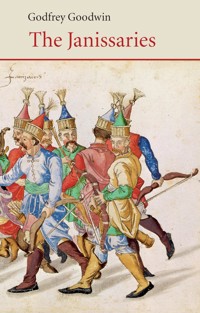
From the fifteenth to the sixteenth century, the janissaries were the scourge of Europe. With their martial music, their muskets and their drilled march, it seemed that no one could withstand them. Their loyalty to their corps was infinite as the Ottomans conquered the Balkans as far as the Danube, and Syria, Egypt and Iraq. They set up semi-independent states along the North African coast and even fought at sea. Their political power was such that even sultans trembled. Who were they? Why were they an elite? Why did they decline and what was their end? These are some of the questions which this book attempts to answer. It is the story of extraordinary personalities in both victory and defeat.
Das E-Book können Sie in Legimi-Apps oder einer beliebigen App lesen, die das folgende Format unterstützen:
Veröffentlichungsjahr: 2014
Ähnliche



















Godfrey Goodwin
THE JANISSARIES
The rebuilding of the fortress at Kars by Lala Mustafa Pasha, 1570 (British Library)
To Gillian
Jacques de Hay: janissary (Maggs)
Contents
List of Illustrations
Acknowledgements
Genealogy of the House of Osman
A Note on Pronunciation
Glossary
Introduction
1. The Origins of the Janissary Corps
2. The Devşirme or Christian Levy
3. Pillars of the Empire
4. The Ottoman Armed Forces
5. The Victorious Years
6. The Great Campaign
7. Fish Stink from the Head
8. Sharp Eyes and Long Legs
9. Tulips and Turmoil
10. The Auspicious Event
Epilogue
Notes
Bibliography
Index
Illustrations
Jacques de Hay, after Jean Baptiste van Mour: sultan and pages wearing the sleeve of Hacı Bektaş (Maggs)
The rebuilding of the fortress at Kars by Lala Mustafa Pasha, 1570 (British Library)
Jacques de Hay: janissary (Maggs)
Agha of the janissaries, mounted (Pepys Library)
Istanbul by Hubert Sattler (Fine Art Society)
Hall of the Halberdiers; a typical barracks of the janissaries at Topkapısaray (Michael Thompson)
Emblems of the janissary ortas from Marsigli (G. Gardiner)
The Ottoman camp from a plan drawn by Marsigli, showing the enclosure of the Grand Vezir with the five tails, guns, baggage wagons, advance and rearguard tents, scouts and camels resting
The Ottoman army in battle array under Süleyman the Magnificent (T.S.M.)
The capture of Tiflis by Lala Mustafa Pasha and Ozdemiroğlu Osman Pasha, 24 August 1578 (British Library)
The Ottoman army: (i) camel carrying two gun barrels; (ii) pack animals and baggage wagons; (iii) water supplies; (iv) the camp: picketed horses, cooking pots and latrines; from Marsigli (G. Gardiner)
Jacques de Hay: solak, bodyguard of the sultan (Maggs)
Agha of the janissaries in full dress (L) and şeyhülislam (R) (Sotheby’s)
The Nüsretiye (Victory) mosque, erected to celebrate the suppression of the janissaries
Jacques de Hay: sipahi (Maggs)
The janissary band (T.S.M.)
Jacques de Hay: aşcıbaşı (Maggs)
Acknowledgements
I have to thank my family and friends for putting up with the janissaries for so long and for their encouragement. I have also to thank Dr Richard Luckett, librarian of the Pepys Library, Professor John Carswell of Sotheby’s, Hugh Bett of Magg’s and Graeme Gardiner for their help with the illustrations. Once again, Jana Gough has been an indomitable editor and André Gaspard continues to be the most equitable of publishers. I must also thank the janissaries themselves, a million or two of them, without whom the great architecture of the Ottomans would never have been accomplished. The mosque of Süleyman the Magnificent is their enduring memorial.
Genealogy of the Sultans of the House of Osman
A Note on Pronunciation
The spelling adopted here is based on modern Turkish but I have even taken liberties with that.
While the pronunciation list may be of some help, the glossary will only please the benign: it would need an extra chapter to cover all the changing nuances of the meaning of words and the nature of various office-holders’ duties over 500 years.
All Turkish letters are pronounced as in English except for the following:
c pronounced j as in jam
ç pronounced ch as in child
ğ not pronounced; lengthens the preceding vowel
ı akin to the pronunciation of u in radium
ö pronounced ö as in the German König
ş akin to the sh in shark
ü pronounced u as in the French tu
Glossary
abd: slave of Allah
acemioğlan: janissary recruit; cadet
agha: general; senior post-holder
ahi: (akhi) member of thirteenth- and fourteenth-century guilds of young élite
akçe: silver coin long used in the Ottoman Empire
akıncı: light cavalry; scout; light horse
alaybey: senior officer of the sipahis
Albigensians: heretical sect in the Middle Ages
Alevi: Shi‘ite sectarian
aşcıbaşı: senior Royal Cook
askeri: military; infantry; auxiliaries
ateşcıbaşı: Chief Cook
ayan (pl.): local chieftains
azap: infantry (later gunners); could also serve at sea
baba: head of dervish sect
bailo: Venetian ambassador to the sultan
bayram: Muslim religious holiday
bey: (originally) ruler, chieftain; (then) man of rank; (now) any man
beylerbey: ‘lord of lords’; viceroy
Bogomil: Balkan follower of Albigensian heresy
bölük: 61 out of the 196 companies of the janissary corps
bölükbaşı: captain; sergeant
bostancı: gardener; division of janissaries
bostancıbaşı: pasha of the bostancıs
boza: drink of fermented barley
caliph: successor to the Prophet
çardak çorbaçı: commandant of the Customs House
çavuş equerry; gate-keeper; usher
cebeci: armourer
celalı: rebels made up of dervishes, disbanded soldiers, students and the dispossessed
celeb: sheep-driver
çelebi: title of member of élite class; baba or master of a Bektaşi tekke
cemaat: 101 out of the 196 companies of the janissary corps
çorbaçı: janissary colonel
defterdar: Keeper of the Account Books; Minister of Finance
deli: ‘maniac’ (hence shock trooper)
derbent (pl.): guardians of the passes; local recruits
dervish: member of a mystical sect
devşirme: Christian levy
divan: general council
Divan: Grand Council of State
dizdar: commandant of a fortress
Enderun Kolej: (‘College Within’), Palace School
esnaf (pl.): guildsmen; traders
fetva (pl. fetvalar): legal ruling with the force of an edict
firman: edict; order-in-council; command
gazi: warrior fighting for Islam/for the Faith
ghulam: royal cadet; slave held by title deed
gözde: chosen girl
güreba: foreign division
hadith: sayings of the Prophet, remembered by his followers after his death and seen as the ordinances of Allah
hajj: pilgrimage to Mecca
hamam: Turkish bath
han: inn
hass: royal estate
hoca: teacher; tutor and chaplain
horsetails: symbols of high-ranking commanders
içoğlan: page studying at Enderun Kolej
imam: prayer leader
irade: imperial rescript, decree
jerid: sport of mounted dart-throwing
jihad: Holy War
kadı: judge
kadıasker: military chief justice of Europe or Asia
kahya: steward
kalafat: crested headdress
kanun: code of civil law
Kanun-i-Teşrifat: Law of Ceremonies
Kanunname: volume of laws and decrees
kapıkulı (pl.): members of the imperial household
kapudan paşa: Grand Admiral
kervansaray: Turkish spelling of caravanserai
kilim: tapestry-weave rug
Kızılbaş: Red Heads; Shi‘ites
konak: villa; mansion
kös (pl.): great drums
kul: slave
kul kahya: steward of the imperial household; adjutant of the janissaries, etc.
lala: tutor
medrese: religious college
mescit: small (Ottoman) mosque without a mimber
meydan: square; open space
millet: non-Muslim citizens; their quarter
mimber: pulpit
molla: professor; senior religious and legal dignitary
müderris: rector; professor
muezzin: crier of the Muslim call to prayer
müsellem (pl.): settled nomads performing military service in return for smallholding
müteferrika: élite company of royal guard of feudal origin
naghile: hubble-bubble pipe
Nizam i-Cedit: New Army
ocak: barracks; hearth
oda (pl. odalar): room; barracks; dormitory
odabaşı: lieutenant
ordu: army; camp
orta: janissary company
otak: imperial tent (lit: high dome)
padişah: sultan
pencik: title-deed, especially to a slave; slave
peyk: foot guardsman
piyade: Anatolian foot soldier
reis efendi: foreign minister
ribat: monastery (often fortified)
şalvar (pl.): pantaloons
sancak: flag; division of a province
sancak bey: Lord of the Standard; governor of a small province
sancak şerif: Standard of the Prophet
saray: palace
sebil: fountain
seferli: recruit
seğmen: janissary in charge of hunting dogs and greyhounds, etc.
selamlık: male guests’ reception rooms
serasker: commander-in-chief
serdengeçti: shock troops (‘Madcaps’)
şeyh: elder; head of a Muslim religious order
şeyhülislam: Grand Mufti
seyyit: descendant of the Prophet
Shi‘ite: unorthodox sect of Islam (cf. Sunni)
sılıhdar: household cavalry recruited from janissaries on a quasi-feudal basis
sipahi: horseman; feudal cavalry
softa: student
solak: royal guard (from sol, meaning left-handed)
Sunni: orthodox sect of Islam (cf. Shi‘ite)
sürücü: drover
teber: double axe (symbol of the Bektaşi dervishes); halberd
tekke: dervish convent
tımar: fief of a retired officer
topçu: gunner
tuğ: horsetail showing rank; drum
ulema (pl.): members of the judicial class; Fathers of the Law
vakfiye: deed of endowment of religious property
vali: governor; (modern use) chief of police
Valide Sultan: Queen Mother
vezir (Turkish spelling of vizier): minister of state
voynuk: Bulgarian who reared and tended the imperial horses; groom when on campaign
yalı: mansion beside the Bosphorus
yamak: auxiliary
yaya: Anatolian foot soldier
yayabaşı: colonel
yürük: nomad; tribesman
zaviye: dervish convent
zeamet: large tımar
Zülfikar: cleft sword of Ali
Introduction
Ertuğrul, the father of the Ottoman dynasty, was a pastoral chieftain grazing his flocks in a small corner of northern Anatolia. His son, Osman I Gazi, died at the taking of the rich trading city of Bursa by his own son, Orhan, on 6 April 1326. From there the Ottoman armies were to invade the Balkans and reach the Danube. Constantinople was isolated and then conquered in 1453 and by 1517 Selim I had subjugated Syria and Egypt. The threat to Rome was frustrated and only foul weather prevented the capture of Vienna in 1529. The coast of North Africa came under Ottoman sway and in 1543 Turkish galleys wintered in Toulon.
These triumphs would not have been possible without a strong bureaucracy and a formidable soldiery. Trained as a standing army, the janissaries were the core of the Ottoman forces. For a time they were dreaded throughout Europe. Who were they?
This book is not a history of the janissary corps but an attempt to understand them as human beings—which they were. Their character inevitably changed over the centuries and yet, in the end, had they changed so much?
Agha of the janissaries, mounted (Pepys Library)
1
The Origins of the Janissary Corps
Dark Birds over Anatolia
In the year 1336 a North African traveller on a tour of the Islamic world crossed Anatolia from south to north and left us an account of his journey. Ibn Battuta1 was known and respected then, as he is now, and so was able to journey from one emirate to the next over territory which offered every kind of refuge to bandits and rapacious nomads. The decline of Mongol authority left the country divided among chieftains whose authority nominally derived from the khan’s governors, such as Eretna, but who were virtually independent. Geographically, the terrain divided naturally into regions with fertile pockets between rude mountains and goat-ravaged wastes2 where the inhabitants of polyglot ethnic stock had cohesive local loyalties. Moreover, the old gods lingered on in their fastnesses in valley and gorge and in the hearts of a peasant population monotonously assaulted by invading bands and companies.3 Superstition remains strong to this day, when files of women still ascend the citadel hill at Kars to perform rites to placate Cybele or woodcutters at Elmalı still alarm the townsfolk of the coastal plain when they emerge from the forest, bronzed and fiercely bearded, armed with their axes.
Long before Hellenistic or Roman times, the government of the sub-continent depended on highways although the importance of one particular route might decline or grow over time. Thus the main road from Pertek to Divriği is still the track that it always was, whereas others now have metalled highways. Beyond the roads were the people and beyond the people were the bandits; this is still true in the mountains, especially in Kurdish areas. In the view of Christian landowners under the Byzantines, an infection as grim as the plague came in the form of Türkmen raiders4 and they were, indeed, harbingers of defeat and desolation: but also of that reorganization into Muslim emirates that Ibn Battuta was to explore.
The Türkmen (known as Karakuş or Dark Birds) were birds of ill omen all over Central Asia. Their outstanding quality as cavalry depended on their sturdy horses, which could cover some 100 kilometres a day and are said to have achieved twice the distance when pressed.5 Their riders were equally tough and could ride twenty hours a day for an entire week. As was to be the custom in the camp of the Ottoman army, they picketed their horses outside their tents and never stabled them. Although the rider carried a whip, it was for show or use on dogs, not his horse; and no man needed a spur.6
Their history was one of raids and pillage, made possible by their great skill as bowmen for they let fly several arrows from the saddle, one after the other, with deadly accuracy. Their favourite and time-hallowed manoeuvre was to ride off as if in retreat and then turn to fire the Parthian shot. Türkmen had been captured and made slaves in the sense of kul (a term which is discussed in Chapter 2) by the Samanids for whom they formed a valued bodyguard. Later, the caliphate was to employ Turkish slaves to its cost for gradually these democratic soldiers became the rulers of the Muslim provinces.
Türkmen were the cavalry of the Seljuk army and when Anatolia became a conglomeration of rival emirates they were the foremost raiders on the frontiers, the gazis (warriors for the Faith) who took their faith—to which they subscribed more for martial reasons than for Allah’s—into Christian territories. In Central Asia, Islam made little progress but by the tenth century Arab merchants were trading in eastern Mongolia. The region had attracted an astonishing number of missionary religions from Zoroastrianism, Buddhism and Christianity to Judaism and Manichaeism; but the original shamanist beliefs and customs were too deep-rooted to be disturbed and it was this primitive worship of the mountains and the sky that the Türkmen took south with them. The year 960 saw the first official conversion to Islam of a numerous group of Turkic people—amounting to 2,000 tents—and the rulers of established states with roughly defined frontiers also gradually became Muslims. By 1127 Aslan Khan had built a minaret 50 metres high in Bukhara.
It was in the eleventh century that the bands of Türkmen led by their beys (chieftains) overran Persia and descended on Mesopotamia. Some of the tribes were Mongol and not Turkish in origin and they had absorbed more Chinese culture than the Türkmen; moreover, they tended to be more aristocratic in outlook. A leader such as Chingiz Khan was so contemptuous of the populace that his history is gruesome with massacres. Only a quarter of the 100,000 inhabitants of Samarkand survived its capture in 1221 and the slaughtered local craftsmen were replaced by Chinese artisans.
Out of this feudal force of Türkmen evolved the Ottoman sipahis (feudal cavalry), but tribes loyal to a nomadic way of life remain a source of worry for the governments of both Turkey and Iran to this day. Transoxiana never lost its political force as the original homeland of Turk and Mongol. In the sixteenth century, the emotional importance of Central Asia for the Ottomans reinforced its strategic significance and an attempt was made to build a canal from the Volga to the Don—this would have circumvented the frontiers of Persia and opened up an Ottoman trade route across Central Asia. But the uneasy Tartar Giray Khan of the Crimea sabotaged this project because he did not wish to see his nominal overlord strongly established across his frontier. The canal would have permitted an Ottoman fleet to sail into the Caspian Sea and encircle the Safavid kingdom of Persia. The call of Asia was one that the janissaries found disagreeable, since few of them were Turks until the end of the sixteenth century, and this, too, resulted in a latent dislike of the mounted sipahis.
Frontier, Faith and Fervour
When the Byzantine army was routed at Manzikirt in 1071, Anatolia was overrun by Asiatic tribesmen; in their wake came the creed of Muhammad, which, with its camaraderie of the frontier, appealed to soldiers above all other sections of society. There is no caste more superstitious than the military and the tribesmen were followed, as if by their shadows, by a heterogeneous throng of mystics and charlatans, inebriated from wine or drugs, and single-minded missionaries for the Faith. There were indeed dedicated men in the midst of this rabble, just as there were true Christians among the raffish monks of the later Middle Ages (or are today in the dilapidated monasteries of Mount Athos). Such men had the authority of their courage and the necessary austerity with which to order the hordes into local communities. They followed after the invading companies of Islam to fix their tekkes (convents) at the crossroads of the conquered territories. From these headquarters they established sufficient tranquillity for agriculture to continue to sustain the villages until their confidence and co-operation had been won. In 1261 Anatolia was infested with robbers and terrorists, corruption was rampant and landlords had fled while the great estates were broken up.7 Seventy years later, Ibn Battuta travelled unmolested.
Many of these dervishes were of the same Turkic stock and thought the same thoughts and shared the same phantoms as the settlers. Their quasi-socialist outlook succoured the indigent peasantry just as much as it did the newcomers at a time when central authority was impotent. Moreover, these fierce frontiersmen protected and advanced their borderlands because there were brothers among them endowed with such religious fanaticism that their daring made them invincible in battle. The Ottomans were later to harness this fervour and use it as a bridge over which the janissaries could traverse the breached defences of their foes. They were not a suicide brigade, however, since their enemies usually fled and the greatest honour was awarded those who achieved the highest heap of infidel dead.
Not all dervish orders were warlike or even populist. The ascetic Mevlevi, based in Konya, had little in common with the Rifai, or Howling Dervishes, whose orgasms for the Faith rendered them impervious to knife or fire. Yet the educative work of the Mevlevi sect, who civilized the leaders of society, was less important to the stability of the emergent Ottoman state in the fourteenth century than the ability of more plebeian orders to absorb the fears and direct the aspirations of the humble. They well knew that survival depended on cunning and dissembling, not least by that pretence of stupidity that was a protective garment which proved to be a hair shirt for successive governments. In this they were akin to peasant knaves or Russian serfs, who also resorted to the mask of simplicity.
But since cunning as a humour is not altogether satisfying, the people yearned for something more than just the wit to ward off the evil day when a rapacious tax-collector, landlord or troop of horse was hungry for forage and fat hens. No man lives without a modicum of hope, even in the shadow of declining fortunes and the depopulation of Anatolia which preceded Selim I’s establishment of stable government in the sixteenth century. Its survival is a tribute to its power even if this hope amounted to the wish to swap places with the tax-gatherer and to be the oppressor rather than the oppressed.
Hope in the abstract sense was kept alive by the dervish orders, who irrationally fired a faith which could never be fuelled by reason. This fanaticism also accounts for the ferocity of such sultans as Selim I, who could not overcome the heretic tribesmen of Anatolia with anything short of an ordered terrorism to outwit their own. Previously, in the fourteenth century, the small size of some emirates had brought relief from oppression because the bey or other local overlord was easily approached—each freeborn Muslim had the right of access to his ruler. Indeed, this right may have been one reason why, some two centuries later, Süleyman I (known to the West as the Magnificent) moved his residence from the centre of Istanbul to Topkapısaray, the seat of government. Public petitioners could now no longer delay him as he rode to and from his place of work. It was a right which extended to women and which was acknowledged from the beginning of Ottoman rule.8 The beys, from whose company the Ottomans emerged, were humble enough rulers: their halls and mosques were small and their towns were what we would call villages. Their summer palaces were tents by a stream in the woods or on a hillside; their wealth was worn on the body or represented by a cup or ewer, like the superb basin in the Mevlevi convent at Konya, which became a potent symbol of authority.
Such localized power could hardly degenerate into tyranny when the leading courtiers had characters as strong as their lord’s. Moreover, one and all were free men dedicated to the advancement of the Standard of the Prophet (sancak şerif) and if ritual prayers were perfunctorily uttered by some—not least, the opportunist Byzantine converts—the unifying force of Islam was too strong for any overt expression of agnosticism.9 Moreover, if the ruler and his vezir (minister of state) were named individuals, whose quirks of personality have come down to us, most men were less personages than the shadow puppets of the brotherhood.
Islam, however, was rent into sects as violently as was Christianity. The emergence of a national ruling house in Persia epitomized this in the sixteenth century: Shah Ismail represented a heterodox sect, the Shi‘ites, who were at odds with the orthodox Sunni Ottomans. The Ottoman adherence to the Sunni creed was partly due to geography. Had their early wanderings led them down into central Anatolia, they might have been sucked into the Shi‘ite whirlwind which stirs the dust of that plateau. But their flocks and their swords grazed northwards and their Sufi dervishes kept pace with them. There the lure of Constantinople was irresistible and they could not remain goatherds and shepherds for long.
If brotherhood belongs to shepherds and soldiers, democracy inhabits battlefields and towns. The countryman is compelled by the seasons to a passivity that the desperate may only escape by banditry, seeking perpetual refuge in the mountain fastnesses. The democracy of the towns in the time of Ibn Battuta was maintained by a free brotherhood possessing considerable sophistication and consisting of younger merchants and the sons of the rich.
Islam as a faith was divided between a military caste and the merchants who were the educated leaders of society. Wealth determined their pursuit of the law—which was also the pursuit of religion since there were no priests, only the judiciary of a republic where all laws stemmed from Allah and religion was the law. However, the Koran only covered laws which were basic to human life at tribal level so that there grew up a miscellany of less primary legislation first collected into the hadith (sayings of the Prophet). Interpreting divine utterances gives scope for human prejudice and imagination, and from early Islamic times the ulema (judicial class) contrived to amass wealth, partly from bribes. Through the vakfiye system (the dedication of property to religious use), charities were established with hereditary family administrators for the benefit of a man’s heirs until much country and most city land was in the hands of these pious foundations. Although the accretion of wealth was immoral and deplorable, it nevertheless obliged merchants and judges to be charitable and to mitigate the worst aspects of urban poverty over and above the payment of their tithe.
Equals among Equals
In thirteenth-century Anatolia, an egalitarian reversal of the usual order of Islam grew in an astonishing manner. Its intellectual roots may be found in the socialistic beliefs of the Karmatians, whose primitive desert communism was long a threat to the learned class. Such concepts were accepted, however, in the clubs set up in many local towns by the ahis, who were young craftsmen and small traders. In 1355 the prisoner Gregory Palamas found the ahis wise and erudite.10 They tended to be bachelors and were tolerant towards women (although they did not go so far as to treat them as equals), allowing them to form a sect of their own. Like the Quakers, the ahis established zaviyes (central meeting-houses) where they feasted and sang as well as prayed. The building was often the finest in the town, as with the zaviye founded by Murat I at Iznik (Nicaea) in honour of his Christian-born mother, Nilufer Sultan. These ‘club houses’ were used as hostels by fortunate travellers like Ibn Battuta, who remarked that there was no other comparable movement in Islam.11 Ibn Battuta was sometimes embarrassed when two zaviyes competed for his patronage but he disposed of the problem by dividing his stay equally between them.12
Prayer, food and ritual music were not the only functions of these clubs. They were the daily meeting-places of the community leaders, the men who paid the taxes and whose skills made civilized life possible. Naturally they conversed, and equally naturally their conversation was political. They were embryonic Jacobins whose talk was not harmless gossip, for the ahis achieved real power and could restrain rulers who might well find their views anarchic. The ahis even ruled in Ankara (Angora) for a time, for there was no prince.
Without written records it is difficult to trace the ahis’ decline; it was paralleled by the rise of the Ottomans whom they supported because the family was committed in deed, as well as word, to the advancement of the jihad (Holy War). For an ahi this was the only war and, if they exerted restraint on the beys who enjoyed fighting each other, it was only to urge them to fight the war that was for Allah.
The ahis also dealt with highwaymen and bandits and were valued allies of Orhan in the capture of Bursa when his father Osman Gazi died, just as they were to be the cause of concern to Murat I when a revolt in the region of Ankara was instigated by his rival, Karaman Bey. They were later to help Cem Sultan against Bayezit II but were one reason why Mehmet I regained the throne after his father’s defeat at the hands of Timur. They had close relationships with his vezir, Bayezit Pasha, an Albanian with possible Bogomil antecedents whose mosque at Amasya has many zaviye characteristics. Anarkis13 calls the ahis the aggregate of all the virtues which distinguished young men of chivalry and it was this chivalry that the Ottomans were to extinguish to their cost. The ahis were as determined in their opposition to banditry as they were to tyranny14 and their apprentices swore to ‘serve the seven virtues, abhor the seven vices: open seven doors and close seven doors’. Nor would they admit atheists, butchers, surgeons, tax-gatherers or money-lenders to their hostels. Most significantly, they refused to shelter astrologers, foes of all rational thought and therefore of freedom, whom monarchs and ulema continued to cherish. They offered with this a kinder faith than that of the uncharitable legalists, permitting men to follow winding paths between hedgerows of peccadilloes which eased the passage through life for some. They argued that wine was no evil, for example. Moreover, in their pursuit of ecstasy they inevitably employed narcotics which, with their pacifying hold over the mind, became a secret political instrument within the Ottoman state.
When the Ottomans, in effect, ceased to be gazis and became ambitious imperialists as eager to engulf Islamic lands as Christian, the highly developed central bureaucracy could not help but be hostile to mysticism and folk socialism. The ahi brotherhood had to be eliminated and if some of their ideas merged with those of Sufi orders, dervishes had little political let alone economic power.
It is true that when Ibn Battuta reached the then Ottoman capital at Bursa, the town was full of dervishes and the term zaviye did not apply simply to their lodges. Dervish lodgings were incorporated into the major mosques, which also sheltered travellers and holy men.15 Only with the conquest of Constantinople in 1453 and the establishment of the autocracy of Mehmet II (known as Fatih, ‘the Conqueror’) did inns and mosques take on lives apart in well-differentiated buildings. Now it was the ulema whose high council met in the mosque of the sultan with all the authority of the established orthodoxy. Dervishes were sent to backchat elsewhere in the Conqueror’s complex. As for the ahis, despite Byzantine precedents that lingered on in 1453, no system was fully organized until late in the sixteenth century. The guilds had to grow again from new roots, taking the form of state corporations rather than free institutions. If these were eventually to become powerful, it was partly due to their infiltration by the janissaries.
From Small Acorns Great Oaks Grow
In this search for the origins of the janissary corps, with their mystique, esprit de corps and cookhouse terminology, it will be seen that they emerged from obscurity with some of the ideals of the past still clinging to them, however feebly. Related to their mystique was an affinity with popular religions which echoed with ghostly voices from the antique pantheon. Janissary fraternization with these polyglot gods and debased ahi concepts may have arisen from a subconscious emotional need but it equally contributed to the decline of the corps as a military force—an inevitable decline, as the dynasty stumbled its way into the nineteenth century.
It may seem odd to trace the history of troops that became the terror of Europe through political roots but armies, whether passively or actively, are political bodies. In the Ottoman state, moreover, the highest officers were trained in the janissaries’ image. Although the palace pages formed a separate and elect body, their connection with the corps was sufficient to quell any tendency to aristocratic disdain for the janissaries. Until power faded, hereditary rank did not count for much under the sultans. Mehmet II pursued a policy of suppressing the hereditary nobility. The promotion of the common folk was pursued by subsequent sultans in face of opposition by the ulema. The proud jurist Ebüssu’ûd even silenced Süleyman’s Grand Vezir, Sokollu Mehmet Pasha, who was a child of Christian parents and therefore a slave, by saying that his witness was inferior to that of a true-born Muslim, however humble. That he had risen to the loftiest office in the empire was of no account.16 In this lay the essential social superiority—and higher pay—of the sipahis which helped foster the bitter rivalry between them and the Christian-born janissaries, a rivalry that the government exploited.
The early Ottoman sultans had no need of special troops, for their ambitions were modest and they were joined by adventurers and warriors who in Europe would have enlisted in the free companies of captains like Hawkwood in Italy. Such an adventurer was Köşe Mikhal (‘Michael the Beardless’), who founded the Mikhaloǧlu family and who had belonged to the mercenary Catalan Company before joining other disillusioned Greeks who became Muslims and helped Orhan Gazi take Bursa. Orhan, together with his brother Alaettin Pasha and Kara Halil Çandarlı, an ahi and an educated man, organized his army into units of tens, hundreds and thousands. The sipahis were placed under the command of another brilliant Greek officer from Karası, Evrenos Bey,17 who also became Commander of the European Marches.18 Orhan appointed his eldest son, Süleyman Pasha, as beylerbey (‘lord of lords’, or viceroy) and serasker (commander-in-chief) in Europe and Köşe Mikhal as commander of the akıncıs (scouts or light cavalry), heirs of the Türkmen raiders. Their flare and panache gave them an authority of their own and upset the wiser if less spectacular plans for gradually absorbing the conquests of Orhan’s successor, Murat I.19
Was the janissary corps really founded by Murat I or was the janissary Konstantin Mikhailović right that it was formed by Murat II’s father, Mehmet I, some thirty years before his own attachment to the corps in 1455?20 It is likely that the first companies of a new corps were composed of captives, corralled and driven around awaiting ransoms which were unlikely to be paid. They were not only a nuisance but also a waste of talent. The anonymous Ottoman chronicle is quite specific on this point.21 Converted to Murat’s cause, they could be valuable warriors. It was a practice which had long been followed in Islam as elsewhere. The captives were sent to learn Turkish on the farms of the feudal cavalry just as janissary recruits were later to be sent—and in that toughening process found another reason to resent their sipahi overseers. The law of 1362 sent one in every five prisoners to spend five to seven years labouring before their transfer to Gallipoli (Gelibolu) and, after 1453, to Istanbul.22 It is probable that the Christian captives formed the nucleus of a standing army; they may also have been the original company that was to grow into the new army, the yeniçeri or janissary corps. Their commanders were chosen from among the companions of the Ottoman bey, thus giving them the benefit of his prestige, so that by the reign of Murat I in the mid-to late-fourteenth century the detachment had its own identity.
The first mention of the enforced enrolment of Christian children23 occurs as late as 1438, in the reign of Murat II, when Isidore Glabas, Metropolitan of Salonika (Thessalonika), wrote to protest at the kidnapping of some boys by pirate crews sent by the emirs of the Anatolian coasts, such as the Menteşe beys.24 By then an embryonic Ottoman corps was certainly in existence and is likely to have recruited the sons of the defeated military caste of the new-won Balkan provinces besides Greeks from the Black Sea region. Otherwise there would have been nothing for these youths to do for by birth they were fitted for little else than carrying arms. Moreover, with the conquest of ever-increasing areas of the Balkans (Rumelia) in the second half of the fourteenth century, there was a reservoir of manhood which the Byzantines themselves had tapped. It is probable that some system of levying a toll of boys from the peninsula to come to work in Constantinople, humbly enough, had been instituted long before the Ottoman period. The capital offered these servants a foothold from which those of spirit could achieve careers which were inconceivable in their villages.25
The rapid expansion of Murat I’s realm left little time in which to train recruits who had been forcibly abducted. However, the new lands were Christian in a different sense from those populated by Greeks for they harboured Bogomil heretics who had affinities with the free-thinking Albigensians.26 They were easily persuaded by dervish missionaries that they had ideas in common with Sufism. This coupling with the mystique of Ali and his two-bladed sword, Zülfikar, was to trouble the janissaries, one of whose emblems it became, and early attracted them to Bektaşi ideas (see Chapter 7) as is apparent from Konstantin Mikhailović’s evidence in the 1450s. The Shi‘ite movements were to hold Ali in esteem and reject Ottoman orthodoxy. The interplay of secret beliefs is difficult to reconcile but that such forces were important is not in doubt. Nor were the common people the only Bogomils for in Bosnia even Stephen, king from 1444 to 1461, was one.
The Slavs were easily converted to Islam and there was no need to extend the recruitment of Christian boys into Anatolia until 1512—which indicates that there was little opposition to the system of forced levies in the Balkans. There was, however, a trade in slaves of both sexes recruited by the Tartars from the Caucasus. These slaves were shipped down the Bosphorus throughout the fourteenth and fifteenth centuries. In about 1400 Johann Schiltberger,27 who became page to Bayezit I, reported a sale of children—the handsomest boys and the prettiest girls—from special slave ships. The trade was permitted to continue after the conquest of 1453 by Mehmet II but he forbade the transportation of Muslims.28 Some boys were taken for the army and some girls for the harem while other youngsters were destined for the markets of Egypt. Some 7,000 Tartar, Circassian, Russian and Magyar children were sold at Alexandria when the Italian merchant Tenenti was there. The Tartars fetched 130–140 ducats but the Circassians only 110–120. The barbarous Uskok pirates of the upper Adriatic were also employed as middlemen who supplied Pope Sixtus V. Two thousand such slaves were sold on the quayside at Ancona in 1599.
The establishment of a central government at Edirne, the former Adrianopolis, with alliances which extended Ottoman masterdom over most of the territories south of the Danube, was quickly achieved. A region that had been mauled by the enmities of local princes was to be unified for 400 years—partly because the well-fed and, usually, paid Ottoman army was initially to be preferred to those of the licentious and rapacious Christian knights and their vagabond hordes. Until the eighteenth century only the Dutch could afford to pay a standing army which could be drilled and made to dig. Mercenaries thought such exercises beneath them. By good discipline and payment for supplies, the loyalty of the local peasants was quickly won. In Bulgaria, for example, the choice lay between serfdom and brigandage or Ottoman order and the country remained subject from 1393 until nationalism liberated it in 1878. The brutal feudal rule of the Bulgarian barons could win no hearts. Once they had bowed their heads to the conqueror, landowners as much as their peasantry were swift to escape the poll tax by being converted to Islam, making religion subservient to economics. The government even had to discourage the proliferation of converts because of diminished revenues, as happened when Bosnia was taken in 1463 and Herzegovina in 1482. In these territories many people would have sought employment in a standing army such as existed nowhere else. Moreover, the army wore distinguishing uniforms, a discipline that was not imposed in Europe until Martinet equipped the French army in the eighteenth century.
There were recruits to hand but the development of the janissary corps was carefully planned if only because of the economics of its pay and maintenance, for which money had to be found. It was not a question of booty, as with some mercenary companies or, later, the corsairs. Tax sources had to be allocated and the money accounted for.
The ultimate consequences of the founding of the corps could not have been foreseen by Murat I or by his successor, Yıldırım (‘the Thunderbolt’) Bayezit. No more could Henry VII of England have foreseen that his college at Eton would furnish a procession of social leaders and house 1,400 boys. The first levy of Balkan yokels did not imagine themselves to be destined to political power but to pay and wounds. They speedily became proud of their bowmanship and, later, their musketry and the comradeship of veterans. Nor were these crack infantrymen aware of any affinities with the populace of Edirne or Istanbul. This was to come later—as if by accident but actually to fill a vacuum. For a time, they had a real place in society as the tribunes of the populace, devoid of constructive concepts though they were. It is this that makes the pursuit of the history of the janissaries a climb up the stairs of no ivory tower but a lookout post from which to watch the struggles beneath the surface of Ottoman politics, the struggles of the tumultuous majority.




