


18,99 €
Mehr erfahren.
- Herausgeber: John Wiley & Sons
- Kategorie: Fachliteratur
- Sprache: Englisch
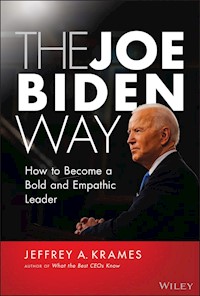
Discover what sets leaders like President Biden apart from the rest In The Joe Biden Way: How to Become a Bold and Empathic Leader, bestselling author and leadership expert Jeffrey Krames provides readers with leadership secrets gleaned from one of the most transformative and successful presidents in modern times: Joseph Robinette Biden, Jr. In this book, the author sets out 7 lessons in inspiring leadership that have helped the 46th President of the United States carry his powerful message to the White House and deliver it to hundreds of millions of people. You'll learn how to: * Lead with empathy and demonstrate you understand what your followers are experiencing * Set a single priority and focus on it with laser precision * Learn to execute on your goals and back your words with meaningful action * Build on and cultivate your strengths and values * Lead diverse groups of people and inspire them to share a common goal Perfect for executives, managers, and other business leaders, The Joe Biden Way is a must-read resource for anyone who strives to unlock the best in their followers and colleagues and discover what sets great leaders apart from the rest of the pack.
Sie lesen das E-Book in den Legimi-Apps auf:
Seitenzahl: 232
Veröffentlichungsjahr: 2021
Ähnliche



















Table of Contents
Cover
Title Page
Copyright
Dedication
Prologue: Lead with Empathy
Tell the Truth and Embrace Competence
Embrace Diversity
Reach Out to Those Who Need You
Overcome Fear
Understand Your Opponents' Intent
Fight Against Misinformation
Be Optimistic
Notes
CHAPTER 1: Set One Priority
Focus on One Thing
Go Big and Keep Your Promises
Know Your Opponent Inside and Out
Work Through Intransigence
Lead with Courage and Vision
Watch All Flanks and Don't Get Distracted
Communicate Directly
What's the Takeaway?
Notes
CHAPTER 2: Execute Strategically
Play “Three-Dimensional Chess”
Exhibit Patience and Discipline
Act “Decisively, Quickly, and Boldly”
Make Good on Promises
Anticipate Surprises
Celebrate Wins
Start a Revolution
Obsess Over Implementation
Persuade Constituents and Finish Strong
Be Memorable
What's the Takeaway?
Notes
CHAPTER 3: Value Specific Experience
Understand the Importance of Experience
Understand That “Talent Is Overrated”
Be Authentic
Know That #2 Can Become an Effective #1
Do What It Takes to Be Persuasive
Learn from Your Worst Experiences
What's the Takeaway?
Notes
CHAPTER 4: Build on Strengths
Be Curious and Read Everything
Reach Across the Aisle
Don't Forget Culture or People
Build Multiple Strengths to Become Extraordinary
Call Out Your Antagonists
Be Tough but Proportional
Be Attentive to Leadership Blind Spots
What's the Takeaway?
Notes
CHAPTER 5: Close Reality Gaps
Make Good on Your Promises Even in the Face of Crisis
Don't Abandon Priorities
Put the Planet First
What's the Takeaway?
Notes
CHAPTER 6: Focus on Leadership, Not Optics
Surround Yourself with Talent
Make History
Pass the First Leadership Test
What's the Takeaway?
Notes
CHAPTER 7: Build a Legacy
Be Pragmatic and Bold
Consider Your Legacy
Return to Empathy
Be a Steady Hand
What's the Takeaway?
Notes
Acknowledgments
About the Author
Index
End User License Agreement
Guide
Cover
Table of Contents
Title Page
Copyright
Dedication
Prologue: Lead with Empathy
Begin Reading
Acknowledgments
About the Author
Index
End User License Agreement
Pages
iii
iv
v
1
2
3
4
5
6
7
8
9
10
11
12
13
14
15
16
17
18
19
21
23
24
25
26
27
28
29
30
31
32
33
34
35
36
37
38
39
40
41
42
43
44
45
47
48
49
50
51
52
53
54
55
56
57
58
59
60
61
62
63
64
65
66
67
68
69
70
71
72
73
74
75
76
77
78
79
80
81
83
84
85
86
87
88
89
90
91
92
93
94
95
96
97
98
99
101
103
104
105
106
107
108
109
110
111
112
113
114
115
116
117
118
119
120
121
122
123
125
126
127
128
129
130
131
132
133
134
135
136
137
138
139
140
141
143
144
145
146
147
148
149
150
151
153
155
156
157
158
159
160
161
162
163
165
166
167
169
170
171
172
173
174
175
176
177
178
179
180
181
THE JOE BIDEN WAY
How to Become a Bold and Empathic Leader
JEFFREY A. KRAMES
AUTHOR OF What the Best CEOs Know
Copyright © 2022 by Jeffrey Krames. All rights reserved.
Published by John Wiley & Sons, Inc., Hoboken, New Jersey.
Published simultaneously in Canada.
No part of this publication may be reproduced, stored in a retrieval system, or transmitted in any form or by any means, electronic, mechanical, photocopying, recording, scanning, or otherwise, except as permitted under Section 107 or 108 of the 1976 United States Copyright Act, without either the prior written permission of the Publisher, or authorization through payment of the appropriate per-copy fee to the Copyright Clearance Center, Inc., 222 Rosewood Drive, Danvers, MA 01923, (978) 750-8400, fax (978) 646-8600, or on the Web at www.copyright.com. Requests to the Publisher for permission should be addressed to the Permissions Department, John Wiley & Sons, Inc., 111 River Street, Hoboken, NJ 07030, (201) 748-6011, fax (201) 748-6008, or online at http://www.wiley.com/go/permissions.
Limit of Liability/Disclaimer of Warranty: While the publisher and author have used their best efforts in preparing this book, they make no representations or warranties with respect to the accuracy or completeness of the contents of this book and specifically disclaim any implied warranties of merchantability or fitness for a particular purpose. No warranty may be created or extended by sales representatives or written sales materials. The advice and strategies contained herein may not be suitable for your situation. You should consult with a professional where appropriate. Neither the publisher nor author shall be liable for any loss of profit or any other commercial damages, including but not limited to special, incidental, consequential, or other damages.
For general information on our other products and services or for technical support, please contact our Customer Care Department within the United States at (800) 762-2974, outside the United States at (317) 572-3993 or fax (317) 572-4002.
Wiley publishes in a variety of print and electronic formats and by print-on-demand. Some material included with standard print versions of this book may not be included in e-books or in print-on-demand. If this book refers to media such as a CD or DVD that is not included in the version you purchased, you may download this material at http://booksupport.wiley.com. For more information about Wiley products, visit www.wiley.com.
Library of Congress Cataloging-in-Publication Data
Names: Krames, Jeffrey A., author.
Title: The Joe Biden way : how to become a bold and empathic leader / Jeffrey A. Krames.
Description: Hoboken, New Jersey : Wiley, [2022] | Includes index.
Identifiers: LCCN 2021028035 (print) | LCCN 2021028036 (ebook) | ISBN 9781119832355 (hardback) | ISBN 9781119832799 (adobe pdf) | ISBN 9781119833604 (epub)
Subjects: LCSH: Biden, Joseph R., Jr. | United States—Politics and government—2017- | Leadership—United States. | Presidents—United States.
Classification: LCC E916 .K73 2021 (print) | LCC E916 (ebook) | DDC 658.4/092—dc23
LC record available at https://lccn.loc.gov/2021028035
LC ebook record available at https://lccn.loc.gov/2021028036
COVER DESIGN: PAUL MCCARTHY
COVER IMAGE: © GETTY IMAGES NEWS | POOL | POOL
To Noah and Joshua,whose shining souls lightmy way forward every day.
Prologue: Lead with Empathy
Tell them what you really think, Joey. Let the chips fall where they may.
—Joe Biden's Grandfather Finnegan
Joe Biden landed in the White House with empathy on full display. The evening before his inauguration, President–Elect Joe Biden and Vice President–Elect Kamala Harris held a somber, thoughtful memorial to the 400,000 Americans killed by Covid-19. Biden acknowledged the unspeakably large sum of dead Americans. “To heal, we must remember. It's important to do that as a nation.” He promised America that, if he were elected, he would make conquering Covid-19 and its ill effects on the economy his top priority.
A month into his administration, President Biden and Vice President Harris held another memorial, this time for the 500,000 who had died from the virus. Once again, Biden led with empathy: “We have to resist becoming numb to the sorrow.” He asked Americans to avoid “viewing each life as a statistic, or a blur, or ‘on the news.'” With feeling, he said we must “honor the dead, but equally important, care for the living, those that are left behind.”
It felt like an odd but familiar moment and event. In celebrating and mourning the ungodly number of the Covid-dead, Joe Biden was playing a role played by other presidents in perilous moments: consoler-in-chief. He was better at the role than most presidents because few doubted Biden's authenticity. Even his greatest opponents liked and respected him.
The president-elect continued on that evening: “We often hear people described as ordinary Americans; there is no such thing. There is nothing ordinary about them. The people we lost are extraordinary. They spanned generations. Born in America, emigrated to America. But just like that so many of them took their final breath alone as Americans…. I know all too well what it's like … not to be there when it happens. I [also] know what it's like when you are there, holding their hands … and they slip away.”1
Joe Biden's long-cultivated empathy was on display when he spoke of knowing about death. He had spent a lifetime remembering the deaths that so profoundly touched his life. The first tragedy was the loss of his first wife, Neilia, and their 13-month-old daughter, Amy, in a life-altering car crash in December 1972. Biden's two sons, Beau and Hunter, were also injured in the crash, but survived with serious injuries. A very shaken Joe Biden spent most every night with his two surviving sons, enduring a multi-hour, daily commute from Delaware to Washington, D.C., and back again. Far more recently, in 2016, Joe Biden lost his son Beau to brain cancer, the same disease that took his dear friend, war hero, senior senator, and former presidential contender John McCain.
His empathy as a leader has infused his storied career. Especially as president, Joe Biden has proven to be a likeable and reassuring figure, the importance of which was amplified because the Biden presidency followed one of the most chaotic administrations in recent memory. Even Republicans in Congress like the good-natured, avuncular Joe Biden. That has been true ever since he won his first Senate race at 29 years of age in 1972.
Early in his political career, a Democratic strategist named John Martella taught a young Senator Biden a lesson he never forgot: “You know, Senator,” he said, “You should not run for president because tactically you can win. The questions you have to ask are why you are running for president and what you will do when you are president. You shouldn't run until you know the answers to those questions.”2 Joe Biden knew the answers to them. Being someone other than Donald Trump was not a good enough reason to be president. He had learned that a positive vision of the future is a politician's most essential driving force.
In fact, Biden's driving force has been to help level the playing field so that the impoverished and people of color get a fair shake. In words and deeds, Biden has demonstrated his penchant to help the Americans who had been left behind by the previous administration. As you will see, there is significant evidence of Joe Biden's earnestness in helping the neediest among us.
***
It is important to note one important point about this work from the outset: this is not a Trump-bashing book; nor is it an anti-Republican book.3 This is a leadership book based on the actions and words of Joe Biden. Nonetheless, Donald Trump, the 45th president, and several of his allies are important to this work for two key reasons. First, to accomplish his sweeping legislative agenda, Joe Biden needed Republican votes in Congress, and Donald Trump remained the de facto head of the GOP heading into the 2022 mid-term elections. Second and as important, the acrid political environment that existed in Biden's first months as president were, in large part, due to Trump, Trumpism, and the enablers who helped give sustenance to what were previously viewed as conspiracy theories.
Tell the Truth and Embrace Competence
Against the most unstable and troubled time in America since 1968, Biden found himself being named the victor on his third serious attempt at becoming America's chief executive. Within hours of the race being called, a seemingly rare commodity started to pour out of the new administration: truth.
The newly minted press secretary, Jen Psaki, gave her first daily briefing seven hours after the 2020 race was called for Biden. The new Biden briefings should have been regarded as unremarkable events, but given the absence of both probity and press briefings in the previous administration, they were a noteworthy and reassuring ritual for many Americans.
The other consistent commodity flowing from the new Biden administration was competence. When any member of the administration spoke, in briefings or television interviews, each looked calm, confident, and competent. There was one reason above all that ignited that confidence and enthusiasm: the fact that every member of the Biden administration knew if they upheld their integrity vows, their boss would have their backs.
Two examples of Biden's superlative cabinet picks were Antony Blinkin for secretary of state and Rochelle Walensky for director of the Centers for Disease Control (CDC) and the administrator of the Agency for Toxic Substances and Disease Registry. These two accomplished individuals epitomized the Joe Biden way. Blinkin served as America's 26th deputy national security advisor and America's 18th deputy secretary of state under President Obama. Walensky held degrees from Johns Hopkins University and the Harvard School of Public Health. Before Biden selected her for the CDC post, she was chief of the Division of Infectious Diseases at Massachusetts General Hospital while maintaining her post as a professor of medicine at Harvard Medical School.
From day one, Biden's cabinet stood in stark contrast to his Republican predecessor. For example, Trump's first choice for secretary of state was Rex Tillerson, who never worked a day in government (he was the CEO of Exxon when tapped for that key post). Tillerson, like many of his fellow cabinet members, did not last long in that administration (in fact, Trump experienced a head-spinning 85 percent turnover of his so-labeled A-team).
With a superb cabinet in place, Biden was able to focus on his key priorities. At the outset that meant mitigating the crushing health and financial effects of Covid-19. He became a better communicator, learning to strike just the right note with the American people. He learned to “level” with people while also transmitting a message of hopefulness. That form of messaging became Joe Biden's way of communicating with the American people.
Here is how Biden summed things up in the second month of his administration: “Today we are living through another long dark winter in our nation's history. Combatting the deadly virus, joblessness, hunger, racial injustice, violent extremism, hopelessness, and despair. But I know we'll get through this. Better days are ahead. I know it because I know the story of the journey of this nation.”4
Embrace Diversity
At his first cabinet meeting a few months into his administration, Biden looked at the multiracial group he had selected and declared the following: this is a cabinet that “looks like America.” Hiring a multiracial cabinet and team became Biden's calling card, his raison d'etre. His commitment to enlisting and empowering a diverse team to serve the nation—and not him—was one more Biden promise kept. Keeping promises, as the world was finding out, was of immense importance to the 46th president of the United States.
On his very first day in office, President Biden issued an executive order on “Advancing Racial Equity and Support for Underserved Communities Through the Federal Government.” The order begins with Biden's true thoughts on the topic of diversity. We know he believes them because he repeated the sentiments often during his presidency: “Equal opportunity is the bedrock of American democracy, and our diversity is one of our country's greatest strengths. But for too many, the American Dream remains out of reach. Entrenched disparities in our laws and public policies, and in our public and private institutions, have often denied that equal opportunity to individuals and communities. Our country faces converging economic, health, and climate crises that have exposed and exacerbated inequities, while a historic movement for justice has highlighted the unbearable human costs of systemic racism.”
To reinforce his continued commitment to his diversity pledge, Biden signed another executive order in the early summer of 2021 “to advance diversity, equity, inclusion, and accessibility (DEIA) in the Federal workforce,” he explained. “Enduring legacies of employment discrimination, systemic racism and gender inequality are still felt today,” he emphasized once more.
“The federal government is at its best when drawing upon all parts of society, our greatest accomplishments are achieved when diverse perspectives are brought to bear to overcome our greatest challenges and all persons should receive equal treatment under the law,” wrote Biden. “This order establishes that diversity, equity, inclusion and accessibility are priorities for my administration and benefit the entire federal government and the nation and establishes additional procedures to advance these priorities across the federal workforce.”
There is only so much a president can do with executive orders. He cannot change the law, and even two executive orders are not close to a civil rights bill. However, in addition to policy they might change or improve, such bills set a tone that Joe Biden has no plan of taking women and people of color for granted.
The Biden Cabinet had the greatest percentage of women (almost 50 percent) leading cabinet-level departments in history. And half of the cabinet are Latinx, Black, Native American, or Asian American. Even America's first Black president did not have a cabinet as diverse as Biden's.
Of course, when it comes to diversity, candidate Joe Biden sent a strong message when selecting Kamala Harris in August 2020 as his running mate. Harris was not only capable; she was the first woman, the first Black American woman, and the first of Asian descent to occupy the critical office of the vice presidency. It meant the world to many black and brown women and children across the globe.
When Biden selected Harris, he was not only choosing a governing partner; he was also choosing a potential successor. According to management guru Peter Drucker, great emphasis must be placed on an executive's thoughtful selection of a successor. Biden understands there cannot be success without a strong successor ready to take over at a moment's notice.
Reach Out to Those Who Need You
Victims of Racial Strife
When Biden assumed office, racial strife had increased dramatically in the previous five years. White supremacists felt buoyed like at no other time in the past half-century. It felt, to many old enough to remember, like 1968. America was sliding backward in time as it pertained to the country's original sin. Biden understood this, addressed it in speeches and actions, and was resolute in leading in such a way that told Black and Brown communities that he at least understood their burden.
In the weeks leading to his inauguration, Biden understood that whatever painting he envisioned creating as the 46th president, his brush strokes would land on a canvas not of his making. He understood how badly his predecessor had marred the landscape and the violence it finally wrought. He knew he needed to heal wounds and that progress would begin with empathy.
Biden's empathy gene surfaced when, during the George Floyd murder trial in Minneapolis in 2021, he reached out to the Floyd family. He had previously visited the family in 2020, his first long-distance trip during the 2020 presidential campaign (he had traveled minimally because of Covid-19).
According to Floyd's brother, Biden wanted him and the rest of his family to know that people in high places cared about the murder of his brother under the weaponized boot of a Minneapolis police officer. Here is how Floyd's brother summed up the call with President Biden: “He knows how it is to lose a family member, and he knows the process of what we're going through. So, he was just letting us know that he was praying for us, hoping that everything will come out to be OK.”5
Biden offered remarks from the Oval Office about that phone call and his feelings for the Floyd family: “I can only imagine the pressure and anxiety they are feeling, and so I waited until the jury was sequestered and I called. They are a good family, and they are calling for peace and tranquility no matter what that verdict is.” Biden then said the evidence against Officer Derek Chauvin was “overwhelming” and that he “prayed the verdict is the right verdict.”6
Biden wanted a guilty verdict because he felt it to be the just outcome, and the last things he wanted were riots erupting in cities like Minneapolis, Chicago, New York, Detroit, and Los Angeles. He did not give voice to that last thought, of course. But it was still a rare occasion that a sitting U.S. president commented on a case that was being tried in the courts. But this was no ordinary case—and no ordinary president.
Just a few hours later came the all-so-critical verdict: the police officer who murdered George Floyd was found guilty on all three counts. Justice had finally been served in the state of Minnesota.
Joe Biden was heavily invested in the George Floyd murder and subsequent court case and its far-reaching implications. On the one-year anniversary of George Floyd's death, in unprecedented fashion, President Biden hosted the Floyd family in the White House.
Citizens in a World of Covid-19
When it came to Covid-19, President Donald Trump mismanaged the effort in spectacular fashion, by underplaying the threat, refusing to recommend or wear a mask, and lying hundreds of times about a pandemic he labeled as a “Democratic hoax.”
A year into Covid-19, Anthony Fauci, director of the National Institute of Allergy and Infectious Diseases, was shocked by the extent of the suffering and stunned by the more than 500,000 dead Americans. The first year of the pandemic was horrific, “not only [for the] suffering … and deaths and loss of loved ones, but [for] what it [had] done to society and the economy, and how … [it had] deepened the divisiveness … making it more intense. People are going to be writing about this, and historically opining about this, for a long time to come.”
President Biden was fiercely determined to get the virus under control and came out often to tell his fellow citizens to mask up and get vaccinated. The number of deaths decreased precipitously throughout Biden's first year in office. Within a few short months, Biden and his team were able to vaccinate three out of every four Americans over the age of sixty-five. That was a remarkable achievement.
The relatively high number of new cases that continued months into his administration only made Biden more determined to deal swiftly and decisively with Covid-19 and its dire consequences. He expressed optimism, but never stopped telling the truth to the people he promised to help.
Overcome Fear
Lies and quicksand have this in common: building anything meaningful upon either is futile.
Joe Biden entered office at one of the strangest, most perilous times in American history. A global pandemic, the threat of domestic terrorism, and a sinking economy were three great crises that he faced upon entering the presidency.
These unsettling events explained, in part, why unease ruled Washington in the first days of January, even before January 6. Instead of clearing and furthering a path for President-Elect Biden and his transition team, President Trump was focused on “stop the steal” and “the election is rigged” messages at public events and in speeches.
According to former Speaker of the House John Boehner, the problems with the Republican party could be traced back almost a decade: “By 2013 the chaos caucus [the Tea Party] in the House had built up their own power base thanks to fawning right-wing media and outrage-driven fundraising cash. And now they had a new head lunatic [Trump] leading the way.”7
Most astounding, Trump never conceded or congratulated the leader who defeated him months earlier. He never acknowledged Biden's victory. Joe Biden sensed the coming havoc well before the election, when he declared to his biographer, “I am worried about them screwing with the election outcome. When the hell have you heard a president say I'm not sure I'll accept the outcome?”8
As a result, fear flourished in the United States in the waning days of 2020 and the first days of 2021. That fear emanated directly from the Trump Oval Office, something unthinkable in the modern era. And that fear—which grew with each day—took two forms. The first: lawmakers feared for their jobs—their literal seats of power. The second: those same politicians also feared for their lives—and the lives of their families.
Cable news channels used the word unprecedented hundreds of times to describe Trump's norm-busting presidency, but never more than in his final months as president. It was then that Trump attempted to sell “the Big Lie.”
The Big Lie was that Joe Biden did not win the 2020 election. Remarkably, Trump stated unequivocally that he, Trump, won the election “in a landslide.” That consequential lie bled into the first year of Biden's administration and became a litmus test for all Republicans. Incredibly, total obedience to the former president became the only true North for members of the GOP, and senior Republican lawmakers proved that in just about every consequential vote.
Former Senator Al Franken of Minnesota summed it up like this: “We have two systems of information. And one of them is disinformation. Republicans in Congress seem to be terrified of the Trump people.” Franken added that truth does not matter to the GOP: “It's a very, very, dangerous situation [that we are in now] in this country.”9
The Big Lie persisted and had a chilling effect on the country. In late March 2021, the governor of Georgia, Brian Kemp, after his state lost the presidential election of 2020 plus the two Georgia Senate seats in 2021, signed a law making it more difficult for older voters and people of color to vote in 2022 and thereafter. The draconian law, as Biden pointed out, was antithetical to democracy. That did not stop other states like Arizona, Texas, and Florida from adopting their own vote-restricting laws.
The new Georgia law made it unlawful to give any voter in line water or food, even if they waited in line for many hours. The same law shortened hours to vote, reduced ballot boxes, and made it more difficult for all kinds of people to vote, especially the poor and voters of color.
That sent chills throughout the country and elicited anger and disgust from Joe Biden, who called it “an atrocity” and issued this statement: “This is Jim Crow in the 21st century. It must end. We have a moral and Constitutional obligation to act. I once again urge Congress … to make it easier for all eligible Americans to access the ballot box and prevent attacks on the sacred right to vote.”10
One prominent lawmaker from Georgia, Congressman Hank Johnson, concluded this kind of law represented “a knee on the neck” of Black Americans.11 The president of the NAACP in Atlanta, Richard Rose, said it felt more like 1921 than 2021.12




