


6,99 €
Mehr erfahren.
- Herausgeber: Book Patch Publishing
- Kategorie: Geisteswissenschaft
- Sprache: Englisch
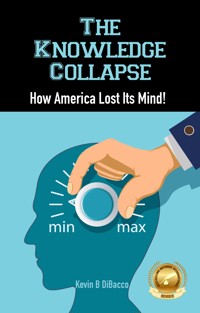
America faces a knowledge crisis that threatens democracy and daily life. Only twenty-six percent can name the three branches of government nearly half think antibiotics kill viruses and two-thirds don't understand compound interest. This isn't about intelligence but about practical knowledge needed for sound decisions and protection from manipulation.
The consequences are everywhere - employers can't find skilled workers voters make uninformed decisions families fall for scams and democracy becomes vulnerable to those who exploit ignorance. Communities lose the shared knowledge that enables cooperation and progress.
In The Knowledge Collapse Kevin B DiBacco exposes how misguided educational theories and cultural attitudes that celebrate ignorance have systematically dismantled America's knowledge base. More importantly he provides practical strategies for individuals families and communities to rebuild these essential intellectual foundations.
This isn't another generational complaint but an urgent call to action backed by research and real solutions. The knowledge collapse is measurable the solutions exist and the question is whether we'll act while there's still time to reverse this dangerous trend.
DiBacco is a filmmaker author and cultural observer who combines rigorous research with practical insights making complex social issues accessible to readers who want to be part of the solution.
Das E-Book können Sie in Legimi-Apps oder einer beliebigen App lesen, die das folgende Format unterstützen:
Veröffentlichungsjahr: 2025
Ähnliche








The
Knowledge
Collapse
How America Lost Its Mind
Kevin B. DiBacco
Book Patch Publishing
Copyright © 2025 by Kevin B. DiBacco
All rights reserved. No part of this book may be reproduced in any form without written permission from the publisher or author, except as allowed by U.S. copyright law.
––––––––
Disclaimer
The information in this book is based on research and the author’s subjective experiences. It is provided for educational purposes only and is not intended as medical advice. The author is not a physician, and readers should consult a qualified healthcare professional before making any health-related decisions. Neither the author nor the publisher assumes liability for any loss, injury, or adverse outcome resulting from the application of the information in this book.
Table of Contents
Title Page
Copyright Page
Prologue: The Great Forgetting
Chapter 1: The Measurement of Ignorance
Chapter 2: Real-World Ignorance in Action
Chapter 3: Civic and Historical Amnesia
Chapter 4: Scientific and Medical Illiteracy
Chapter 5: Mathematical and Financial Disaster
Chapter 6: Cultural and Practical Knowledge Death
Chapter 7: Educational and Digital Causes
Chapter 8: The Lost Art of Logical Thinking
Chapter 9: Cultural Accelerants
Chapter 10: Individual Knowledge Recovery
Chapter 11: Systemic Solutions
Conclusion: Rebuilding America's Knowledge Base
References
Prologue: The Great Forgetting
I remember the exact moment I realized we had a knowledge crisis on our hands.
It was during a town hall meeting in 2019, discussing a local bond measure for infrastructure improvements. A well-dressed professional in the audience stood up and confidently declared that government debt "works just like household debt" and that communities should "tighten their belts" during economic downturns – displaying a fundamental misunderstanding of public finance that would have been laughable to any high school civics student from the 1960s.
But here's what chilled me: nobody corrected him. Not one person in that room of 200+ citizens recognized the basic economic fallacy. Heads nodded. People applauded. The moderator thanked him for his "common sense" perspective.
This wasn't about intelligence. These were smart, successful people – engineers, small business owners, teachers, retirees who'd built comfortable lives through decades of competent decision-making. But somewhere along the way, we'd lost our collective grip on foundational knowledge that earlier generations took for granted.
That moment crystallized something I'd been sensing for years in my work as a filmmaker and author: we're living through what I call the Great Forgetting – a systematic erosion of practical knowledge that's leaving Americans increasingly vulnerable to manipulation, poor decision-making, and civic dysfunction.
This isn't the same as the cognitive decline I explored in my previous work. This is about the specific, practical knowledge that citizens need to navigate the modern world – understanding how government works, grasping basic scientific principles, managing personal finances, recognizing historical patterns, supporting essential life skills.
The Scope of What We've Lost
Consider these sobering statistics:
Only 34% of Americans cannot name all three branches of government (66% can name them, 2023 data)
23% don't know that the First Amendment protects freedom of speech,
44% don't know freedom of religion is protected, and 50% don't know freedom of the press is protected
73% fail basic financial literacy tests (only 27% correctly answer at least 5 of 7 basic questions)
About 38% struggle with basic scientific knowledge
(Americans average 62% correct on fundamental science questions)
These aren't obscure academic trivia questions. This is foundational knowledge that informed citizens possessed throughout most of American history. The kind of practical understanding that helps people make sound decisions about everything from voting and investing to health care and family planning.
But the knowledge collapse goes deeper than survey results. It's visible in:
Workplace Incompetence: Employers reporting unprecedented difficulty finding workers who can follow multi-step instructions, perform basic calculations, or write coherent reports.
Civic Dysfunction: Citizens unable to evaluate policy proposals, understand ballot initiatives, or engage in informed political discourse.
Financial Victimization: Millions falling prey to scams and schemes that exploit basic gaps in economic understanding.
Health Misinformation: Widespread susceptibility to medical misinformation, often with life-threatening consequences.
Cultural Fragmentation: Loss of shared reference points and common knowledge that historically bound communities together.
Why This Matters More Than Ever
The timing of this knowledge collapse couldn't be worse. We're facing challenges that require an informed citizenry capable of complex reasoning and sound judgment: climate change, technological disruption, global economic shifts, demographic transitions, geopolitical realignments.
Yet we're confronting these challenges with a population that increasingly lacks the foundational knowledge necessary to understand the issues, evaluate proposed solutions, or make informed choices about the future.
This creates a vicious cycle. As knowledge erodes, people become more dependent on others to interpret reality for them. They become more susceptible to demagogues, conspiracy theories, and simplistic solutions to complex problems. Democratic institutions weaken. Trust in expertise declines. The knowledge base erodes further.
The Knowledge vs. Intelligence Distinction
It's crucial to understand that knowledge and intelligence are different things. Intelligence is your mental processing power – your ability to reason, analyze, and solve problems. Knowledge is the information and understanding you've acquired through learning and experience.
A highly intelligent person without knowledge is like a powerful computer without software – lots of potential but limited practical capability. Conversely, someone with extensive knowledge but limited raw intelligence can still make sound decisions and contribute meaningfully to society.
Throughout most of American history, we've done a reasonably decent job of building both intelligence and knowledge in our population. But over the past few decades, while we've maintained (or even enhanced) certain cognitive abilities, we've allowed our collective knowledge base to erode catastrophically.
The result? We have people who are capable of complex reasoning but lack the foundational information needed to reason accurately about critical issues. They can process information quickly but don't possess the historical context to evaluate it properly. They can solve abstract problems but struggle with practical decisions that require domain-specific knowledge.
What This Book Will Show You
In the pages that follow, we'll explore the full scope of America's knowledge collapse and its implications for our future. We'll examine:
• How we measure what people actually know (versus what they think they know)
• Real-world consequences of knowledge gaps in workplaces, communities, and homes
• The collapse of civic knowledge and historical understanding
• Scientific and medical illiteracy that threatens public health
• Mathematical and financial ignorance that impoverishes families
• The death of cultural knowledge and practical skills
• Educational and technological factors driving the decline
• Cultural forces that actively discourage learning and knowledge retention
• Individual strategies for rebuilding your personal knowledge base
• Systemic solutions to restore America's intellectual foundations
This isn't another lament about "kids these days" or a nostalgic plea to return to some imaginary golden age. This is a clear-eyed assessment of a genuine crisis, backed by data and research, along with practical solutions we can implement starting today.
The knowledge collapse is real, it's accelerating, and it's threatening the foundations of American society. But it's not inevitable. Knowledge can be restored, systems can be reformed, and cultures can be changed.
The question is whether we'll act before it's too late – while we still have enough collective knowledge and institutional memory to guide the restoration effort.
Let's begin by measuring exactly what we've lost and why it matters.
Chapter 1: The Measurement of Ignorance
Getting the Baseline on What Americans Actually Know
Before we can address the knowledge collapse, we need to understand its scope and severity. That means going beyond anecdotal evidence and viral social media videos to examine systematic research on what Americans actually know about the world they inhabit.
The picture that emerges from decades of surveys, assessments, and studies is startling: we're witnessing the most dramatic decline in practical knowledge in American history, affecting every domain from basic civics to essential life skills.
The Challenge of Measuring Knowledge
Unlike intelligence testing, which attempts to measure cognitive capacity, knowledge assessment focuses on specific information and understanding that people have acquired. This presents unique challenges:
Knowledge is domain specific. Someone might know a great deal about sports statistics but nothing about constitutional law. Expertise in one area doesn't predict knowledge in another.
Knowledge is culturally constructed. What counts as "important" knowledge varies across communities, regions, and time periods. The knowledge considered essential for citizenship in 1950 differs from what's deemed crucial today.
Knowledge degrades over time. Unlike cognitive abilities, which tend to remain relatively stable throughout adult life, specific knowledge requires maintenance through use or deliberate review.
Knowledge varies by generation. Older Americans learned different things in school, consumed different media, and lived through different historical experiences than younger cohorts.
Despite these challenges, researchers have developed robust methods for assessing knowledge in key domains. The results provide a sobering portrait of American ignorance.
Civic Knowledge: The Foundation of Democracy
Let's start with civic knowledge – understanding of how government works, constitutional principles, and political processes. This is foundational knowledge for democratic citizenship, the kind of information that enables people to vote intelligently, evaluate policies, and hold leaders accountable.
The Collapse of Constitutional Literacy
The Annenberg Public Policy Center has tracked Americans' knowledge of the Constitution since 1997. The trends are alarming:
• Three Branches of Government: In 1997, 38% of Americans could name all three branches of government. By 2022, this had fallen to just 26%.
• First Amendment Rights: Only 54% can name freedom of speech as a First Amendment right. Just 19% can name freedom of religion. A mere 14% know about freedom of the press.
• Bill of Rights: 67% of Americans cannot name a single right protected by the First Amendment. This includes college graduates and self-identified "politically engaged" citizens.
• Constitutional Basics: 73% don't know what the Constitution does. 81% can't explain the difference between the Declaration of Independence and the Constitution.
These aren't trick questions or obscure constitutional trivia. This is basic knowledge that was once considered essential for citizenship. The fact that supermajorities of Americans lack this understanding represents a fundamental breakdown in civic education.
Political Process Ignorance
Knowledge of how government actually works has declined even more dramatically:
• Congressional Representation: 82% of Americans cannot name their congressional representative. 91% don't know when they're up for reelection.
• Electoral Process: 67% don't understand the difference between primary and general elections. 54% think the popular vote determines presidential elections.
• Policy Making: 78% don't know the difference between federal, state, and local government responsibilities. 85% can't explain how a bill becomes law.
• Judicial System: 69% don't know what judicial review means. 73% can't explain the role of the Supreme Court beyond "they're the highest court."
This isn't just academic ignorance – it has real consequences. Citizens who don't understand how government works can't effectively advocate for their interests, evaluate candidates' promises, or hold officials accountable for their actions.
Historical Knowledge Gaps
Perhaps most troubling is the collapse of historical knowledge – the context citizens need to understand current events and avoid repeating past mistakes.
The National Assessment of Educational Progress (NAEP) civics assessment reveals profound historical ignorance:
• Basic Timeline: 43% of American adults don't know when the Civil War was fought. 38% can't identify the century when World War II occurred.
• Constitutional History: 72% don't know why the Constitutional Convention was held. 84% can't explain the significance of the Federalist Papers.
• Civil Rights: 67% don't know what "separate but equal" referred to. 59% can't identify the decade when the Civil Rights Act was passed.
• Economic History: 81% don't know what caused the Great Depression. 76% can't explain the New Deal or its lasting impact.
This historical illiteracy leaves Americans vulnerable to demagogues who exploit ignorance of the past, unable to recognize dangerous patterns, and incapable of understanding how current institutions developed.
Scientific Knowledge: The Reality Crisis
Scientific literacy – understanding of basic scientific principles and methods – is crucial in a technological society. Citizens need this knowledge to make informed decisions about everything from medical treatment to environmental policy.
The State of Scientific Understanding
The National Science Foundation's Science and Engineering Indicators provide a comprehensive view of American scientific knowledge:
• Basic Scientific Facts: 43% of Americans believe antibiotics kill viruses. 38% think the sun revolves around the Earth. 52% don't know that electrons are smaller than atoms.
• Scientific Method: 67% can't explain what a control group is in an experiment. 74% don't understand the difference between correlation and causation.
• Health Science: 59% don't know that bacteria can develop antibiotic resistance. 46% think vaccines contain harmful chemicals that cause autism despite overwhelming evidence to the contrary.
• Climate Science: 31% don't believe human activity contributes to climate change. Among those who accept climate change, 68% can't explain the greenhouse effect.
Medical Illiteracy
Health literacy – the ability to understand medical information and make informed health decisions – is particularly concerning:
• Medication Understanding: 78% of Americans can't correctly interpret prescription drug labels. 85% don't understand potential drug interactions.
• Disease Prevention: 61% don't know that most heart disease is preventable through lifestyle changes. 54% believe "natural" treatments are always safer than conventional medicine.
• Mental Health: 72% can't distinguish between normal sadness and clinical depression. 67% don't know that mental illness has biological components.
This medical ignorance contributes to poor health outcomes, unnecessary deaths, and billions in wasted healthcare spending.
Mathematical and Financial Knowledge
Mathematical literacy – the ability to reason with numbers and understand quantitative relationships – is essential in modern life. Yet American mathematical knowledge has declined precipitously.
Basic Mathematical Competence
The National Assessment of Adult Literacy reveals alarming gaps in mathematical knowledge:
• Mental Arithmetic: Only 47% of American adults can correctly calculate a 15% tip on a restaurant bill without using a calculator.
• Fractions and Percentages: 62% can't determine which is larger: 1/3 or 3/8. 74% don't understand that 50% means the same as 1/2.
• Basic Statistics: 83% can't interpret a simple graph showing correlation between two variables. 91% don't understand margin of error in polling data.
Financial Illiteracy Crisis
Perhaps nowhere is the knowledge collapse more dangerous than in personal finance:
• Compound Interest: 69% of Americans don't understand how compound interest works – the most basic principle of investing and debt management.
• Credit and Debt: 58% don't understand how credit scores are calculated. 73% can't calculate the actual cost of credit card debt.
• Investment Basics: 81% don't know the difference between stocks and bonds. 87% can't explain diversification or why it matters.
• Retirement Planning: 76% don't understand how 401(k) plans work. 84% can't calculate how much they need to save for retirement.
This financial illiteracy leaves Americans vulnerable to predatory lending, investment scams, and retirement insecurity. The Federal Reserve estimates that financial ignorance costs the average American household over $1,200 annually in fees, penalties, and poor investment returns.
Cultural Knowledge: The Disappearing Commons
Cultural knowledge – shared understanding of literature, history, art, and social traditions – once provided common reference points for American discourse. This shared knowledge base is rapidly disappearing.
Literary and Cultural References
E.D. Hirsch's Cultural Literacy Institute has tracked Americans' knowledge of cultural references since 1987:
• Literature: 73% of American adults can't identify the author of "To Kill a Mockingbird." 84% don't know what "1984" refers to beyond the year.
• Historical Figures: 67% can't identify Frederick Douglass. 59% don't know who Susan B. Anthony was.
• Cultural Concepts: 78% don't understand what "separation of church and state" means. 85% can't define "due process."
• Geographic Knowledge: 56% of Americans can't locate Iran on a world map. 73% don't know where Afghanistan is despite two decades of war there.
This cultural illiteracy fragments public discourse and makes democratic deliberation more difficult. When citizens lack shared reference points, they struggle to communicate across political and social divides.
The Generational Divide
The knowledge collapse isn't evenly distributed across age groups. Systematic surveys reveal troubling generational patterns:
Knowledge by Age Cohort
• Ages 65+: This cohort shows the strongest performance across most knowledge domains, particularly civic and historical knowledge.
• Ages 45-64: Moderate knowledge levels, with particular strength in practical skills but weakness in scientific literacy.
• Ages 25-44: Significant knowledge gaps across all domains, with particular weakness in civic and financial knowledge.
• Ages 18-24: The most concerning results, with mediocre performance in virtually every knowledge category measured.
Implications of Generational Differences
These patterns suggest that knowledge loss is accelerating. As older, more knowledgeable cohorts age out of the population, they're being replaced by younger cohorts with significantly less foundational knowledge.
This demographic transition has profound implications:
• Institutional Memory: Organizations and communities are losing institutional knowledge as experienced members retire or die.
• Democratic Participation: Younger voters have less knowledge to guide their political decisions, potentially undermining democratic accountability.
• Economic Productivity: Workplaces are reporting increased difficulty finding employees with basic knowledge and skills.
• Cultural Transmission: Traditional mechanisms for passing knowledge between generations are breaking down.
The Knowledge Confidence Gap
Perhaps most troubling, research reveals a growing disconnect between what people know and what they think they know. This "knowledge confidence gap" has serious implications for learning and decision-making.
The Dunning-Kruger Effect in Action
Multiple studies document that Americans consistently overestimate their knowledge:
• Civic Knowledge: People who score in the bottom quartile on civics knowledge tests rate their own knowledge as "above average" 67% of the time.
• Scientific Knowledge: Americans who fail basic science literacy tests express "high confidence" in their scientific understanding 74% of the time.
• Financial Knowledge: Individuals with poor financial knowledge are most likely to express confidence in their financial decision-making abilities.
This overconfidence creates a vicious cycle: people who most need to learn are least likely to recognize their ignorance and seek additional knowledge.
The Google Illusion
The internet has exacerbated the knowledge confidence gap by creating an illusion of knowledge. Research shows that people confuse their ability to access information with actually possessing knowledge.
Studies demonstrate that internet search makes people:
• Overestimate their own knowledge
• Show increased confidence in their ability to answer questions
• Confuse external information sources with internal knowledge
• Resist acknowledging the limits of their understanding
This "Google effect" undermines motivation to acquire and retain knowledge, contributing to the broader knowledge collapse.
––––––––
INTERNATIONAL COMPARISONS
How does American knowledge compare to other developed countries? International surveys provide sobering context:
Civic Knowledge Internationally
The International Association for the Evaluation of Educational Achievement compares civic knowledge across countries:
• Constitutional Knowledge: American students rank 23rd out of 38 developed countries in understanding of democratic principles.
• Political Processes: U.S. students score below the international average in knowledge of how government works.
• Historical Understanding: American students rank in the bottom third for knowledge of world history and democratic development.
Scientific Literacy Rankings
The Program for International Student Assessment (PISA) compares scientific knowledge:
• Scientific Understanding: American students rank 18th out of 36 developed countries in science literacy.
• Mathematical Reasoning: U.S. students rank 25th in mathematical literacy, behind most European and Asian countries.
• Problem Solving: American students score below average in applying scientific knowledge to real-world problems.
These international comparisons suggest that the knowledge collapse isn't just an absolute decline – Americans are also falling behind peers in other developed countries.
Why Knowledge Assessment Matters
Understanding the scope and severity of the knowledge collapse is crucial for several reasons:
Democratic Accountability
Democracy depends on informed citizens who can evaluate policies, hold leaders accountable, and participate meaningfully in civic life. When citizens lack basic knowledge of how government works, democratic institutions weaken.
Economic Competitiveness
In a knowledge-based economy, human capital – the knowledge and skills of the workforce – drives economic growth. Countries with more knowledgeable populations enjoy higher productivity, more innovation, and greater prosperity.
Social Cohesion
Shared knowledge provides common ground for social interaction and democratic deliberation. As this common knowledge base erodes, social fragmentation increases, and productive discourse becomes more difficult.
Individual Welfare
Personal knowledge affects individual life outcomes. People with better financial knowledge build more wealth. Those with scientific literacy make better health decisions. Citizens with civic knowledge participate more effectively in democratic processes.
––––––––
THE PATH FORWARD




