


21,99 €
Mehr erfahren.
- Herausgeber: John Wiley & Sons
- Kategorie: Geisteswissenschaft
- Sprache: Englisch
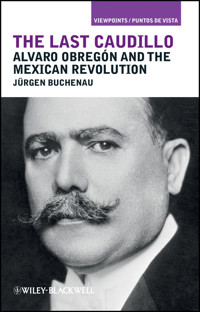
The Last Caudillo presents a brief biography of the life and times of General Alvaro Obregón, along with new insights into the Mexican Revolution and authoritarian rule in Latin America.
- Features a succinct biography of the life and times of a fascinating figure in Mexico's revolutionary past
- Represents the most analytical and up-to-date study of caudillo/military strongman rule
- Sheds new light on the networks and discourse practices that support rulers such as the Castros in Cuba and Hugo Chávez in Venezuela, and the emergence of modern Mexico
- Offers new insights into the role of leadership, the nature of revolution, and the complex forces that helped shape modern Mexico
Sie lesen das E-Book in den Legimi-Apps auf:
Seitenzahl: 390
Veröffentlichungsjahr: 2011
Ähnliche




















Table of Contents
Cover
Table of Contents
Half title page
Series page
Title page
Copyright page
Dedication
List of Illustrations
Preface
Acknowledgments
Introduction
1 The Background of the Last Caudillo
From Santa Anna to Díaz
The Sonoran Background
2 An Improvised Leader, 1880–1913
Obregón’s Early Years
Obregón and the Beginning of the Mexican Revolution
Obregón’s First Campaign
3 Chaos and Triumph, 1913–1916
Obregón and the War Against Huerta
Obregón and the Clash Between Carranza and Villa
Obregón in the War Between the Factions
4 The Path to Power, 1916–1920
Obregón’s Emergence as a Political Leader
The Cincinnatus of the West (Part One)
The Campaign for the Presidency
5 The President, 1920–1924
The Construction of Obregón’s Political Machine
Rebuilding the Nation
The Violent Breakup of the Sonoran Alliance
6 The Last Caudillo, 1924–1928
A Troubled Agribusiness
The Cincinnatus of the West (Part Two)
The Second Presidential Campaign
The Death of the Caudillo
7 The Unquiet Grave
After the Caudillo
An Arm and a Revolution on a Stage
A Revolution and a Leader Lose Respect
Bibliography
Index
The Last Caudillo
Viewpoints/Puntos de Vista
Themes and Interpretations in Latin American History
Series editor: Jürgen Buchenau
The books in this series will introduce students to the most significant themes and topics in Latin American history. They represent a novel approach to designing supplementary texts for this growing market. Intended as supplementary textbooks, the books will also discuss the ways in which historians have interpreted these themes and topics, thus demonstrating to students that our understanding of our past is constantly changing, through the emergence of new sources, methodologies, and historical theories. Unlike monographs, the books in this series will be broad in scope and written in a style accessible to undergraduates.
Published
A History of the Cuban Revolution
Aviva Chomsky
Bartolomé de las Casas and the Conquest of the Americas
Lawrence A. Clayton
Beyond Borders: A History of Mexican Migration to the United States
Timothy J. Henderson
The Last Caudillo: Alvaro Obregón and the Mexican Revolution
Jürgen Buchenau
In preparation
Creoles vs. Peninsulars in Colonial Spanish America
Mark Burkholder
Dictatorship in South America
Jerry Davila
Mexico Since 1940: The Unscripted Revolution
Stephen E. Lewis
The Haitian Revolution, 1791–1804
Jeremy Popkin
This edition first published 2011
© 2011 Jürgen Buchenau
Blackwell Publishing was acquired by John Wiley & Sons in February 2007. Blackwell’s publishing program has been merged with Wiley’s global Scientific, Technical, and Medical business to form Wiley-Blackwell.
Registered Office
John Wiley & Sons Ltd, The Atrium, Southern Gate, Chichester, West Sussex, PO19 8SQ, United Kingdom
Editorial Offices
350 Main Street, Malden, MA 02148-5020, USA
9600 Garsington Road, Oxford, OX4 2DQ, UK
The Atrium, Southern Gate, Chichester, West Sussex, PO19 8SQ, UK
For details of our global editorial offices, for customer services, and for information about how to apply for permission to reuse the copyright material in this book please see our website at www.wiley.com/wiley-blackwell.
The right of Jürgen Buchenau to be identified as the author of this work has been asserted in accordance with the UK Copyright, Designs and Patents Act 1988.
All rights reserved. No part of this publication may be reproduced, stored in a retrieval system, or transmitted, in any form or by any means, electronic, mechanical, photocopying, recording or otherwise, except as permitted by the UK Copyright, Designs and Patents Act 1988, without the prior permission of the publisher.
Wiley also publishes its books in a variety of electronic formats. Some content that appears in print may not be available in electronic books.
Designations used by companies to distinguish their products are often claimed as trademarks. All brand names and product names used in this book are trade names, service marks, trademarks or registered trademarks of their respective owners. The publisher is not associated with any product or vendor mentioned in this book. This publication is designed to provide accurate and authoritative information in regard to the subject matter covered. It is sold on the understanding that the publisher is not engaged in rendering professional services. If professional advice or other expert assistance is required, the services of a competent professional should be sought.
Library of Congress Cataloging-in-Publication Data is available for this title
ISBN 9781405199025 (hardback)
ISBN 9781405199032 (paperback)
A catalogue record for this book is available from the British Library.
This book is published in the following electronic formats: ePDFs [ISBN 9781444397178]; Wiley Online Library [ISBN 9781444397192]; ePub [ISBN 9781444397185]
To my mother, Sabine Prange
List of Illustrations
Maps
Map 1.1 Mexico in 1910.
Map 1.2 Sonora in 1910.
Figures
Figure 2.1 The Ranch House at “La Quinta Chilla.”
Figure 2.2 Corn Harvest Time at “La Quinta Chilla.”
Figure 2.3 The Rich Battalion (Alvaro Obregón is in the center of the bottom row; Francisco Serrano is on the far right).
Figure 3.1 Defending León from the División del Norte.
Figure 3.2 Obregón after the loss of his arm, June 3, 1915.
Figure 4.1 Obregón and his family, c. 1927.
Figure 4.2 Obregón campaigning in the state of Oaxaca.
Figure 4.3 The presidential inauguration, November 30, 1920.
Figure 5.1 The human cost of the “headless rebellion.”
Figure 6.1 The execution of Father Pro.
Figure 6.2 Obregón’s last moments.
Preface
Each book in the “Viewpoints/Puntos de Vista” series introduces students to a significant theme or topic in Latin American history. In an age in which student and faculty interest in the Global South increasingly challenges the old focus on the history of Europe and North America, Latin American history has assumed an increasingly prominent position in undergraduate curricula.
Some of these books discuss the ways in which historians have interpreted these themes and topics, thus demonstrating that our understanding of our past is constantly changing, through the emergence of new sources, methodologies, and historical theories. Others offer an introduction to a particular theme by means of a case study or biography in a manner easily understood by the contemporary, non-specialist reader. Yet others give an overview of a major theme that might serve as the foundation of an upper-level course.
What is common to all of these books is their goal of historical synthesis. They draw on the insights of generations of scholarship on the most enduring and fascinating issues in Latin American history, while also making use of primary sources as appropriate. Each book is written by a specialist in Latin American history who is concerned with undergraduate teaching, yet has also made his or her mark as a first-rate scholar.
The books in this series can be used in a variety of ways, recognizing the differences in teaching conditions at small liberal arts colleges, large public universities, and research-oriented institutions with doctoral programs. Faculty have particular needs depending on whether they teach large lectures with discussion sections, small lecture or discussion-oriented classes, or large lectures with no discussion sections, and whether they teach on a semester or trimester system. The format adopted for this series fits all of these different parameters.
In this fourth volume in the “Viewpoints/Puntos de Vista” series, I analyze the Mexican Revolution (1910–1940) through the lens of one of its protagonists: General Alvaro Obregón Salido, one of the greatest military leaders in the history of Latin America. The Mexican Revolution is of global historical significance because it was the first great revolution with an agrarian and social basis, and its successes and failures helped inform more radical social revolutions in Russia, China, and Cuba.
Obregón was the “undefeated caudillo of the Mexican Revolution” whose military genius and political acumen always put him on the winning side. His alliance of middle-class landowners from the northern border state of Sonora directed the destinies of Mexico between 1920 and 1935, a period that featured the formation of many of the institutions and political practices of modern Mexico. The life of Obregón therefore offers an ideal vantage point from which to appreciate the causes, process, and outcome of the Mexican Revolution. It also affords an opportunity to study political leadership, authoritarianism, and political culture in Latin America more generally.
Jürgen Buchenau
University of North Carolina, Charlotte
Acknowledgments
The idea for this book was born in 1998 during a Latin American Studies Association meeting at a bar at the Chicago Hilton, when Colin MacLachlan suggested that I write a biography of Obregón. At the time, I resisted the idea, as I knew and admired Linda Hall’s Alvaro Obregón: Power and Revolution in Mexico, 1911–1920, the only extant English-language biography of Obregón and a meticulously researched work focusing on his role in the violent phase of the revolution in the 1910s. Instead, I wrote a life and times of Obregón’s most significant political ally, Plutarco Elías Calles, a leader among the primary architects of the country’s modern political institutions. But Colin’s suggestion never completely left my mind, and my examination of Calles raised fresh questions about the nature of leadership in the revolution and Obregón’s role, specifically. Almost twelve years later, at the centennial of the revolution, I have finally written the book that Colin suggested, as part of a larger research agenda on the Sonoran Dynasty in Mexico.
I appreciate the assistance of the National Endowment for the Humanities, which provided a year-long fellowship that gave me the time to write this book. Financial support from UNC Charlotte, and particularly a Faculty Research Grant and an award from the Small Grants Program of the College of Liberal Arts and Sciences, allowed me to undertake the necessary research. I appreciate the permission of the University of New Mexico Press to republish, in shortened and revised form, my book chapter “The Arm and Body of a Revolution: Remembering Mexico’s Last Caudillo, Alvaro Obregón,” from Lyman Johnson, ed., Death, Dismemberment, and Memory: Body Politics in Latin America (2004).
I could not have written this book without the assistance of the superbly competent staff at the Fideicomiso Archivos Plutarco Elías Calles y Fernando Torreblanca, probably the finest private archive in all of Mexico. In addition, I appreciate the help of my research assistant, Xenia Wirth. Xenia spent six weeks in Mexico City working through thousands of files in the Fideicomiso, and the research for the manuscript would have taken much longer to complete without her help.
At Wiley-Blackwell, I particularly thank my editor, Peter Coveney, for supporting both the general idea for the Viewpoints/Puntos de Vista series and, specifically, the idea for a book that examines the Mexican Revolution through the lens of studying a single individual. Galen Smith was instrumental in keeping me on track and in guiding the manuscript through the production process. At UNC Charlotte, my fellow Latin Americanist historians Lyman Johnson, Jerry Dávila, and Tom Rogers contributed valuable suggestions. Among my professional colleagues at other institutions, Greg Crider, Bill Beezley, Daniela Spenser, Doug Richmond, Tim Henderson, and Linda Hall helped me sharpen and focus my ideas regarding Obregón’s career.
Finally, a word of thanks to my family: Anabel, Nicolas, and Julia. Writing this book was a time consuming exercise, which was even more taxing on all of them at a time when I also assumed administrative responsibilities at my university. I know that they are as glad that this book is completed as I am.
Introduction
He who fights with monsters should look to it that he himself does not become a monster. And when you gaze long into an abyss, the abyss also gazes into you.
Friedrich Nietzsche, Beyond Good and Evil (p. 102)
On November 16, 1989, descendants of General Alvaro Obregón Salido gathered to cremate his arm. He had lost the limb on June 3, 1915 during a battle that pitted his troops against the legendary “División del Norte” (Division of the North) commanded by General Pancho Villa. While Obregón lost his arm, Villa lost the decisive battle of the Mexican Revolution. The arm was all that was left of the general, assassinated in 1928 and buried in his hometown of Huatabampo in the northwestern state of Sonora. Preserved in a formaldehyde solution, since 1943, it had been displayed in a jar in the Mexico City monument to Obregón. Located at the exact spot of the assassination, the monument was an impressive testimonial, even featuring the holes in the floor left by the assassin’s bullets. Its role was to remind Mexicans of the sacrifice that the leaders of their revolution had made for their nation—a message useful to a ruling party that claimed its legitimacy from the revolution itself: the Partido Revolucionario Institucional (PRI, or Institutional Revolutionary Party). At the time of the cremation, which occurred exactly one week after the fall of the Berlin Wall, the PRI and its predecessors had ruled Mexico for sixty years. By 1989, the PRI’s leadership had given up on most of the goals that identified “the revolution” in the eyes of the public: democracy, national sovereignty, and social justice. The arm eerily resembled this ruling party in that the decades had taken their toll. A ghastly white color, it had swollen to the point that the fingers had acquired the shape of tomatoes. Frayed tendons issued from its severed end. The limb had run its course, both physically and symbolically.
The fact that a severed arm had been on display for so long was a testament to its owner’s great stature in history as the “undefeated caudillo of the Mexican Revolution”.1 A farmer who had worked hard to achieve a modest prosperity, Obregón did not participate in the first phase of the revolution, which began on November 20, 1910 as a movement to overthrow dictator Porfirio Díaz. Under Díaz’s long tenure (1876–1880 and 1884–1911), a small clique had dominated politics in a primarily rural nation. Large haciendas and foreign-owned mining corporations controlled most of the land and mineral resources. In the spring of 1912, after the triumph of that movement had installed democratic rule, Obregón joined the fighting as the head of an impromptu military force to help defend his state from rebels trying to overthrow the newly elected government. Victorious, he returned to the battlefield in March 1913 following the coup d’état of General Victoriano Huerta, and his army made decisive contributions to Huerta’s defeat in July 1914. The war against Huerta mobilized hundreds of thousands of (poor rural dwellers) and workers. Success in this conflict required leaders like Obregón to broaden their aims to include reforms that would benefit campesinos, workers, and an increasingly beleaguered middle class. Relying on different regional and social bases in a far-flung and diverse nation, the winners could not agree on common goals beyond the removal of two dictators, and they turned to fighting among themselves in an all-out war. In this conflict, Obregón combined an appeal to campesinos and workers with a commitment to reestablish political legitimacy. After his army had defeated Villa’s División del Norte, Obregón emerged as the nation’s preeminent political figure. In 1920, he became president and embarked upon a rebuilding program based on the new, revolutionary Constitution, which promised democracy, Mexican ownership of resources, land for campesinos, a wholly secular society, and improved working conditions.
Lesen Sie weiter in der vollständigen Ausgabe!
Lesen Sie weiter in der vollständigen Ausgabe!
Lesen Sie weiter in der vollständigen Ausgabe!
Lesen Sie weiter in der vollständigen Ausgabe!
Lesen Sie weiter in der vollständigen Ausgabe!
Lesen Sie weiter in der vollständigen Ausgabe!
Lesen Sie weiter in der vollständigen Ausgabe!
Lesen Sie weiter in der vollständigen Ausgabe!
Lesen Sie weiter in der vollständigen Ausgabe!




