


18,49 €
Mehr erfahren.
- Herausgeber: The History Press
- Kategorie: Geisteswissenschaft
- Sprache: Englisch
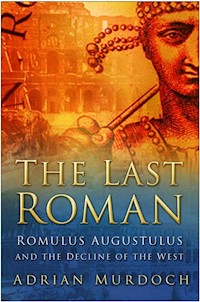
The Last Roman is the only biography about Romulus Augustulus. It focuses on the personalities behind this powerful story and reveals the world into which Romulus was born - an empire that was about to die. Author Adrian Murdoch explores how Romulus's father Orestes, secretary to Attila the Hun, rose through the ranks to become kingmaker; how all was lost to another usurper in an Italy wracked with civil war; and how Romulus found peace at last, founding a monastery. This dramatic and poignant story of politics, decline and loss has inspired. Drawing on extensive new archaeological and historical research and using numerous contemporary sources, many translated for the first time since the nineteenth century, The Last Roman is the vivid story of an empire breathing its last.
Das E-Book können Sie in Legimi-Apps oder einer beliebigen App lesen, die das folgende Format unterstützen:
Veröffentlichungsjahr: 2006
Ähnliche



















THE LASTROMAN
THE LASTROMAN
ROMULUS AUGUSTULUSAND THE DECLINE OFTHE WEST
ADRIAN MURDOCH
First published in 2006
The History PressThe Mill, Brimscombe PortStroud, Gloucestershire, Gl5 2QGwww.thehistorypress.co.uk
This ebook edition first published in 2013
All rights reserved© Adrian Murdoch, 2006, 2013
The right of Adrian Murdoch to be identified as the Author of this work has been asserted in accordance with the Copyrights, Designs and Patents Act 1988.
This ebook is copyright material and must not be copied, reproduced, transferred, distributed, leased, licensed or publicly performed or used in any way except as specifically permitted in writing by the publishers, as allowed under the terms and conditions under which it was purchased or as strictly permitted by applicable copyright law. Any unauthorised distribution or use of this text may be a direct infringement of the author’s and publisher’s rights, and those responsible may be liable in law accordingly.
EPUB ISBN 978 0 7524 9608 5
Original typesetting by The History Press
For Susy
‘As father of my country I will probably be Rome’s last emperor. For that reason alone, I occupy a rather forlorn position in world history. No matter what happens I shall end up with a bad reputation.’
Friedrich Dürrenmatt, Romulus the Great
‘Romulus Augustulus!’ the polymath had said. ‘What a name! Poor chap, he was very good-looking, it seems, and only sixteen.’
Patrick Leigh Fermor, A Time of Gifts
Contents
Introduction
It’s the End of the World as We Know It
One
Guess Who’s Coming to Dinner?
Two
Breaking Up is Hard to Do
Three
To Be Beside the Seaside
Four
No More Heroes
Five
Imitation of Life
Notes
INTRODUCTION
It’s the End of the World as We Know It
In the spring of AD 477, the sea lanes across the Mediterranean opened again after the winter storms. Making one of the first voyages of the year, a ship docked at the harbour near the Great Palace in Constantinople. On board were senators from Rome with a letter for Emperor Zeno, head of the Eastern Roman empire.
New Rome, as Constantinople or Byzantium was dubbed, had been the capital of the empire for the past 147 years. Constantine’s city had been formally dedicated in the summer of AD 330 at the time of his silver jubilee. No longer was it a new town with the whiff of paint, the strange scent of drying plaster, the dust of marble being shaped, the noise of carpenters, masons and engineers. It was the seat of government, the emperor and his court. The army chiefs of staff were based there, as were the law courts.
The city had been adorned with all the trappings of the power and the glory. Wide-open forums, streets protected with colonnades, squares decorated with columns and statues recalling battles won and generals honoured. There were massive and sprawling public buildings, palaces, important monasteries as well as the structures necessary to keep a growing urban population entertained. Byzantium boasted 4,388 individual homes to Rome’s 1,800 – roughly two and a half times more. There were baths and theatres as well as the most famous building of all, the hippodrome in the centre of town, right in front of the Great Palace.
The diplomats did not approach Constantinople via the Golden Gate, the monumental ceremonial entrance to the city made of polished marble. They arrived, as everyone should, by sea, coming up the south-facing Marmara coast – increasingly the right address in this period, especially if you wanted protection from the winds that howled down from the north for most of the winter.
As they sailed closer to shore, they saw why Byzantium was growing fat, rich on the profits from the sea trade that had to pass through the Bosphorus Straits. Not only was it the land bridge between East and West, it was the sea link between north and south. The senators passed two huge artificial harbours named after previous emperors, Theodosius I and Julian the Apostate, filled with ships from the East with their cargoes of grain – centuries away from the oil tankers that now ply their trade up and down the straits.
Lesen Sie weiter in der vollständigen Ausgabe!
Lesen Sie weiter in der vollständigen Ausgabe!
Lesen Sie weiter in der vollständigen Ausgabe!
Lesen Sie weiter in der vollständigen Ausgabe!
Lesen Sie weiter in der vollständigen Ausgabe!
Lesen Sie weiter in der vollständigen Ausgabe!
Lesen Sie weiter in der vollständigen Ausgabe!




