


Erhalten Sie Zugang zu diesem und mehr als 300000 Büchern ab EUR 5,99 monatlich.
- Herausgeber: Books on Demand
- Kategorie: Geisteswissenschaft
- Sprache: Englisch
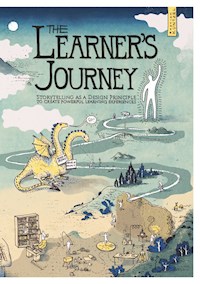
By thinking of learning events as a story and the learners as the protagonists who are embarking on a transformative journey, Bastian Küntzel has designed a simple and innovative way for facilitators, trainers, teachers and other educators to design powerful learning experiences for their participants. The Learner's Journey is a practical guide for anyone who accepts the responsibility of accompanying learners on a journey of discovery, growth and development.
Sie lesen das E-Book in den Legimi-Apps auf:
Seitenzahl: 134
Veröffentlichungsjahr: 2019
Das E-Book (TTS) können Sie hören im Abo „Legimi Premium” in Legimi-Apps auf:
Ähnliche




















Author BASTIAN KÜNTZEL
Copyediting CHRISTIAN DUMAIS
Cover Design and Illustrations MICHAL WRONSKI
Layout ANNA POMICHOWSKA
I received extensive feedback from Dorota Mołodyńska-Küntzel, Alex Jbeily and Alex Neumann for which I am profoundly thankful.
Andreas Karsten, Anna-Maria Hass, Anna Pomichowska, Viola Thuma, Elisa Gazzotti, Birgit Mohai, Sneszana Baccijl-Koch, and Marcos Tourinho also read early drafts and I’m thankful for their comments and encouragement.
I wrote this for you. I hope you like it.
Hello World,
I love Sendung mit der Maus, a children’s TV programme in Germany that explains how things are made and work. I watched it as a child and now my children watch it with me. I’ve probably watched the making of The Lord of the Rings more often than I watched the actual movie. I just love to know how the things I cherish get made.
I recently stumbled across a theory that explained how something that I have been enjoying for a long time worked: stories. My whole life I’ve loved movies from Terrence Hill and Bud Spencer Italo Westerns to The Godfather to Peter Jackson’s The Lord of the Rings adaptations. When I watch a film, you cannot talk to me. I’m not there - I’m in the movie. The same is true for me with novels. As each Harry Potter book came out, I read it instantaneously, completely sucked into the experience.
I am, of course, far from alone as a story enthusiast. Everyone seemingly loves stories, otherwise there’d be no publishing industry, no Hollywood, no Bollywood, no TED and no bedtime reading rituals with our kids.
A tech leader I follow on Twitter, Michael Loop (@rands) recently put it very nicely: “Story is the fundamental human currency.” People worldwide tell stories, listen to stories, and make sense of their lives and communicate powerful insights through stories. Stories resonate so much because we experience our lives as stories and ourselves as the protagonist in their centre. We identify with the protagonists of the stories we consume either because they are similar to us and the experiences we’ve had, or because they reflect who and how we would like to be.
The theory I bumped into was the monomyth or the hero’s journey – two expressions for the same concept originally developed by Joseph Campbell. I also came across the work of screenwriter/director Dan Harmon, who had studied Campbell’s work and had developed his own simplified approach to story structure based on it: the story circle.
My first reaction to learning about Harmon’s theory was “Wow, this is so cool!” I can’t watch movies anymore without constantly thinking about the meta-level of where we are in the story circle and how each protagonist’s journey is presented. And it doesn’t ruin the experience for me - it improves it. I love it!
After the initial shock of “Wow, this is so cool!” passed, I realised that most, if not all, great learning experiences that I’ve had followed the same steps as were laid out in this theory.
Since then I’ve used Harmon’s version of the story circle as a framework for developing very different educational experiences for very different groups. I’ve designed management retreats for eight people, conferences for over a hundred people, training courses for 20 people, and strategic planning workshops for 40 people – all using this framework.
And it always worked fantastically.
I call this approach The Learner’s Journey.
A short note on terminology use, my approach to popular stories and who this book is for
I’m going to be using the term learning event as an umbrella for any type of organised learning - whether that be a conference, seminar, lesson, workshop, retreat or training.
I’m going to use learning facilitator to refer to anyone that is charged with planning, leading and influencing this process - teachers, trainers, facilitators, moderators, coaches, professors or lecturers. And the term participant for anyone who is consciously attending to learn something, such as pupils, students, attendees or, well, training course participants.
I use popular stories to make my point about the universality of the structure of stories and how they relate to the process of designing learning events. Popular as in - I love them. So if you don’t like Star Wars, Harry Potter, Moana (known to my family and many others as Vaiana), The Blues Brothers, The Lord of the Rings or Notting Hill. Humour me.
The basic structure works with your favourite stories as well, so if you get annoyed with my favourites, I invite you to use your own examples.
I wrote this book as a contribution to my community of praxis. I hope that it will be a valuable and meaningful contribution to the development of environments, experiences and situations where learning can take place in safe but challenging ways.
If the framework I am offering here can help learning facilitators to remove some of the barriers for learning - it would make me very happy indeed.
Contents
PART I: Story - the basic human currency
The Power of Story
The actual Hero’s Journey
The Story Circle as a Journey of Transformation
PART II: Setting the Scene
Situating Learning
Stakeholder
Needs (Content, Results)
Context
People
Existing Social Bonds
Hierarchy
Language
Group size
Physical Environment
The room, where it happens
The wider environment
Time
PART III: The learning flow - building the story
Phase I: Purposeful Departure
Phase II: Exploration
Phase III: Transformative Integration
PART IV: Some concrete examples
The 2nd International Youth Volunteering Conference of UNESCO
Authentic Authority Management Retreat for a global financial institution
Mission, Vision and Values Workshop for an international aviation company
Over to you
PART I: Story - the basic human currency
The actual Hero’s Journey
The Story Circle as a Journey of Transformation
PART I: Story - the basic human currency
The Power of Story
As soon as humans started to communicate, they told stories. You can go visit cave-paintings that are thousands and thousands of years old and you’ll see stories that are being told visually. Some of the earliest human writings also tell stories. We don’t know what people talked about once talking became a thing, but chances are there were many stories being told around the fire in the evenings.
That’s because, as humans, we experience the world around us not as impulses of light and sound that we take in through our senses, but rather as something more than that: we experience it as a reality that has a meaning we can make sense of. The world around us makes no sense by itself. We make sense of it by embedding what we experience into a story.
Identity is the story we tell ourselves about ourselves. It has been well established that, particularly in conflicts, we might resort to tell a victim story about ourselves, or a helplessness story, i.e. that we have no other choice but to act with aggression, retreat or whatever else we need to justify doing something to someone else. We also explain other people’s behaviour in terms of stories: “Ah yes, she behaves this way because she is terribly in love with her neighbour, but her aunt just died, who had harboured a life-long love for this person as well, and now she has a guilty conscience because…”1
In fact, deprive any situation of its history and context and it becomes downright weird. Most of what we do, say, or react to in any particular way is saturated with the continuous story that provides everything with meaning.
In Yuval Noah Harari’s book Sapiens, he makes the point that the evolution of homo sapiens stopped being biological at some point and became cultural.
Humans didn’t need to adjust physically to the changing environments they lived in to the degree other species did. Their adaptability was catalysed and amplified from what they could learn from their ancestors and they in turn from their ancestors through the stories they passed on.
Instead of needing to change our digestive and sensory organs to the food that was available, and our instincts to the predators that were out to get us, we could simply talk and listen. People could learn from the stories that were told to them from their peers, the scouts that went out to search for new resources, and the elders who’d seen it all, and thus adapt rapidly. It was no longer necessary to observe and learn from everything directly. Language and our ability to tell and comprehend stories gave us an incredible evolutionary advantage and we came to dominate every environment we entered (for better or worse).
Every conversation tells a story, sometimes explicitly, sometimes implicitly. Every comment someone makes gets inserted into the story we tell ourselves about that person and every experience we make becomes a part of the mythology of ourselves.
I think of this self-mythology as a body of experiences, ideas and self-perceptions that give a sense to who we are today, what is good and bad, and what is the mental-model we use to see ourselves in the world. The experiences we think back on with pride are most often those we might turn into the major plot points of our own story. Mental breakdowns, personal crises and periods of confusion are often moments when we’re not sure if the story we’ve been telling about ourselves is the one we want or should be telling.
Psychologist Daniel Kahneman distinguishes between the ‘experiencing self and the ‘remembering self. The ‘experiencing self is basically us in the now, taking in the environmental stimuli and immediately processing them. In his words:
“…the remembering self is a storyteller. And that really starts with a basic response of our memories -- it starts immediately. We don’t only tell stories when we set out to tell stories. Our memory tells us stories, that is, what we get to keep from our experiences is a story.”2
It is, of course, nothing revolutionary to claim that stories are important. But it is quite remarkable just how fundamental stories are to our lives. It’s not only when we sit down for a good book, watch a movie or read a fairy tale to our children that stories surround us. It’s all the time.
Observe children and you can see how a great part of their play is impersonating different characters: from being mum and dad to a cat to a super-hero.
On my children’s birthday, they receive a photo-album of their previous year. So they each have a row of albums on a shelf essentially telling their story that grows a new volume every year. They love looking at them. When guests visit, the kids routinely take their albums out and show them their story.
We’re constantly explaining our and other’s behaviour in terms of story - the hero, the villain, the helper, the stupid-but-fun-sidekick, etc. That’s because we have no choice but to think of ourselves and others in these terms. They are how we navigate this complex world around us and find our place in it.
And that makes a lot of sense, given what stories provide. When you read about soap or lavender, in addition to the cortex in your brain that interprets symbols such as letters, the olfactory cortex also lights up. So when we are reminded in the abstract about something we have physically experienced in the past (smelling lavender, for example), our brain resurfaces those experiences and makes it come to life. We can literally smell lavender when we read about lavender.
When you read about movements, the motor-cortex lights up. When you read about other people’s emotions, the emotional centre of the brain, the limbic system, is active. Reading, watching or listening to stories give us a chance to experience someone else’s life, literally experience it, without having to be in it.3
People who read a lot of fiction or watch movies have a better capacity for theory of mind, meaning the ability to know what others might be thinking or feeling at this moment. This empathy is a crucial skill in navigating our complex social environments.
All this is to say that stories naturally work on us as humans. Stories suck us in, catch our attention and keep us interested in what’s happening next. And we’re looking for the story of what’s going on; unconsciously, most of the time, but relentlessly.
What does all of this talk about stories have to do with learning?
Well, my contention is that in powerful learning experiences, the learners actually see themselves as the protagonists of a story of transformation.
Think about it - what was your most powerful learning experience? What was the struggle you had to go through? What was the context you came from and how did those new competences you were developing going to be impacting that context? Did you have a guide or companion, someone you trusted, but who would also challenge you and push you farther than you thought you could go?
If I take the learning experiences that I’ve had and that are still with me today and I overlay the structure of stories, it’s a real good fit. Learning experiences are stories. And as learning facilitators we can learn from the principles of good storytelling and apply them as design principles into our programme design. The learners participating in our learning events will be framing the experience in a story about themselves anyway, so we might as well structure what we’re planning to do within their framework.
Storytelling has historically been used as an educational tool. The most explicit example are case-studies where the story of what happened to someone is literally right there on paper and used to analyse the decisions of the protagonist(s). Through this process, learners hope to gain a deeper understanding of the dynamics and influences that led to the outcome it did. You can’t write the word history without story. Even in math or physics lessons, good teachers tell gripping stories of how, for example, two trains are running towards each other at different speeds and we could prevent a tragedy if we can determine where exactly they will collide.
The Learner’s Journey is not about how to use storytelling as a method, such as a case-study, an anecdote during a presentation, or a simulation. Of course, knowing how good stories are constructed will help you tell better stories as you run your trainings, teach your seminars or give your talk.
But what if we think of these learning events AS a story that you and the learners are the protagonists of? And how about designing the learning path along the basic core structure that every story ever told has as its skeleton? I’ve done this a bunch of times now and I couldn’t be happier with the results.
Let me tell you how.
1 The excellent book Crucial Conversations by Kerry Patterson, Joseph Grenny, Ron McMillan and Al Switzler goes into a lot more depth in this, highlighting also how crucial it is to understand the story we subconsciously tell ourselves, and to have empathy for the stories others might tell themselves, in order to solve conflicts and speak about uncomfortable issues.
2 He said this in his 2010 TED Talk “The riddle of experience vs. memory”. I also heard him speak about this on The TED Interview podcast in the episode: “Daniel Kahneman wants you to doubt yourself”.
3 The brain mechanics involved in this probably include so called mirror neurons – neurons that fire when you do something as well as when you observe someone else doing something. This means that by observing someone doing something, our brain is behaving as if we were doing that same thing. This is proven in monkeys, but not yet definitive in humans. It is, however, very likely that we work in very similar ways.




