



1,99 €
Niedrigster Preis in 30 Tagen: 1,99 €
Niedrigster Preis in 30 Tagen: 1,99 €
Mehr erfahren.
- Herausgeber: DigiCat
- Kategorie: Geisteswissenschaft
- Sprache: Englisch
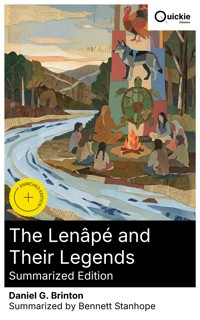
In "The Lenâpé and Their Legends," Daniel G. Brinton delves into the rich oral traditions and cultural tapestry of the Lenâpé people, a Native American tribe from the northeastern United States. Through the lens of ethnographic and anthropological exploration, Brinton employs a narrative style that intertwines lyrical storytelling with scholarly analysis, offering readers a profound insight into the myths, legends, and everyday lives of the Lenâpé. This work not only serves as a collection of folklore but also contextualizes their stories within the broader landscape of Indigenous narratives in America, revealing themes of harmony with nature, spirituality, and the human condition. Daniel G. Brinton was a pioneering anthropologist and linguist whose deep interest in Native American cultures and languages shaped his scholarly pursuits. His extensive travels and interactions with Indigenous communities informed his efforts to preserve their legacy, especially at a time when many were facing cultural erasure due to colonial influences. Brinton's unique position as both a scholar and a sympathetic observer allowed him to convey the wisdom and nuances of the Lenâpé traditions with authenticity and respect. This book is highly recommended for readers interested in Native American literature, folklore, and anthropology. Brinton's work is invaluable for anyone seeking to understand the complexities of Lenâpé culture, as well as for scholars and laypeople who appreciate the intricate relationship between narrative and identity in Indigenous communities. In this enriched edition, we have carefully created added value for your reading experience: - A succinct Introduction situates the work's timeless appeal and themes. - The Synopsis outlines the central plot, highlighting key developments without spoiling critical twists. - A detailed Historical Context immerses you in the era's events and influences that shaped the writing. - A thorough Analysis dissects symbols, motifs, and character arcs to unearth underlying meanings. - Reflection questions prompt you to engage personally with the work's messages, connecting them to modern life. - Hand‐picked Memorable Quotes shine a spotlight on moments of literary brilliance. - Interactive footnotes clarify unusual references, historical allusions, and archaic phrases for an effortless, more informed read.
Das E-Book können Sie in Legimi-Apps oder einer beliebigen App lesen, die das folgende Format unterstützen:
Veröffentlichungsjahr: 2022
Ähnliche
















The Lenâpé and Their Legends
Table of Contents
Introduction
At the crossroads of memory and method, The Lenâpé and Their Legends wrestles with how a people’s narratives can be gathered, translated, and framed by nineteenth‑century scholarship without losing the living resonance that gives them meaning, following trails of language, symbol, and place as Daniel G. Brinton seeks to preserve Lenape tradition while acknowledging the limits of his sources, the ambiguities of transcription, and the unsettled balance between preservation and interpretation that shadows any attempt to carry oral knowledge into print, raising enduring questions about who speaks for the past, what survives the passage between tongues, and how study can honor what it inevitably transforms.
This work belongs to the intersecting genres of ethnology, folklore study, and philological analysis, emerging from the late nineteenth century when American scholars were assembling records of Indigenous languages and traditions. Its focus is the Lenape, historically associated with the mid‑Atlantic region of North America, and its materials reflect an era of collecting, classifying, and comparing cultural texts. Brinton’s study offers a scholarly treatment of Lenape legends and linguistic observations, including a prominent cycle known as the Walam Olum, presented within the conventions of his time. Its publication context situates it among early efforts to formalize Indigenous knowledge in print for academic audiences.
Readers encounter a carefully organized presentation that moves between narrative materials and commentary, balancing stories, symbols, and names with glosses and cross‑references that aim to render Indigenous forms intelligible to a learned readership. The voice is authoritative and painstaking, the style dense with notes and comparisons, and the tone sober, reflecting confidence in method while attending to gaps in the record. Brinton’s approach is to assemble sources, translate and interpret them, and propose connections within a broader ethnological framework. The result is a layered reading experience: one thread follows the legends themselves; another engages the apparatus of analysis that seeks to explain them.
A central theme is the transmission of knowledge across boundaries—linguistic, cultural, and temporal—and the ways translation shapes what later readers believe they understand. The book explores how memory is mapped onto geography, how ritual and story intertwine, and how language encodes distinctive ways of relating to land and history. It also exposes the friction between oral tradition and written systematization, a friction heightened by the asymmetries of power that marked nineteenth‑century research on Indigenous peoples. Throughout, the study suggests that interpretation is inseparable from the tools and assumptions that guide the interpreter.
Another enduring theme is the status of evidence: what counts as an authentic record, how textual lineages are established, and where skepticism is warranted. Subsequent scholarship has subjected the Walam Olum to careful scrutiny, with many researchers challenging its authenticity and the reliability of the transmission chain that brought it to print. Reading Brinton today thus invites methodological reflection as much as cultural learning, encouraging attention to provenance, translation choices, and the framing effects of editorial practice. The book remains instructive not only for what it presents but for what its procedures reveal about the possibilities and hazards of documenting tradition.
For contemporary readers, the value of this volume lies in its dual utility as a repository and a case study. As a repository, it preserves historical transcriptions, interpretations, and linguistic observations that continue to inform discussions of Lenape cultural history, albeit through a mediated lens. As a case study, it illuminates the development of American ethnology and the responsibilities that attend cross‑cultural scholarship. Approached critically—alongside contemporary Lenape perspectives and more recent research—it can deepen understanding of how knowledge about Indigenous peoples has been collected, debated, and revised over time.
Ultimately, The Lenâpé and Their Legends matters because it foregrounds the stakes of interpretation: the ethical demands of representing others, the fragility and resilience of cultural memory, and the long afterlives of scholarly choices. Its pages invite readers to consider how narratives migrate between worlds, how authority is claimed and tested, and how a respectful engagement with the past can grow from careful, self‑aware reading. Without foreclosing complexity, Brinton’s study offers an entry into Lenape traditions and into the history of how such traditions have been studied, prompting continued dialogue about method, meaning, and responsibility.
Synopsis
Daniel G. Brinton’s The Lenâpé and Their Legends, published in 1885, assembles linguistic, historical, and mythic materials concerning the Lenape (Delaware) people within a single analytical framework. Writing as a nineteenth-century ethnologist, Brinton aims to document traditions, clarify classifications within the Algonquian language family, and appraise sources whose reliability varies. He outlines his methods, identifies the limits of his evidence, and explains how missionary records, early explorers’ notes, and native narratives inform his study. The book’s organizing question centers on what can be known, through texts and comparison, about Lenape origins, social institutions, beliefs, and remembered migrations, and how such knowledge should be evaluated critically.
The opening chapters survey Lenape ethnography and geography, tracing their historical presence in the mid-Atlantic region and their affiliations within the wider Algonquian world. Brinton describes tribal divisions and dialectal variation, stressing how phonology and morphology help map group relations. He situates the Lenape alongside neighboring peoples to show shared features and local distinctiveness. Throughout, he synthesizes data from primary sources and earlier scholars, weighing agreements and contradictions. This groundwork prepares readers to understand later textual analyses, since questions about interpretation depend on how words, names, and categories function within Lenape speech and tradition as recorded in diverse, sometimes fragmentary, accounts.
Brinton then turns to Lenape narrative materials, foregrounding myths, etiological tales, and ritual themes as expressions of worldview and social memory. He discusses recurrent motifs, the role of spiritual beings, and the moral and instructive uses of story in communal life. Attention is given to the interplay between narrative and practice, including how tales encode norms, commemorate group experiences, and relate to ceremonial observances. Rather than treating myths as isolated curiosities, Brinton reads them comparatively, identifying patterns that resonate with broader Algonquian traditions while tracking distinctly Lenape formulations that reflect local environments, historical pressures, and intertribal contact.
At the center of the volume stands the Walam Olum, a sequence of symbols accompanied by texts that purport to narrate Lenape origins, migrations, and conflicts. Brinton reproduces the figures, provides transliterations, and offers an English rendering designed to follow the internal structure of the verses. He explains how mnemonic devices and pictorial cues might anchor collective memory, and he outlines the interpretive choices required by gaps or ambiguities in the materials. The Walam Olum is presented both as a potentially valuable historical record and as a challenging document whose form and transmission demand cautious philological and ethnological scrutiny.
An extended inquiry evaluates the Walam Olum’s authenticity. Brinton tests internal linguistic consistency, asking whether morphology, lexicon, and syntax align with known Lenape usage. He checks place-names, ethnonyms, and described movements against independent historical and geographical information. He also compares narrative motifs with attested Algonquian patterns to distinguish likely tradition from possible invention or conflation. The discussion balances positive correspondences with anomalies and uncertainties, emphasizing method: corroboration across sources, attention to textual layers, and the necessity of distinguishing mythic structure from potential historical inference.
Supporting chapters and appendices broaden the evidentiary base. Brinton compiles vocabulary lists, grammatical notes, and annotated place-names to aid future research, and he juxtaposes variants of tales to demonstrate how transmission and context shape meaning. He documents aspects of social organization, including kinship and totemic identifications, and considers effects of colonial contact and missionization on language and belief. These materials serve a dual purpose: they illuminate passages in the Walam Olum and other narratives, and they stand alone as resources for comparative Algonquian studies, offering data for cross-checking claims about identity, chronology, and movement.
The book concludes by situating Lenape traditions within debates about evidence, authority, and cultural continuity, without insisting on a single definitive resolution. Its enduring resonance lies in the careful collation of texts, the articulation of a transparent critical method, and the preservation of materials later scholars continued to reexamine. As a foundational compilation, it influenced subsequent assessments of the Walam Olum and contributed to the documentation of Lenape language and lore. While later research has refined or challenged parts of its argument, Brinton’s volume remains a touchstone for understanding nineteenth-century approaches to Indigenous histories and the responsibilities of source criticism.
Historical Context
Published in Philadelphia in 1885, Daniel G. Brinton’s The Lenâpé and Their Legends emerged from a city that had long housed key repositories for Native American studies, including the American Philosophical Society and the Academy of Natural Sciences. Brinton (1837–1899), a physician turned ethnologist and linguist, was then consolidating his reputation as an Americanist scholar. Issued as part of “Brinton’s Library of Aboriginal American Literature,” the book gathers Lenape (Delaware) lore, linguistic notes, and historical testimony. It also prints and re-translates the Walam Olum, accompanied by an inquiry into its authenticity, reflecting an era committed to collecting, comparing, and systematizing Indigenous texts within emerging academic frameworks.
The Lenape historically inhabited the Delaware River valley and adjacent coasts, in present-day New Jersey, eastern Pennsylvania, Delaware, and southeastern New York. They spoke an Algonquian language and organized society around three principal divisions—often identified as Unami, Unalachtigo, and Munsee—with prominent totemic associations such as Turtle, Turkey, and Wolf. European colonization progressed from Dutch and Swedish to English control in the seventeenth century, culminating in William Penn’s proprietary Pennsylvania. Dispossession accelerated through contested agreements like the Walking Purchase of 1737. These upheavals, and the resulting colonial records and mission archives, created both disruptions to Lenape life and textual sources Brinton later mined.
Eighteenth- and early nineteenth-century Moravian missionaries provided foundational Lenape documentation that shaped Brinton’s sources and method. David Zeisberger produced extensive Delaware lexicographic and grammatical materials; John Heckewelder’s 1819 Account of the History, Manners, and Customs of the Indian Nations offered ethnographic syntheses; and George Henry Loskiel’s 1794 history recorded mission-era observations. Many of these materials circulated through the American Philosophical Society and related scholarly networks in Philadelphia. Brinton drew on this corpus to triangulate language, mythic motifs, and historical recollections, exemplifying a practice common among nineteenth-century Americanists: building new syntheses from mission records, early travel narratives, and surviving Indigenous testimonies.
A central feature of Brinton’s volume is the Walam Olum, a text first publicized in 1836 by Constantine Samuel Rafinesque, who claimed it derived from Lenape mnemonic pictographs accompanied by a phonetic recitation. From its debut, the document prompted questions about provenance, transmission, and accuracy. In 1885, Brinton reproduced the complete text and symbols, offered a fresh translation, and analyzed linguistic and cultural elements to test consistency with Lenape and broader Algonquian traditions. His discussion weighs internal evidence and comparative data, situating the Walam Olum within contemporary standards of philological critique and the period’s drive to authenticate contested Indigenous sources.
The book appeared amid institutional consolidation of American ethnology. The Smithsonian’s Bureau of American Ethnology, founded in 1879 under John Wesley Powell, promoted systematic fieldwork, bibliographies, and linguistic surveys across North America. Philadelphia’s scholarly societies preserved extensive manuscript holdings that Brinton consulted. Within a year of this volume, the University of Pennsylvania created the first professorship in American archaeology and linguistics (1886), appointing Brinton to the chair, signaling a shift from gentleman-scholar networks to university-based research. The Lenâpé and Their Legends reflects these infrastructures: careful collation of sources, attention to language, and an aspiration to produce authoritative reference works for an expanding scholarly readership.
Intellectually, the book belongs to a moment shaped by comparative philology, evolutionary anthropology, and comparative mythology. Thinkers such as Edward B. Tylor and Lewis Henry Morgan framed debates about cultural development, while Max Müller’s approaches to myth encouraged parsing narratives for recurrent natural or cosmological themes. American archaeology was also discarding the separate “Mound Builder” hypothesis in favor of Indigenous authorship, a scholarly realignment completed in the 1890s. Brinton’s methods—classifying myths, tracing migrations through linguistic clues, and correlating oral traditions with historical records—embody this synthesis of rigorous comparison and period-specific theories about culture, language, and antiquity.
The contemporary political context intensified the drive to record Indigenous traditions. After the Indian Removal Act of 1830, many Lenape were successively displaced westward, with communities established in the Midwest and later in Indian Territory (present-day Oklahoma); others settled in Ontario. Late nineteenth-century assimilation policies—exemplified by the Carlisle Indian Industrial School (founded 1879 in Pennsylvania) and, soon after, the Dawes Act of 1887—pressured language and ceremonial continuity. Brinton’s preservationist framing, common to his generation, responded to fears of cultural loss, motivating the documentation of vocabularies, narratives, and ethnographic notes before further disruption.
On publication, The Lenâpé and Their Legends became a reference point for Lenape linguistics and lore, even as debate over the Walam Olum persisted. Twentieth-century reassessments—most prominently late-century analyses by David M. Oestreicher and Ives Goddard—argued that Rafinesque’s text was a modern fabrication rather than an authentic Lenape chronicle. Read today, Brinton’s volume reveals both the strengths and limits of its era: careful compilation, wide reading, and linguistic attention, alongside evolutionary assumptions and contested source materials. As historical artifact and scholarly resource, it mirrors the ambitions, institutions, and critical tensions of Americanist research in the 1880s.




