


1,99 €
Mehr erfahren.
- Herausgeber: Quickie Classics
- Kategorie: Geisteswissenschaft
- Sprache: Englisch
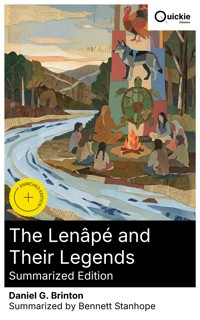
The Lenâpé and Their Legends distills Lenape history, mythology, and language through a rigorously annotated edition of the Walam Olum, accompanied by pictographs, glossary, and notes. Brinton surveys dialects (Minsi, Unami, Unalachtigo), clan totems (Turtle, Wolf, Turkey), Delaware Valley place-names, and cosmology, situating Lenape traditions within Algonquian comparanda. Composed in the philological, documentary style of nineteenth‑century salvage ethnography, the volume became a touchstone, even as the Walam Olum's authenticity later drew sustained critique. Daniel G. Brinton—physician, linguist, and early American anthropologist—taught at the University of Pennsylvania and edited the Library of Aboriginal American Literature. Working from missionary wordlists, colonial records, and Rafinesque's manuscripts, and writing in the Lenape homeland's shadow, he applied a comparative method informed by the era's psychic unity thesis, seeking to codify Lenape lore before displacement and modernity erased its traces. Read critically, this remains a vital resource for historians of anthropology, Algonquianists, and readers of Native studies. Its dense notes, translations, and toponymic and dialectal data repay study, especially alongside contemporary Lenape scholarship and community voices, revealing both enduring sources and the nineteenth‑century frameworks that organized them. Quickie Classics summarizes timeless works with precision, preserving the author's voice and keeping the prose clear, fast, and readable—distilled, never diluted. Enriched Edition extras: Introduction · Synopsis · Historical Context · Brief Analysis · 4 Reflection Q&As · Editorial Footnotes.
Das E-Book können Sie in Legimi-Apps oder einer beliebigen App lesen, die das folgende Format unterstützen:
Veröffentlichungsjahr: 2026
Ähnliche
















The Lenâpé and Their Legends (Summarized Edition)
Table of Contents
Introduction
At the crossroads of memory and mediation, The Lenâpé and Their Legends turns the living breath of an Indigenous tradition into a nineteenth‑century artifact, inviting readers to confront the uneasy pact between preservation and transformation, the authority of symbols and translations over the voices they claim to echo, and the larger question of who, in the relay of collecting, editing, and annotating, ultimately speaks for a people whose histories, migrations, and meanings reside not only in texts and plates but in lands, languages, and relations that exceed the scholar’s page.
Daniel G. Brinton, an American ethnologist and linguist, assembled this volume in the late nineteenth century, when American anthropology often sought to catalog Indigenous cultures of the Eastern Woodlands. Centered on the Lenape (also known as the Delaware) of the mid‑Atlantic region, the book blends ethnographic reportage, linguistic observation, and comparative myth studies. It presents, along with commentary, the text and pictographic symbols commonly referred to as the Walam Olum, which Brinton edited and translated for scholarly and general audiences. Within this historical frame, the work reads as a formal study shaped by contemporary methods and the period’s expectations of scientific classification.
As a reading experience, the volume proceeds with measured, documentary clarity, interleaving narrative summaries of Lenâpé traditions with philological notes, source criticism, and comparative references across Algonquian languages and neighboring peoples. Brinton writes in a confident scholarly voice characteristic of his era, favoring catalogs, cross‑references, and extended annotations that aim to stabilize variant materials. The tone is earnest and explanatory rather than dramatic, yielding a study that foregrounds method as much as matter. Readers encounter a layered apparatus—translations, glosses, and reproductions—inviting slow, attentive engagement rather than swift immersion in story.
Among the book’s central themes are the entanglements of language, place, and memory, and the ways oral tradition adjusts when transferred into writing and illustration. Brinton’s attention to vocabulary and names underscores how meaning is embedded in sound patterns and semantic fields, while his cross‑references sketch a map of affinities that link Lenâpé narratives to wider regional knowledge. The volume repeatedly circles questions of origin, movement, and social order without collapsing them into a single scheme, instead exposing how multiple tellings coexist. In tracing these currents, it also examines the scaffolding of evidence that scholarly readers demand and communities negotiate.
The work also bears the imprint of its time, reflecting collecting practices and assumptions that later scholarship has scrutinized. Much of its source base depends on prior intermediaries and translations, and debate has long surrounded the authenticity and provenance of the materials known as the Walam Olum. Readers need not master the controversy to appreciate the volume, but awareness of these discussions sharpens a critical lens on methodology, citation, and authority. As an artifact of late‑nineteenth‑century knowledge making, the book shows both the ambitions and the blind spots of salvage ethnology, illuminating how archives are constructed as well as what they contain.
For contemporary readers, the volume matters as both resource and caution. It preserves records that can aid language study and cultural history, yet it simultaneously models the need for collaboration, attribution, and consent in representing Indigenous knowledge. Engaged alongside Lenape‑authored scholarship and community voices, the book helps frame questions about evidence, translation ethics, and the politics of interpretation that animate today’s decolonizing work in the humanities. It invites readers to ask how meaning shifts across media and time, how to weigh competing narratives, and how scholarship might support living traditions rather than speaking over them.
Approached with that balance of curiosity and care, The Lenâpé and Their Legends becomes a demanding but rewarding study of how knowledge travels. Its formal prose and dense apparatus slow the pace, yet they allow readers to watch analysis taking shape, to see hypotheses tested against fragments, and to reckon with uncertainty without erasing it. The book thus functions as both an introduction to materials associated with the Lenape and a case study in the perils and possibilities of translation across cultures. Reading it today affirms that preservation is inseparable from responsibility, and that interpretation carries consequences beyond the page.
Synopsis
Daniel G. Brinton’s The Lenâpé and Their Legends presents a sustained study of the Lenape, often known as the Delaware, interweaving ethnography, linguistics, and textual scholarship. Framed as both a cultural overview and a documentary edition, the book’s central aim is to situate Lenape traditions within the broader Algonquian world while introducing and examining a controversial record known as the Walam Olum. Brinton explains his sources, methods, and limits, emphasizing comparison across historical accounts and native testimony. He positions his work as a careful compilation that seeks to preserve, interpret, and test materials that had long circulated but lacked a rigorous, critical apparatus.
The opening discussions outline who the Lenape are and how their names, divisions, and territories have been identified in historical records. Brinton surveys the language’s place within the Algonquian family, distinguishing dialectal features and recurrent phonetic patterns that help adjudicate variant spellings and transcriptions. He pairs this with observations on social organization, settlement distribution, and intertribal relations, drawing on early descriptions while noting their uneven reliability. Throughout, he underscores the need to separate consistent traditions from later accretions, setting standards for evaluating claims and preparing readers for the textual scrutiny that follows in the book’s central sections.
From this foundation, Brinton turns to religion, symbolism, and narrative as they appear in Lenape thought. He describes spiritual concepts, ritual expressions, and mythic episodes as preserved in oral accounts and mnemonic devices, while resisting reduction to a single system. Place-names and personal names are analyzed for semantic clues to landscape use, memory, and identity. He also treats pictorial signs and mnemonic practices as legitimate sources, provided their transmission can be traced. This cultural profile supplies the interpretive context for reading longer traditional narratives, clarifying how metaphors, cosmological figures, and moral exempla operate within Lenape storytelling.
The book’s centerpiece is Brinton’s presentation of the Walam Olum, which he introduces as a set of symbolic figures paired with Lenape verses and an accompanying narrative. He reproduces the symbols, offers a transliteration and translation, and annotates key terms. Brinton treats the text as a complex blend of mythic motifs and historical recollection, organizing it into thematic sequences rather than claiming a single, fixed version. Without insisting on definitive chronology, he highlights recurrent images of movement, encounter, and social formation. The editorial apparatus explains choices in rendering words and lines, inviting readers to examine form as well as content.
Brinton’s analytical method foregrounds philology. He tests the Lenape wording against known morphological patterns and attested vocabulary, noting where readings align with established dialectal forms. Comparative references to Algonquian languages serve to clarify uncertain passages, while parallels in regional mythology illustrate how themes circulate and transform. He also probes the relation between imagery and geography, cautiously weighing whether motifs correspond to remembered places or later interpretations. The result is a layered commentary that distinguishes probable archaisms from likely modern intrusions, always returning to linguistic evidence as the most durable check on conjecture.
A substantial inquiry addresses the Walam Olum’s authenticity. Brinton reviews its reported provenance, the chain of transmission, and the credibility of informants and intermediaries. He measures internal consistency, asks whether the pictorial system comports with known mnemonic practices, and evaluates whether the language reflects natural usage rather than retrospective invention. He engages objections point by point, acknowledging gaps and ambiguities while presenting reasons some features appear genuine. His assessment remains measured, balancing skepticism with the possibility of an older core, and leaves room for further research rather than foreclosing debate with categorical claims.
In closing, Brinton situates the study within broader questions about American prehistory, Indigenous intellectual traditions, and the responsibilities of scholarship. He argues that careful collection and critical evaluation can preserve voices otherwise at risk of distortion or loss, and that linguistic and cultural analysis must proceed together. The Lenâpé and Their Legends endures less for any single answer than for the standards it models: explicit methods, transparent sources, and openness to revision. By pairing a detailed cultural overview with a rigorously edited traditional text, it continues to shape discussions of evidence, interpretation, and respect for Native narratives.
Historical Context
Published in Philadelphia in 1885, Daniel G. Brinton's The Lenâpé and Their Legends emerged amid the institutionalization of American anthropology and philology. Brinton (1837–1899), a physician-turned-ethnologist, was active in the American Philosophical Society and the Academy of Natural Sciences, and a year later would become professor of American linguistics and archaeology at the University of Pennsylvania. The volume appeared as No. 5 in his Library of Aboriginal American Literature, a series designed to edit, translate, and contextualize Indigenous texts. Its methods—comparative linguistics, folklore collection, and historical synthesis—reflect the era's salvage impulse to record Native traditions perceived as endangered by colonial expansion and assimilation.
The Lenape, an Algonquian-speaking people, traditionally inhabited Lenapehoking, the Delaware River watershed across present-day New Jersey, eastern Pennsylvania, northern Delaware, and southeastern New York. Their major dialect groups—Munsee, Unami, and Unalachtigo—figured in early colonial accounts. From the 1620s, Dutch traders of New Netherland, followed by Swedes in New Sweden (1638–1655) and then the English, established posts and settlements that transformed regional trade and diplomacy. Beaver pelts, wampum production, and shifting alliances with neighboring nations shaped Lenape political strategies. These contacts generated some of the earliest European records of Lenape language and customs, sources later mined by nineteenth-century scholars like Brinton.
After the English seized New Netherland in 1664, William Penn's proprietary colony (chartered 1681) pursued diplomacy and land acquisition among the Lenape. Treaties associated with Penn's early years, later romanticized in Pennsylvania memory, were followed by intensified pressure on Lenape territory. The 1737 Walking Purchase, engineered by colonial officials using a disputed walk, vastly expanded colonial claims along the Delaware and forced many Lenape from homelands to the Susquehanna and Ohio valleys. This sequence—initial negotiation, legal instruments, and sharp dispossession—frames much of the eighteenth-century historical record Brinton consults and helps explain migrations that underlie several traditions he analyzes.
Christian missions, particularly the Moravians, became crucial intermediaries and record-keepers. David Zeisberger, active among Lenape communities in Pennsylvania and the Ohio Country, compiled extensive notes on vocabulary and grammar and kept journals describing ritual, kinship, and settlement life. John Heckewelder, a Moravian missionary and later a correspondent of learned societies, published his Account of the History, Manners, and Customs of the Indian Nations in 1818. Zeisberger's Lenape grammar and related materials were edited and printed in 1827 under the auspices of the American Philosophical Society. Brinton drew heavily on these missionary texts, treating them as authoritative linguistic and ethnographic sources.
Conflict and displacement intensified during and after the American Revolution. The 1778 Treaty of Fort Pitt, the first treaty between the United States and a Native nation, engaged the Delaware in wartime diplomacy but did not prevent subsequent violence. In 1782, Pennsylvania militiamen killed dozens of Christian Lenape at Gnadenhütten in the Ohio Country, accelerating moves west. Through the early nineteenth century, successive pressures and treaties pushed Lenape communities from Ohio and Indiana into Missouri and Kansas. An 1867 agreement facilitated relocation to Indian Territory, where Delaware descendants formed communities in present-day Oklahoma, while others remained in Ontario. These trajectories inform Brinton's historical framing.
Central to the volume is the Walam Olum (Painted/Red Record), a purported Lenape mnemonic chronicle first published by Constantine Samuel Rafinesque in 1836, combining pictographs and a Delaware text he claimed to have obtained in the Midwest. Brinton reproduced the symbols, supplied a new translation, and appended an inquiry into the document's authenticity, reflecting contemporary philological debates about sources and transmission. While the text stimulated nineteenth-century interest in Lenape migrations and cosmogony, later analyses—most notably David M. Oestreicher's work in the 1990s—argued it was spurious. Brinton's treatment captures both the appeal and the methodological limits of his era's evidence.
Brinton worked amid expanding federal and scholarly infrastructures for American ethnology. The Bureau of American Ethnology, founded in 1879 under John Wesley Powell, promoted fieldwork, linguistic classification, and the compilation of Native traditions. Evolutionary frameworks popularized by E. B. Tylor's Primitive Culture (1871) and Lewis Henry Morgan's Ancient Society (1877) encouraged comparative readings of myth and social organization. Parallel growth in archaeology—especially studies of Midwestern mounds—reinforced ambitions to write continent-wide prehistories. Brinton's analyses, attentive to language families and mythic motifs, align with these currents, seeking regular patterns across cultures while anchoring discussion in printed sources and museum collections centered in Philadelphia.
As a synthesis of colonial records, missionary philology, and putative native texts, The Lenâpé and Their Legends mirrors late nineteenth-century scholarship: urgent about preservation, confident in comparative method, and reliant on intermediaries. Its careful collation of vocabularies and narratives foregrounds Lenape intellectual traditions within a predominantly Euro-American archive. At the same time, Brinton's evaluation of the Walam Olum signals emerging source criticism, even as he circulated a contested document. The book thus records enduring materials and the assumptions of its moment, inviting later readers to reassess methods, evidentiary standards, and the ethical stakes of representing Indigenous histories in print.




