


9,99 €
Mehr erfahren.
- Herausgeber: 50Minutes.com
- Kategorie: Lebensstil
- Serie: Management & Marketing
- Sprache: Englisch
Find your niche and future-proof your business!
This book is a practical and accessible guide to understanding and implementing the long tail theory, providing you with the essential information and saving time.
In 50 minutes you will be able to:
• Understand the uses of the long tail theory in the digital product market and how you can use it to sell products and for search engine optimization
• Identify the products in your portfolio that make up the ‘head’ and ‘tail’ sections of the long tail theory and use these findings to form your strategy
• Learn about how you can increase future profitability using Chris Anderson’s strategy of “selling less of more”
ABOUT 50MINUTES.COM | Management & Marketing
50MINUTES.COM provides the tools to quickly understand the main theories and concepts that shape the economic world of today. Our publications are easy to use and they will save you time. They provide elements of theory and case studies, making them excellent guides to understand key concepts in just a few minutes. In fact, they are the starting point to take action and push your business to the next level.
Das E-Book können Sie in Legimi-Apps oder einer beliebigen App lesen, die das folgende Format unterstützen:
Seitenzahl: 25
Veröffentlichungsjahr: 2015
Ähnliche















The long tail theory for business
Key information
Name: long tail theory.Uses: this concept refers to all of the products offered by a company that only sell a few units, but where the sum of their sales may exceed the revenue made from the top-selling products. This is the same as saying that the most popular and best-selling items only contribute to a minority of turnover, the mass effect playing strongly in favour of the more marginalised products.Why is it effective? The inclusion of such a strategy allows a company to benefit from constant sales from its entire product portfolio.Key words:Bestseller: a flagship product, often assigned a high advertising budget, which achieves record revenues.E-commerce: online commerce (via the internet).Opportunity cost: indication of the loss caused by investing resources into one function more than another.Profit: financial gain from an action. For example, a sale is an action that can generate profit or loss.Profitable: something that generates reward or a certain amount of profit.Statistics: a set of data relating to a group of individuals or units that allows for observing trends. Turnover: cumulative and recorded value – usually over a period of one year – from the sales of goods and services offered by a company.Introduction
The long tail theory was introduced in 2004 by Chris Anderson (editor of Wired magazine, born in 1961) and resulted from an essay written by Clay Shirky (a specialist in new information and communication technology, born in 1964) which states that some blogs have a significant number of web links pointing to them while the majority of blogs only have a very small number of links pointing to them.
Chris Anderson builds on this thinking to try and explain present and future economic models (as part of the digital economy). He describes how, in his opinion, all products with low demand can collectively generate significant turnover.
However, it is the emergence and increasing use of digital technologies that make the economic model of the long tail possible: entrepreneurs who benefit from very low storage costs, sometimes zero or ‘virtual’, when marketing digital products (e-books, online movies, music, etc.), can now offer a wide catalogue online, which diversifies supply and pleases those who prefer marginal assets.
Definition of the model
The long tail is an economic and statistical concept that illustrates the distribution of a company’s turnover for all of its products, including the most popular products – the ‘bestsellers’ – as well as the more specific and marginal products. Therefore, this is a tool for developing commercial and marketing strategies.
The model consists of two elements:
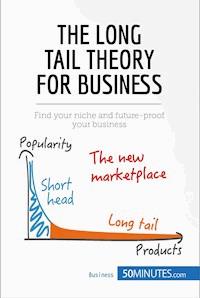
the ‘head’, characterised by a limited number of popular or high-demand products, each generating a high sales rate;the ‘tail’, characterised by a large number of niche or low-demand products, each generating a low sales rate.




