


Erhalten Sie Zugang zu diesem und mehr als 300000 Büchern ab EUR 5,99 monatlich.
- Herausgeber: Origin
- Kategorie: Geisteswissenschaft
- Sprache: Englisch
The Highland Clearances are a well-documented episode in Scotland's past but they were not unique. The process began in the Scottish Lowlands nearly a century before, when tens of thousands of people – significantly more than were later exiled form the Highlands – were moved from the land by estate owners who replaced them with livestock or enclosed fields of crops. These Clearances undeniably shaped the appearance of the Scottish landscape as it is today as they swept aside a traditional way of life, causing immense upheaval for rural dwellers, many of whom moved to the new towns and cities or emigrated. Based on pioneering historical research, this book tells the story of the Lowland Clearances, establishing them as a wider part of the process of Clearance which affected the whole country and changed the face of Scotland forever.
Sie lesen das E-Book in den Legimi-Apps auf:
Seitenzahl: 253
Veröffentlichungsjahr: 2012
Das E-Book (TTS) können Sie hören im Abo „Legimi Premium” in Legimi-Apps auf:
Ähnliche



















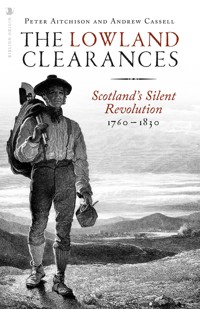
THE LOWLAND CLEARANCES
THE LOWLANDCLEARANCES
Scotland’s Silent Revolution, 1760–1830
Peter Aitchison and Andrew Cassell
This edition first published in 2012 by
Birlinn Limited
West Newington House
10 Newington Road
Edinburgh
EH9 1QS
www.birlinn.co.uk
First published in 2003 by Tuckwell Press Ltd, East Linton
Copyright © Peter Aitchison and Andrew Cassell, 2003 and 2012
The moral right of Peter Aitchison and Andrew Cassell to be identified as the authors of this work has been asserted by them in accordance with the Copyright, Designs and Patents Act 1988
All rights reserved. No part of this publication may be reproduced, stored or transmitted in any form without the express written permission of the publisher.
ISBN 978 1 78027 069 2
British Library Cataloguing-in-Publication Data A catalogue record for this book is available from the British Library
Typeset by Hewer Text (UK) Ltd, EdinburghPrinted and bound by Clays Ltd, St Ives, plc
Contents
Acknowledgements
Map
One:
Introduction
Two:
Scotland before Improvement
Three:
The Galloway Levellers
Four:
Winners and Losers
Five:
Enlightened Improvement
Six:
Revolution without Protest?
Seven:
Emigration – the dripping tap
Eight:
The Rural Refugees – one family’s story
Nine:
Conclusion – the Scottish Clearances
Select Bibliography
Index
Acknowledgements
This book is based on the research conducted in preparation for a series of programmes transmitted in May and June 2003 on BBC Radio Scotland. We are grateful to Maggie Cunningham, the head of Radio Scotland, for not just allowing us permission to proceed with the book, but for embracing the idea that led to The Lowland Clearances project. As a Gael she appreciated from the outset the importance of setting the record straight on what actually happened to the majority of the Scottish population who lived below the Highland Line. We are also indebted to Jane Fowler, commissioning editor and head of features, for her support and criticism and to Kate Hook who supervised the budget and somehow managed to keep us organised. Thanks are also due to other members of staff at the BBC, especially David Neville who co-ordinated and produced the drama sequences which have inspired some of the elements of this work; and to Michael Calder who was the sound engineer on the radio series. When we were comfortable in a warm car or at the table of a restaurant, he was still tramping about the countryside trying to obtain the right ‘noises’ to ensure that the programmes were of the highest technical quality possible. Mic was also a key part of the production team. His input was substantial and invaluable.
Of course producing documentaries and writing books requires time which is not always a ready commodity in the life of a busy newsroom. But our colleagues, Blair Jenkins, Stewart Easton and Phil Taylor, made it possible for us to meet our commitments by an indulgent and generous organisation of work rotas. For their patience we would also like to thank Colin Blane, Sean McGrath and John Morrison whose constructive criticism was a source of constant inspiration.
Much of what follows was derived from interview transcripts and we are indebted to all of those academics and individuals who agreed to take part. Professor Tom Devine of Aberdeen University in particular was generous with his encouragement and advice. Tom has done so much to make Scottish history accessible. He has a unique power of oratory and an almost messianic zeal for his discipline. We never tired of listening to him outline events that took place centuries ago, yet to which Tom seemed able to give a contemporary feel.
From that starting point we tapped into what is a remarkable seam of historical debate. All of our interviewees provided fresh and moving perspectives on a contentious subject. Professor Chris Whatley of Dundee University opened up the dynamic area of social, economic and political protest, whilst Professor Callum Brown of Strathclyde University provided the religious context to a turbulent age. The Historiographer Royal, Professor Christopher Smout, was more sanguine on the outcome for the majority of lowlanders and his wry and comprehensive overview gave us much to ponder as we drove around Scotland. No story of lowland clearance could be attempted without acknowledging the appalling events that later occurred in the Highlands. Dr James Hunter provided that reference point and a lot more besides. The long discussions we held with Dr Hunter, in the warmth of his kitchen and the chill of the hillside overlooking Kiltarlity, provided a tangible link between north and south. Scotland is fortunate to have such a wealth of academic expertise in these matters and they will all recognise their influence in this work.
A sense of empathy with the past existences of ordinary people was delivered by Sandy Fenton at the National Museums of Scotland and by Gavin Sprott who took us to the Museum of Scottish Country Life near East Kilbride. There we were given a vivid appreciation of the hardships of daily life in pre-Improvement times. Gavin, who as well as being a renowned ethnologist is also one of Scotland’s leading authorities on Robert Burns, then gave context to some of the work of our national bard. In Burns’ cottage in Alloway he explained how the family were almost brought to ruin by the great changes. But for the income from the Edinburgh edition, they might well have been forced to emigrate.
Millions did leave Scotland in search of a new life, which led us to the door of two specialists in this field: John Beech who unearthed a treasure-trove of original documentation and Dr Marjory Harper of Aberdeen University whose recent work shows that the exodus was far from being highland-dominated.
History without a human face can be interesting – but history which provides the real stories of real people can, we believe, be much more illuminating. We found the true testimony of cleared lowlanders on the Scarborough Bluffs, an outcrop overlooking the shores of Lake Ontario in modern-day Toronto. A few taps on the modern tool of the internet had brought us the story of James McCowan, exiled in the 1830s when he lost his hold on land in Lanarkshire. It was to those bluffs he brought his family and it was on that escarpment that we met with his descendant Bruce McCowan. Bruce and his wife Bea gave us a marvellous welcome and then opened our eyes to the reality of what life had been like for the McCowans through a huge array of original source material that they had spent years amassing.
Back in Scotland we found more evidence of lowland settlement at the deserted fermtoun of Lour in Peeblesshire. Through the trained eye of amateur archaeologist Ed Archer incongruous hillocks were transformed into what they had once been – the base of a few scattered cottages that were thrown down when the laird decreed the people should move. Whilst in the Borders we saw the other side of the story of improvement through the archives of John Home Robertson MSP. His ancestors prospered from the changes, and he welcomed our interest because, he said, whilst a lot is known of what happened to those who did well, history is largely silent on what happened to those who did not.
The story of the Galloway Rising, when hundreds of ordinary peasants, outraged and distressed by attempts to enclose their land, took to arms, is well documented. But local historian Alistair Livingstone brought the episode to life through his dramatic commentary at the very site of the rising. We are grateful to Alistair and to all of those who have given so generously of their time and expertise and who have answered our questions with patience and good humour.
Our thanks are also due to the staff and librarians at a number of institutions: the Mitchell Library and the Byres Road Library in Glasgow, the National Archives of Scotland and National Library of Scotland in Edinburgh, Helensburgh Library and Lochwinnoch Community Museum.
John and Val Tuckwell of Tuckwell Press goaded us onwards with a deadline that would put many news editors to shame. Like all deadlines, it concentrated our minds, but also meant long evenings and absent weekends from our families. A final, but heartfelt, thanks to our wives and children for their support, encouragement and perhaps above all else understanding.
CHAPTER ONE
Introduction
‘The social dislocation in the rural Lowlands in the later eighteenth century has virtually been overlooked and though the Highlands have stimulated a veritable scholarly industry the Lowland Clearances still await their historian.’
Professor Tom Devine, The Scottish Nation
Tom Devine achieved many things in his seminal and wonderfully readable account The Scottish Nation but for us as journalists and broadcasters it was this hanging question which intrigued. Like many Scots we felt we had a decent appreciation of the Highland Clearances, a raw sore on the national psyche which still has the power to shame; a despicable episode in our nation’s past which destroyed a traditional way of life, which set clansmen against chieftain and sent a whole people overseas in the stinking holds of emigrant ships. It was a process predicated on profit and carried out all too often by the Sassenach factors of estates which once were clanheld, but now were claimed by the chiefs themselves.
In spite of recent revisionism, the reality and brutality of what happened in the straths and glens of the Highlands and Islands in the nineteenth century cannot be denied.
Yet here was arguably Scotland’s foremost living historian almost casually introducing a whole new dimension to the story: The Lowland Clearances. As a phrase it has shock-value. Few outside academia have ever considered why it is that Scotland south of the Highland Line was improved whilst those who lived to the north and west of that imaginary divide were cleared. The more we considered the issue, the more nonsensical that use of language seemed. As we drove from Galloway, through the hilly uplands of Lanarkshire to the Trossach moorlands and on to the forests of Inverness-shire, what did we see? Sparsely populated territory, the ruins of long deserted steadings, and cud-chewing beasts. Large chunks of Lowland Scotland were mirroring the traditional picture of the deserted Highlands: sheep and cattle in abundance; people at a premium.
This book is not an academic work in the traditional sense. It has no footnotes and only a select bibliography. But as journalists we have spent a great deal of time teasing out the salient facts, and analysing the various points of contention from many of the nation’s leading historians as well as amateur enthusiasts in both Scotland and Canada. What has emerged is a remarkable consensus.
The Highland Clearances did not just suddenly happen, and were not the result of planned ethnic cleansing by Lowland or English demons. There were many reasons why clan chiefs turned their backs on centuries of tradition. But perhaps the overriding motivator was the template provided by events in the south, which had taken place decades earlier. These events were known at the time, and have been referred to by historians since, as ‘The Age of Improvement’. What actually took place from Berwickshire to Buchan, from Solway to Shetland, from Orkney to Aberdeenshire and all points in between was a wholesale revolution in agriculture. Over the course of two generations, or from around 1760 to 1830, the very structures of Lowland society were ripped apart; thousands of people were forced from their lands; hundreds of tiny settlements were abandoned or destroyed; an entire social stratum was eradicated and Scotland changed forever. These Lowland Clearances paved the way for the events which would later sweep through Highland Scotland. They were part and parcel of the same process. They ought to be called The Scottish Clearances.
Moreover it became clear that a by-product of the great changes which struck Scotland, north and south, was the creation of two countries. At the start of the eighteenth century there was no lowland-highland divide. Scotland was a peasant society, with one of the most backward agricultural systems in Europe. It was an almost wholly rural country, with Edinburgh at forty thousand and Glasgow at less than fifteen thousand people the only sizeable towns. Though the crops grown might have differed, and the land occupied was of varying quality, cottars in the Lowlands and clansmen in the Highlands worked the same runrig system of subsistence farming. They herded their beasts in the same way. They used the same implements. They occupied the same houses. A butt and ben, for example, was a Lowland term and a Lowland invention, adapted by the Highlander. Nor did language differences stand in the way of communication. English was by no means a standard for all. If some Scottish peasants spoke Gaelic, then Doric was the tongue of others, or Gallowayan the leid of others still. When they mixed or mingled, for instance at cattle droves, folk managed to make themselves understood. This was one Scotland.
Come forward to the nineteenth century and that homogeneity had fractured. Farming in the Lowlands was now about profit and production for the market. The link between people and the land had, for the most part, been broken. New ‘planned’ villages housed the surplus labour which had been forced out when collectivisation replaced the strip system. Some of these places seem incongruous to the modern mind.
Towns and then great cities gorged on the overflow from the rural Lowlands. Scotland experienced the fastest urban growth in Western Europe in the last two decades of the eighteenth and first two decades of the nineteenth century. Where one in ten of the population had lived in towns in 1700, the number by 1821 was one in three. Ranch-style estates replaced the patchwork of individual holdings, producing huge quantities of food and pulling in dramatically increased rents for the lairds who claimed legal ownership over areas of formerly common land.
The early nineteenth-century Lowland landscape looked very different from that of the Highlands and Islands. Lowland society, once almost as clannish, was now structured along the lines of class and wealth. These profound changes were achieved within the space of seventy years. Breakneck speed considering that so little had altered in the previous five centuries. And it had all happened peacefully, with no major unrest and no social upheaval. Or did it?
There is now general agreement amongst historians that what took place between 1760 and 1830 could, with some accuracy, be called a Lowland Clearance. There can be no disputing the documentary evidence on the wholesale movement off the land of people whose families had lived there for generations. As well as estate papers, court records and individual accounts there is also the happy historical accident of Scotland being one of the best-mapped countries in the world.
Dutchman Jan Blaeu produced forty-seven detailed maps of Scotland in 1654, based on the earlier work of Timothy Pont. In every Lowland county there were literally dozens of settlements, known as fermtouns. Each contained a number of families, averaging perhaps fifty to a hundred individuals. They lived and worked together, farming the runrig strips of the infield, and herding their animals on the outfield and the common land. These fermtouns were the rock of Lowland stability. Some, like Lour in Peeblesshire, could trace their history back to the Iron Age or even earlier. The cottars of Lour had endured Roman occupation, and successive invasion and liberation during the long wars of Scottish Independence. They had lived through famine and plague but they could not survive the whim of a new landowner who, in the mid-eighteenth century, decided to rationalise his estate. The people were replaced by sheep and the village disappeared, only to be rediscovered by archaeologists two centuries later.
Fermtouns across the Lowlands suffered the same fate as Lour. Nineteenth-century maps contrast sharply with those produced by Pont and Blaeu. Regular fields with the occasional village dotted on the landscape were now the norm. If fermtouns survive at all, it is usually only by accident. Individual farms, those created from the aggrandisement of several family holdings, sometimes kept the name of the original settlement. But the people for the most part have gone.
Another remarkable resource, which confirms the impact of agricultural improvement in mid- to late eighteenth-century Scotland, is the twenty-one volume Old Statistical Account of Scotland. Compiled by Sir John Sinclair in the 1790s, this was a digest of returns, usually from Kirk ministers, from virtually every parish in the land. Some gave more information than others on population, agricultural practices, industry, topography and suchlike. But in Lowland parish after Lowland parish commentators noted, sometimes in the most powerful language, the full impact of what was going on in the countryside. Ministers reflected on the increased productivity of the estates and also on the often baneful effects on the local populace. Cottages were pulled down, villages deserted, whole areas made devoid of people especially in marginal upland parishes. It is a picture which equates almost perfectly with that of the crofting townships of the nineteenth-century Highlands and Islands.
Those who remained on the land now paid many times more rent than previous tenants, and the lowest elements of rural society – the subtenants and cottars – were fast disappearing. It was the cottars who moved, or were moved, into the new villages which were being constructed at the edges of the big farms, or who were drawn to the burgeoning industrial towns and cities of Scotland’s central belt – or who went overseas in a wave of lowland migration.
How were the Lowland Clearances achieved? What were the factors which led the lairds to drastically change what had been unaltered for so long? What impact did these changes have? Was it, as Tom Devine believes, ‘a silent revolution’? Or were there significant protests which brought Scotland to the brink of bloody upheaval? Could the changes have been avoided? What sort of Scotland might we now have but for the Age of Improvement but which could just as accurately be called the Age of Clearance? And why do we know so much of what happened in the Highlands yet so little of what took place in the Lowlands?
These were some of the questions we sought to answer in the BBC radio documentaries. The same questions we asked of people who have worked extensively on the period. The answers they gave, and the evidence we gathered, form the basis of this book.
Professor Devine was perhaps being disingenuous in his plea for a historian to come forward and tackle the subject. Along with his team he has spent many years researching and analysing the structure and nature of Lowland society using reams of documents and estate records. Devine’s motivation, beyond the need to seek out truth, was to remedy that imbalance between the cottage industry of Highland history and the relative neglect of the rest of Scotland where seventy to eighty per cent of the population live. He expected to find protest. Perhaps he even hoped to find some significant event or movement which shouted out against the changes. Beyond routine vandalism and petty crime, however, Professor Devine’s studies revealed a remarkable quiescence in the face of tremendous upheaval. Even though an entire social layer – the cottars – who made up a third of the population in some parishes vanished during the Lowland Clearances, still, he says, there was no threat to the established order.
One of the reasons for that, says Devine, is the speed of change. Although the Clearances happened in a relatively short period of time, they were piecemeal and haphazard. There was no overall sense of nationwide change until that process was all but complete. Professor Devine also says that many of the evictions were carried out within the legal framework. Starting from the later seventeenth century, leases began to be written down, and when these expired tenants were obliged to leave, thereby allowing multiple farms to be amalgamated into a more productive and lucrative single unit. This ‘clearance by stealth’ had the cloak of legality and was backed up by the still considerable feudal power of the local laird or lord. The landowners also used the fig-leaf of legislation passed in the 1690s to justify their appropriation of huge areas of common land. In Berwickshire, for example, the Homes of Wedderburn owned only 1000 acres, yet in the 1750s and 1760s they were able to seize a large portion of the north of the county which they proceeded to ‘improve’. There is no doubt that the productivity of this part of the eastern border, the Merse, leapt as a consequence. But there is also no doubt that this action pushed people out of rural life – people who depended on access to the common land and who lived on the edge of subsistence.
For those forced from the land there were choices – sometimes unpalatable, but choices nonetheless. Cottars could become linen-weavers in places like Coldingham or fishermen in the booming coastal centre of Eyemouth. Many of the landowners who were in the vanguard of introducing new farming methods, men like John Cockburn of Ormiston in East Lothian, also built villages to house the displaced labour. Others followed suit in a wave of construction. Professor Christopher Smout has identified around a hundred and thirty of these communities. Although they were a uniquely Scottish solution to the problem of what to do with surplus labour, Smout is clear that there was no altruism involved. These were little more than holding centres for people who were needed in the still labour-intensive harvest season. During the rest of the year they were put to work in mills or factories, the profits of which generally went to the laird. All the while they continued to pay rent on their houses to the estate.
It would be wrong to infer that the clearances were all about ‘push’. In both the Lowlands and in the Highlands there were significant ‘pull’ factors which drew people away from the land. While this may have been underplayed when explaining the depopulation of the Highlands, it could well have been overplayed in traditional accounts of the Lowland improvements.
It is not difficult to appreciate the attraction of towns to those used to the unrelenting harshness of scraping a living from the soil. This process of movement developed its own momentum as friends and relatives sent news back to the countryside of how their new lives compared. For some the urban swap was but a stepping stone to emigration, and new research from Dr Marjory Harper and John Beech has revealed the true extent of what was a massive shift of lowland Scots. As Dr Harper reveals, more attention is paid to highland migration to Canada and elsewhere because it came suddenly. But lowland emigration was just as significant and it is now evident that far more people left the Lowlands than ever departed the Gaelic-speaking areas of Scotland known as the Gaeltachd.
One such family was the McCowans. They had been tenant farmers in Ayrshire before they were forced to move in the first wave of clearances in the West of Scotland. For a while they managed to attain the lease on a small coal mine and got a foothold on the land at Stockbriggs, near Lesmahagow in Lanarkshire. But the family were bankrupted again when a new owner raised the rents and, despairing of a future in Scotland, they opted for the adventure and danger of a new life in Canada. It was either that or the slums of Glasgow. Within fifteen years of arriving penniless on the shores of Lake Ontario, the McCowans managed to acquire 800 acres of arable land on what is now regarded as millionaires’ row in downtown Toronto. Bruce McCowan, descendent of the original settler, has traced not just his family tree but has also amassed a huge collection of papers which confirm the fate of one victim of the Lowland Clearances. The McCowans’ story is one which must have been repeated thousands of times over. They, like the other emigrant families in Toronto, rejoice in their lowland legacy: the Weirs, Purdies, Scotts and Davidsons. These were all Lanarkshire folk who left Scotland at the same time and settled in Canada in the same area.
Here is yet more evidence that emigration to Canada, Australia and New Zealand was not simply that of the Highlander. In the main the Highlander was in the minority.
The idea of a Lowland Clearance and the suggestion that without these events there could have been no similar exodus of people in the Highlands may seem a controversial conclusion. Yet it was one which Dr Jim Hunter, author of the acclaimed book The Making of the Crofting Community felt comfortable to endorse. He, like other academics, was uneasy about the use of blanket terms such as ‘improvement’ and ‘clearance’. As Dr Hunter pointed out, lowland Scotland extended from the English border to his own home at Kiltarlity in Inverness-shire, and included the Northern Isles. Large parts of what many regard as the Highlands are actually within the orbit of lowland agriculture.
The Highland landowners, clan chiefs in the main, chose a different route to maximise their income. But when crofting and kelping failed, from the start of the second decade of the nineteenth century, they looked to do as their southern peers had done. They looked to ‘improve’ their lands. The topography of much of the North and West was ill-suited to crop rearing, and people were removed to make way for livestock, especially sheep. Something very similar had happened in the upland regions of Lanarkshire, Galloway and the Borders. The difference in the Highlands was the lack of any opportunities for the people who were deprived of their land. There was no industry to speak of, and though planned fishing villages were built along the coast, they could not provide for or sustain the population which was so suddenly, and at times violently, evicted.
Because the men involved in carrying through the Highland Clearances were often lowland farmers, the myth of a highland-lowland divide was created and cemented. The most notorious actor in this drama was Patrick Sellar, factor to the Duke of Sutherland. His infamous destruction of the crofting townships in Strathnaver is often quoted as an extreme example of the brutality of the Clearances. Less well known are Sellar’s origins. His own grandfather was evicted from Morayshire in the earlier Lowland Clearances. In spite of his belief that the Highlanders were racially inferior, Sellar evidently thought that, like his own family, his victims would ultimately profit from what he saw as modernisation and progress.
There is some debate over whether Lowlanders, by the time of the Clearances, had already lost the almost mystical attachment to land which Highlanders still held. However, ethnologist Dr Gavin Sprott from the National Museums of Scotland believes that it’s folly to dismiss the notion that Lowlanders had no natural affinity with the soil. Until the great changes of the later eighteenth century the land and what it produced was all that ninety-five per cent of the Scottish population knew.
As the whole issue of clearance or improvement has opened up, a growing number of historians are beginning to question just how acquiescent the Lowlands really were when faced with the upheaval involved. Professor Chris Whatley of Dundee University is clear that Scotland was ‘on fire’ with meal riots in the later eighteenth century and that these were rooted in the social dislocation caused by the displacement of communities. When people were thrown into the growing towns or mill villages they became wage slaves. But this proletariat still harked back if not to a golden age of plenty, then at least to a time when they were masters of their own destiny. They may have experienced dearth and occasional famine when on the land but there was a certainty about their existence. There were no such certainties in the new environment of profit and loss ledgers – when something called ‘economics’ led to unfathomable trade cycles which, in turn, could cause the mills to close. No work meant no bread – all the more galling to these erstwhile cottars when they saw their former homelands producing more grain than ever before.
Whatley also identifies the lessons the lairds learned from the only genuinely violent reaction to improvement. In the 1720s landowners in Galloway corralled their estates behind stone dykes, removing the people and bringing in cattle for sale in the lucrative English market. Local historian Alastair Livingston has done extensive research on the popular protests this evoked, culminating in a stand-off on the slopes of Keltonhill near Castle Douglas. The experience of the Galloway revolt was a chastening one. But did it affect the actions of the lairds elsewhere and much later in the century?
Other writers have suggested that protest may have been articulated in a fashion which we might find hard to understand today. Instead of placards and slogans, Professor Callum Brown believes the disaffected of the eighteenth century used the language of religion to make their points. He has examined schisms within the Kirk and charted the progress of disputes in individual parishes, which sometimes led to violent affray in church. Patronage rows, where the people defied the landowner’s right to place his nominee in a pulpit, moved from south to north, as if following the spreading agricultural changes. This, to Professor Brown, was no accident. Religious dissent and the breakdown of deference to the lairds was evidence of a ‘psalm-infested revolution’.




