


Erhalten Sie Zugang zu diesem und mehr als 300000 Büchern ab EUR 5,99 monatlich.
- Herausgeber: Pocket Essentials
- Kategorie: Geisteswissenschaft
- Sprache: Englisch
Just ten short years ago, Manchester hosted the most exciting British music movement since the Two-Tone explosion of the '80s. The home of legendary acts such as New Order and The Smiths, the early '90s saw Manchester give birth to great groups like The Happy Mondays, James and The Stone Roses. Blending the attitudes of The Fall and The Buzzcocks with cutting edge sampling techniques and the occasional chemical, these bands created the superb 'Madchester' sound. Of course, no sooner had the apple cart been upset than the scene began to suffocate under the weight of impostors. You need look no further than Primal Scream and Oasis to see that not all that was great about baggy died along with regional institutions like Factory Records and The Hacienda. The Pocket Essential Madchester profiles all the major bands of the time, together with the groups that influenced them and the swines that ripped them off. The book also pays tribute to important local figures like impresario Tony Wilson and DJ Mark Radcliffe and doffs its cap to Michael Winterbottom's ambitious attempt to transfer the story to the big screen, 24 Hour Party People.
Sie lesen das E-Book in den Legimi-Apps auf:
Seitenzahl: 184
Veröffentlichungsjahr: 2016
Das E-Book (TTS) können Sie hören im Abo „Legimi Premium” in Legimi-Apps auf:
Ähnliche




















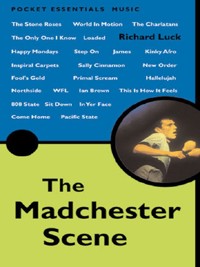
The Madchester Scene
In the 1990s, Manchester hosted the most exciting British music movement since the Two-Tone explosion of the '80s. The home of legendary acts such as New Order and The Smiths, the early '90s saw Manchester give birth to great groups like The Happy Mondays, James and The Stone Roses.
Blending the attitudes of The Fall and The Buzzcocks with cutting edge sampling techniques and the occasional chemical, these bands created the superb 'Madchester' sound. Of course, no sooner had the apple cart been upset than the scene began to suffocate under the weight of impostors. You need look no further than Primal Scream and Oasis to see that not all that was great about baggy died along with regional institutions like Factory Records and The Hacienda.
The Pocket Essential Madchester profiles all the major bands of the time, together with the groups that influenced them and the swines that ripped them off. The book also pays tribute to important local figures like impresario Tony Wilson and DJ Mark Radcliffe and doffs its cap to Michael Winterbottom's ambitious attempt to transfer the story to the big screen, 24 Hour Party People.
About the Author
Richard Luck is a regular contributor to Total Film and Hotdog who also writes for Empire, Premiere, Uncut and The Rough Guide To Rock. He is the author of Pocket Essentials on Steve McQueen, Sam Peckinpah and the guides to The Beastie Boys and The Madchester Scene.
To Harry, for making the Luck family happier than it ever
thought it could be.
This book is dedicated to the memory of Rob Gretton.
“I met Rob in town one day and he asked if he could manage us. I said: ‘yes, come down to rehearsals next Monday,’ but unfortunately I forgot to tell the rest of the group. So Rob turned up and everyone just turned round and said: ‘who’s this grey-haired, beer-swilling polar bear?’ So I said: ‘Forgot to tell you, forgot to tell you - he’s our new manager. How about it?’ So we gave him a trial and he turned out to be... very adequate.”
-Bernard Sumner, Joy Division/New Order
Acknowledgements
Many, many thanks to: my sister-in-law Emma who somehow balanced subbing and research duties with the ordeals that are raising a young child and being married to my brother; to Matt Jeary for web surfing above and beyond the call of duty; to Dan Jolin, my reviews editor at Total Film, for giving me the inside rub on 24 Hour Party People; to Al Spicer, Mark Ellingham and Jonathan Buckley for breaking me in as a music writer; to Paul Duncan and Ion Mills for so many reasons; and to John Ashbrook for the greatest gift a friend can give - a career.
CONTENTS
1. Wrote For Luck
A preface by the author
2. Madchester - So Much To Answer For
An introduction to the scene with snapshots of some of its personalities
3. Forefathers
Buzzcocks, Joy Division, New Order, The Fall, The Smiths
4. The Big Two
The Stone Roses, Happy Mondays
5. The Also-Bands
The Charlatans, James, Inspiral Carpets, 808 State, Primal Scream, Electronic, Oasis
6. Lost In Music
The bands that didn’t make it: Northside, The Mock Turtles, Flowered Up, The High
7. Bog Awful Baggy
Bands that just didn’t get it: EMF, The Farm, Jesus Jones, Blur, The Soup Dragons, Candy Flip
8. Rave On?
Madchester lives on in the film 24 Hour Party People
9. Reference Materials
Books, videos, DVDs and Websites
1. Wrote For Luck
“I’ve finally got a group,” exclaimed the then 26-year-old Ewan McGregor to Neon magazine in 1997 on having fallen in love with Oasis. It took me a long time to find a band, too -not as freakishly long as Ewan but a long time, nonetheless. I’d been buying records for years (pretty haphazardly, mind you. I’m sure I was one of the few 13-year-olds to own records by both Grandmaster Flash and Bucks Fizz), but while I’d bought copies of ‘Shellshock’ and ‘State Of The Nation,’ it wasn’t until the release of the New Order compilation Substance and the single ‘True Faith’ that I truly found my sound.
I can’t really put my finger on the appeal of New Order and perhaps that’s how it should be. But I can say that I liked the story behind the band. I was impressed by their earlier work as Joy Division. I respected them for what they’d gone through. I loved the sublime swash of their synthesisers and admired the fact that a skinny rabbit like Steven Morris could land a place in a pop group. I liked the fact that Bernard Sumner sung in a voice so fragile it couldn’t disguise his sincerity and I was choked by the fact that here was a band who told you how it is and then showed you how wonderful it could be. But what special ingredient X made me feel for them in ways I’d never felt about any other band, I couldn’t say and I couldn’t care. Within a month of buying Substance, I owned the entire New Order/Joy Division album back catalogue.
And from there, I became a follower of most things Madchester. I picked up The Stone Roses’ ‘Elephant Stone’ because it was produced by Peter Hook and then bought their debut album during the first week of release. I bought Academy, New Order’s awful concert video which came with a T-shirt so tight, even Posh Spice would have struggled to get into it. I was even one of those fresh-faced saps who wandered into Our Price and said: “Hello, have you got Bummed by the Happy Mondays?”
There were, I should point out, limits to my dedication. I never grew my hair long and the only hooded top I owned was the one I trained for rugby in. But my first gig couldn’t have featured a more Mancunian line-up (New Order supported by Happy Mondays) and I did pay a visit to the sainted city, although since I was on a rugby tour I was more concerned about my hamstring and my coach’s experimental decision to play me out of position than about visiting the Hacienda or experimenting with E.
Of course, I could have been a more committed member of the Madchester community. I could have bought more records, worn more appropriate clothes, taken any drugs. But 1990, the year the movement really hit its straps, was a ludicrously happy time for me - England’s glorious failure in the World Cup, visiting America and Paris, getting my rugby colours, passing A-Levels I expected to fail - and it’s because this music was the soundtrack to such a great summer that I remember it so fondly and have longed to write about it so badly.
Almost a decade on, my music tastes have changed. Now I listen to Blur, Air, Rage Against The Machine, Foo Fighters, Beastie Boys, De La Soul, DJ Shadow and Daft Punk. But despite all the years that have passed and all the records I’ve bought, the final revelation of The Stone Roses’ ‘Sally Cinnamon’ still chokes me up a bit, The Charlatans’ ‘The Only One I Know’ remains one of the few songs guaranteed to bring a smile to my face, Black Grape’s recapturing of the Mondays’ glory couldn’t have felt sweeter and I am happier than anyone that New Order never properly split up. And when The Stone Roses’ ‘Fools Gold’ came on the sound system at LA2 on Charing Cross Road in the early hours of 1 September 2001, do you think I was there dancing like a primate with the rest of the throng? Well of course I wasn’t! I’m 29 for fuck’s sake! I did feel pretty privileged that I was writing a book about them, mind you.
Richard Luck
Welwyn Garden City, September 2001
2. Madchester - So Much To Answer For
“Madchester - what a name! Best name ever for a scene, wasn’t it?”
- Clint Boon, Inspiral Carpets
‘And on the eighth day, God created Madchester.’ That was a T-shirt slogan you saw quite a lot of in the late 1980s and early 1990s. (Tops were also available which claimed that the miracle occurred on the Lord’s sixth or seventh day at the office.) It wasn’t the only weird thing appearing on leisurewear around that time. You could also buy gear sporting the blandest of monikers, Joe Bloggs, or carrying obscure out-of-context phrases like ‘Come Hone.’ Or, if you preferred, you could purchase a T-shirt baring an image of a mashed-up cow smoking a spliff and the legend ‘Cool As Fuck.’
The one thing you didn’t see a lot of back then were shirts bearing the crests of Manchester City or Manchester United. Utterly dominant in recent years, it’s incredible to think that Man U were really on the ropes at the ass end of the 1980s. Outside of a few FA Cup wins, the team had achieved little during the decade outside of sacking managers, fielding players who weren’t up to the task (Mike Duxbury, anyone?) and getting ever so frightfully pissed off about finishing second to Liverpool. As for the men from Maine Road, meanwhile, their parlous state was best summed up by Steve Coogan’s pissed-up, pissed-off scrounger Paul Calf: “I had a trial for Man City but I was terrible - missed an open goal, headed it into my own net, I was absolutely shite. Anyway, they offered me a place... but I was sixteen - I wanted to concentrate on smoking. But you can say what you like about Manchester City. You can say they’ve gone down, you can say they’re rubbish, you can say they’re the biggest shower of shite you’ve ever seen but... I forget the original point I was making.”
As soccer was always seen as being the heartbeat of Manchester, you’d imagine this sort of failure might have caused a metropolis-sized depression. But it didn’t and the reason it didn’t was the most exciting musical movement since the Two-Tone explosion of a decade earlier: Madchester.
But what was Madchester? Well, like a lot of youth movements, Madchester was about being young, dumb and full of come. But it was about so many other things. Yes, it was about being naïve, but it was also about knowing yourself. It was about having a bit of money, a plectrum and a few grams of your ‘medicine’ of choice in your pocket. It was about drinking beer but also quaffing litre after litre of water. It was about altering Manchester street signs so that they now carried the name of the scene. It was about experimenting with E, blagging bennies and coke, and maybe even rediscovering glue. It was about eating stodge just to soak up the booze and pick up the ‘poison.’ It was about talking in an exaggerated Mancunian accent whether you came from Hulme or Hythe. It was about using words and phrases like ‘bangin’,’ ‘sorted,’ ‘crackin’,’ ‘top one,’ ‘kickin’,’ ‘blindin’’ and ‘on one.’ It was about growing your hair really long and then cutting it with the aid of a bowl. It was about buggering up your posture, hunching up your shoulders, scuffing your feet on the floor when you walked and swinging your arms like you were Galen from Planet Of The Apes. It was about dancing like a monkey. It was about staying out so late, you got up before you fell asleep. It was about constantly looking as if you were in need of a few hours kip and a gallon of orange juice. It was about romanticising gang culture and graffiti even though you probably weren’t in a gang and almost certainly didn’t own an aerosol. It was about hanging outside warehouses on the off chance that there was something going down inside and thinking that it would be great to be a drug dealer even though you were probably going to wind up working in a bank. What’s more, it was about owning albums such as Happy Mondays’ Bummed and Pills ‘N’ Thrills & Bellyaches, Inspiral Carpets’ Life, James’ Gold Mother and The Stone Roses’ er... The Stone Roses. It was about referring to yourself as a ‘scally’ irrespective of the term’s negative connotations. It was about pouring a pint of lager over your head at the Hacienda i) to help you cool down and ii) because you felt like it. It was about wearing outsized T-shirts, huge hooded tops and bog-awful beanie hats. It was about sporting labels like Reebok, Kangol and Joe Bloggs. It was about wearing a pair of jeans with 19 inch bottoms that threatened to trip you up every time you took a step. It was about learning to like a city in spite of its shite weather, hideous 1960s architecture and absence of certainties. It was about realising that no matter how shit things got, there was another great Saturday night just around the corner. It was about realising how terrifying life was and then choosing not to be afraid. And it was about realising the whole world was against you and then saying: “OK, let’s have it!”
So when did this party begin? Opinion is divided although people certainly agree that the North was well and truly at its heights when Spike Island, a massive concert, was staged in Widnes. It was headlined by The Stone Roses and proved that the scene could support a gig that rivalled Knebworth for size if not organisation, situation and sound quality. There’s also little argument about when the scene hit the mainstream. Jackie Brambles and Jenni Powell were the hosts who brought you that 29 November 1989 edition of Top Of The Pops. The line-up that evening featured two Manchester acts, Happy Mondays and The Stone Roses. To be fair, the performances they gave that night were pretty lacklustre. Shaun Ryder struggled to remember the lyrics to ‘Hallelujah’ that he was supposed to lip-synch to, Ian Brown looked like he couldn’t be bothered as he performed his simian shuffle to ‘Fools Gold’; shit, if it hadn’t been for the immaculate Kirsty McColl who guested with the Mondays that night, you could easily have overlooked either band. Mondays’ dancer/vibe merchant Bez knew exactly why the groups appeared so ambivalent: “The thing about Top Of The Pops is that it’s the most boring, crap day you’ve ever had. It looks great on television but in reality you’re just stuck in a room with a mirror, a sink, a chair and yourselves for company.” Top Of The Pops producer Chris Cowey, though, thought the bands were both brilliant: “It was just a complete breath of fresh air. You could feel the brooding resentment, bollocks-to-the-lot-of-you attitude coming right down the camera.” Regardless of whether The Roses and Mondays were brilliant or bloody awful, by the time the show went off air, the whole country had heard of Madchester.
And as for what happened next, well, it was really quite beautiful. A small but gifted band of bands sprung up across the North-West like Oldham’s Inspiral Carpets, the idiosyncratic James, the synthesiser and sample driven 808 State. You couldn’t ignore them and you couldn’t deny they were talented. And then groups in other parts of the country like The Charlatans from Wolverhampton and London/Glasgow’s Primal Scream started to make music along similar lines, turning a local scene into a national phenomenon. Hip comedians like Rob Newman and David Baddiel made maligning Manchester a key part of their act (as well as Newman claiming that Myra Hindley should have been given a few more weeks freedom so she could have seen to James’ Tim Booth and The Charlatans’ Tim Burgess, the pair donned Mondays’ mufti so that New-man’s Ryder could ask Baddiel’s Bez exactly what it was he paid him to do). Scally fashions started to be worn in places as far afield as Sittingbourne, Scarborough and Stirling. The city became the place to go to university. As critic and author John Robb explained: “If you’re 18 with three A-levels, where do you want to go? Do you want to go to York because it’s got lots of beautiful old buildings, or do you want to go to a city where you can party like mad? You want to go to the party city. Unless you’re stupid.” People began to flock to Manchester like it was an exotic holiday destination. TV presenter Gail Porter: “I went to Manchester for a weekend and stayed for three months.” They talked about the Hacienda nightclub in awed tones. They made a big deal about Dry, the bar owned by New Order. They did the pills. They enjoyed the thrills. They put up with the bellyaches. They partied. Hard. “The thing about the 1960s,” Robb continues, “was that there were two people in London having a party and everyone else was trying to find it. But I think Manchester was the opposite - you had 200,000 people having a party and anyone could find it.”
The beat Madchester grooved to had three basic components. The first of these was funk, but we’re not talking about that nice, smooth American funk that came out of Philadelphia during the 1970s. We’re not even talking about the crazy-ass, aliens-in-the-ghetto, drug-induced P-funk that George Clinton made so popular. Madchester funk was an altogether scuzzier, more fucked-up affair. Raw, libidinous, deep down and dirty, it was a sound you couldn’t resist but you felt like you ought to have a shower the moment you stopped listening to it.
Madchester was also characterised by a distinctive guitar sound. It had its origins in the 1960s but it was hard to trace the evolutionary path as this, too, had been dirtied up. Yes, there was a trace of the Merseybeat jangle, an element of The Kinks, a bit of The Byrds, a sniff of the Small Faces and you couldn’t help but identify elements of Johnny Marr but, again, Madchester’s artists had taken something invented elsewhere and put such a heavy, heady spin on it, that it now belonged to them.
Since so much emphasis was placed on accentuating the rawness of the music, someone or something was needed to add a sheen to the Madchester sound to enable it to cross over into the mainstream. The men for the job turned out to be not producers but DJs. Prior to the scene starting up, you tended to associate the term DJ with entities like Radio One. With the arrival of 808 State, who were basically a bunch of DJs who experimented with keyboards, and Factory Records’ decision to let club kings Steve Osborne and Paul Oakenfold remix the Mondays’ Pills ‘N’ Thrills... not only did the Madchester sound acquire a slightly cleaner, more commercial edge but the foundations had been laid for the DJ culture that was to engulf Britain towards the end of the 1990s.
Of course, it wasn’t quite that straightforward. There were other influences like the attitudes of punk and the dance sounds coming out of Ibiza, New York and Detroit. It’s also worth noting that baggy bands weren’t just looking overseas or to the distant past for inspiration. Indeed, Happy Monday Shaun Ryder had clearly been checking out contemporary British acts like Big Audio Dynamite, whose blend of reggae beats, hip hop breaks, alternative guitar and film dialogue samples came on like a more polished version of the Mondays’ early recordings. The precision work of DJs is of special interest, however, since it was a little at odds with the general Madchester ethos. Not being able to play your instruments had been a prerequisite of being a musician in Manchester ever since the 1970s. Indeed, one of the reasons New Order hired Gillian Gilbert in 1980 was because she wasn’t particularly skilled, just like the three incumbent members of the group. By the time Madchester was in full swing, the ‘have guitar, can’t play’ ethos had reached ridiculous levels. That a man like Mark ‘Bez’ Berry could have been in a band, Happy Mondays, for almost a decade despite the fact that his abilities extended to dancing badly and shaking the occasional maraca said a lot about the movement’s attitude towards musicianship. It’s not even as if anyone tried to disguise Bez’s ineptitude. Originally listed as the group’s percussionist, when the Mondays’ second album was released the contributors’ list began with ‘Shaun Ryder - vocals’ and ended with ‘Bez - Bez.’ That was his job; being himself. But then that was what Madchester was really all about.
However, there was a lot more to the Madchester scene than just music. The movement was a genuine cultural phenomenon that affected all media and even coloured the country’s social history. And so here for your nostalgic enjoyment are just some of the things that Manchester had to answer for: cultural phenomena and fashions, people and places that illustrate the time and the place and without which the baggy boom might have been a mere whimper.
Tony Wilson
Variously recognised as a Cambridge graduate, TV presenter, documentary film-maker, game show host, nightclub owner and “twat” (according to Peter Hook), Anthony H Wilson is perhaps best known as the co-founder of Factory Records.
Setting the label up with band manager Alan Erasmus and designer Peter Saville, Wilson funded Factory’s first release with £3,000 he’d been left by his mother. When he saw a return on that money, he knew he had enough to invest in a band he’d taken a liking to called Joy Division. Arranging a lunchtime meeting with the group’s manager Rob Gretton, Wilson penned a contract on a napkin that was so generous towards Joy Division as to be almost ludicrous. So began Factory’s policy of blending extreme generosity (the label’s 18% royalty policy compared favourably with the industry standard of 12-15%) with naïveté that was as charming as it could be crippling.




