


9,59 €
Mehr erfahren.
- Herausgeber: Salt
- Kategorie: Gesellschafts- und Liebesromane
- Sprache: Englisch
The stories in The Manet Girl explore sexual relations – from both male and female points of view – in the present, but sometimes with a backdrop of several decades. Stories of desire and confusion – other men and other women – sit alongside stories of art – galleries, studios, allusions to painters – which gets in the way as least as often as it illuminates. Choices are made, in the knowledge that distractions may be the most important things of all.
Das E-Book können Sie in Legimi-Apps oder einer beliebigen App lesen, die das folgende Format unterstützen:
Veröffentlichungsjahr: 2013
Ähnliche



















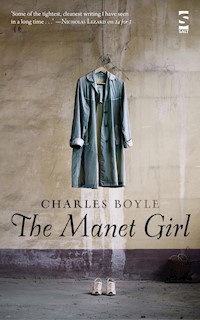
The Manet Girl
The stories in The Manet Girl explore sexual relations – from both male and female points of view – in the present, but sometimes with a backdrop of several decades. Stories of desire and confusion – other men and other women – sit alongside stories of art – galleries, studios, allusions to painters – which gets in the way as least as often as it illuminates. Choices are made, in the knowledge that distractions may be the most important things of all.
Praise for Charles Boyle
‘Some of the tightest, cleanest writing I have seen in a long time . . . This is a little marvel of a novella. It’s funny, clever, illuminating, deeply kind-hearted, and doesn’t outstay its welcome. It’s not self-indulgent: things happen in it, surprising things, like in an old-fashioned novel, yet it’s perfectly contemporary; and every word has been chosen with subtle care.’ —Nicholas Lezard on 24 for 3
‘Ingeniously observed, clever, elliptical and funny. It’s like the best moments from a novel – minus the padding.’ —Geoff Dyer on Days and Nights in W12
‘Much cooler and funnier than Sebald’s baroque and melancholy meditations on place, Days and Nights in W12 lies somewhere between Walter Benjamin’s musings on Paris and Berlin and the wonderfully crazy mini-monologues that make up Thomas Bernhard’s The Voice Imitator. There is nothing else like it in English.’ —Gabriel Josipovici on Days and Nights in W12
The Manet Girl
CHARLES BOYLE has published a number of poetry collections (for which he was shortlisted for the T.S. Eliot, Forward and Whitbread Prizes), a short novel (winner of the 2008 McKitterick Prize) and two books combining text and photography. He runs the small press CB editions. This is his first book of stories.
Also by Charles Boyle
POETRY
The Very Man
Paleface
The Age of Cardboard and String
FICTION
(as Jennie Walker)
24 for 3
FICTION/NONFICTION
(as Jack Robinson)
Recessional
Days and Nights in W12
Published by Salt Publishing Ltd
12 Norwich Road, Cromer, Norfolk NR27 0AX
All rights reserved
Copyright © Charles Boyle, 2013
The right of Charles Boyle to be identified as the author of this work has been asserted by him in accordance with Section 77 of the Copyright, Designs and Patents Act1988.
This book is in copyright. Subject to statutory exception and to provisions of relevant collective licensing agreements, no reproduction of any part may take place without the written permission of Salt Publishing.
Salt Publishing 2013
Created by Salt Publishing Ltd
This book is sold subject to the conditions that it shall not, by way of trade or otherwise, be lent, re-sold, hired out,or otherwise circulated without the publisher’s prior consent in any form of binding or cover other than that in which it is published and without a similar condition including this condition being imposed on the subsequent purchaser.
ISBN 978 1 84471 960 0 electronic
I for my part have never been able to understand his figures nor, for all my asking, have I ever found anyone who does. In these frescoes one sees, in various attitudes, a man in one place, a woman standing in another, one figure accompanied by the head of a lion, another by an angel in the guise of a cupid; and heaven knows what it all means.
– Vasari, Lives of the Artists, on Giorgione
The Manet Girl
Budapest
In the kitchen, which is the room where they eat, an ancient peasant cat, no fancy breed, is lying awkwardly on a chair and panting, though the day is cold. No one is paying it attention. Beyond the window are clouds, fields, the kind of view people call uninterrupted.
He is trespassing, he has no right to be here, and it feels like freedom.
‘The wood across the valley is the largest in the county,’ James announces from the other end of the table, as if he had planted every tree himself.
‘There are wolves,’ C says quietly, looking at him, teasing.
‘They bay to the moon,’ he says.
‘They do more than that.’
‘Is it OK?’ asks the woman called Marcia. ‘Should we get it some water or something?’
She’s worrying about the cat, and he is wary of the drift. If anyone asks if he has animals of his own, he’ll say no. He has no affinity with dumb creatures. And yet just this week he has yielded to pressure – family pressure, normality pressure: he was cornered – and purchased a pair of rabbits for his pair of children. They squat, shivering with fear, or hunger. How is he to know? Their droppings are hard brown beads.
The cat is ill. It is a fuse easily lit, after so much wine and loosening of voices. James, C’s husband, is intent on spending a large amount of money on an operation to prolong its life. Let it go, C says, as if pushing it to the side of her plate. Anything else is selfishness, not love. He wants to spend that money for himself, truth be told. Take the cat in and bring it back hurt, bewildered, pawing at its shaved and mangled body, or take it in unknowing and put it down. A good life come to term, and no suffering. That is mercy.
He knows it is her marriage she is talking about. Every-thing here – the hand-painted plates on the dresser, the photographs, the scribbled lists and numbers of emergency plumbers – is a stage set, history, disposable. Excitement makes him tremble. He wants to turn to whoever is sitting next to him, which happens to be Marcia, and hug her. He knows that if anyone says even the weakest thing funny, he is danger of laughing too loud.
‘I’m sorry,’ C says, standing up. Lighter than skin, the folds of her dress cascade; he still has the ghost of it on his fingers from when they came in. She has, he’s noticed, a way of widening her eyes after speaking; she is not apologising at all. ‘Really, you shouldn’t be listening to this. Who wants more wine?’
Marcia puts her hand over the rim of her glass, as if she’s about to perform a conjuring trick. But James does want, pushing his own glass across the table. The gambling table: faites vos jeux. It occurs to him that James has him down as gay. There were meant to be just four around the table, C and James and Marcia and his brother, Maurice, recently widowed, whom she’d wanted to put together with Marcia, but when she called and his brother had explained that he happened to be staying then of course, why not.
Marcia is a counsellor, with devout opinions. Everything can be explained. Everyone else, to her, is like a pet, dependent. James is a retired lawyer, a former colleague of his brother’s; he is, or was, a brilliant mind, his brother has said. C is his fate. A few weeks from now – sooner, sooner – she will turn to him in bed, and say: ‘James thought you were gay.’ He is sure of this. Her hand will be toying with him, she will be everything he has waited for.
‘Did you?’
‘He still does.’
Across the street, Marcia is coming out of the village bookshop with Maurice. She turns away, but they have seen her. There is a pause, until the road is clear, and then they are surrounding her with their togetherness, thanking her for the lunch, fumbling with bags, showing her what they have bought in the bookshop. She is not surprised.
Maurice has sprained his wrist. He parades his bandage. He was putting the lawnmower back in the shed; he slipped, he fell, he put out a hand to save himself, and now this. For all that he is a lawyer, it’s a wonder he didn’t electrocute himself too. Men are so helpless. He can’t even work a tin-opener. Marcia is cooking for him.
‘He did everything, for years and years,’ Marcia says. She means for Alice, Maurice’s wife, who is dead, who died of complications. Alice was alcoholic, everyone knows this.
‘And really, it’s bloody difficult,’ Marcia goes on. She is gleeful, victorious. ‘He’s so stubborn. He’s given so much he’s forgotten how to take. It’s the harder thing, of course, but just as important. We’re starting from scratch.’
She has known Marcia for a decade, longer. She is happy for her. She hadn’t conceived that life could be so simple.
‘She’s a good teacher,’ says Maurice, a schoolboyish gleam in his eyes that takes her aback. He likes his food.
The eyes, yes, and other small things too – the way he tilts his head to the left when he’s listening – though there is little obvious physical resemblance between the brothers, nothing you’d notice at first glance. She suspects that they get on but they are not close, these brothers. They see things in each other that they don’t like about themselves, they are happy to stay out of range. Brotherhood: the roles assumed, the competition, one pitching camp where the other leaves space unguarded.
Maurice is still looking at her, awaiting a blessing.
She is beginning to think like Marcia, to analyse, which is a form of helplessness. She looks over Maurice’s shoulder: the street, the weathered stone buildings, the shopkeepers who chat and ask neutral questions and tot up little sums; and then the green hills, as still as on the picture postcards. The names on the village war memorial – Atkinson, Hancock, Smith, Weatherspoon – are a mantra that holds this place in its grip. She met Alice only twice, maybe three times. Once at a law society dinner. There had been a point at which she’d been completely beautiful. Her glance was withering. It was a long marriage; there are children somewhere, out in the world, Hong Kong, Australia. The weather is mild, changeable. At the weekend it will be hot. The traffic on this street gets worse every year. Marcia and Maurice head off towards the post office, her hand cupping his elbow.
She has a flat in town – really it is her husband’s flat, James’s, there are law books in glass-fronted bookcases, but since he retired it’s almost never used. He wakes in her bed to the sound of shouting voices and the screech of tyres. A fight in the street, he thinks. Grey light, sometime around dawn. Naked, he walks through to the living room and finds her sitting cross-legged on the floor, watching a film on TV. He strokes her hair. Leaning back into his shoulder, she pats the floor for him sit beside beside her. Together they watch two women driving fast through small towns, on the run. She will watch to the end, even though the end is foretold by the music. After half an hour, with the heating still not come on, he sweeps the covering from the sofa and wraps it around them.
Daily, the world reveals more of itself. Sometimes he feels like a tourist in his own city. He talks to strangers. He tells her about the man he met while walking through the park, a man like a gypsy with his hair twisted around the strap at the back of his baseball cap. The man said he was from the north of Sweden, the far north, and he was a poet – would he like to hear a poem? He said he would rather hear a joke. The man told him a long joke, it must have gone on for at least five minutes, entirely in Swedish or some remote dialect from beyond the Arctic Circle, and by the end the man was doubled up, laughing uncontrollably. She laughs too, not just with her face but her toes, her fingers, her belly.
Or he is waiting at the barrier when the train comes in and does its meek slow stop and the doors open and the people file through, the busy ones checking their watches and the old women who have been travelling since the days of porters and the students with their crass but ergonomic backpacks, and he carries on waiting till the platform is bare as a seaside promenade in winter and she isn’t there. What she teaches her lovers, he thinks, and not for the first time, is patience.
There are days when there’s white cloud all morning and mizzly rain in the afternoon and then at seven in the evening the sky clears to china blue and the sun shines undimmed as if it’s never put a foot wrong in its life.
Not patience of the kind that’s deemed a virtue (it isn’t). There’ve been times when, heading to her flat, they haven’t been able to wait but have ducked into an alleyway and torn at each other’s clothing.
He goes home. It would fit better if when he comes in his wife is peeling carrrots but she isn’t, she’s just standing in the kitchen knowing there is a next thing to do but having lost track.
‘Did you get the . . . ?’ she asks.
‘The milk?’
‘The milk, yes. We’re out.’
‘I forgot,’ he says. ‘I’m sorry.’
From his room at the top of the house where he now sleeps he can see the rabbit cage in the garden, and his younger child sitting cross-legged in front of it. No sign of the rabbits. They are in their hutch, their little room, sulking.
He phones her. He doesn’t leave a message.
On the way to the station, he decides, she came across a maimed owl, which needed putting back in one piece. Or just as she was about to leave a friend called her from Romania, or maybe Hungary – which country is Budapest the capital of? – in tears. She has a problem with time-tables, with the 24-hour clock. She doesn’t wear a watch. Her appetite is limitless and like most people with appetite she is also generous. When he pulls on clothes and says he must go she kicks off the sheets and opens her legs, offering, asking to be kissed, lips to lips.
He is late, so often these days, but his son is still there, cross-legged, in front of the rabbits’ cage, waiting for them to appear. All day, all night if need be. Where it comes from, this stubbornness, this dedication, he has no idea. He cannot recall when he has been more proud. If this is his son, he cannot be all that bad: this a way, one of many he knows, of damning himself.
The rabbits, he thinks, have been eaten by a fox – there are plenty around, probably more than where she is, in the countryside – but there is no litter of tufts of fur and bloody scraps. Or they have escaped, are returning to the wild, in which case they will not survive for long.
His phone rings. She tells him she’s tired, that today has not been the best of days, that –
‘When will I see you?’
She’s not sure – the weekend, maybe. She’ll come up on Saturday, yes. Saturday early.
‘The milk train?’ he says. Then he asks after the cat.
There is no cat. The cat disappeared, she says, weeks ago. She has heard of this before: they have some instinct that tells them their time is drawing near, and they go off alone to meet their maker in private.
When he looks out of the window again his son is not there but the rabbits are, out of their hutch and pressed up against the wire. He closes his eyes and sees the wood across the valley, ‘the largest in the county’; he enters its shade, its darkness, hears rustlings and flutterings and sudden sharp cries. Though they have done nothing to deserve it – but when was anything decided on merit? – animals have the last word, even the last laugh. They are primed for this, it’s in their genetic engineering. The thought is like a mouthful of food that tastes very different from what you’d expected, from what you’d imagined.
A year later C is in Budapest, visiting Hannah. Hand-luggage only, and she still doesn’t wear a watch. Instead, on her wrist there is a sequence of numbers, written in biro and starting to smudge. It is a cold afternoon, autumn, but they are eating outside, on a terrace. Life is complicated. Also with them, but not just now at the table, is a Peruvian child, a boy of around six, with flat black hair and eyes so clear and deep she could swim in them.
‘Oh, him,’ she says, in answer to something Hannah has said. Him, in distinction from the other him, James, whom they’ve been talking about for the past half hour. It’s like being part of a reading group, discussing the characters.
She is holding a stuffed animal, a sheep, which the boy has more than relinquished. He is over there, crouched in a corner of the terrace, exploring. They have been swimming in the pool of an old and expensive hotel that predates the Communist era and has come out the other side with surly changing-room attendants untrained in the ways of customer service. She feels lucky to have all her life been free.
Except that she is not free. She feels she is on the set of a film, whether farce or thriller she doesn’t yet know. The boy is the adopted child of Hannah and her Hungarian husband; the husband has been cast adrift by Hannah but is determined to climb back on board and has taken to following them around, stalking them. He refuses to drown. Hence the numbers inked on her hand, which she must punch into the alarm system in Hannah’s apartment within ten seconds of entering. She scrabbles around in the dark, trying not to panic, imagining that she will be arrested and taken to an underground cellar and interrogated under a blinding light and will have her fingernails slowly pulled out.
‘He has wonderful eyes,’ she says. And adds, having given herself the cue: ‘He has a wonderful cock. Effervescent.’
The boy comes to his mother with a spider cupped in his hands. ‘A boy spider or a girl spider?’ he wants to know. He speaks English like an American. (This, she has been meaning to say, is why Hannah cannot leave him alone in the apartment while she’s at work, alone with the TV tuned to American game-shows; and why she herself cannot abide indoors for more than an hour in that clean, functional but badly windowed flat, where you have to switch on a light even to make breakfast; why she must take the boy out and thereby condemn herself to the frantic punching of the code on the keypad when they have run out of things to do. But she has only been here for two days.)
‘For god’s sake,’ Hannah says, laughing. She is happy, or believes she is. She delivers a lecture on the good life – Hannah is not unlike Marcia, in her belief that life can be made to fit – while all the time attending to the boy’s asking, asking. Why do spiders have so many legs? How long do spiders live? Is this a baby spider or a grown-up?




