


Erhalten Sie Zugang zu diesem und mehr als 300000 Büchern ab EUR 5,99 monatlich.
- Herausgeber: Banipal Books
- Kategorie: Gesellschafts- und Liebesromane
- Sprache: Englisch
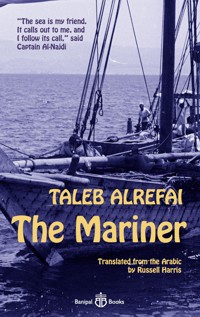
Taleb Alrefai turns a spotlight on Kuwait's pearl-fishing history in this enthralling fictional re-telling of that fateful day, 19 February 1979, when the country's famous dhow shipmaster Captain Al-Najdi is lost at sea in a treacherous storm. In between fishing for seabream with two friends, the retired mariner looks back on how the sea has been calling him since childhood, on the punishing work of pearl-divers, and how he became a captain at 14. As he recalls his voyages around the Arabian Peninsula, some with renowned Australian sailor Alan Villiers, he meditates on how the sea was abandoned when pearl-fishing ended with the discovery of synthetic pearls and oil. In a kind of revenge, howling winds and enormous black waves suddenly erupt and quickly engulf the small fishing boat.
Sie lesen das E-Book in den Legimi-Apps auf:
Seitenzahl: 151
Veröffentlichungsjahr: 2020
Das E-Book (TTS) können Sie hören im Abo „Legimi Premium” in Legimi-Apps auf:
Ähnliche



















The Mariner
The Mariner
First published in English translationby Banipal Books, London 2020
English translation copyright © Russell Harris, 2019
First published in Arabic 2004
Original title: Al-Najdi
published by Manshurat Thatalsalasil, Kuwait, 2017
© Taleb Alrefai 2017
The moral right of Tayeb Alrefai to be identified as the author of this work and of Russell Harris to be identified as the translator of this work have been asserted in accordance with the Copyright, Designs and Patents Act, 1988.
No part of this book may be reproduced in any form or by any means without the prior written permission of the publisher
Cover photograph by Alan Villiers
© National Maritime Museum, Greenwich, London
A CIP record for this book is available in the British Library
ISBN 978-1-913043-08-7
E-book: ISBN: 978-1-913043-09-4
Banipal Books
1 Gough Square, LONDON EC4A 3DE, UK
www.banipal.co.uk/banipalbooks/
Banipal Books is an imprint of Banipal Publishing
Typeset in Bembo
To Abd al-Aziz al-Dakheil
A lifelong friend and brother
The walled city of Kuwait does not appear at its best, seen from the anchorage, but it has one of the most interesting waterfronts in the world. There are more than two miles of it, and the place is one great shipyard of Arab dhows. All along the waterfront, running east and west along the shore of the shallow bay … the big ships and the little ships jostle one another.
Alan VilliersSons of Sindbad (London, 1940)
This novel is a fictional retelling of what might well have happened to Captain Ali Nasser Al-Najdi, and is based on real events that took place on Monday 19 February 1979.
Chapter 1
11:30 a.m.
“Come.”
I was perhaps five years old, I remember, the first time I heard the call of the sea. I was a child sitting on the front stoop of our old home in the Sharq neighbourhood, where a narrow dirt path separated our family home from the coast. I never stopped hoping I’d see the dhows lying on their sides on the sandy shore, and behind them the sea. A strange question would whisper inside my heart: What had the sea done with the big ships to make them so small on its distant lap?
The sea went on calling me:
“Come.”
Wearily, the sun sank down to sleep in the depths of the sea, as the sky spread the ashes of darkness across our house’s outer walls and inside our rooms. My sister Maryam sat in the courtyard, busily wiping soot from the glass lanterns. She’d wind a rag around her small hand and push it inside the glass mouth to clean the insides. Beside her sat my mother Fatima, who seemed distracted, yet was closely watching the movements of my sister’s hands. I left them to go to my sister Latifa back in the kitchen, as I loved to eat flatbread hot from her hands. She would peel a loaf from the metal griddle, then wave it in the air to cool before handing it to me. She noticed me and said with a smile:
“Come back in a bit, and I’ll have your bread.”
I told no one about how the sea called to me. I evaded my mother and sisters and slipped out of the house.
When darkness heard the voice of the muezzin calling the evening prayer, it descended from the sky. Because men were afraid to face the dark, they stopped work and hurried off to the mosque for prostrations and prayers. The path in front of our house was empty of passers-by, except for a few boys running to the mosque.
I was not afraid of the dark. In a moment, I’d crossed the dirt road, and my bare feet sank into the sand. Here, I heard the call of the sea more clearly:
“Come.”
I sat on the damp sand and looked into the distance, to where the sea meets the sky. How many times I’d wished I could walk upon the sea! I’d imagined I could walk all the way out, between the sea and sky. My head would be in the clouds while my feet were on the water. I stretched out on the wet sand. I don’t know how the breeze came over me, nor how the darkness closed my eyes. “Ali. Ali.”
The repeated calls snatched the covers off my slumber, and I became aware of the cold damp sand against my ribs.
“Ali.”
I opened my eyes in the darkness. The roar of the waves quickened and filled my ears, chasing away my drowsiness.
“Ali!” I recognized the sound of my father calling me.
“Yes.”
I saw two ghostly shapes fighting their way through the darkness: my father carrying a lantern and, at his side, my oldest brother Ibrahim.
“God forgive you, ” Ibrahim said. “We’ve been looking for you for the past hour.”
They came nearer, and I stood and took refuge in the folds of my father’s dishdasha. He handed the lantern to Ibrahim and lifted me to his chest, kissing me. “My son.”
In that moment, I was afraid. I felt I’d made a mistake.
“What if our neighbours, the Fadala children, hadn’t seen you heading down to the sea?” Ibrahim asked.
“Don’t ever do this again, ” my father told me, adding: “The sea could take you, and then you’d drown.”
“I wouldn’t drown.”
My father stopped, as did Ibrahim, who was holding up the lantern. I looked into my father’s face.
“The sea’s my friend, ” I told him.
Behind me, a wave echoed with words I didn’t understand.
“The sea doesn’t have friends, ” my father said, with a note of pain in his voice.
I held back the question: Why doesn’t the sea have friends?
* * *
Now, memories come flooding back to me. On that day, I was five years old. More than sixty-five years have passed since that night. Rest in peace, Father. I wish you’d lived to see how your son befriended the sea, and how the sea offered him friendship and gave him life in all its abundance. But Father, the secret call of the sea still fascinates me. Fate decreed that your son be born a mariner whose sights were set only on the sea.
Father, in your hands I became a sailor and a captain – a nakhoda. I first sailed the sea on your boat, at your side, with you as the captain. I too became one when still a young man, and so the sailors and the people of Kuwait came to call me “Nakhoda”.
Father, I am the shark that dies the moment it leaves the sea. Since I left it, life has abandoned me. The loneliness and desolation of dry land have not stopped gnawing at my soul ever since I embraced the sea. It calls to me, and I go to it, as if hypnotized. I have lived my life in its vast house. Many times, it was cruel to me, but it has never forsaken me.
Father, did you ever imagine such a friendship between the sea and a man? Between the sea and a drop? I am that drop in the heart of the sea.
I set aside Sons of Sindbad, written by my friend, the Australian captain Alan Villiers. The book tells of his travels with me on my dhow, the Bayan. For the last two days, I have been leafing through its pages. I read bits of it and look at the pictures: ones he took of me and the sailors, of sections of the dhow, and of the seaports.
It was more than ten years ago that a friend gave it to me: “Published by the Arab Book House in Beirut”.
I long for these memories of my time at sea, and I return to the book. I leaf through its pages, and with it, the stages of my life. I re-live its most beautiful moments. The trip I can never forget.
I sit down with my wife. “Noura, ” I say. She turns toward me.
“Listen to what Captain Alan says about your husband the first time we met, in the office of the merchant Ali Abdellatif al-Hamd in Aden.”
I read to her: “He was a small, slight man …”
“You aren’t small, ” Noura interrupted.
“Alan was tall, so he thought I was short. Listen to what else he has to say: “with a strong face …”
“Your face isn’t strong.”
I smiled at her and went on reading: “He was handsome, in his own way, with an oval face, a close-clipped black moustache, a hawk nose, and a well-defined, determined chin. He was wiry and lean, and he looked strong …”
“Well that’s true, ” Noura said with a laugh.
“Just listen. Listen! ‘There was about his face and all of him an air of strength and goodness, and of alert ability which augured well for any ship he might command, and of complete self-assurance which boded ill for any who tried to thwart him …’”
“That sounds right.” Noura cheerfully interrupted. I looked at her. A deceptive calm fell between us.
And before me the sea.
Yesterday, when we were having our nightly get-together in my diwaniya, I came to an agreement with Abd al-Wahab and Sulayman:
“Tomorrow, we’ll go fishing.”
This was not the first time. We scarcely went more than a week without a fishing trip together.
“I’ll be at your place before the noon prayer, ” Abd al-Wahab had said.
“You’re welcome, I’ll be waiting for you two.”
“Noura, ” I call to her, so she’ll look up from where she’s sitting. “Abd al-Wahab and his brother Sulayman are coming over here.”
This statement surprises her. She realises I’m planning to go out to sea.
“The sea, ” she says, her voice tensing with affectionate reproach. “The sea has bewitched you!”
That happened a long time ago. It has been a lifelong love affair.
A cloud moves across her face. “Stay with me today.”
Her request is strange. She adds, in a pleading tone, “Don’t go.”
My heart is touched by something hidden in her tone. I wish I could do as she asks, but I say: “We’ve already arranged it.”
“Make an excuse. Say the weather’s too cold.”
“I can’t. The two of them are on their way by now, and they might be here any moment.”
“It’s no use, it’s your nature. Your words never change, and you never back down.”
“A man’s worth is in his word, Noura.”
I notice her staring at my face.
“We agreed on this yesterday.”
She stays silent, but her restless gaze says everything. I smile and urge her: “Say it.”
“I’m afraid for you. May God prolong your life, you’re over seventy.”
“The sea brings youth back to my soul.”
“May God keep you safe, ” she says resignedly, then asks: “When will you be back?”
I hadn’t yet given that a thought, nor come to any agreement with Abd al-Wahab or Sulayman.
“I don’t know.”
She keeps looking at me, waiting for a clarification.
“We’ll be back by evening.”
“Your attachment to the sea makes me anxious.”
“The sea’s my second home.”
What I don’t tell her is that the sea is calling to me. I remember what I’d said many times to my friend Captain Abdallah al-Qutami: My end will be in the sea. I pity Noura, and don’t tell her about this.
It’s as if I can hear the sea calling out to me, “Come.”
“Do you want me to make something to take with you?” Noura asks.
“There’s no need, I already arranged it with Abd al-Wahab and Sulayman … I’d better get changed before they arrive.”
“Don’t be late coming home.”
“I’ll try.”
I stand up, holding the book. Noura follows me with her eyes. I smile at her and say: “Listen. Let me read you what Alan Villiers wrote about the Kuwaiti sailors once he’d got to know them, and then you might forgive their love of the sea.”
I flip through the book’s pages. “Listen: ‘I had grown to like the Arabs, especially this … group of Sindbads who dwelt on our poop. Sindbad himself if he ever existed … could not have concocted adventures such as were commonplace with them.”
Noura looks at me, and I add: “Alan was talking about the Kuwaitis when he gave his book its title.”
“I know, Abu Husayn. You’ve told me that already.”
I give her a farewell smile: “I’ll go and get changed.”
* * *
Noura had set aside a special section in the wardrobe for my clean seafaring clothes. A few days ago, my eldest grandson Nasser told me: “One of al-Rabah’s sons says hello.” I looked at him, and he added: “He sees you when you visit the shop of Ahmad al-Rabah, his grandfather.”
I tried to call the shop and the boy’s appearance to mind. Smiling, Nasser added: “He’s impressed by your style. He told me ‘Your grandfather always has such clean and neatly ironed clothes and cloak, which smell of incense and agarwood oil.’”
“Your friend flatters me.”
Nasser laughed. “No, Grandpa, everyone knows how much care you put into looking smart.”
He said nothing for a few seconds and then added: “My friend says they can smell you coming.”
* * *
I put on my heavy sea-going dishdasha and place a kufiyah on my head. I walk up to Noura and give her a farewell look.
“May God keep you safe.”
“We’ll be in God’s hands.”
I go out and stand by the door.
My house is in the Kayfan neighbourhood, which is beside Shamiya. The only sounds are those of the passing cars. The small dirt road still separates my house from the sea, which I can no longer see when I open the door. The damp smell of the sea washes over me, reviving me, and it stays with me as I walk.
The air is cold. It’s February. You’re old now, Ali. You have to take the cold into account.
* * *
Two days earlier, when I began leafing through Alan’s book, the pictures had rekindled my love of the sea. My boat came back to me, with me sitting in my special spot, or standing beside the tiller. My thoughts flashed back to the mast, the sails, the crew, the songs, and the harbours. I remembered the words of Yusuf al-Shirazi, that kind sailor who was in my service: “You’re the most important mast on the boat, Captain.”
The days of my youth come back to me: how I’d sailed with my friend Captain Abdallah al-Qutami from one port to another, from one country to another, to buy and to sell. How we built good relationships and gave friendly gifts to the elders and notables of the tribes all down the cost of Southern Arabia. Abdallah used to say to me:
“Such extravagance.”
I would smile back at him and say:
“That’s how the business is won.”
He would keep looking at me, and I would add:
“Generosity is good for humanity.”
The photographs in the book stirred my memories of the days that had been dimming in my heart. I saw many faces without knowing from whence they’d come. I could see myself hoisting the mainsail in the headwind, which then filled out the mizzen sail to the accompaniment of the sailors’ voices chanting:
“O God, O God
We entrust ourselves to You
God, keep us safe!”
Those memories had become part of my very being.
I was seven when I finished memorising the ‘Amma’ and ‘Tabarak’ sections of the Qur’an. I had studied for a year with the mullah, who was a friend of my father. Every morning, I would go to his house with the children from the lane. We would sit on the rush mats as he stood before us with his long stick, his red-hennaed beard, and his booming voice. He taught us reading, writing, and the basics of arithmetic. I remember the day he told me:
“You learn quickly. You’ll be the imam of a mosque someday, God willing.”
“I’m going to be a sea captain, ” I said.
“Better an imam than a sea captain.” He silenced me, irritation entering his tone. I did not understand the reason for his anger.
“My father is a sea captain, and I’m going to be like him, ” I said again.
He raised his voice to scold me: “Quiet. Don’t talk back.” He pointed to the pole to which our legs would be tied when he wanted to beat us on our feet:
“That’s what happens to children who can’t hold their tongue.”
I hated how he shouted at me and was angered by his threat. I imagined myself lying on my back, two boys holding up my feet, which would be tied to the bastinado with a rope, and I pictured him striking my feet with his long stick. I could not bear to sit in front of him. After a while, I stood quietly and left the other children, the rush mats, and the hot shack.
“Sit, ” he shouted at me.
I ignored him, and his voice rose: “Sit down, boy!”
A boy got up to grab me, but I kicked him before he could lay a hand on me. I left the mullah behind me with his sessions, the children, his long stick, and his bastinado while, barefoot, I went home. I told my father:
“Your friend the mullah shouted at me and threatened me with bastinado. I’m not going back tomorrow.”
“What happened?”
My father told me to finish my lessons with the mullah: “After the mullah, you’ll go to the Mubarakiyya School.”
“But I’m not going to go to the mullah or to the Mubarakiyya.”
He looked at me as if he were waiting on my decision, testing my resolve.
I said: “I’ve learned how to read and write, and I’m going to sea.”
* * *
Sulayman’s car is coming. It’s closer … It stops, and Abd al-Wahab climbs out.
Sulayman’s voice greets me from inside the car: “Good morning to you, Captain!”
The word thrills me, and I answer:
“Good morning to you.”
“Are you ready?” I ask Abd al-Wahab.
“We’ve bought all the supplies.”
“Get in, ”Abd al-Wahab calls to me.
He always insists that I sit in front, beside his brother Sulayman, who does the driving.
He says: “Since you are the Captain and the pillar of Kayfan, you sit in front.”
The trip from the Kayfan neighbourhood to the Mariners’ Club, where the boats are moored, takes less than half an hour.
“It’s cold today, ” Sulayman informs me.
“The sea will be warm, ” I tell him.
“Only if there are fish to be had, ” Abd al-Wahab asks, jokingly. “As you remember, last time …”
“Be optimistic.”
“God is generous.”
I sit beside Sulayman as he steers the car towards the harbour.




