


9,99 €
Mehr erfahren.
- Herausgeber: 50Minutes.com
- Kategorie: Fachliteratur
- Serie: Management & Marketing
- Sprache: Englisch
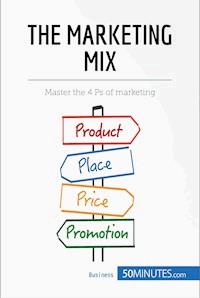
Master the 4 Ps of marketing
This book is a practical and accessible guide to understanding and implementing the marketing mix, providing you with the essential information and saving time.
In 50 minutes you will be able to:
• Launch a new product or test an existing marketing strategy
• Understand the 4 Ps of the marketing mix and use them to attract your target market
• Analyze case studies of well-known companies to see how the marketing mix operates in real life
ABOUT 50MINUTES.COM| Management & Marketing
50MINUTES.COM provides the tools to quickly understand the main theories and concepts that shape the economic world of today. Our publications are easy to use and they will save you time. They provide elements of theory and case studies, making them excellent guides to understand key concepts in just a few minutes. In fact, they are the starting point to take action and push your business to the next level.
Das E-Book können Sie in Legimi-Apps oder einer beliebigen App lesen, die das folgende Format unterstützen:
Seitenzahl: 25
Veröffentlichungsjahr: 2015
Ähnliche










The marketing mix
Key information
Names: marketing mix, marketing-mix, marketing mix policy.Uses: the marketing mix is a basic tool for marketing decisions.Why is it successful? The model summarises all the tools available to marketers for decision-making.Key words: product, price, place, promotion, target market.Introduction
History
The term ‘marketing mix’ first appeared in the article entitled ‘The Concept of the Marketing Mix’ (1948) written by theorist Neil H. Borden (1895-1980), a professor of marketing and advertising at Harvard Business School. He said himself that he was inspired by the research of James W. Culliton (1912-2004) who described the role of marketing managers as ‘mixers of ingredients’ and proposed a list of twelve elements of the industrial marketing mix at this stage. In 1960, Professor Jerome McCarthy (born in 1928) developed Borden’s theory and kept four main points, namely the 4 Ps (product, price, place and promotion) in his book Basic Marketing: A Managerial Approach. The mnemonic feature of this approach has contributed to its success and it is widely used by marketers. The marketing mix and the 4 Ps of marketing are often used to express the same idea, although they are not really synonymous. The marketing mix is a concept that describes the steps and choices that companies or brands have to make throughout the process of entering a market with a product or service; whereas the 4 Ps model is probably the best-known way of defining the marketing mix.
Definition of the model
The marketing mix is a marketing concept that includes all of the tools available to marketers to develop efficient actions and achieve their sales penetration targets within a target market.
Theory
Objectives of the model
The marketing mix includes all of the marketing decisions and actions taken to ensure the success of a product, service or a brand in its market.
The first decisive step in the marketing process: market analysis. Once this is done, the 4 Ps model can be used as a good decision-making tool for marketers. In fact, in addition to covering all of the elements that marketers can focus on, the model is easy to use. Its distinctive name has also undoubtedly added to its success. This classification system is one of the most used in the marketing mix, both in textbooks and in real life.
More broadly, the marketing mix model can be used to help decision-making in the context of a new offer on the market, as well as to test an existing marketing strategy.




