


Erhalten Sie Zugang zu diesem und mehr als 300000 Büchern ab EUR 5,99 monatlich.
- Herausgeber: Pocket Essentials
- Kategorie: Geisteswissenschaft
- Sprache: Englisch
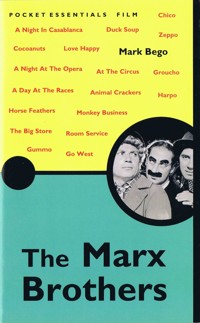
Wise-cracking Groucho Marx with his trademark cigar and painted on black moustache. Blonde, curly-wigged, mute Harpo, chasing girls, beeping his blub horn and chasing pretty girls. Rubber-faced Chico, twisting phrases into hysterical malapropisms. And, handsome straight-man Zeppo Marx. Who can forget their antics in such classic comedy films as The Cocoanuts (1929), Animal Crackers (1930), Monkey Business (1931), Horse Feathers (1932), and Duck Soup (1933), which literally defined the cinematic term 1930's screwball comedy. After their first five movies became box-office hits, The Marx Brothers were bona fide movie stars. However, once they moved out to Hollywood, their film career seemed to stall. That was until Chico asked for help from one of his poker playing buddies, MGM head Irving Thalberg. Taken under Thalberg's wing, the brothers--now trimmed down to the trio of Groucho, Harpo and Chico--began the second stage of their film career. While at MGM, the kooky Marx trio reached new heights with their films including A Night At The Opera (1935), A Day At The Races (1937), Room Service (1938), At The Circus (1939), Go West (1940), The Big Store (1941), and A Night In Casablanca (1946). After World War II ended, movie tastes changed, and The Marx Brothers each went their separate ways. In 1949 however, they reunited for their final film together, Love Happy, which included a now-famous scene between Groucho and a struggling newcomer who called herself Marilyn Monroe. The Pocket Essential Marx Brothers includes a concise look at the incredible career of this unforgettable troupe, from their beginnings on the vaudeville circuit, to becoming Broadway stars, to their classic film stardom. All of the films, the co-stars, the plotlines, and all of the background tales are included. Also, the end of the film careers of the brothers is only part of the story, as Groucho, Harpo and Chico all branched out into other areas of the business on both radio and television.
Sie lesen das E-Book in den Legimi-Apps auf:
Seitenzahl: 132
Veröffentlichungsjahr: 2012
Das E-Book (TTS) können Sie hören im Abo „Legimi Premium” in Legimi-Apps auf:
Ähnliche
















THEMARXBROTHERS
Mark Bego
POCKET ESSENTIALS
For Glenn Hughes: Millions of fans around the world knew you as the Leatherman in the Village People, but I will always remember you as a dear friend.
Acknowledgements
The author would like to thank Bob & Mary Bego, Paul Donnelley, Paul Duncan, Janet Dammann, Jan Kalajian, David Kelly, Ion Mills, Bobby Reed and Beth Wernick.
CONTENTS
1. Introduction - The Brothers Marx
2. The Family Business - Show Business
3. The Vaudeville Years
4. Minnie’s Boys In Chicago
5. The Road Back To Broadway
6. The First Films
7. Hooray For Hollywood
8. The TV And Radio Years
9. Obscure Marx Films And Shorts
10. Video And DVD Guide
11. Quote Sources
12. Bibliography
13. Websites
Copyright
1. Introduction- The Brothers Marx
When you think of the classic comedies of the 1930s, it’s hard not to recall the painted-on moustache and cigar smoke of Groucho Marx, the malapropism-ladened Italian accent of Chico Marx, the pantomime harp-playing clown Harpo Marx or the bumbling straight man as characterised by Zeppo Marx. They were The Marx Brothers and together they produced some of the most memorable, joke-filled, hysterical movies and comedy moments ever filmed.
This family of brothers, whose impressive body of work includes Duck Soup, Horse Feathers, Animal Crackers, A Night At The Opera and A Night In Casablanca, performed with each other for five decades. There was never a comic troupe quite like The Marx Brothers, although their antics inspired countless comedians including: The Three Stooges, Abbott and Costello, Dean Martin and Jerry Lewis, and even Cheech & Chong.
However, The Marx Brothers were not a product of Hollywood at all. For 20 years before they set foot on a movie sound-stage, they struggled on the vaudeville circuit, playing in every town and whistle-stop in the United States and Canada. Their mother Minnie Marx was part of the act, was their manager and was often their producer. There was even a fifth brother, Gummo, who dropped out of the act before fame finally struck.
Finally, after years of struggling, The Marx Brothers arrived when I’ll Say She Is became the surprise Broadway hit of 1924. Suddenly they were on a hot streak. They quickly followed it with The Cocoanuts, which ran from October 1925 to November 1927, and then Animal Crackers in October 1928.
In 1929, when motion pictures with sound were suddenly all the rage and set to revolutionise the film business, studios were scrambling to find actors who could not only act, but who could sing and talk as well. They looked to Broadway and so The Marx Brothers made The Cocoanuts in 1929. It was the first of 13 full-length feature films they made in a 20-year span. The rest, as they say, is history.
Thanks to video, and now DVDs, the films of The Marx Brothers are still very much alive and accessible to modern audiences. Hopefully this book will inspire you to investigate the classic comedy work of The Marx Brothers, or perhaps discover a forgotten classic or two that you have never had the opportunity to see before.
The films are rated as follows:
1/5 – OK, with fun moments
2/5 - Amusing
3/5 – Very Good
4/5 – Great
5/5 - Classic
2. The Family Business- Show Business
To fully appreciate The Marx Brothers story, one has to go all the way back into their past to see how their individual characters, and their entire act, evolved. Groucho, Chico, Harpo, Gummo and Zeppo each owe as much credit to their family roots in show business, as they do in their own vast talent as comedians, musicians and actors.
The Schönberg family came from the area of Germany then known as Prussia. They moved in the late 1800s to New York City. At the time, Meine (Minnie) Schönberg was fifteen years old. It was in New York City that she met Samuel (“Frenchy”) Marx, formerly of Alsace, France. They fell in love and were married January 18, 1885.
Samuel and Minnie Marx and their large family lived on Manhattan’s Upper East Side, in an area known as Yorkville, which was a neighbourhood teaming with German immigrants. The Marx clan resided at 197 East 93rd Street. As Groucho was to later recall, ‘In addition to the five brothers...there were my father and mother (in fact they got there before we did), my mother’s father and mother, an adopted sister and a steady stream of poor relations that flowed through our house night and day.’ (1) (See Chapter 11 for Quote Source 1) The adopted sister was actually the boys’ cousin Pauline, or “Polly” as she was nicknamed.
Minnie’s brother was Al Shean (1868-1948) who became famous as one half of the vaudeville duo: Gallagher & Shean. Al Shean was to be instrumental in the growing stardom of his young nephews, before finding fame of his own in the Ziegfeld Follies Of 1922 on Broadway. The big number that was to make them household names was called ‘Oh Mr Gallagher, Oh Mr Shean.’
The Marx boys’ maternal grandparents, Levy Schönberg (1823-1920) and his wife, Fanny Sophie Solomons Schönberg (1829-1901), had show-business roots themselves. However, when they arrived in America, their career on the stage came to a crashing end - the victim of moving to a new country where German was rarely spoken outside of the neighbourhood. As Groucho explained, ‘Since neither my grandfather nor my grandmother spoke any English, they were unable to get any theatrical dates in America. For some curious reason there seemed to be practically no demand for a German ventriloquist and a woman harpist who yodelled in a foreign language.’ (1) However, no one suspected how instrumental that very harp was to be in later shaping the career of one particular member of The Marx Brothers.
Prior to finding success with Gallagher, Uncle Al Shean performed with several partners in a variety of acts, including The Manhattan Quartet (1894) and The Manhattan Comedy Four. By 1899 Al was not only a featured singer and comedian, but he also graduated to become a writer of his own stage material. His trademark style became a series of wisecracking malapropisms and comically confused one-liners. This same silly stage banter was to become the staple of The Marx Brothers’ routines in later years - especially between Groucho and Chico. Al was to become very influential in the development of the boys’ act as a performing troupe - as a role model and as a writer.
Just after the turn of the century, Uncle Al Shean was appearing with a new partner, Charles Warren. They performed different comedy skits including ‘Quo Vadis Upside Down’ (1901) and ‘Kidding The Captain,’ which was a spoof of ‘Captain Kidd.’ Adept at penning witty satire, it was Uncle Al Shean who was to write one of The Marx Brothers’ first hit shows, Home Again, which ran from 1914 to 1918. But, we are getting ahead of ourselves here!
Minnie (Miene) and Samuel (Simon) Marx had six boys. The first one, Manfred, was born in January 1896, and sadly died in July of that year. Their other sons were: Leonard (Leo/Chico) Marx, born March 22, 1887; Adolph (Arthur/Harpo) Marx, born November 21, 1888; Julius Henry (Groucho) Marx, born October 2, 1890; Milton (Gummo) Marx, born October 23, 1892; and Herbert (Zeppo) Marx, born February 25, 1901.
The boys’ father, whose nickname was Frenchy, due to his dapper appearance, floated from career to career over the years. Eventually the boys supported the family, with Mama Minnie becoming their manager. Frenchy had one unsuccessful business venture after another, including one stint as a tailor. Unfortunately, according to his sons, he was the worst tailor anyone could imagine. Eventually, Frenchy found out that he was great in the kitchen and he became the family cook. According to Groucho, no one could cook quite like Frenchy could.
The three oldest boys had very strong personalities from the very start. Because Leonard (Chico) had been born and - unlike Manfred - survived, he grew up being the favourite, or the favoured son. Leonard always felt that he was loved and cared for, and Minnie spoiled him. He had a cocky sense of self-confidence, and he learned to hustle cards or dice at a very early age. By the time he was 12 years old, he was already a compulsive gambler.
Adolph (Harpo) was known in the family as ‘the good son.’ He became a mimic at an early age. Every day after school he would pass a cigar store, and watch a man in the window rolling cigars and making a cross-eyed, round-mouthed, tongue-rolled face while he did so. Adolph copied this look, which he called his “gookie” face, and it was to become one of his trademark bits as a comedian.
Julius was the intellectual son. He loved to read so much that he would sometimes lock himself in the family bathroom with a book so that he wouldn’t be disturbed. His grasp of knowledge, both of facts and of words, made him the blossoming intellectual the world would come to know as “Groucho.” He was always good with his money from an early age.
One of the most confusing factors of telling the story of The Marx Brothers, is the fact that Minnie had a habit of lying about her sons’ ages. Up to five years was added or subtracted for many assumed reasons. One of the first reasons for this deception was to make certain that Minnie’s boys successfully avoided being drafted into American military service. The family didn’t escape from Europe only to lose its sons in the brewing European conflict which would eventually blossom into World War I. The second convenient birth date deception was a show business-based one. When each of the boys wandered onto the stage, they did so playing juvenile or youth roles. How much more talented a child would look on stage if he claimed to be only 14, when he was in fact a semi-adult 19-year-old. In the ensuing years, there were apparently several reported incidents in which young teenage Groucho would be caught in front of a theatre’s men’s room mirror, shaving off all of the evidence of a more mature man’s five o’clock shadow.
From an early age - around 11, Minnie’s oldest son Chico had a keen sense of street smarts, hanging out with tough street gangs and staying out until all hours of the night. By the time he was 12, Chico had dropped out of school and was working for a lace factory, where his job was to keep track of the other employees’ hours. As luck, or misfortune, was to have it, there was a revolving crap game at the factory, and when it was discovered that Chico was gambling on the premises - he was fired.
To keep their eldest son off the streets, Minnie and Frenchy bought a used piano and hired a music teacher for him. Both piano playing and gambling were to become lifelong passions for Chico.
3. The VaudevilleYears
The Marx boys wandered into the world of show business in various ways. The first Marx brother to enter showbiz was Chico. In fact, he was employed in the movies! Not on screen however. His first film career was as a piano player in silent-film theatres and nickelodeons. Later he graduated to playing piano in saloons and dance halls as well.
The first of Minnie’s boys to actually perform on stage was Milton (Gummo). Apparently, Uncle Heinie (Henry/Harry), Uncle Al Shean’s brother, figured that if Al could make a living in show business, so could he, and he decided to use Grandpa Levy Schönberg’s ventriloquism act. The fact that Uncle Heinie had zero talent as a ventriloquist wasn’t about to throw a wrench in his plans either. The idea he struck upon was to use a hollow dummy’s head, put Milton inside the little outfit and pass him off as a supposedly mute mannequin. The far-fetched charade called for Heinie mid-act to stab the dummy’s leg with a long pin to prove that it was in fact an inanimate dummy in the costume, and not a real live person. The deception called for both of little Milton’s legs to be shoved into one pant leg of the dummy’s costume, while the other one was to be stuffed. However, when it was time for the revealing hat-pin ploy to take place on stage, forgetful Heinie stabbed Milton in the wrong leg, and the child leapt from his uncle’s leg, writhing in pain. Needless to say - this was to be a very short-lived act.
Groucho was later to recall that he was then cast as Heinie’s dummy for a short time. ‘I did an act with my uncle, Harry Shean. The fact that he was completely deaf didn’t make a difference...We concocted an act which consisted of a ventriloquist’s dummy, in which I was inside. The head was over my head, and I operated the mechanical part as well as speaking.
Uncle Henry just stood there. That the act lasted only a couple of weeks is evidence that it was not a success.’ (2)




