


7,99 €
Mehr erfahren.
- Herausgeber: The Lilliput Press
- Kategorie: Geisteswissenschaft
- Sprache: Englisch
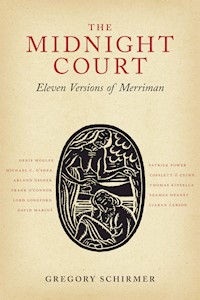
Many translations into English verse of Brian Merriman's celebrated eighteenth-century narrative poem Cúirt an Mheán Oíche (The Midnight Court) have been made by Irish poets over the past two centuries. All translators have tackled the problem of being Irish poets working in English and drawing upon the Irish-language tradition in various ways, as well as having to negotiate between Merriman's world and their own historical moments. This tension in translation is the major focus of The Midnight Court: Eleven Versions of Merriman. The author sets out the problems of translation in an introductory chapter and gives a general note on the tradition of translating Merriman's poem. He then focuses attention on eleven translators, who are given a chapter each for discussion: Denis Woulfe, Michael C. O'Shea, Arland Ussher, Frank O'Connor, Lord Longford, David Marcus, Patrick C. Power, Cosslett Ó Cuinn, Thomas Kinsella, Seamus Heaney and Ciaran Carson. As the book progresses, a picture forms of a layering in the life of the translated poem as translators rescue overlooked themes or stylistic approaches. This interesting undertaking, with its keen scrutiny of the text on a line-by-line basis, brings something new to Merriman scholarship, with examples of the myriad options available to the translator that illuminate nearly two hundred years of poetic translation and exchanges across two cultures.
Das E-Book können Sie in Legimi-Apps oder einer beliebigen App lesen, die das folgende Format unterstützen:
Veröffentlichungsjahr: 2015
Ähnliche




















The Midnight Court: Eleven Versions of Merriman
Gregory A. Schirmer
The Lilliput Press
Dublin
Dedication
For Jane
Contents
Acknowledgments
Introduction
Denis Woulfe: Cultural Loss and Metrical Finesse
Michael C. O’Shea: Nationalism Unleashed
Arland Ussher: On Behalf of the Ascendancy and Liberal Humanism
Frank O’Connor: Restoring the Nation
Lord Longford: Merriman and the Theatre
David Marcus: Marginality and Sexuality
Patrick C. Power: Scholarship and Poetic Translation
Cosslett Ó Cuinn: The Footprint of Sectarianism
Thomas Kinsella: ‘A Dual Approach’
Seamus Heaney: Ovid, Feminism and the North
Ciaran Carson: ‘Wavering between Languages’
Appendix: Text of Cúirt an Mheán Oíche with literal translation
Bibliography
Copyright
Acknowledgments
First and foremost, thanks are due to Antony Farrell of The Lilliput Press for his enthusiasm, generosity and editorial savvy throughout the process of translating manuscript into finished book. I’m also grateful to Tom Dunne for advice and camaraderie and to the late Robert Welch for contributions in print and in general. Thanks also to Frank Clune, Michael Kelleher, Hilary Lennon, Dónal Ó Conchubháir, Hallie O’Donovan, Patrick O’Shea, Kathleen Shields, Alan Titley and Helen Walsh. For various kinds of research assistance, I’m grateful to the National Library in Dublin, the Boole Library at University College Cork and the University of Mississippi Library, and for grant support to the College of Liberal Arts and Department of English at the University of Mississippi.
Ciaran Carson, excerpts fromThe New Estate and Other Poems(Oldcastle, Co. Meath: Gallery Press, 1976)andThe Midnight Court: A New Translation of ‘Cúirt an Mheán Oíche’(Oldcastle, Co. Meath: Gallery Press, 2005) reprinted with permission of the author and The Gallery Press.
Seamus Heaney, excerpts fromThe Midnight Verdict(Oldcastle, Co. Meath: Gallery Press, 1993) reprinted with permission of Faber and Faber Ltd.
Frank O’Connor, excerpts fromThe Midnight Court: A Rhythmical Bacchanalia from the Irish of Bryan Merryman(London, Dublin: Maurice Fridberg, 1945) reprinted with permission of Harriet O’Donovan Sheehy.
Patrick C. Power, excerpts fromCúírt an Mheán-Oíche: The Midnight Court(Cork: Mercier Press, 1971) reprinted with permission of Helen Walsh and Ann Farrell.
Every reasonable effort has been made to secure permission to quote specific passages. The author would be grateful to hear from any copyright holders not acknowledged here.
Epigraph
To a greater or lesser degree, every language offers its own reading of life. To move between languages, to translate, even within restrictions of totality, is to experience the almost bewildering bias of the human spirit towards freedom. If we were lodged inside a single ‘language-skin’ or amid very few languages, the inevitability of our organic subjection to death might well prove more suffocating than it is.
—George Steiner,After Babel: Aspects of Language and Translation(1975)
Introduction
Brian Merriman’s Cúirt an Mheán Oíche (The Midnight Court) is the best-known and most admired narrative poem in the Irish language.1 It’s also the most frequently translated. Since the poem was written, presumably around 1780,2 at least twelve complete translations into English verse have been made, beginning with a metrically ambitious version done early in the nineteenth century by a bilingual schoolmaster living in Merriman’s part of east Clare, and running up to a self-consciously postmodern translation published in 2005 by the Belfast poet Ciaran Carson. In between, Merriman’s poem has attracted as translators some of the most esteemed writers in modern and contemporary Ireland: Frank O’Connor, Thomas Kinsella and Seamus Heaney, as well as Carson.
Cúirt an Mheán Oíchehas received its fair share of scholarly attention, much of it (perhaps too much) speculating as to sources and influences, but the translations of the poem have, with a few exceptions, been mentioned only in passing.3The Midnight Court: Eleven Versions of Merrimanattempts to fill that gap by providing detailed critical, historical and comparative analyses of eleven poetic translations of Merriman’s poem composed over the course of nearly two centuries.4Not only has no such study of the work of Merriman’s translators been done, but also, although poetic translation from the Irish has been going on steadily since the beginning of the eighteenth century, and constitutes a significant body of poetry in its own right, no such study has been made of the translations of any poem, or group of poems, in Irish. By focusing on a number of translations of a single poem,Eleven Versions of Merrimansheds light on the process of poetic translation itself, offering a view from the translator’s workshop. It investigates such questions as how Merriman’s translators attempt – or don’t attempt – to carry over into their translationsCúirt an Mheán Oíche’s principal themes, how their translations negotiate between those themes and issues contemporary to the translators, and how they address the problem of rendering into English verse Merriman’s intricate prosody and exuberant diction and imagery, all of it deeply rooted in the Irish-language tradition. And because any translation is inevitably an interpretation, these translations constitute in effect a body of criticism ofCúirt an Mheán Oícheas revealing as some of the conventional critical commentary that the poem has elicited.
Translation is always a form of negotiation – between two languages, between two cultures, between two historical moments. The analyses inEleven Versions of Merrimanattempt to show how translation from the Irish has engaged and contributed to the relationship between the Irish- and English-language traditions in Ireland, and so between the country’s two principal cultures.Cúirt an Mheán Oícheis particularly suited to this process, being both the final, culminating expression of the Irish-language tradition before the relative silence of the nineteenth century, and a poem very much aware of the tradition of English poetry; its use of tetrameter owes something to eighteenth-century English verse, especially that of Jonathan Swift, and its ‘court of love’ structure can be found, as W.B. Yeats argued, in Swift’s ‘Cadenus and Vanessa’.5Also, as the translations occur over a relatively long period, they reflect changes in social, political and aesthetic issues, many of which bear on the often fraught relationship between Ireland’s two main traditions. Looking at that relationship, for example, from the viewpoint of colonialist analysis, translation from Irish into English is generally seen as an act of cultural and political appropriation, resting on the assumptions that the Irish-language tradition can – and perhaps should – be known adequately in English translations, and that the English language, because of a presumed superiority, has proved uniquely able to harbour all kinds of foreign texts in translation. But one inevitable implication of translating Irish-language texts into English is to concede the significance of the tradition to which they belong. As George Steiner has said, ‘To class a source-text as worth translating is to dignify it immediately and to involve it in a dynamic of magnification,’6and Merriman’s poem has been dignified and magnified again and again by its many translators; indeed, its status inside as well as outside the Irish-language canon has much to do with it having been translated so often.
As an act of negotiation, translation is inevitably bound up in the translator’s historical and cultural moment. A detailed study of various translations of one poem over a relatively long period not only addresses changing cultural realities and issues, but also analyzes how those realities and issues are made manifest, and at what cost in terms of fidelity to the original. The existence of so many translations over nearly two centuries itself argues that there is something inherent inCúirt an Mheán Oíchethat encourages multiple and widely varying translations; the poem, which has enjoyed a considerable reputation almost from the day it was written,7is able, as Seamus Heaney has said, ‘to subsume into itself the social and intellectual preoccupations of different periods’.8And Merriman’s poem undoubtedly has presented to its translators as well as to its readers a wide range of issues readily capable of reaching beyond the specific culture of Merriman’s day: the promotion of sexual and imaginative freedom, the questioning of various kinds of hierarchy, a profound but also often parodic view of the Irish-language tradition, a realistic representation of rural life in Ireland, and the creation of an alternate reality inside a dream-vision in which society’s injustices can be reversed. The poem’s remarkable formal and narrative qualities – its dramatically effective use of a courtroom setting, its ability to negotiate between a highly developed literary style andcaint na ndaoine(the speech of the people), the vitality of its imagery and language and the wonder of its intricate, complex prosody – have also had much to do with its attraction for poetic translators.
The poem’s generally subversive nature, appealing to so many of Merriman’s translators, surfaces early in the narrative. Following a fairly conventional opening describing the narrator walking along a river and then falling asleep, Merriman introduces into the narrator’s dream-vision a character who rebelliously recycles one of the staples of theaisling(vision) poem in the Irish-language tradition: the appearance of aspéírbhean, literally ‘sky-woman’, but also, since in Irish folklore the sky is often peopled with fairies and spirits, a fairy-woman. In the typicalaislingpoem, a form that flourished in the eighteenth century, the young and beautifulspéirbheanpredicts the success of the Stuart cause and the demise of English rule in Ireland. Merriman’sspéirbhean, a towering, glowering, and hideous-looking bailiff, is anything but fairy-like or lovely. And far from prophesying an end to Ireland’s sufferings, she complains of the numerous ills affecting Irish society – a passage that many of Merriman’s translators have found convenient as a forum for their own social and political critiques. The bailiff then drags the narrator to a court presided over by a local fairy queen named Aoibhill, and convened to address the problem of the sexual inadequacies of Irish men and the consequent sexual frustrations suffered by Irish women.
From this point on, the poem’s structure is largely dramatic, organized around three major speeches, two by a young woman and one by an old man. The young woman opens her first speech by saying that men in Ireland either marry only when they’re too old to satisfy their wives sexually, or they marry old women. She lists her own attractive qualities, and describes everything that she’s tried, including the use of various folk remedies, to secure a husband. Near the end of her speech, she expresses, in plangent tones, a fear of growing old without husband or children.
The temperature of the poem rises sharply when the second speaker appears before the bar, an old man who, in responding to the young woman’s complaints, relies principally on personal insult,ad hominemargument, and vitriolic attacks on women in general. The old man also provides an account of his marriage to a young woman who gave birth to a child that was not his, and then, somewhat surprisingly, makes a short speech in defence of bastards.
The young woman returns to the witness stand to describe in unblinking detail the sexual frustrations that the old man’s young wife experienced. She then delivers a set piece questioning celibacy, making deliberately shocking comments about the sexual attractions of the clergy – a passage that appealed especially to translators intent on using Merriman’s poem as a vehicle for critiquing the Catholic Church’s power in modern Ireland and especially its puritanical teachings. Aoibheall then delivers a judgment in favour of the young woman, and calls for various kinds of punishment to be inflicted on men who avoid marriage, including the narrator. But just as the young woman invites the other women in the court to help her torture the narrator, he awakes from his dream-vision, and the poem ends.
The various ‘social and intellectual preoccupations’, in Heaney’s words, of Merriman’s many translators are generally grounded in a liberal, humanistic view ofCúirt an Mheán Oíche.9This world-view manifests itself in many different ways, from the modern philosophical humanism that finds its way into Arland Ussher’s translation of 1926, to the attacks on a puritanical Catholic Church found in the translations of Frank O’Connor (1945) and David Marcus (1953), to an historically grounded argument for the rights of women informing the translation of Patrick C. Power in 1971, to the celebration of female empowerment and poetic freedom that governs Seamus Heaney’s partial translation, published in 1993. The question of how far a translator should stray from the original to advance his or her own agenda is not easy to answer. The most accomplished translators of Merriman’s poem manage to express issues close to them while staying within the orbit of the original – to negotiate effectively between the world of the translator and the very different world that Merriman inhabited. In less effective translations, contemporary issues tend to displace the themes and ideas in Merriman’s poem. Michael C. O’Shea’s version of 1897, awash in the discourse of nineteenth-century Irish nationalism, provides one example; Cosslett Ó Cuinn’s version of 1982, in which wholly invented passages attacking the Catholic Church are inserted at will, provides another.
The poet-translator coming toCúirt an Mheán Oíchefaces problems other than questions of loyalty to Merriman’s themes and ideas. One of these is how – or whether – to render into English verse the prosodic intricacies that root Merriman’s poem in the Irish-language tradition, and provide so much of its dazzling panache. While Merriman’s tetrameter couplets are conscious of English-language verse, particularly of Swift’s favoured octo-syllabic line, Merriman’s prosody comes straight out of the Irish-language tradition; Merriman’s couplet, constructed on an abbc/abbc pattern of internal and terminal assonance on the four stressed syllables of each line, is derived from thecaoineadhmeasure in the Irish-language tradition.10Also, as Liam P.ÓMurchú has shown, the pattern is often extended over four lines, forming quatrains rather than couplets, and there are places in which couplets and quatrains are linked by assonance as well; indeed, according to Ó Murchú, passages constituting quatrains or quatrains joined to couplets account for more than two-thirds of the poem.11Direct imitation in English verse of Merriman’s basic pattern of assonance over two lines is difficult enough, but extending it over four or six can be done, if at all, only with awkwardness or tedium, or both.
Merriman’s translators have tried various strategies – with varying degrees of success – to represent some of the prosodic qualities of the original. Denis Woulfe’s translation, the closest in time toCúirt an Mheán Oíche, is probably the most ambitious in trying to imitate Merriman’s assonantal patterns, but it often pays a price in unwieldy diction or phrasing. Some translators, like Ussher, O’Connor and Marcus, translate Merriman into tetrameter couplets using terminal rhyme rather than terminal assonance, with internal assonance relied on only occasionally and with little or no adherence to the original’s abbc/abbc pattern. Kinsella, acknowledging that much of Merriman’s prosody is simply untranslatable, renders Merriman into English verse informed by what he calls ‘ghosts of metrical procedures’,12and avoids both terminal assonance and terminal rhyme. Patrick C. Power’s translation, on the other hand, uses terminal assonance, and Seamus Heaney employs a variety of terminal links, most frequently half-rhyme, enabling him to vary the pitch of his couplets to reflect the variety and auditory nuances of Merriman’s terminal assonance. Finally, Ciaran Carson says he based his translation of Merriman’s poem on the rhythms of a jig tune, ‘Paddy’s Panacea,’ that he’d heard from a singer in County Clare.13
Merriman’s diction and imagery pose another set of problems. At times extravagant, copious, and parodic – ‘the fine surprising excess of poetic genius in full flight’, in Seamus Heaney’s words14– the language of the poem is also, appropriately enough for a work made up primarily of dialogue, very closely tuned tocaint na ndaoine(the speech of the people); indeed, part of the miracle of the poem is Merriman’s ability to write in a language that is both literary and ordinary, poetic and earthy.15Cúirt an Mheán Oíchealso contains numerous passages in which lists of related nouns or adjectives run on for several lines, a practice that doesn’t translate readily into English verse.16
Of Merriman’s translators, Kinsella and Carson, in different ways, are the most sensitive to Merriman’s diction and imagery. Kinsella has said that in his work in translation from the Irish in general, ‘all images and ideas occurring in the Irish are conveyed in translation and images or ideas not occurring in the Irish are not employed’.17Carson’s translation, although less conservative than Kinsella’s, seeks to imitate what Carson sees as the primary, underlying quality of Merriman’s diction, something that reflects, in his view, the‘deep structure’ of the Irish language itself: the multiple layers of meanings and implications, often quite different, embedded in a single word or phrase.18Not surprisingly, given the mastery of dialogue that characterizes his short stories, O’Connor is particularly adept at translating thecaint na ndaoineof Merriman’s Irish into ‘the speech of the people’ in English. At the other end of the spectrum, O’Shea’s and Ó Cuinn’s translations tend to rewrite Merriman’s language into the discourse of their political and religious views, and Marcus’ translation was specifically written, he says, in the English spoken in Ireland in the 1950s.
There are some puzzling lacunae in the history of the translations ofCúirt an Mheán Oíche. Setting aside O’Shea’s version, published privately in Boston in 1897, no translations were produced in England or Ireland between Woulfe’s early in the nineteenth century and Ussher’s in 1926, despite the great flowering of translation from the Irish in the middle decades of the nineteenth century as well as during the Irish literary revival. The poem was widely available in manuscript form immediately after its composition and well into the nineteenth century, and it was first published, in Dublin, in 1850. Although Merriman’s poem would probably have held little appeal for romantically inclined nineteenth-century translators like J. J. Callanan and James Clarence Mangan, or for the leading lights of the literary revival, given their own generally romanticized sense of Gaelic culture, the lack of any translation, even a partial one, from writers deeply invested in the folk tradition – Douglas Hyde, Padraic Colum, James Stephens, for example – is difficult to fathom. Finally, although one of the poem’s primary themes is the empowerment of women, even if the argument is delivered in terms not always likely to win the unqualified enthusiasm of modern or contemporary feminists, no woman has undertaken to translateCúirt an Mheán Oíche.19
Setting out to render a complex and difficult poem deeply rooted in the Irish-language tradition at the end of the eighteenth century into accomplished poetry written in English for readers often living in worlds at a great distance from Merriman’s, the poetic translators examined here faced a task that was undeniably problematic. The same might be said for any effort to assess the work of those translators. As Jackson Mathews has argued: ‘Just as every way of translating poetry is partial, every way of judging the results is partial. It is one of the most hazardous … of all literary judgments.20But like translation itself, the critical analysis of translation gets done, even if the critic rarely finds firm ground to stand on.Eleven Versions of Merrimantakes to heart George Steiner’s view that, at best, what the critic writing about translation can provide are ‘reasoned descriptions of processes’,21and the ‘reasoned descriptions of processes’ that this book provides of eleven translations ofCúirt an Mheán Oíchedo not pretend to be definitive, and they cannot, of course, be neutral. They are, however, motivated by some of the desires that drive translators themselves – in the words of Umberto Eco, ‘loyalty, devotion, allegiance, piety’.22
1. Alan Titley, ‘Cúirt an Mheán Oíche: A Wonder of Ireland,’ in The Midnight Court / Cúirt an Mheán Oíche, ed. Brian Ó Conchubhair (Syracuse, N.Y.: Syracuse Univ. Press, 2011), describes Merriman’s poem as ‘the most famous Irish poem of all’ (p. 47). Aodh de Blacam, Gaelic Literature Surveyed, 2nd ed. (Dublin, Belfast: Phoenix, n.d. [1927]), says that Cúirt an Mheán Oíche ‘is esteemed by many critics as the most original and artistic piece of work in late Modern Irish’ (p. 334). And Sean Ó Tuama, ‘Brian Merriman and his Court,’ Irish University Review, Vol. II (1981); rpt. in Repossessions: Selected Essays on the Irish Literary Heritage (Cork: Cork Univ. Press, 1995), describes Cúirt an Mheán Oíche as ‘undoubtedly one of the greatest comic works of literature, and certainly the greatest comic poem ever written in Ireland’ (p. 64).
2. Because the year 1780 is given at the end ofCúirt an Mheán Oícheas the time of the sitting of Aoibheall’s court, most critics have taken it to be the date of the poem’s composition. But Breandán Ó Buachalla has argued that there’s no reason to assume that the poem was completed in 1780: ‘It could be twenty years earlier, it could be twenty years later – my sense is that it’s earlier’ (unpublished lecture given in 2005, cited in Brian Ó Conchubhair, ‘Introduction: Brian Merriman’s Daytime Mileu,’The Midnight Court / Cúirt an Mheán Oíche, ed. Ó Conchubhair, p. xvi).
3. There are two essays considering Frank O’Connor’s translation: ‘Merry Men: the Afterlife of the Poem,’ by Declan Kiberd, inFrank O’Connor: Critical Essays, ed. Hilary Lennon (Dublin: Four Courts Press, 2007), pp. 114–28, and ‘Aistriúchán / áin Frank O’ Connor deChúirt an Mheonoíchele Brian Merriman,’ by Liam P. Ó Murchú, inAistriú Éireann, eds. Charlie Dillon and Rióna Ní Fhrighil (Belfast: Queens Univ. Press, 2008), pp. 131–45. Kiberd’s essay considers O’Connor’s translation, in part, as ‘an occluded autobiographical work’ (p. 121), while also paying some attention to the translations of Arland Ussher, Cosslett Ó Cuinn, Seamus Heaney, and Ciaran Carson. Ó Murchú’s essay is largely an examination of differences between the 1945 edition of O’Connor’s translation and the version published inKings, Lords and Commonsin 1959. An essay on Merriman’s translators in general, ‘Poetry, Fear, and Translation: Versions of Merriman,’ by Robert Welch, is forthcoming inBrian Merriman and His World: Merriman ar an mbinse, eds. Máirín Ní Dhonnchadha, Gearóid Ó Tuathaigh, and Patrick Crotty (Dublin: Four Courts Press). I am grateful to Professor Welch for the letting me read this essay in typescript.
4. With the exception of Seamus Heaney’s partial version, the translations considered in this study are complete translations of Merriman’s poem. There are two complete published translations not examined here, on the ground they are of little poetic interest:On Trial at Midnight, by Bowes Egan (Killybegs: Brehon Press, 1985), andCúirt an mheodhon oidhche: The Midnight Court: Done into Dublin English, by Yam Cashen (Dublin: Ashfield, 2005). Also, according to Brendan Behan’s biographer, Behan turned up one night in 1952 at McDaid’s in Harry Street, and recited, in its entirety, his complete translation of Merriman’s poem. Three days later, Behan was reportedly in a fight in the Conservative Club in York Street, and the manuscript of his translation was lost, although the opening twenty-two lines of it appeared six years later in his autobiographical workBorstal Boy(Ulick O’Connor,Brendan Behan[London: Hamish Hamilton, 1970], p. 122).
5. Yeats’s comments on the connection between Swift and Merriman are to be found in his preface to Arland Ussher’s translation ofCúirt an Mheán Oíche(The Midnight Court and The Adventures of a Luckless Fellow[London: Jonathan Cape, 1926], pp. 5–7). A.C. Partridge says that Merriman’s couplets are ‘reminiscent of the writing of Swift and Goldsmith’ (Language and Society in Anglo-Irish Literature[Dublin: Gill and Macmillan, 1984], p. 143). And Vivien Mercier, referring to Yeats’ comments, says, ‘it is hard to see where else Merriman could have encountered a court in which each sex blames the other for the decay of love’, and adds that Merriman’s line could easily be considered an imitation of Swift’s octosyllabic line (The Irish Comic Tradition[Oxford: Clarendon Press, 1962], pp. 193–4).
6. After Babel: Aspects of Language and Translation(Oxford and New York: Oxford Univ. Press, 1975, 1992, 1998), p. 317.
7. Ó Tuama,‘Brian Merriman and hisCourt,’ says of Merriman’s poem that ‘scores of copies were transcribed and reproduced in the immediate years after its composition: it was read with avidity, discussed, and frequently added to’ (p. 64). Bríona Nic Dhiarmada, ‘ApproachingCúirt an Mheán Oíche / The Midnight Court,’ inThe Midnight Court / Cúirt an Mheán Oíche,ed. Ó Conchubhair, says that numerous manuscript copies were circulating not just in Merriman’s lifetime, but far into the nineteenth century as well (p. 79). Indeed, Liam P. Ó Murchú has argued that the poem ‘reached the zenith of its popularity in the first half of the nineteenth century’ (‘Merriman’sCúirt an Mheonícheand Eighteenth-Century Irish Verse’, inA Companion to Irish Literature, Vol. 1, ed. Julia M. Wright [Chicester, West Sussex: Wiley-Blackwell, 2010], p. 179). From the middle of the nineteenth century on, the poem has been published in printed editions no fewer twelve times – in 1850, 1879, 1893, 1905 (with a German translation), 1900 (a bowdlerized edition for use in the schools), 1909, 1912, 1927 (another bowdlerized edition), 1949, 1968, 1971 and 1982. See the Bibliography for a detailed list of these editions.
Given the considerable reputation ofCúirt an Mheán Oíche,it’s surprising how much obscurity still surrounds its author. The year of Merriman’s birth has been given variously as 1747, 1749 and 1750. According to one scholar, he was born into a Protestant family (Partridge,Language and Society in Anglo-Irish Literature, p. 143), and according to others, he was illegitimate (Ó Tuama, ‘Merriman and His Court’, p. 75). Even his name is not certain; the Irish version has been variously given as Mac Gillameidre, Mac Giolla Meidhre and Mac Manaman, and anglicized versions include Bryan Merryman, Bryan Merriman, and Brian Merriman. His birthplace is said by some to be Ennistymon, Co. Clare, but by others to be the parish of Clondagad, some fifteen kilometres southwest of Ennis. His family is said to have moved to Feakle, near Lough Graney in east Clare, when Merriman was quite young, although one nineteenth-century scholar has said that Merriman, a ‘wild youth and fond of amusement’, left his father’s house when he was a young man and settled by himself near Feakle (Seán Ó Dálaigh, inPoets and Poetry of Munster[2nd series], 1860; quoted in Liam P. Ó Murchú, ‘An Réamhra’ (‘Introduction’),Cúirt an Mheon-Oíche,ed. Ó Murchú (Baile Átha Cliath: Clóchomhar, 1982, p. 13). Most accounts say Merriman taught school near Feakle, in a hedge school possibly, and may have tutored some of the local gentry, while also doing a little farming. He presumably wroteCúirt an Mheán Oíchewhile living in Clare, and then, sometime later, moved to Limerick, where he taught mathematics, and where he died, according to three local newspapers, on the 29th of July, 1805(Ó Murchú,Cúirt, p. 13). Only two other poetic works, both minor, have been attributed to him. For a summary of the various accounts of Merriman’s life, see Ó Murchú,Cúirt,pp. 11–14.
8. ‘Orpheus in Ireland: On Brian Merriman’sThe Midnight Court,’The Redress of Poetry(Farrar, Straus and Giroux, New York, 1995), p. 53.
9. Gearóid Ó Crualaoich has described the theme of Merriman’s poem as ‘a civil and psychological liberation of the individual’ (‘The Vision of Liberation inCúirt an Mheán-Oíche,’Folia Gadelica, aistí ó iardhaltaí leis a bronnadh ar R.A. Breatnach[Cork Univ. Press, 1983], p. 99). John Eglinton, writing in 1906, described Merriman as ‘this Irish free-thinker of the eighteenth century’ (Bards and Saints, [Dublin: Maunsel, 1906], p. 54). And Alan Titley, ‘The Interpretation of Tradition,’Frank O’Connor: Critical Essays, says of Merriman’s poem: ‘It is funny, bawdy, explicit, dramatic and intelligent and in one declamation seems to destroy the stereotype of the repressed and puritanical peasant. That is to say, it is a poem which represents the direct opposite of the regnant assumptions of those ignorant of Irish culture’ (p. 227). On the other hand, Liam P. Ó Murchú argues that Aoibheall is speaking for Merriman when she attributes the decline of the Gaelic aristocracy to mixed marriages between the nobility and the lower classes (Merriman:I bhFábhar Béithe[Baile Átha Cliath: Clochomhar, 2005], p. 106).
10. Ó Murchú says that Merriman‘developed and harnessed in an unprecedented manner the well-establishedcaoineadhmeasure, giving to the end product a rushing fluency’ (‘Merriman’sCúirt an Mheonoícheand Eighteenth-Century Irish Verse,’ p. 190). The standardcaoineadhmeasure consists of four-line stanzas, with each line carrying four stresses. The four lines are connected through terminal assonance falling on the last accented vowel of each line, and internal assonance occurs between the second and third accented vowels in each line.
11. Cúirt an Mheon-Oíche, pp. 79–81.
12. ‘Introduction,’An Duanaire: 1600–1900: Poems of the Dispossessed, ed. Sean Ó Tuama, trans. Thomas Kinsella (Mountrath: Portlaoise: Dolmen, 1981), p.xxxv.
13. ‘Foreword,’The Midnight Court: A New Translation of ‘Cúirt an Mheán Oíche’(Oldcastle, Co. Meath: Gallery Press, 2005), p. 11.
14. ‘Orpheus in Ireland,’ p. 48.
15. Merriman’s diction manages to occupy, as Declan Kiberd has put it, ‘an teorainn dhoiléir sin idir an litríocht “liteartha” agus an litriocht bhéíl’ (‘that indistinct border between “literary” literature and the literature of speech’) (Idir Dha Chultúr[Dublin: Coiscéim, 1993], p. 34).
16. Ó Murchú says that this practice is ’frémhaithe i nós na gnáthchainte agus cuireann sé go mór fuinneamh na véarsaíochta’ (‘rooted in the custom of ordinary speech and it contributes much to the vigour of the verse’ (Cúirt anMheon-Oíche, p. 77). Ó Murchú sees Merriman’s use of these lists as part of an effort to represent the life of the people in east Clare with realistic accuracy (I bhFábhar Béithe, pp. 93–4).
17. ‘Introduction,’An Duanaire, p. xxxv.
18. ‘Sweeney Astray: Escaping from Limbo,’ inThe Art of Seamus Heaney, ed. Tony Curtis (Chester Springs, Pa.: Dufour, 1985), p. 143.
19. The artist Pauline Bewick produced in 2007 a set of eleven large-scale paintings entitled ‘The Visual Translation of “The Midnight Court”’.
20. ‘Third Thoughts on Translating Poetry,’ inOn Translation, ed. Reuben A. Brower (New York: Oxford Univ. Press, 1966), p. 68.
21. After Babel,p. xvi.
22. Eco,Mouse or Rat? Translation as Negotiation(Weidenfeld and Nicolson, 2003), p. 192.
Denis Woulfe: Cultural Loss and Metrical Finesse
The destruction of Gaelic civilization in the seventeenth century was still very much alive in the country’s cultural memory when Merriman was writingCúirt an Mheán Oíche, and the social, political and cultural consequences of that catastrophe were all too evident in Merriman’s rural Co. Clare. Denis Woulfe’s translation of Merriman’s poem, probably written early in the nineteenth century, is particularly sensitive to that memory and those consequences. A schoolmaster in east Clare and Co. Limerick in the early decades of the nineteenth century, Woulfe knew the ground of Merriman’s poem – its landscape, its people, its culture, its language. (It’s also possible that he knew Merriman himself.) As someone who wrote poetry in both Irish and English, Woulfe would have been acutely conscious of the question of audience, and his translation was no doubt intended, in part at least, to make an English-speaking readership aware of the lamentable realities of rural Irish life around the turn of the nineteenth century. Woulfe’s bilingualism also may account for his ambitious efforts to reproduce in English verse the assonantal patterns that rootCúirt an Mheán Oíchein the Irish-language tradition, as well as carrying over into English the lively, colloquial diction of Merriman’s dialogue. Indeed, Woulfe’s translation, in edging so close to the formal qualities of the original, both embodies and argues for a symbiotic relationship between the English- and Irish-language traditions at this moment in Irish history.
Little is known about Woulfe (Donncha Ulf) himself. According to one account, he was from Sixmilebridge, Co. Clare, and was working as a schoolmaster between 1817 and 1826.1In addition to writing poetry in English and Irish, he put together three collections of poetry from Clare and Limerick. Little is also known about the date of his translation of Merriman’s poem. Although there are four manuscript copies extant, none, according to Liam P. Ó Murchú, who included Woulfe’s translation in his 1982 edition ofCúirt an Mheán Oíche, is in Woulfe’s hand. But it’s likely that the translation was done sometime in the early decades of the nineteenth century. For one thing, it includes the phrase ‘my love of Union’ – a reference not in Merriman’s poem – and the Union, if that is what Woulfe is referring to, did not come into existence as a political institution until 1801.2The translation was published twice in the nineteenth century, once in a Clare newspaper of unknown date, and in 1880, the supposed centenary of the composition of the original, in the weekly journalThe Irishman.3
Perhaps because of Woulfe’s shared geography and history with Merriman, his translation is often particularly sensitive to Merriman’s representation of various social and political problems of the time, such as rural poverty, the powerlessness of the Irish peasant, a shrinking population, cultural and linguistic marginalization and corruption in the administration of justice – all arguably consequences of the collapse of Gaelic civilization in the seventeenth century and its replacement in the eighteenth by the Anglo-Irish Ascendancy. Despite the view of some critics that Merriman’s poem is not particularly interested in political and social issues,4these kinds of questions surface often enough inCúirt an Mheán Oíche,most notably perhaps in the bailiff’s recounting, early in the poem, of the various ills afflicting Ireland at the end of the eighteenth century:
Gan sealbh gan saoirse ag síolrach seanda,
Ceannas i ndlí ná cíos ná ceannphoirt,
Scriosadh an tír is níl ‘na ndiadh
In ionad na luibheanna acht flíoch is fiaile,
An uaisle b’fhearr chum fáin mar leaghadar
Is uachtar lámh ag fáslaigh shaibhre
Ag fealladh le fonn is foghail gan féachaint
D’fheannadh na lobhar ‘s an lom dá léirscrios.
Is dochrach dubhach, mar dhiú gach daoirse,
Doilbheadh dúr an dúcheilt dlíthe,
An fann gan feidhm ná faighidh ó éinne
Acht clampar doimhin is loighe chum léirscris,
Falsacht fear dlí agus fachnaoide airdnirt,
Cam is calaois, faillí is fábhar,
Scamall an dlí agus fíordhath fannchirt,
Dalladh le bríb, le fís, le falsacht.5
(Without property, without freedom for an ancient race,
Sovereignty in law or rent or rules,
The land destroyed and nothing after it
In place of the herbs but chickweed and weeds,
The best nobility wandering as they faded away to nothing
And rich upstarts have the upper hand
Deceiving with inclination and pillaging without regard
Skinning the leper and the naked in their devastation.
It’s distressing and sorrowful, like the worst of every oppression,
A hard affliction [is] the dark denial of the law,
The weak without influence who get nothing from anyone
But great deceit and submitting to destruction,
Falseness from the man of law and derision from high power,
Crookedness and fraud, neglect and favouritism,
The law [is] a darkness with nothing of [even] weak justice,
Blinding with bribe, with fees, with falseness.)6
Woulfe’s translation of this telling passage is deeply grounded in the distressingpolitical and social realities of Ireland at the turn of the nineteenth century:
No land or store the old possessing,
No friends in court their wrongs redressing,
In lieu of herbs and fragrant seed
There grew wild rape and chicken weed.
The ancient nobles fast decaying,
And sordid clans in grandeur swaying,
Foul deceit and fell oppression,




