



1,99 €
Niedrigster Preis in 30 Tagen: 1,99 €
Niedrigster Preis in 30 Tagen: 1,99 €
Mehr erfahren.
- Herausgeber: DigiCat
- Kategorie: Religion und Spiritualität
- Sprache: Englisch
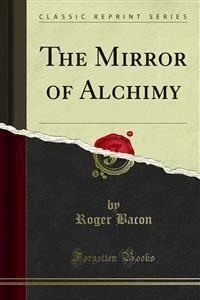
In "The Mirror of Alchimy," Roger Bacon intricately explores the interconnected realms of science and mysticism, presenting alchemy as a precursor to modern scientific inquiry. Written in the late medieval period, Bacon's work is characterized by a rigorous yet lyrical prose style that fuses philosophical reflection with practical experimentation. He utilizes a dialectical approach to deconstruct alchemical processes, revealing not only the techniques of transformation but also the underlying metaphysical principles. This seminal treatise serves as both a comprehensive guide to the alchemist's art and a profound meditation on the nature of knowledge and reality, firmly situating it within the burgeoning intellectual landscape of the 13th century, which laid the groundwork for the Renaissance and the Scientific Revolution. Roger Bacon, a Franciscan friar and philosopher, was a pioneer in advocating for empirical methods of inquiry, influenced by the works of Aristotle and his own observations. His experiences in academia and his encounters with various scientific disciplines motivated him to seek a deeper understanding of nature through alchemical practices. Bacon's unique perspectives on the synthesis of philosophy and science reflect his belief in the transformative potential of knowledge, positioning him as an early advocate for the experimental approach that would characterize later scientific thought. "The Mirror of Alchimy" is a compelling read for scholars, philosophers, and curious minds alike. Its rich historical context and Bacon's visionary synthesis of science and mysticism provide profound insights into the origins of modern thought. For anyone interested in the interrelation of alchemical traditions and their influence on contemporary science, this work is an essential addition to the canon, inviting readers to contemplate the transformative power of knowledge. In this enriched edition, we have carefully created added value for your reading experience: - An Introduction draws the threads together, discussing why these diverse authors and texts belong in one collection. - Historical Context explores the cultural and intellectual currents that shaped these works, offering insight into the shared (or contrasting) eras that influenced each writer. - A combined Synopsis (Selection) briefly outlines the key plots or arguments of the included pieces, helping readers grasp the anthology's overall scope without giving away essential twists. - A collective Analysis highlights common themes, stylistic variations, and significant crossovers in tone and technique, tying together writers from different backgrounds. - Reflection questions encourage readers to compare the different voices and perspectives within the collection, fostering a richer understanding of the overarching conversation.
Das E-Book können Sie in Legimi-Apps oder einer beliebigen App lesen, die das folgende Format unterstützen:
Veröffentlichungsjahr: 2022
Ähnliche













The Mirror of Alchimy
Table of Contents
Introduction
Curatorial Vision
This collection brings together works that chart alchemy’s full compass, from concise principles to exacting operations and reflective philosophy. Roger Bacon’s The Mirrour of Alchimy establishes a framework of definitions, elemental principles, materials, regimen of fire, vessels, colors, and projection. The Smaragdine Table of Hermes presents the gnomic core that generations read as the art’s charter. Hortulanus, in his brief commentary, unfolds those axioms into a working cosmology. Galid the sonne of Iazich contributes a systematic sequence of masteries and processes. Finally, Bacon’s discourse on the force of Art and Nature situates practice within a broader philosophy of making.
The guiding thread is the reconciliation of art and nature through the Great Work. Across these texts, matter is understood as responsive to proportioned heat, suitable vessels, and the measured circulation of moisture and dryness; yet the same operations mirror a metaphysical ascent. Bacon’s chapters on the procreation of minerals and the matter of Elixir stand beside Hermes’ doctrine of the One, and Hortulanus’ insistence on Father and Mother, Sun and Moon. Galid’s progressive path from solution to rubification complements this scheme, while Bacon’s general discourse argues that disciplined craft discloses the potentialities seeded within created things.
Our aim is to reveal the art’s coherence by letting its voices build upon one another. The sequence moves from axioms and definitions into controlled practice, then outward to philosophical reflection, so the reader witnesses a single argument unfold in distinct idioms. Concepts like the One Stone, the division into two, fixation and volatility, and the scale of colors recur in different guises, inviting comparison rather than reduction. By placing precise instructions about fire and vessels alongside meditations on creation, the collection foregrounds how procedural exactitude and symbolic vision mutually sustain the promise of transmutation and perfection.
Unlike isolated presentations of a single treatise, this gathering presents a layered conversation in which aphorism, commentary, manual, and philosophical discourse are each indispensable. The Mirrour of Alchimy gains sharper profile when read beside the Smaragdine Table and Hortulanus’ exposition; Galid’s exhaustive operations test and refine the same principles; Bacon’s broader discourse frames their significance. The result is neither a mere compendium nor a polemic, but a structured vista across distinct yet converging strands of alchemical reasoning. In this arrangement, each text illuminates the others, revealing continuities and productive tensions that remain obscured when encountered alone.
Thematic & Aesthetic Interplay
The Smaragdine Table speaks in compressed maxims—above and below, separation and reunion, the single thing achieved through wise operation. Hortulanus responds with a sequential elucidation: division of the Stone into two parts, the presence of the four elements, the lineage of Father and Mother, and the naming of conjunction as conception. He insists that perfection requires the soul fixed in the body, a doctrine that refracts through subsequent steps of mundification, elevation of the unfixed, and ultimate fixation. His cadence is scholastic, yet attentive to imagery, marrying metaphysical propositions to laboratory-suited counsel without dissolving their mystery.
Roger Bacon’s Mirrour answers this metaphysical scaffolding with practical architecture. Its movement from definitions to mineral principles, to the nearer extraction of the matter of Elixir, and onward to the governance of fire and the choice of vessels, supplies a grammar of procedure. The chapter on colors—accidental and essential—translates philosophical ascent into observable phases, while the projection of the medicine upon imperfect bodies transforms doctrine into test. Where Hermes invokes unity, Bacon measures heat; where Hortulanus allegorizes conjunction, Bacon times it. The dialogue is not rivalry but complementarity, each voice filling what the other implies but cannot, alone, articulate.
Galid the sonne of Iazich deepens this interplay by cataloguing the four masteries—solution, congelation, albification, rubification—and the arts that service them: decoction, contrition, subtiliation, separation, commistion, and fixation of the spirit. His attention to the quantity of fire, the washing and purification of the Stone, and the circulation of elements offers a procedural mirror to Bacon, yet his insistence that there is but one Stone echoes Hermes and Hortulanus. The tonal texture shifts toward methodical instruction, but metaphysical claims remain explicit, especially in the conversion from white to red, where the tension between volatility and fixation is resolved.
Bacon’s separate discourse on the force and efficacy of Art and Nature widens the aperture. Here the emphasis falls on what craft discloses about the latent powers of matter and the lawful ways those powers may be drawn forth. Read against the Mirrour’s furnace and the Table’s axioms, the discourse articulates a philosophy of instrumented nature: art does not violate, but cooperates. This stance stabilizes the collection’s contrasts in tone—aphoristic, exegetical, instructional, speculative—by suggesting that all belong to a single praxis oriented to discovery. The result is a polyphony in which procedure and contemplation are mutually clarifying.
Enduring Impact & Critical Reception
These works remain vital because they register a formative interface between craft knowledge and natural philosophy. The meticulous governance of fire, the calibration of vessels, and the observation of colors promote a disciplined empiricism, while the language of Sun and Moon, fixation and volatility, supplies an imaginative grammar for thinking transformation. Together, they remind scholarship that inquiry can be exacting without disenchanting, and visionary without abandoning testable procedure. The collection, therefore, models how technique, symbol, and metaphysics mutually enrich an investigation of nature—a model that continues to inform debates about the scope and limits of human making.
General assessments have long acknowledged the Smaragdine Table as a touchstone for alchemical reflection, and the paired presence of a commentary by Hortulanus demonstrates how axioms invite disciplined exegesis. Roger Bacon’s Mirrour is often cited as a lucid scholastic approach to operative alchemy, especially in its attention to fire and color, while his broader discourse articulates the rationale for trusting art to collaborate with nature. Galid’s sustained attention to the four masteries consolidates procedural expectations. Taken together, these works have repeatedly anchored discussions of alchemy’s credibility, not as a single claim, but as a layered program of inquiry.
Their cultural afterlife is equally notable. The sequence of colors, the marriage of Sun and Moon, and the ideal of a perfected Stone have furnished allegorical resources for poets, painters, and natural philosophers, while the insistence on measured heat and the purification of matter has guided practical experiment. Disputes recur over literal transmutation versus moral or medical improvement, and these texts are central witnesses to that debate. They are cited to justify both an artisanal discipline of care and an aspirational vision of renewal, thereby crossing the boundaries of technical recipe, metaphysical thesis, and ethical desideratum.
By convening Bacon, Hermes, Hortulanus, and Galid, this volume demonstrates that alchemy’s legacy is not reducible to promise or refutation. It is a durable method of thinking with hands and images, of testing materials while interpreting symbols. The works gathered here foster comparative reading: practical chapters on the furnace gain resonance from aphorisms about unity; commentarial glosses sharpen the criteria for success in the laboratory. In their convergence, these texts propose an ethics of workmanship joined to a cosmology of transformation, a synthesis that continues to inspire inquiry wherever craft, contemplation, and disciplined wonder are held together.
Historical Context
Socio-Political Landscape
The anthology emerges from a world where learning, authority, and ecclesiastical oversight were tightly interwoven. Roger Bacon’s association with Merton and Brasen-nose in Oxford signals the university’s growing role in adjudicating knowledge, even as mendicant discipline and clerical suspicion constrained inquiry. The Preface frames the compilation as a licit pursuit of nature’s secrets, positioning the reader within sanctioned curiosity rather than sorcery. The Mirrour of Alchimy promises method and order, hedged by moral caution. The Smaragdine Table and Hortulanus’s Commentarie draw on venerable antiquity to stabilize status. Together they navigate a hierarchy in which knowledge moved only under watchful institutional eyes.
Royal courts and civic magistracies struggled with coinage, taxation, and scarcity, sharpening interest in metallic transformation. Where rulers feared debasement and fraud, authors emphasized regulation of fire, vessels, and intention. Chapters on projection in The Mirrour of Alchimy answer princely dreams of augmentation while implicitly acknowledging statutes against illicit “multiplication.” The Booke of the Secrets of Alchimie inventories necessary instruments, presenting artisanal order as a civic virtue. Bacon’s excellent discourse on Art and Nature balances utility with restraint, hinting that true power resides in disciplined practice. The Preface thus mediates between political desire for revenue and theological anxiety over unlawful gains.
Mediterranean trade, diplomatic entanglements, and military campaigns intensified cross-cultural contact. The Booke of the Secrets of Alchimie, attributed to Galid the sonne of Iazich, proclaims a path from Hebrew into Arabic, then Latin, and finally English. This itinerary signals a world where techniques, substances, and recipes traveled alongside merchants and envoys. It also points to the authority politics of translation: who could claim fidelity, who could speak for the original, and who profited by rendering secrets portable? The collection’s multilingual lineage mirrors a geopolitical mesh in which states sought leverage through knowledge as much as through arms.
Urban workshops—glasshouses, smithies, dye-vats, and apothecary benches—ground the rhetoric of transformation in daily labor. The Mirrour of Alchimy’s chapters on the furnace, vessel, and moderation of fire presuppose a regulated craft environment subject to municipal oversight and guild secrecy. Such pages imply the social bargain of late medieval towns: privileges granted to skilled work in exchange for reliable supply, fair weights, and public safety. The anthology’s recipes and color-stages would have resonated with artisans measuring heat by hue and timing by habit. Even lofty claims about Elixir rest on the choreography of tools, fuels, and workshop discipline.
Church courts policed the borders between natural philosophy and forbidden arts. The Smaragdine Table, dressed in antique authority, offered a pious cosmology of correspondence, while Hortulanus’s Commentarie sought clarity without trespass. Bacon’s admonitions about method and intent place the worker under moral scrutiny as well as technical instruction. The Preface insists that true Alchimy imitates nature rather than coerces spirits, countering charges of necromancy. In this arena, the anthology asserts obedience to creation’s order, not rebellion against it. Its rhetoric—mundification, fixation, and union—doubles as ethical language, legitimizing practice before confessors, preachers, and cautious university readers.
Demographic shocks and recurrent plagues sharpened hopes for restoration, both economic and bodily. The anthology’s language of purification, health, and perfection speaks to a public imagining remedies beyond ordinary physic. Chapters on decoction, washing, and separation in the Booke of the Secrets of Alchimie promise recoveries of potency from corruption. The Mirrour of Alchimy’s careful progress through colors and fixations reassures that order can emerge from decay. Patronage—civic, monastic, and princely—attached to any craft that offered resilience against crisis. Thus the texts straddle the material and the medicinal, addressing rulers anxious about revenue and subjects desperate for longevity and stability.
Intellectual & Aesthetic Currents
The anthology’s argumentative cadence arises from scholastic classrooms. Definitions, distinctions, and ordered chapters—especially CHAP. I of The Mirrour of Alchimy—reflect a didactic habit in which clarity is a moral as well as logical demand. By distributing the art into parts—fire, vessel, principles, and projection—the text inhabits a curriculum where topics are posed, terms stabilized, and objections anticipated. The Preface frames intention, scope, and limits, echoing academic prologues. Even as secrets remain veiled, the method promises intelligibility. The result is a rhetoric of disciplined ascent: from definition to demonstration, from sensible operations to higher claims about nature’s inner workings.
The inherited cosmology of elemental balance structures the collection. The Mirrour of Alchimy’s natural principles and the Commentarie of Hortulanus on the Smaragdine Table share a doctrine of correspondence between the large world and the small. When Hortulanus explicates father and mother as Sun and Moon, he translates cosmic order into laboratory allegory. CHAP. IIII of the Mirrour on moderating fire mirrors celestial temperance. The Smaragdine Table’s concise dicta license this blending of heaven’s measure and earthly craft. Thus the anthology moves confidently between macrocosm and microcosm, grounding its logic in a universe where qualities circulate and analogies carry causal force.
Alchemical writing cultivates deliberate obscurity. Hortulanus’s exegesis turns the Smaragdine Table’s compressed verses into a curriculum of division, conception, and fixation. The Mirrour’s sequence—definitions, principles, matter, fire—offers plain structure but shelters secrets under emblematic speech. The Booke of the Secrets of Alchimie names solution, coagulation, and albification, yet preserves the subtlety of when and how. This aesthetic of the veiled allows authority to stand without exhaustive disclosure. Readers are invited to become apprentices in a tradition transmitted by hints, images, and controlled unveilings, where the right naming of stages is itself a moral and technical initiation.
Chromatic doctrine anchors theory to sight. The Mirrour of Alchimy’s chapter on accidental and essential colours turns the eye into an instrument, teaching the worker to read nature’s signs. The Booke of the Secrets of Alchimie orchestrates solution and coagulation so that whiteness and redness arrive as proof of right proportion. Hortulanus’s mundification—cleansing toward clarity—aligns colour with virtue and potency. This shared palette gives the anthology an aesthetic program: transformation is legible as a sequence of hues, a choreography of light emerging from darkness. To see correctly is to know; to know is to direct heat, mixture, and time.
The anthology elevates instrumentality. The Booke of the Secrets of Alchimie devotes a chapter to necessary things and implements, while other chapters detail decoction, contrition, washing, and the governance of fire. The Mirrour of Alchimy instructs on vessels and furnaces, insisting that form and matter in tools mirror form and matter in works. Technique is not ancillary; it is the embodiment of theory. Fire’s quantity, vessel’s quality, and the patient repetition of operations build an experimental habit. In this milieu, the laboratory becomes a school of the senses, where metaphysical axioms are tested by glass, flame, and measured persistence.




