


18,99 €
Mehr erfahren.
- Herausgeber: John Wiley & Sons
- Kategorie: Geisteswissenschaft
- Sprache: Englisch
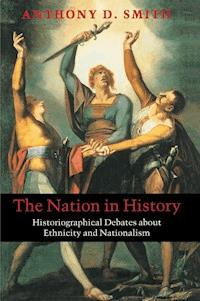
In this thought-provoking new book, Anthony Smith analyses key debates between historians and social scientists on the role of nations and nationalism in history.
In a wide-ranging analysis of the work of historians, sociologists, political scientists and others, he argues that there are three key issues which have shaped debates in this field: first, the nature and origin of nations and nationalism; second, the antiquity or modernity of nations and nationalism; and third, the role of nations and nationalism in historical, and especially recent, social change.
Anthony Smith provides an incisive critique of the debate between modernists, perennialists and primordialists over the origins, development and contemporary significance of nations and nationalism. Drawing on a wide range of examples from antiquity and the medieval epoch, as well as the modern world, he develops a distinctive ethnosymbolic account of nations and nationalism.
This important book by one of the world's leading authorities on nationalism and ethnicity will be of particular interest to students and scholars in history, sociology and politics.
Sie lesen das E-Book in den Legimi-Apps auf:
Seitenzahl: 211
Veröffentlichungsjahr: 2014
Ähnliche




















THE NATIONin HISTORY
Historiographical Debates about
Ethnicity and Nationalism
Anthony D. Smith
POLITY PRESS
Copyright © 2000 by the Historical Society of Israel
First published in the United Kingdom in 2000 by Polity Press in association with Blackwell Publishers Ltd
Simultaneously published in the United States of America by University Press of New England, Hanover, NH
Editorial office:Polity Press65 Bridge StreetCambridge CB2 1UR, UK
Marketing and Production:Blackwell Publishers Ltd108 Cowley RoadOxford OX4 1 JF, UK
All rights reserved. Except for the quotation of short passages for the purposes of criticism and review, no part of this publication may be reproduced, stored in a retrieval system, or transmitted, in any form or by any means, electronic, mechanical, photocopying, recording or otherwise, without the prior permission of the publisher.
Except in the United States of America, this book is sold subject to the condition that it shall not, by way of trade or otherwise, be lent, re-sold, hired out, or otherwise circulated without the publisher’s prior consent in any form of binding or cover other than that in which it is published and without a similar condition including this condition being imposed on the subsequent purchaser.
The lectures were originally presented under the auspices of the Historical Society of Israel, the Menahem Stern Jerusalem Lectures.
ISBN 978-0-7456-6885-7 (Single-user ebook)
A catalogue record for this book is available from the British Library.
This book is printed on acid-free paper.
Contents
Foreword by Yosef Kaplan
Introduction
1. Voluntarism and the Organic Nation
Organic and Voluntarist Nationalism
Cultural Determinism and the Political Ideal
Ethnic and Civic Nations
Cultural Primordialism
Conclusion
2. The Nation: Modern or Perennial?
The Modernist Orthodoxy
Modernist Historiography
The Perennialist Critique
Continuous Perennialism
Recurrent Perennialism
Ancient Nations ?
Conclusion: Problems with Perennialism
3. Social Construction and Ethnic Genealogy
Invented Traditions, Imagined Communities
A Critique of Social Constructionism
An Ethnosymbolic Account of Nations and Nationalism
Conclusion
Notes
Bibliography
Index
Foreword
Yosef Kaplan
In a few weeks we shall mark the tenth anniversary of the tragic death of our teacher and friend Menahem Stern. Once again we shall go up to the cemetery on Har Hamenuhot in Jerusalem, as we have done every year; again we shall recite those eternal words from the Psalms; and again we shall feel as if the author of those sublime verses were referring to Stern’s spirit when he wrote: “Oh, how I love your teachings! They are my meditation all day long. ... I have kept my feet from every evil way, so that I might keep your word” (Ps. 119:97, 101).
It was easy to love Menahem Stern, and indeed he was beloved by everyone who had the privilege of knowing him. He was a man of peace in the full meaning of the term, a humanist with his entire heart and soul, who never allowed even a hint of hatred to stain his behavior, his way of life, and his humanistic worldview.
His life was cut short in Jerusalem, the city to which he was bound with all the cords of his heart, by blind hatred that was entirely foreign to his personality and his exemplar humanae vitae.
In establishing the Jerusalem Lectures in History in Memory of Menahem Stern six years ago, the Historical Society of Israel wished to express the feelings of esteem and obligation of the community of historians in Israel to the greatest scholar of Jewish history during the Second Temple period in our generation and one of the most prominent scholars ever produced by the field of Jewish studies. In this way we wished to honor the memory and intellectual legacy of a brilliant historian who, from the start of his studies at the Hebrew University in Jerusalem in 1943 until his death, never interrupted his historical research, not even for a single day; a historian of astounding erudition, whose knowledge was not restricted to specific periods or fields but who felt at home in all periods of Jewish history and no less so in classical and European cultures.
Opening address to Professor Anthony D. Smith’s Jerusalem Lectures in History in Memory of Menahem Stern, 11 May 1999.
Nationalism played a central role in Menahem Stern’s life. Identification with the rebirth of the Jewish nation brought his parents to the Land of Israel a short time before the outbreak of the Second World War. Stern was then thirteen years old, a talented boy from a Yiddish-speaking family in Bialystock, where he absorbed not only the riches of the ancient Jewish heritage but also the foundations of modern Hebrew culture. When he became a historian, he gave expression, throughout his academic career and in his extensive scholarship, to his deep commitment to the renewal of Hebrew culture, which is one of the outstanding marks of modern Jewish nationalism. To our great regret, nationalism, in its dark aspect, also played a role in his death.
He had reservations about the name “The Jerusalem School,” which was applied to the group of historians who laid the guidelines for research in Jewish history at the Hebrew University in Jerusalem and to the first generation of their students, to which Stern belonged. At the same time, he realized that these historians and he himself shared a national approach to Jewish history. Menahem Stern was one of the five Jerusalem historians who collaborated in writing the comprehensive History of the Jewish People, edited by Haim Hillel Ben-Sasson. It was clear to him that a definition applicable to those five historians, “despite the great differences among them, would take into account their inclination to describe Jewish history as the history of a living nation ... including the various aspects of its life, and not, emphatically, the history of Judaism.”1 There is no doubt that his own work was deeply influenced by the perennialist approach to Jewish history and to the Jewish nation, which was one of the distinguishing features of the historiographical view of those who founded the study of Jewish history in Israel.
In the general introduction to the Hebrew edition of the History of the Jewish People, which was published in 1969 (interestingly, that introduction was not published in the English edition that came out in 1976), Ben-Sasson wrote: “The national framework is still appropriate for the true clarification of history, for it is the natural and conscious framework that organizes generation after generation of human actions and social relations.”2 Ben-Sasson added:
The continued existence of one nation out of many is a series of transformations within the framework of unifying factors and forces. The Jewish nation has recorded one of the oldest continuous histories in the world. The proper study of the history of this nation shows that in the movement and dispersal of the Jews throughout their long and varied history, there is far more continuity in the body that bears the culture, far more preservation of symbols of unity and solidarity, and far more persistence of culture than among most of the nations by whose side and in whose shadow the Jews lived.3
Though there are good reasons to suppose that Stern was not entirely in agreement with some of these statements, there is no doubt that his work also belongs to the category of “continuous perennialism,” as defined by Anthony Smith; and in Stern’s relation to the Zealots and Sicarii, whom he defined as “branches of a national liberation movement,” one can find something resembling the retrospective nationalism that characterized the work of more than a few historians of Ancient Israel and of scholars of Jewish history from the Hasmonean period to the Bar-Kokhba uprising.4
The study of Jewish history has expanded since then, and historiographical controversies have arisen around the question of the continuity of Jewish history, the place of nationalism in it, and so on. The influence of national ideology on Jewish historiography here in Israel has declined since then, for the same reasons that the old belief in the unity and superiority of the nation has declined in the contemporary West, and of course for other reasons as well, which are peculiar to our experience here in Israel. The penetrating discussions that take place in Israeli society regarding national and cultural identity naturally echo within academic discussions of continuity and change in Jewish history and of the connection between modern Jewish nationalism and Jewishness in premodern periods. This is not surprising, though, in this controversy, regrettably, we often lack the modesty of which Stern spoke and that was so typical of his scholarship. In these heated arguments, which are naturally imbued with political and ideological assumptions, imprecise concepts are frequently aired; this does not favor the clarification of issues, which demands more than a little self-restraint.
Therefore, we could not hope for a more appropriate lecturer at this time than Professor Anthony Smith, who is one of the major scholars of ethnicity and nationalism during the past thirty years.
With the appearance of the first edition of his Theories of Nationalism in 1971, he emerged as one of the central theoreticians in the study of nationalism. One after another he has published an impressive series of articles and books that are regarded as landmarks in the study of nationalism. These include Nationalism in the Twentieth Century (1979), The Ethnic Revival in the Modern World (1981), The Ethnic Origins of Nations (1986), National Identity (1991), Nations and Nationalism in a Global Era (1995), and most recently, Nationalism and Modernism (1998).
Many of us historians engage in dialogue with the disciplines of social science, both to sharpen the conceptual and theoretical aspects of our historical research and also to add historical and cultural depth to the works of sociologists, anthropologists, and other social scientists. It is to Anthony Smith’s credit that this dialogue is an integral part of his work, which is outstanding in its conceptual sharpness and rich theoretical imagination, on the one hand, and in extensive historical knowledge and understanding, on the other.
While it is possible to find clear continuity in his writing and a consistent search for the connection between preexistent ethnicity and modern nationalism, it is also characterized by the tireless quest for a unified theory or agreed paradigm that will encompass all the problems and topics included within nationalism. As a student of Ernest Gellner, his point of departure was acceptance of the modernity of both nations and nationalism. In his recent work he has also emphasized that “the modernists are surely right to insist on the modernity of many nations as well as of nationalism-in-general (the ideology and theory). The conditions of modernity clearly favour the replication of nations, national states and nationalism in all parts of the globe.”5
However, the transition that took place in his scholarly interest—from nationalism to nations and from nations to ethnic communities—brought him to appreciate the important role played by ethnicity in the ancient and medieval world and the immense power contained in ethnic survival. Hence, he came to the conclusion that “the problem of ethnic survival seemed particularly important for later nationalisms: the ability to call on a rich and well documented ‘ethno-history’ was to prove a major cultural resource for nationalists.”6 Moreover: “Specific nations are also the product of older, often premodern ethnic ties and ethno-histories.”7 Or, in an even sharper formulation: “Some nations and their particular nationalisms have existed well before the advent of modernity.”8
In his penetrating and extraordinarily interesting controversy with the theses of Hobsbawm and Anderson, Smith argued: “The ‘inventions’ of modern nationalists must resonate with large numbers of the designated ‘co-nationals,’ otherwise the project will fail. If they are not perceived as ‘authentic’ ... they will fail to mobilise them for political action. Better, then, to ‘rediscover’ and reappropriate an ethnic past or pasts that mean something to the people in question, and so reconstruct anew an existing ethnic identity, even where it appears shadowy and ill documented.”9
Smith is far from any sense that he has resolved all the complicated problems aroused by the issue of nationalism. Only recently he has said that “the analysis of nationalism remains elusive. So many basic questions continue unanswered, so few scholars are prepared to agree even on first principles.”10
Dear Anthony Smith, who more than we, as Israelis, for whom the intense project of building a national culture in which new and old are mingled is our daily bread, is aware of the complexity and difficulty of understanding the national phenomenon. Who more than we, who are involved in Jewish history over the ages, are aware of the complexity of the questions regarding continuity and change that a concept such as “nation” arouses, which, as you noted so well, is firmly embedded historically. We thank you for coming to share your knowledge and thoughts with us. We can only hope that you will find compensation for your trouble and effort in this renewed encounter with the questions and insights that our life here in the State of Israel will again raise in the mind of an intellectual steeped in curiosity like yourself.
Acknowledgments
For some years I had been preoccupied with the question of the historical nature of the category of the nation and of the antiquity of particular nations like the Greeks, Armenians, Persians and Jews. So I was especially pleased to receive an invitation from the Historical Society of Israel to give the 1999 Jerusalem Lectures in memory of Professor Menahem Stern on the subject of “The Nation in History” As I had only been able to touch on these issues in previous publications, this invitation gave me the opportunity to develop my views in the context of the many debates among historians of ethnicity and nationalism. This book is an extended version of the Jerusalem lectures.
I should like to record my great appreciation and gratitude to the Society, and in particular to its chairman, Professor Yosef Kaplan, and his colleagues, Professors Jonathan Frankel and Michael Heyd, for their warm welcome, kindness and hospitality. I should also like to thank them for the chance to meet with a group of Israeli doctoral students in history and to discuss their research with them. I am particularly grateful to Mr. Zvi Yekutiel, General Secretary of the Historical Society of Israel, to Ma’ayan Avineri-Rebhun and to Tovi Weiss for their care and attention to my needs and those of my family, both before and during my visit, and for making our stay both enjoyable and rewarding.
Finally, I would like to express my thanks to University Press of New England and to April Ossmann for publishing these lectures, and for seeing the manuscript through to publication with such speed and efficiency.
London School of EconomicsOctober 1999
A.D.S.Introduction
I was greatly honored to have been invited by the Historical Society of Israel to deliver the 1999 lectures in memory of the late Professor Stern. This is doubly the case, first, because of his eminence in the field of Hellenistic Jewish history and, second, because my own first love was ancient history, in particular the history of Israel and the classical world, the very field in which Professor Stern made such a distinguished contribution before his tragic death. My thoughts have returned more than once to this seminal period of ancient and Jewish history in order to gain some perspective on the problems of ethnicity and nationalism. I was therefore particularly grateful to the society for their kind invitation to lecture in Jerusalem.
Lesen Sie weiter in der vollständigen Ausgabe!
Lesen Sie weiter in der vollständigen Ausgabe!
Lesen Sie weiter in der vollständigen Ausgabe!
Lesen Sie weiter in der vollständigen Ausgabe!
Lesen Sie weiter in der vollständigen Ausgabe!
Lesen Sie weiter in der vollständigen Ausgabe!




