


27,99 €
Mehr erfahren.
- Herausgeber: John Wiley & Sons
- Kategorie: Fachliteratur
- Sprache: Englisch
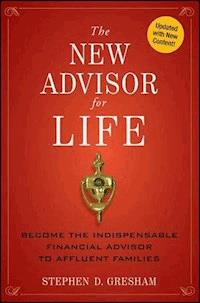
Expert advice on building an unshakable foundation as a financial advisor to the elite The revised and updated edition of the definitive guide to growing and maintaining a financial advice firm, The New Advisor for Life explores the fallout of the market crash on up-and-coming advisors. With a particular focus on the generation X and Y concern with debt management and long-term investment, this new edition examines what young investors look for in an advisor. Today, more than ever, insight, analysis, and validation are valued, but to be truly successful, an advisor needs to walk the line between being well-informed but not appearing condescending. * What today's investors want in a financial advisor is someone who can cut through the noise and clutter of the financial services industry and the mainstream media * Covers the basics, from setting a client's investment goals, selecting complementary investments, and monitoring portfolio balance, to the advanced--developing a personal finance plan for your clients based on their specific needs * Steve Gresham presents a 19-point checklist for financial advisors to offer their clients "life advice" Keeping clients engaged is more important than ever, and The New Advisor for Life gives the aspiring financial advisor the secrets to success normally reserved for the country's top firms.
Sie lesen das E-Book in den Legimi-Apps auf:
Seitenzahl: 553
Veröffentlichungsjahr: 2011
Ähnliche


















Contents
Acknowledgments
Part I: The State of the Advice Industry and Your Opportunities
Introduction
Chapter 1: The Value of Advice
Why the Affluent Want You
The Acid Test—Can You Show True Concern?
The Four Commandments
Be Inspirational—The Fifth Dimension
Part II: Investment Counsel Advice for Life
Chapter 2: How to Develop a Compelling Investment Philosophy
Common Values and Your Success
Time Horizon—Is Time on Your Side? Better Yet, Is it on Your Clients’ Side?
Bull Markets and Bravery
Risk—Wall Street’s Four-Letter Word
Volatility—Can You Weather the Storm?
Style—Is Yours Fleeting or Steady?
Investment Vehicles—How Do You Execute Your Investment Philosophy?
Cost—Sometimes a Tough Issue to Justify
Passive versus Active—Two Oars Keep the Boat Straight
Style Boxes versus Core and It’s Up to You
Inflation—Fighting This Hidden Tax
Taxes—The Bane of Investors
For the Many Other Considerations—Ask!
Recruit Others to Your Investment Philosophy—and Turn Away Skeptics
Chapter 3: Creating a Defined, Effective Investment Process
From What to How—The Institutional Method
Now It’s Your Turn
Your Assignment
Chapter 4: Setting Goals: What Really Matters?
Setting Goals: Baby Boomers
Begin with the End in Mind
It’s Needs First, Goals Second
Great Expectations—Everyone Has Them
Life after Work: Where to Live
Health Care—The Real Money Pit
Last Chance to Make a Difference
Having Fun Yet?
Setting Goals: Generations X and Y
Summing Up
Chapter 5: Defining Risk
Do You Work with Anyone Like Me?
Embrace Risk (But Not Too Tightly)
The Risk List
1. Medical Risks
2. Liquidity Risk—Assets Yes, Money No
3. Purchasing-Power Risk (a.k.a. Inflation Risk)—What Happens When Your Assets Are Devalued in Currency Terms?
4. Premature Death—Its Impact on a Family, Especially if a Business Is Involved
5. Disability—Always a Possibility
6. It’s Legal or It’s a Liability
7. Market Risk—Managing Turbulence
8. Family Care Risk—Dividing Resources between Adult Children and Aging Parents
9. Longevity Risk—Living too Long
10. Reputation Risk—For Those Who Are Personally, Professionally, or Financially Vulnerable
The Risk List: Generations X and Y
The Three Rules for Dealing with Risk
What’s In It for You: Compensation for the Soul
Chapter 6: Diversification
Step 1: The Investment Goal—Begin with the End in Mind
Step 2: The Investment Policy Statement—The Blueprint
Step 3: Selection of Complementary Investments
Step 4: Rebalancing to Improve Risk-Adjusted Returns
Four Strategies for Better Portfolios
Chapter 7: Alternative Investments
Real Estate
Commodities
Hedge Funds
Part III: Wealth-Management Advice for Life
Chapter 8: Managing Dreams and Fears
Great Expectations
Greater Concerns
What to Do
Protecting Your Assets
Lifestyle Can Be a Trap
Advisor Action Plan
Chapter 9: You Can Help Clients Grow
Promoting the Competition
The Advisory Ballet—Competition Keeps You on Your Toes
Ask Your Clients
The Monthly Competition Breakfast
The Stealth Competitor in the High-Net-Worth Marketplace
Chapter 10: All in the Family and Keeping It That Way
Postcard from a Campfire Review
Making Family Meetings Work
A Word about Family Offices
Concentrating on the Core
Top Advisors Talk about Family Issues
Long-Term Care Insurance: Price Worth Paying?
Chapter 11: Money for Life
Blessings and Challenges of Longevity
Where to Live
Retire to . . .Work?
Enjoying Leisure
How They’ll Be Remembered
When the End Is Near
How They’ll Pay for It
Part IV: Building Your Advisor for Life Practice
Chapter 12: What Is Your Value?
Value Ladder Step 1: Who Are You?
Value Ladder Step 2: What Do You Do?
Value Ladder Step 3: Why Do You Do What You Do?
Value Ladder Step 4: How Do You Do What You Do?
Value Ladder Step 5: Who Have You Done It For?
Value Ladder Step 6: What Makes You Different?
Value Ladder Step 7: Why Should I Do Business with You?
The Missing Piece
Chapter 13: How to Price Your Unique Value
The Value Test
Chapter 14: The Advisor-Client Tango
The First Contact
The Right Starters
Prospective Clients of Generations X and Y
The Prospect Is a Client; Now What?
Summing Up the Client Experience
Chapter 15: Driving Referrals
It’s 10 a.m.—Do You Know What Your Clients Are Saying about You?
Generating Referrals from Four Sources
Referral Action Plan
A Final Thought about Referrals
Chapter 16: Selling Yourself
The New Prospecting
Have Toolkit, Seek Target
Millionaire Hot Buttons—Press Here
Marketing through the Media
Chapter 17: Valuing the Advisor for Life Practice
Chapter 18: Taking Care of Number One
Your Turn
Being the Advisor for Life Is a Challenge for Your Life
Your Role: Advisor or Service Provider?
The Seven Dragons
Your Maintenance Plan: The Four Pillars of Vitality
Maintaining Your Guardrails
The End of the Road
Parting Thoughts
Appendix A: Practice Analysis
Appendix B: Investment Policy Statement
Appendix C: Top 20 Client Analysis
About the Author
About the Contributors
Index
Copyright © 2012 by Stephen D. Gresham. All rights reserved.
Published by John Wiley & Sons, Inc., Hoboken, New Jersey.
Published simultaneously in Canada.
The first edition of this book was titled Advisor for Life: Become the Indispensable Financial Advisor to Affluent Families.
No part of this publication may be reproduced, stored in a retrieval system, or transmitted in any form or by any means, electronic, mechanical, photocopying, recording, scanning, or otherwise, except as permitted under Section 107 or 108 of the 1976 United States Copyright Act, without either the prior written permission of the Publisher, or authorization through payment of the appropriate per-copy fee to the Copyright Clearance Center, Inc., 222 Rosewood Drive, Danvers, MA 01923, (978) 750-8400, fax (978) 646-8600, or on the Web at www.copyright.com. Requests to the Publisher for permission should be addressed to the Permissions Department, John Wiley & Sons, Inc., 111 River Street, Hoboken, NJ 07030, (201) 748-6011, fax (201) 748-6008, or online at http://www.wiley.com/go/permissions.
Limit of Liability/Disclaimer of Warranty: While the publisher and author have used their best efforts in preparing this book, they make no representations or warranties with respect to the accuracy or completeness of the contents of this book and specifically disclaim any implied warranties of merchantability or fitness for a particular purpose. No warranty may be created or extended by sales representatives or written sales materials. The advice and strategies contained herein may not be suitable for your situation. You should consult with a professional where appropriate. Neither the publisher nor author shall be liable for any loss of profit or any other commercial damages, including but not limited to special, incidental, consequential, or other damages.
For general information on our other products and services or for technical support, please contact our Customer Care Department within the United States at (800) 762-2974, outside the United States at (317) 572-3993, or fax (317) 572-4002.
Wiley also publishes its books in a variety of electronic formats. Some content that appears in print may not be available in electronic books. For more information about Wiley products, visit our web site at www.wiley.com.
Library of Congress Cataloging-in-Publication Data:
Gresham, Stephen D.
The new advisor for life : become the indispensable financial advisor to affluent families / Stephen D. Gresham. – 1
p. cm.
Rev. ed. of: Advisor for life. 2007.
Includes index.
ISBN 978-1-118-06288-3 (hardback); ISBN 978-1-118-14881-5 (ebk); ISBN 978-1-118-14880-8 (ebk); ISBN 978-1-118-14872-3 (ebk)
1. Financial planners. 2. Investment advisors 3. Affluent consumers—Finance, Personal. I. Gresham, Stephen D. Advisor for life. II. Title.
HG179.5.G738 2011
332.024—dc23
2011021457
To the most important people in my life: Jane, Rachael, Meggie, T.J. Gresham, and Jeter.
Acknowledgments
“What do you think we should do?” It was the right question, given the topic under discussion. The setting was the office where I offered my services as a portfolio manager and registered representative of a regional brokerage firm. The year was 1985, and asking the question was a couple, each about 60 years old, and recently retired. We talked about a wide variety of choices, including travel, education, recreation, and family, and how they might fund those passions. And even though they were each twice my age, these successful professionals wanted my advice. And they are both still going strong.
I have learned to appreciate that there is no greater professional compliment than to be asked your opinion by a client, a colleague, your manager—or one of your kids. As I reflect on a career in financial services that spans more than 30 years, has taken me to nearly every state, all of the Canadian provinces, and global locales from Seville to Singapore, I realize I have been on a mission—to have the insights and perspective worthy of answering that question.
The New Advisor for Life is a literary suitcase stuffed full during my travels among some of the world’s best financial advisors from all different corners of the financial advice industry. And while you alone can determine the appropriate path for your own career, I’m confident that the experiences of these professionals can add to your toolbox of client solutions and make you the trusted advisor so highly prized by affluent families. It is a privilege to share those stories with you in this book, and to collaborate with so many accomplished men and women.
The New Advisor for Life builds on a work begun nearly 15 years ago when I had the opportunity to formalize my best practices observations. That long trail has helped me find some of the most interesting original thinkers in the advice industry. I can start with Rob Knapp, George Kempf, Bruce Johnston, and Greg Gloeckner, who were instrumental in those earlier days as we talked about ideas that became SuperNova. Russ Alan Prince showed me the value of high-net-worth investor psychology long before any other pundit—and remains a trusted friend. Leo Pusateri and I traveled the world working on the transition to Private Wealth with a leading international brokerage firm—among many other collaborations that were both personally and professionally enriching. More recently, Leo and his colleagues Giles Kavanaugh, Jeff Liebel, and Bruce Dyer have reset the high bar for professional development. Their contributions are tangible, actionable, and enduring. Find them at pusatericonsulting.com. Len Reinhart and Frank Campanale were always close to innovation, and provided excellent perspective. Chris Davis of The Money Management Institute, Walt Zultowski of The Phoenix Companies, Jack Sharry of LifeYield, Tim Welsh, Connie Chartrand of Merrill Lynch and later Morgan Stanley, Rose Cammareri of AGF Funds, and Darlene DeRemer of Grail Partners each provided important opportunities that added mightily to my studies of advisor practices. More recently, old friend Randy Ambrosie has opened a new door to the future with Accretive 360.
Many top advisors have been incredibly generous with their time. Kerry Bubb, John Rafal, Peter Burton, Louis Chiavacci, Clayton Hartman, Sandy Smith, Brian Kelly Sr, Brian Kelly Jr, Mary Beth Emson, Leon Levy, Bill Lomas, Robert Levy, Trisha Stewart, Scott Finlay, Greg Miseyko, Steve Grillo, Jim Pratt-Heaney, and Ken Gordon stand out in the pages to follow.
I’ve had great luck with editorial partners—each of whom has vastly improved my amateur efforts. Evan Cooper got me started when he was at On Wall Street and co-authored the first book, Attract and Retain the Affluent Investor, in 2000 after three years of writing columns. Evan is a great friend. Evan Simonoff, now of Financial Advisor magazine, has always provided valuable advice, along with David Smith and Charlie Stroller. One of the great experiences of my life was partnering with my father, retired physician and hospital director, Glen Gresham on a column suggested by David Geracioti of Registered Rep—Retirement Doctor—that was rewarding for us both.
My colleague Laura Walsh at Wiley & Sons had the idea to revitalize the 2007 edition of Advisor for Life and gave me fresh perspective and insight to re-engineer the original work. Wiley has been a great partner for five years now and I am grateful for our relationship.
This refresh of Advisor for Life required a new team, and three longtime allies made it happen. Mike Lynch is a smart and insightful market observer and he brings great expertise forward in our investing sections. Arlen Oransky is my longtime friend and trusted partner in every business effort during the past nearly 20 years. And I cannot imagine this book without the incredible efforts of Tom Johnson, who is conscientious, meticulous, and creative—the rock that held steady throughout the process and who drove the content refresh to include Gens X and Y.
The final acknowledgment is due you, the reader, for investing your cash and your time in search of ideas to challenge your skills and to provide a better service to your clients. Your professional curiosity is at the root of greater expertise—and that expertise will draw valuable clients to you as they seek answers to their own versions of the question, “What do you think we should we do?” Good luck!
PART I
THE STATE OF THE ADVICE INDUSTRY AND YOUR OPPORTUNITIES
Introduction
When I wrote the introduction to the first edition of this book, which was published in 2007, I highlighted several trends that were emerging at the time and asked financial advisors to consider the way those trends were impacting not only their practices, but also their lives. Those trends are still emerging—but boy, have they been affected by the events that followed about a year after the book hit store shelves. The questions I raised then seem even more important now.
The first trend I identified was the challenge to prove the value of advice, especially to the baby-boom generation (the 77 million Americans born between 1946 and 1964). In the early years of what we now recognize as the financial services industry, most baby boomers were still very young; if they had any awareness of brokers or advisors at all, they most likely concluded that such people were employed only by the very wealthy. Over time, as these boomers began accumulating significant assets, they did not seek out the service of an advisor, even though their financial situation called for one. Such professionals are only interested in the very, very rich—or so the boomers believed.
You may remember those television commercials from the early 1980s, in which a couple of guys are sitting in a restaurant or at a sporting event talking, and one of them utters: “My broker is E.F. Hutton, and E.F. Hutton says . . .” Everyone else in the immediate vicinity stops speaking; there is dead silence as people hope to get some free advice from someone wealthy enough to employ his own broker.
That was undoubtedly a compelling image, and it helped establish the notion that personalized financial advice is a service available only to a chosen few. The far larger group of moderately affluent or even sort of wealthy had to look for guidance elsewhere, and in time there was no shortage of places for them to find it. When commissions were deregulated on May Day 1975, several new companies set up shop and reached out to smaller investors—those who believed they didn’t have enough money to garner the attention of a full-service financial advisor—and over time and with very aggressive, very imaginative, and very successful marketing, they became household names: Charles Schwab. Fidelity Investments. The Vanguard Group. These companies have shown themselves to be brilliant at delivering financial services to the broad marketplace, and each delivered value and innovation. Schwab pioneered the use of a single platform to hold securities and mutual funds from multiple companies. Fidelity became one of the largest providers of actively managed mutual funds and the world’s largest provider of retirement plans. Vanguard attracted a substantial following by offering low-cost index (passively managed) mutual funds.
With the benefit of hindsight, it’s obvious that these firms found precisely the right moment to deliver their message. Less than a year before the May Day deregulation, Congress passed the Employee Retirement Income Security Act (ERISA), which was the government’s response to the bear market of 1974. Among many other innovations, the ERISA regulations established the Individual Retirement Account (IRA), which was a way for employees not covered by traditional pension plans to invest money and defer taxes on gains until they began withdrawing funds in retirement.
That groundbreaking legislation would trigger a seismic shift in the way Americans began thinking about saving and investing—especially as it was followed just a few years later by the establishment of the 401(k) plan. For a number of reasons, workers stopped looking to their employer to fund their retirement and took that responsibility on themselves. Numbers tell the story: In 1980, 60 percent of Americans were covered by a traditional pension plan; by 2006, that figure had fallen to just 8 percent. Some 70 percent of workers were enrolled in a 401(k) plan, and 22 percent were covered by a combination of defined-benefit and defined-contribution plans. That’s a remarkable shift in just 30 years!
Perhaps because of their Depression-era childhoods, relatively few members of the so-called Silent Generation—that is, the baby boomers’ parents—had invested in the stock market, but an overwhelming majority of their children were regular investors and some managed to accumulate significant wealth, often through a company-sponsored 401(k). Yet most of them had never consulted a full-service financial advisor, because they still clung to the outdated image of personalized service as something accessible only to the very wealthy—an image that should have served as a warning sign to the wirehouses even before the economic catastrophe of 2008. And with the advent of discount brokers, many baby boomers became do-it-yourselfers, giving little or no thought to hiring a professional financial advisor.
This situation has also created a dilemma for individual advisors. Many of them have used technology in innovative ways to customize online offerings and leverage their knowledge and guidance. There are challenges to delivering personal service to a mass audience, but a number of firms have made great progress in delivering choice, service, guidance, and value.
On a smaller scale, many individual advisors opted to follow the path of constantly seeking out more and more clients. As their client base grew, the time they had to devote to each client shrunk and the quality of the relationship deteriorated—or they ended up working far more hours than they’d ever intended. Somewhere in that mix, someone was dissatisfied—and dissatisfaction inevitably results in change. It’s only a matter of time.
In the earlier edition, I questioned whether the financial services industry would follow the same road as the American automobile industry (a comparison that seems a bit eerie, given the events of the past few years). When the latter industry was in its infancy, quality was of the utmost importance because, at that time, cars were considered a luxury, not a necessity. Affluent customers aren’t going to accept second-rate products or services, especially if they don’t believe they truly need what is being marketed to them.
There was a time when the great U.S. automakers controlled every aspect of production; the Ford Motor Company, for instance, was a substantial miner and smelter of iron ore. However, once the idea of owning a vehicle caught the public’s imagination, the quality of many American automobiles began to slip. Automakers began using inferior materials to widen their profit margin, and by the 1960s had even embarked upon a strategy of planned obsolescence—building cars that weren’t meant to last! Detroit somehow convinced itself that people would buy whatever it was selling—good, bad, or otherwise—and for a time, they were right. In the industry’s golden era, demand so outstripped supply that people would wait months for a car. General Motors became the largest private-sector employer in the world and was the first public company to pay more than $1 billion a year in taxes. Many other automakers were almost as big, and the market was theirs . . . to lose. And lose it they did.
In the early 1970s, the Arab oil embargo highlighted the risks associated with America’s dependence on foreign oil. Service stations ran out of gas, customers had to wait in long lines for the ones that were operational, and Americans were crying out for more fuel-efficient vehicles. The automobile industry initially turned a deaf ear to the outcry and continued to produce large, expensive gas-guzzling cars loved by a declining percentage of the American auto-buying public. Meanwhile, a group of German and Japanese carmakers entered the fray, with different models with a value bent. Despite innovations and improvements in later years, Detroit never returned to the industrial prominence it enjoyed in the 1940s and 1950s. By 2009 GM was no longer the world’s number one automaker—Toyota took the crown and GM was struggling to survive.
“What are the lessons to be learned by full-service financial advice firms from the experiences of the automotive industry, as humbled by the boomers? And is it too late?” Those were questions I asked in 2007. If most Americans had answered the latter question in the final months of 2008 or the early months of 2009, many would have said, “Stay alert! Financial services firms, like automobile manufacturers, have to focus on the end experience—choice, value, service—and never stop working to maintain trust.”
Many people of all income and asset levels saw their portfolios hit hard by the financial crisis of 2008 and the recession that followed (the effects of which are still being felt as I write this). Venerable institutions, from internationally recognized Wall Street firms to local and regional banks in cities and towns across the country, have closed their doors or merged with former rivals as a way to stay in business. The phrase ‘too big to fail’ which has entered the national lexicon, was coined to describe financial institutions (and, eventually, two of the remaining Big Three automakers) that were rescued by the federal government because, it was believed, their collapse would be even more costly than the billions of dollars in taxpayer money required to keep them in operation.
The dire circumstances of what has come to be called the Great Recession have engendered a lot of understandable pessimism, but it has also underscored a trend that has been evident in every economic downturn in recent decades: Demand for financial advice goes up when the market (and the economy) goes down. In the 1990s, the longest bull market in American history, the financial planning profession enjoyed tremendous growth; even so, many of the people who made a lot of money during that decade did not engage the services of an advisor for the simple reason that they didn’t think they needed one: Their portfolio was doing just fine on its own. After the Tech Wreck of 2000 and 2001 caused the market to plummet, many people finally sought out professional assistance in managing their money. It was a hard lesson, but one that proved the value of professional financial guidance.
In the pages that follow, I will attempt to help you consider the issues facing our industry and to evaluate choices as they apply to you and your practice, by helping you clarify the value you bring to clients and differentiate yourself within the crowded financial-services marketplace. Along the way, I will also suggest ways in which you can help your clients understand what exactly you can (and can’t) do for them, and how you can make sure that you consistently deliver high-quality performance to each of your clients—without losing yourself or ignoring your own needs and goals in the process.
The other emerging trend I highlighted in the earlier edition centers on the baby boomer market. In 2007, the oldest members of this generation—those born in the years immediately following World War II—began to reach the age at which they could take early retirement. The wealth-accumulation phase of their financial lives was drawing to a close, and the wealth-distribution phase was about to begin in earnest. The assets these people had amassed during their working years would have to see them through another 15 or 20 years, according to current life expectancy guidelines. Therein lay a challenge: These boomers had spent on average 40 years accumulating assets, and now those assets had to last on average another 20 years—and many of their portfolios have recently sustained heavy losses.
The advisor-client relationship will change as the client’s life circumstances change. Is he or she prepared for that transformation? Are you? Later chapters in this book detail the issues that both of you will face and ways in which you can discuss and address them.
However, in this edition of Advisor for Life I am moving beyond the scope of the original book, which focused primarily on the baby boomers, and am including information that I hope will prove helpful as you consider the affluent within the next generation of Americans, those known as Generations X and Y. Taken together, these two groups represent some 125 million Americans, and the oldest among them will turn 45 this year—a pivotal age at which many people finally start getting serious about saving for retirement. This market has not been a central focus of the financial services industry.
Just as the baby boomers differ dramatically from their Silent Generation parents with regard to attitudes about saving and investing, Generations X and Y are very different from baby boomers. Despite their relative youth, they tend to be much more conservative investors than the generation that precedes them and many even tend to identify themselves as savers rather than investors.
Financial security in retirement is a key concern of these younger Americans, particularly Generation X, even if retirement still seems distant for many of them. A 2008 study by the American Education Savings Council and the American Association of Retired Persons found that 70 percent of Generation X and 51 percent of Generation Y have given some thought to retirement. The figures are even higher for those who are covered by a retirement plan at work, suggesting that participation in a plan fosters long-term thinking about retirement goals. Although the study found that 21 percent of the Generation X respondents expect to retire in their 70s, compared to just 13 percent of Generation Y, most participants said they expect to retire in their 60s, just like the Baby Boomers.
However, the generations diverge when it comes to funding that retirement. Unlike the Boomers, who expected Social Security to be a primary source of retirement income, most Gen-Xers and Gen-Yers expect to pay for their golden years with the proceeds of their investments—defined-contribution plans, non-work-related investment accounts, and savings accounts. Only 7 percent said they expect to rely on Social Security as a primary source of income in retirement.
The financial-planning relationship with Generations X and Y tends to be much more collaborative than with Baby Boomers. But in order to work effectively with this market, you must first understand them. Many young Americans hold contradictory beliefs about the world and their place in it. On the one hand, their expectations are very high with regard to jobs, money, material possessions, and more. On the other hand, they are often skeptical about the role of government, corporate America, and the news media. In short, they expect a lot from institutions in which they are not fully confident. That attitude can affect their relationship with a financial advisor—but it doesn’t have to. I will explain more about building trust in later chapters.
Much has been written in the past couple of years about how the economic crisis triggered by the meltdown of the subprime mortgage market has forever altered the financial landscape. And yet individuals must press on. They still need to manage their finances, save money, and plan for retirement. Even as they acknowledge that they need help with these tasks, they may be skeptical—even suspicious—of your ability to assist them. “Why should I trust you?” they may ask. “What sets you apart from other advisors?” This book will help you answer those questions and show you how to build the advisory practice of your—and your clients’—dreams.
CHAPTER 1
The Value of Advice
WHICH ADVICE IS MOST VALUED BY AFFLUENT HOUSEHOLDS—AND WHAT SHOULD IT COST?
What services are today’s clients willing to pay you to provide?What can you offer—and what do you want to offer?What five words can help guide you to provide a consistent offering of services valued by affluent clients?If other service professions can be a guide to financial advisors, they reveal that the most reliable long-term profits can be earned from those services that cannot be easily delivered via “non-human” means, such as over the telephone or via the Web.
There is an incredible, once-in-a-lifetime opportunity for those advisors willing to engage those who need long-term financial help. The most lucrative segment of the industry will remain for those advisors who can deliver what clients will pay for—real advice for real issues. That advice will require you to determine for each client household its greatest:
Needs—the requirements of daily living, including household income.
Concerns—issues that worry a household based on current conditions, such as the care of an aging parent.
Fears—potential problems, such as the chances of contracting a major illness or being confined to a nursing home.
Risks—vulnerabilities—financial, emotional, or otherwise.
Goals—what people hope to accomplish.
Dreams—the things people hope to do, but typically do not as circumstances catch up to them and realities or lack of motivation outweigh the potential.
Why the Affluent Want You
Now save yourself a lot of time. Here’s a simple exercise to determine if you have the right stuff to be an Advisor for Life:
Think about your own life and family. What do you need to live on right now? What level of income is required by your current lifestyle? If you are a successful advisor, you earn a six figure annual paycheck—or more. So what is that annual number? Now ask yourself: What would you do if your income fell by 50 percent this year? Where would you turn? Who would you ask for advice?
Lesen Sie weiter in der vollständigen Ausgabe!
Lesen Sie weiter in der vollständigen Ausgabe!
Lesen Sie weiter in der vollständigen Ausgabe!
Lesen Sie weiter in der vollständigen Ausgabe!
Lesen Sie weiter in der vollständigen Ausgabe!
Lesen Sie weiter in der vollständigen Ausgabe!
Lesen Sie weiter in der vollständigen Ausgabe!
Lesen Sie weiter in der vollständigen Ausgabe!
Lesen Sie weiter in der vollständigen Ausgabe!
Lesen Sie weiter in der vollständigen Ausgabe!
Lesen Sie weiter in der vollständigen Ausgabe!
Lesen Sie weiter in der vollständigen Ausgabe!
Lesen Sie weiter in der vollständigen Ausgabe!
Lesen Sie weiter in der vollständigen Ausgabe!
Lesen Sie weiter in der vollständigen Ausgabe!
Lesen Sie weiter in der vollständigen Ausgabe!
Lesen Sie weiter in der vollständigen Ausgabe!
Lesen Sie weiter in der vollständigen Ausgabe!
Lesen Sie weiter in der vollständigen Ausgabe!
Lesen Sie weiter in der vollständigen Ausgabe!
Lesen Sie weiter in der vollständigen Ausgabe!
Lesen Sie weiter in der vollständigen Ausgabe!
Lesen Sie weiter in der vollständigen Ausgabe!
Lesen Sie weiter in der vollständigen Ausgabe!
Lesen Sie weiter in der vollständigen Ausgabe!
Lesen Sie weiter in der vollständigen Ausgabe!




