


17,99 €
Mehr erfahren.
- Herausgeber: John Wiley & Sons
- Kategorie: Fachliteratur
- Sprache: Englisch
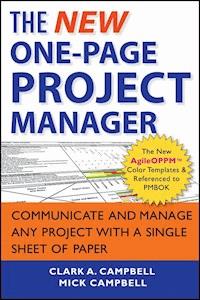
How to manage any project on just one piece of paper The New One-Page Project Manager demonstrates how to efficiently and effectively communicate essential elements of a project's status. The hands of a pocket watch reveal the time of day without following every spring, cog, and movement behind the face. Similarly, an OPPM template reduces any project--no matter how large or complicated--to a simple one-page document, perfect for communicating to upper management and other project stakeholders. Now in its Second Edition, this practical guide, currently saving time and effort in thousands of organizations worldwide, has itself been simplified, then refined and extended to include the innovative AgileOPPM(TM). * This Second Edition will include new material and updates including an introduction of the ground-breaking AgileOPPM(TM) and an overview of MyOPPM(TM) template builder, available on-line * Includes references throughout the book to the affiliated sections in the Project Management Body of Knowledge (PMBOK®) * Shows templates for the Project Management Office (PMO) This new and updated Second Edition will help you master the one-page approach to both traditional project management and Agile project management. (PMBOK is a registered marks of the Project Management Institute, Inc.)
Sie lesen das E-Book in den Legimi-Apps auf:
Seitenzahl: 234
Veröffentlichungsjahr: 2012
Ähnliche


















Table of Contents
Praise for The New One-Page Project Manager
Title Page
Copyright
Dedication
Foreword
Acknowledgments
Introduction
70 Years of Experience
Project Management: A Brief History
Chapter 1: The Necessity of Simplicity and the Power of Visuals
The Guiding Principle
The Power of Visuals
Critical Path Method and Earned Value Management
Now to Turn Things 180 Degrees—Beware of Being Too Simple
Chapter 2: OPPM Is All about Communication
Chapter 3: What Is the One-Page Project Manager?
Chapter 4: A Traditional Project
Five Essential Parts of a Project
Ownership Is Remarkably Powerful
Chapter 5: The 12 Construction Steps for a Traditional OPPM
Step 1: The Header
Step 2: The Owners
Step 3: The Matrix
Step 4: The Sub-Objectives
Step 5: The Major Tasks
Continuous Improvement
Step 6: Aligning Tasks with Sub-Objectives
Step 7: The Report Dates
Step 8: Aligning Tasks to Report Dates
Step 9: Aligning Tasks and Schedule to Owners
Step 10: Risks, Qualitatives, and Other Metrics
Step 11: Costs and Metrics
Step 12: Summary & Forecast
The 12 Steps Come Together
Chapter 6: The Five Reporting Steps for a Traditional OPPM, or OPPM in Action
Five Steps to Creating a Report Using the OPPM
Examples of the OPPM in Action
A Report Early in the Project
A Report Midway through the Project
A Report Near the End of the Project
Chapter 7: An Agile Project: Five Essential Parts of an Agile Project
Chapter 8: The 12 Construction Steps for an Agile OPPM
Step 1: The Header
Step 2: Development Team
Step 3: The Matrix
Step 4: Feature Sets
Step 5: Releases and Sprints
Step 6: Aligning Sprints with Feature Sets
Step 7: Sprint Dates and Time Boxes
Step 8: The Schedule
Step 9: Backlog Burndown
Step 10: Risks, Qualitatives, and Other Metrics
Step 11: Overall Status
Step 12: Summary & Forecast
Chapter 9: The Seven Reporting Steps for an Agile OPPM
Seven Steps to Creating a Report Using the OPPM
Chapter 10: Thinking about Projects
The Visionary Thinker
The Start-to-Finish Thinker
The Finish-to-Start Thinker
Assets of These Thinkers
Liabilities of These Thinkers
People Are Multidimensional
What the Project Leader Needs to Do
Chapter 11: The Project Management Office
Project Dashboard
Corporate Project Methodology
Project Training
Consistent Application
Project Public Relations
Project Prioritization
Project Review and Corrective Action
Project Archives and Continuous Improvement
Example
Chapter 12: Consulting and Marketing with the OPPM
Phase 1: The Small Consulting Engagement
Phase 2: The Large Consulting Engagement
Appendix A: The One-Page OPPM
Appendix B: OPPM and the PMBOK
OPPMs and Communication Processes
Index
Praise for The New One-Page Project Manager
“The New One-Page Project Manager is an essential part of my executive toolkit. OPPMs communicate a project's plan and then communicate progressive performance to that plan in a complete yet efficient way, thereby increasing the visibility and collaboration so vital for successful project management.”
—Michael O. Leavitt, Chairman, Leavitt Partners; Secretary, United States Department of Health and Human Services (2005–2009); Administrator, United States Environmental Protection Agency (2003–2005); Governor of Utah (1992–2003)
“Creating clarity from ambiguity, while organizing complex interrelated processes, lies at the heart of outstanding project management. The New One-Page Project Manager is a tremendous tool to assist in achieving that goal.”
—Chris Liddell, Former CFO,Microsoft and Vice Chairman and Chief Financial Officer,General Motors
“As the CEO of Deloitte, I had oversight of countless projects, both at Deloitte and at our clients. Successful change initiatives require clear vision, strong leadership, meaningful milestones, focused execution, and clear accountability. Clark Campbell, through The New One-Page Project Manager, has successfully integrated those critical success factors in one readable page. The difference between projects that succeed and those labeled as disappointments is always made in the execution. The OPPM can be an effective enabler of strong project management, significantly increasing the likelihood of success.”
—James H. Quigley, CEO Emeritus of Deloitte
“While at initial glance this book may appear to be simply about developing a ‘dashboard’ for tracking an important project, it soon becomes clear that it is much more than that. The approach outlined by Clark Campbell, an experienced and accomplished project leader, provides a proven process for project management that significantly improves the chances that the project will be completed on time, on budget, and on target for its intended purposes. Furthermore, it provides a straightforward yet compelling set of steps to ensure that those with the ability and responsibility to achieve the desired results are supported, guided, and focused in their efforts to do so. This approach will prove especially beneficial to students and practitioners who want to learn and apply the skills and tools of effective project leadership.”
—Steven C. Wheelwright, PhD, Baker Foundation Professor,Senior Associate Dean, Director of Publications Activities,Harvard Business School, Harvard University
“Impressive in its simplicity, yet universal in its application, the One-Page Project Manager began assisting Chinese project managers in 2003, when Mr. Campbell first lectured in Beijing. OPPM is easy to learn and use, and is impressive in its clear capacity to communicate. It should be required reading for every manager who wants to improve project performance, accurately tell their story, and do it efficiently.”
—Jonathan H. Du, PhD, CEO and Chairman,WiseChina Training Ltd., Beijing, China
“Total Lean Management requires lean communication. OPPM is in very deed—a lean communication tool. O.C. Tanner, a Shingo Prize winner, is among the top 3 percent of Lean companies in North America. Their distinctive combination of OPPM with Toyota's A3 report reveals a unique, continuous improvement, one that documents, in part, how they have executed their strategy to achieve market dominance and profitable growth.”
—Ross E. Robson, PhD, President DNR Lean LLC,Strategic Founder and Executive Director of the Shingo Prize (retired)
“Don't be fooled into thinking that OPPM is applicable only to monumental and product related tasks. OPPM is a way of organizing the way one thinks about tasks that lie ahead. It is a way to identify what goals are worth the investment of time and other resources, and then to describe them in simple and measurable terms. It is just as useful in building a winning little league team as it is in building a ball field. Once understood, OPPM is a tool useful for any task important enough to plan for.”
—Justice Michael J. Wilkins, Utah Supreme Court (retired)
This book is printed on acid-free paper.
Cover image: Courtesy of Clark A. Campbell
Cover design: John Wiley & Sons, Inc.
Copyright © 2013 by Clark Campbell and Mick Campbell. All rights reserved.
Published by John Wiley & Sons, Inc., Hoboken, New Jersey.
Published simultaneously in Canada.
No part of this publication may be reproduced, stored in a retrieval system, or transmitted in any form or by any means, electronic, mechanical, photocopying, recording, scanning, or otherwise, except as permitted under Section 107 or 108 of the 1976 United States Copyright Act, without either the prior written permission of the Publisher, or authorization through payment of the appropriate per-copy fee to the Copyright Clearance Center, 222 Rosewood Drive, Danvers, MA 01923, (978) 750-8400, fax (978) 646-8600, or on the web at www.copyright.com. Requests to the Publisher for permission should be addressed to the Permissions Department, John Wiley & Sons, Inc., 111 River Street, Hoboken, NJ 07030, (201) 748-6011, fax (201) 748-6008, or online at www.wiley.com/go/permissions.
Limit of Liability/Disclaimer of Warranty: While the publisher and author have used their best efforts in preparing this book, they make no representations or warranties with the respect to the accuracy or completeness of the contents of this book and specifically disclaim any implied warranties of merchantability or fitness for a particular purpose. No warranty may be created or extended by sales representatives or written sales materials. The advice and strategies contained herein may not be suitable for your situation. You should consult with a professional where appropriate. Neither the publisher nor the author shall be liable for damages arising herefrom.
For general information about our other products and services, please contact our Customer Care Department within the United States at (800) 762-2974, outside the United States at (317) 572-3993 or fax (317) 572-4002.
Wiley publishes in a variety of print and electronic formats and by print-on-demand. Some material included with standard print versions of this book may not be included in e-books or in print-on-demand. If this book refers to media such as a CD or DVD that is not included in the version you purchased, you may download this material at http://booksupport.wiley.com. For more information about Wiley products, visit www.wiley.com.
Library of Congress Cataloging-in-Publication Data:
Campbell, Clark A., 1949–
The new one-page project manager : communicate and manage any project with a single sheet of paper / Clark A. Campbell and Mick Campbell.
p. cm.
Rev. ed. of: The one-page project manager. c2007.
Includes index.
ISBN 978-1-118-37837-3 (pbk); 978-1-118-46113-6 (ebk); ISBN 978-1-118-46115-0 (ebk); ISBN 978-1-118-46147-1 (ebk)
1. Project management. 2. Business report writing. I. Campbell, Mick, 1974- II. Campbell, Clark A., 1949- One-page project manager. III. Title.
HD69.P75C363 2013
658.4′04–dc23
2012032709
Foreword
You have in your hands a book that is both a critical tool for, and a symbol of, our innovation economy.
Our twenty-first-century workplace is the scene of rapid, visible evolution. This rapid evolution means we are surrounded by projects. Some projects are huge, such as a new commercial airplane model. But the proliferation of projects is due more to an increase in small projects, such as implementing standardized processes in an operating room, a promotion campaign for a winery, or opening a new office for a growing business. There are many reasons the pace of change and the number of projects are increasing, but there is no doubt it is true, for the evidence is all around us.
Projects generate chaos. How could they not? The definition of a project is work that has a beginning and an end, and produces a unique product or service. By their nature, every project has an element of discovery, doing something that hasn't been done exactly that way before. Every project is different from the last one. It's the opposite of the twentieth-century focus on continuous process improvement—refining the way we manufacture a car or process a bank loan until we drive out all inefficiency and error. Managing a single project may not quite constitute chaos, but as projects proliferate we find ourselves juggling a collection of increasingly diverse tasks, goals, and resources.
The project-driven workplace emerged in the 1990s. In that one decade, the discipline of project management broke out of its construction and defense industry niche and spread throughout all organizations: for-profit, nonprofit, and government. With it came an explosion of training, methodology, software, and certification—all directed toward gaining control over the ever-increasing complexity associated with managing more and more projects.
Our approach to managing the complexity of projects has become equally complex. Project Management Offices (PMOs) are staffed with expert project managers. Enterprise project management software attempts to systematize the juggling game, corralling our jumble of projects into a common framework and database. All of this effort and structure introduced to get our arms around this chaotic work has allowed us to juggle more and bigger projects.
Yet there have been two significant departures from this trend toward larger, more complex project management. The first, the Agile software development approach, broke the paradigm of rigidity and control because it became clear that increased structure both slowed projects down and degraded the quality and usefulness of the resulting software. Within a decade, the appeal of Agile transcended the software and information technology industries and is being used with other kinds of projects where discovery and rapid learning play major roles in project success. Agile does acknowledge the complexity of projects, but it addresses the complexity with principles and techniques that are designed to coexist with complexity rather than conquer it.
The second significant trend away from complex project management is described in this book, The One-Page Project Manager, or OPPM. The OPPM also accepts that projects can be large and complex, but insists that to effectively manage them we must be able to distill the complexity to bring the major themes into focus. Using the OPPM, we can simultaneously pay attention to several key dimensions of project performance, producing a sufficiently complete understanding to make good decisions.
How is it possible that we can manage a major project using the information formatted onto a single page? Even simple project management methodologies call for a half dozen separate documents. But that is the magic and the value of the OPPM. Project management is already a discipline populated by graphic techniques, because a picture not only is worth a thousand words, but it may be the only way to truly synthesize and digest the meaning of those words. The OPPM takes synthesis and summary to a new level.
During 20-plus years of teaching and consulting in the field of project management, my team at The Versatile Company has worked with many thousands of projects and project managers in industries as diverse as health care, education, aerospace, and government. Throughout this time I have prized the practical over the theoretical. I particularly attempt to focus on the minimum management overhead that produces the greatest productivity benefit, so it is natural for me to appreciate the OPPM. I am also naturally skeptical, so I was cautious in embracing it. I've developed my own rules of thumb for evaluating a project and the minimums needed for effective management, and they are published as the Five Project Success Factors in my own popular book, The Fast Forward MBA in Project Management, 4th edition (John Wiley & Sons, 2012). I used the lens of the five factors to view the OPPM and was impressed that it contributed to every one of them.
Amazingly, the OPPM is the product of a very few executives—and of one in particular, Clark Campbell. Among all the other methods and techniques in the world of project management, it is nearly impossible to find one with a single inventor, as most techniques have evolved out of common usage across hundreds or thousands of projects. The clear exception is Henry Gantt, who literally a century ago introduced the now ubiquitous chart that bears his name. Like Gantt, Clark Campbell and his colleagues produced this new graphic for project reporting out of necessity and honed its design through use.
This new edition benefits from five years of feedback since its initial publication in 2007. Appropriately, it also includes a modified OPPM for Agile.
In our innovation economy characterized by rapid evolution and abundant projects, project management has taken on increased importance. It is also necessary to realize that we need both complex and simple approaches to managing projects. The OPPM does not replace the complex methods—Clark Campbell is clear about that. The OPPM creates an interface between the sophisticated, specialized skills of professional project managers and the many other project stakeholders whose expertise is needed for the project.
I congratulate Clark on his success pioneering this timely management and communication tool. It is well suited to the demands of leadership in these turbulent times.
Eric Verzuh, PMP President, The Versatile Company,www.VersatileCompany.com Author, The Fast Forward MBAin Project Management, 4th edition
Acknowledgments
In addition to those foundational contributors acknowledged in the first three OPPM books, we are profoundly grateful for the insight, contributions, and support from:
Finally, gratitude is extended to a continually expanding group of companies and individual OPPM users for collaboration, skilled deployments, and best practices in communicating project plans, and communicating performance to those plans.
Introduction
Seventeen years ago, a skeleton of the One-Page Project Manager (OPPM) was crafted in the Cincinnati airport by a small project team while we waited for a delayed flight. Our company president had asked us to find a way to collect the necessary project components, wrap them around a standard X-chart, and report to him on a single page.
That sounded nearly impossible. Project reports for upper management typically ran to many, often dozens, of pages, so we were certainly in favor of exploring ways to eliminate any non-value-added work. We therefore crafted the first OPPM to document the plan and communicate the progress for a project to design and build a $10 million warehouse with automated storage and distribution. Then, for the next decade, we used the OPPM to communicate the status of projects of all sizes and also to actually manage small projects.
It has now been seven years since work was started on my book The One-Page Project Manager, where the OPPM templates and methods were shared with project managers and other interested practitioners. Since that initial publication, I have taught project management at the University of Utah and Westminster College in Salt Lake City and have consulted with Fortune 500 companies and taught seminars in the United States and abroad. Two additional books followed, The One-Page Project Manager for IT Projects and The One-Page Project Manager for Execution, written with O.C. Tanner and Westminster colleague Mike Collins.
Another considerable change is that after 30 years I retired from the O.C. Tanner Company and founded OPPM International (OPPMi) with my son Michael (Mick) Campbell. At OPPMi, we provide web-based project management tools and write, consult, train, and speak around the world on both traditional and agile methods, as well as on how to use the OPPM. Interacting with thousands of folks has considerably enhanced our understanding of the communication issues project managers face every day and how the OPPM has become part of the solution.
Finally, readers of all the OPPM books—and more than 100,000 copies have been sold in seven languages—have been gracious and generous in their feedback. They have told us numerous stories about their use of the OPPM, its benefits, and the challenges encountered when incorporating this tool into their project management processes. From their comments we have learned an enormous amount, and thank them for their observations.
OPPM provided me with valuable benefits which will make me and my company more productive. The lessons and insights gleaned from Mick and Clark were very interesting as well as valuable. I highly recommend!
—E. McCasland, Dell Telephone Cooperative
Combining this feedback and experience, we decided not to call this a second edition but to retitle the book, The New One-Page Project Manager.
It is new in two ways: updated and expanded. It is an update of the first book with some content from the second and third, and it is expanded, both in quantity and scope. Quantitatively, this book contains additional templates and displays. In terms of scope, it includes a discussion of the agile OPPM, references to the Project Management Body of Knowledge (PMBOK), coverage of the OPPM as a marketing tool, illustrations of how the OPPM aligns to current communication research, and all of this—finally—with templates in color!
70 Years of Experience
In January 1962, when I was a 12-year-old in junior high school, Dad passed away in his sleep. Mother, a government secretary, then tackled the challenge of raising my younger brother, my two younger sisters, and me.
To keep me engaged and out of trouble, mother assigned me a “project” to build in our unfinished basement. I, of course, knew very little about carpentry, electricity, heating, or any project management methods.
Fortunately, we lived in a neighborhood with plenty of SMEs—subject matter experts—although we didn't call them that at the time. One neighbor owned a building supply company, another was an electrician, and another did heating and air-conditioning. I arranged for them to provide some needed help but had to do most of the work myself. As a young teenager, unbeknownst to me, I had been given a most valuable gift. From that early formative experience, I learned many of the basics of project management, one failure at a time. A passion for project management was born.
As I write this, I am 63. That's a half-century where nearly every professional responsibility and assignment that came my way required project management in one form or another.
As a student publisher of the campus newspaper and then president of the student body, projects were what captured my interest. Two years in London saw me gravitate to revising and publishing reports on volunteer service. Tasks as an economic analyst for the government were project based. My first real job was as a young MBA/chemical engineer with DuPont assigned to the Kevlar commercialization project. DuPont was deeply committed to communicating via graphs and charts and tutored me in the visual display of data. In 1979 I joined O.C. Tanner to manage a dozen internal consulting projects. I continued to direct projects for the next three decades, retiring as chief project officer and senior vice president.
Mick, as I said, is my partner at OPPM International, which we started in 2008. Agile methods, information technology (IT), and computer projects were the focus of his master's degree and eventual position as vice president for a mid-sized telecom company. He brings 20 years (he is now 38) of experience to our work, including both traditional and agile project management. His Cisco certifications and insights into lean and agile project management, coupled with his understanding of the PMBOK, have refined and enlarged the content, tools, and techniques introduced in this book.
Phenomenal learning environment. What a pleasure to have both Mick and Clark Campbell available to present the material. I was honored to have the opportunity to hear “The One-Page Project Manager” presented by this father–son team. It doesn't get any better than that. The wealth of experience and working knowledge Mick and Clark possess is absolutely invaluable.
—J. Fenton-Sims, Allstate
Project Management: A Brief History
The Microsoft Office website notes that in the latter half of the nineteenth century, large-scale government projects became the basis for project management methodology. Modern project management dates from the 1950s and 1960s.
During the early years of project management's modern history, timelines and PERT (program evaluation and review technique) scheduling techniques were the most commonly taught methods. Construction, engineering, defense, and aerospace were the drivers of more formal methods, with Primavera (now owned by Oracle) launching its project management tools in 1983. IT projects themselves began to be aggressively supported with the launch of Microsoft Project in 1990.
Agile project management is of more recent vintage. According to John C. Goodpasture in his book Project Management the Agile Way, this form of project management began in Japan in the 1980s for use in the product development industry. It was in response to new products often not meeting expectations. Agile project management got on a more formal footing in 2001, when a group of project management thinkers gathered in Snowbird, Utah, to find common ground among competing and untraditional methods and produced a framework it named the Agile Manifesto. From this came the Agile Principles and the Agile Alliance.
Today, project management is an academic discipline, a business activity, and a strategy—indeed, a profession. A growing demand for project management tools has fueled the development of a broad array of software, methodologies, and applications, each seeking to aid project managers in their pursuit for project success. There exist publications and websites that cover only issues related to project management. A small library could be compiled consisting exclusively of books about project management. Training organizations, seminars, and certifications focus exclusively on the topic. A Google search today reveals more than 200 million results. Dozens of universities offer master's degrees in the discipline, and a few offer doctorates. A topic and a skill set that were originally developed on an ad hoc basis are today a significant industry, profession, and topic of academic study.
* Mick has collected these comments from readers and users who have read our books, have attended his seminars, and have used the OPPM.
Chapter 1
The Necessity of Simplicity and the Power of Visuals
Not a single project manager would disagree with the necessity of simplicity or that a “picture is worth a thousand words.”
The difficulty arises in our attempts to find that elusive balance between too little and too much and in crafting just the right visual.
For us project managers, the “detail syndrome” seriously compromises this quest. Yes, the detail syndrome—you have it, and so do I. We have been successful project managers in large measure because we understand and focus on the details, we manage and drive the details, we constantly think about the details, we know which details are critical to our project's success, and we want management to appreciate the complexity of our efforts.
However, our attempts to communicate often include too much detail.
Now before moving on, let me make it clear that this propensity for both detail awareness and management is indeed essential to successful project management, yet it can add confusion to, and dilute the clarity of, our project communication.
Okay, still no debate. Yes, we should communicate simply even when it feels counterintuitive. So how do we know how much is too much? Mick calls this the quest for “serious simplicity.”
Edward R. Tufte is professor emeritus at Yale University, where he taught courses in statistical evidence and information design. In his remarkable book The Visual Display of Quantitative Information, 2nd ed. (Cheshire, CT: Graphics Press, 2001), he says, “Often the most effective way to describe, explore, and summarize a set of numbers—even a very large set—is to look at pictures of those numbers. Furthermore, of all methods for analyzing and communicating statistical information, well-designed data graphics are usually the simplest and at the same time the most powerful.”
Einstein is reputed to have said, “Everything should be made as simple as possible, but no simpler.”
The Guiding Principle
Be as simple as is practicable.
Practicable




