


22,99 €
Mehr erfahren.
- Herausgeber: ibidem
- Kategorie: Geisteswissenschaft
- Serie: Soviet and Post-Soviet Politics and Society
- Sprache: Englisch
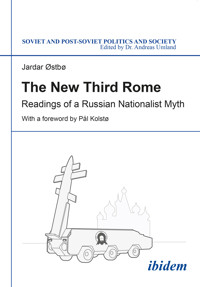
This in-depth analysis discloses the sources, contents, and implications of post-Soviet Russian messianism. Since its rediscovery 150 years ago, writers ranging from Western critics of Moscow’s foreign policy to ardent Russian imperialists have used the concept of Moscow as the Third Rome as ‘evidence’ of Russia’s particularism and expansionism. But for the original author of the formula of the Third Rome, the Orthodox monk Filofei of Pskov, it was a religious concept he referred to when criticizing what he saw as the apostasy of his time. This book is the first to look beyond this dichotomy. Drawing on theories of political myth and concepts of nationalism, Østbø develops a novel analytical perspective. Rather than dismissing political uses of the religious, medieval idea as ‘wrong’, the author analyzes the modern content and ideological function of the myth of the Third Rome. Through case studies of four prominent nationalist intellectuals, Vadim Tsymburskii, Aleksandr Dugin, Nataliia Narochnitskaia and Egor Kholmogorov, the author shows how this messianic myth is used to ‘reinvent’ Russia after the collapse of the Soviet Union. These writers use their own constructed image of the Russian nation to demonstrate what Russia ‘should be’ and its allegedly rightful place in the world. Existing in radically diverging versions, the myth of the Third Rome routinely conveys rabid anti-Westernism. At ‘best’, it is employed to forge a self-image of the Russians as an essentially isolationist civilization. At worst, it is used to ‘explain’ how the Russians are divinely elected to be the rulers of a world empire.
Das E-Book können Sie in Legimi-Apps oder einer beliebigen App lesen, die das folgende Format unterstützen:
Seitenzahl: 568
Veröffentlichungsjahr: 2016
Ähnliche




















ibidem-Press,Stuttgart
Table of Contents
Acknowledgments
This bookcouldnot have beencompletedwithout the help of others.First of all,I am deeply indebted to my twoPhDsupervisors, Jostein Børtnes and Pål Kolstø. Without their support, enthusiasm and constructive commentariesfrom the very outset, it would not have been possible to start work on the project in the first place. Their critical readings of my manuscripts and continuous engagement at all stages have been crucial.I am particularlypleasedthat Pål Kolstø, who sparked my interest in the field when I was an undergraduate student in the 1990s,haskindly agreed to write the foreword.
I would like to thank the Faculty of Humanities, University of Bergen,for granting me athree-year fellowship and thus providing idealconditionsforconductingresearch.I am also grateful to my currentworkplace, the Department of Literature, Area Studies and European Languages(ILOS)at the University of Oslo, withproject coordinator Geir Flikke,for making it possible for me to prepare and update the manuscript forbookpublication.
Special thanks goto Yngvar B. Steinholt forusefuland constructive commentaries on the first version of the project outline.
As an otherwise independent PhD student,I had the great advantage of participatingin the research project‘The Borders of Europe’, headed byLillian Helle, Helge Vidar Holm, Sissel Lægreid and Torgeir Skorgen. Earlyversions ofChapters 4 and 6of thisbookwere presented at the project’sinternational workshopsin St Petersburg (June 2008) and Athens (April 2009),respectively.I am grateful to all participants forenlightening discussions and forproviding astimulating andencouragingmilieu.
I have also reaped the benefits of two international research projectsatthe University of Bergen:‘Landslide of the Norm: Linguistic Liberalization and Literary Development in Russia in the 1920s and 1990s’(2005–2008) and‘The Future of Russian: Language Culture inthe Era of New Technology’(2009–2012). Whilethematicallynot directly related to my work, these projects have, thanks toseminars,guest lecturesand other events, given me the opportunity to discuss aspects of my project with prominent researchers invariousfieldsofRussian studies. It hasbeen inspiring to participate in the activities of these projects, and I am deeply indebted to their leader, Ingunn Lunde, for her enthusiasm and welcoming attitude from the outset.
I would like to thankDmitrii Sidorov for his keen interest in my project and for fruitful discussions during my visit to Moscow.
I am grateful to Andrzej de Lazari at the University of Łódź for help and support during my stay in Warsaw.
I wouldalsolike to thank myBergencolleagues in general andinthe Russian section in particularformaking thedepartment a pleasant place towork.Special thanks go tomy fellow PhD studentsAlexander Berdichevsky, Kåre Johan Mjør and Martin Paulsen,and toresearch fellowsEllen Rutten and Vera Zvereva, with whom I have been sharinganoffice,for interesting discussions andcompanionship.
I am grateful to Kyrill Dissanayake forcopyeditingofthe first version ofthe manuscriptandto Susan Høivikfora final language check.Any remaining errorsand omissionsare, of course, my own.
Last, but by no means least: without the love and support frommywife,Anna,and myparents,Anne Sofie and Johannes,this project could not have been completed. I dedicate this book to mychildrenStanisławand Maja.
On Transliteration,Translations,Referencesand Sources
All translations of quotations from Russian sources are my own, unless otherwise noted.For transliteration from Cyrillic, I have used a slightly modified version of the Library of Congressstandard. Exceptions are not madefor personal names(El’tsin, not Yeltsin). On the other hand, names of Russian scholarspublishing mainly in a foreign language, whether émigré or not,have been rendered in the most common way (Alexander Yanov, not Aleksandr Ianov).I have made an exception for topographic names with a commonly acceptedEnglishversion(Moscow) and for Tsar Peter (not Petr) the Great. However, certain inconsistencies have provenunavoidable, and I apologize foranyirritation this might cause.
Manyof the sourcesforthis studycanbefound on the Internet. For lengthyarticles with only one URL, I have, instead of making unspecified references(e.g.‘Kholmogorov, 2005e’), chosen to refer to the page.Astext sizes may differ, I alsosupplythetotal numberof pages:‘Kholmogorov, 2005e, p. 3/10’means thatthe information in questionisfound on page3iftheprintedarticle amounts to ten pages. ForChapter 5,where thesource materialconsistslargely of books (often collections of articles) with an intricate system of cross-referencing, I refer to the paragraph headline, and, if possible, toits URL.For websites with unknown year of publication, Igivethe yearin which I accessedthe sitein square brackets (e.g. Danilevskii, [2009].
Iemploya‘footnote-author-date’reference system (e.g.‘Kholmogorov, 2005, p. 5’).Offeringshort versionsof titleswouldbe likely to create confusion, asseveralhave deceptivelysimilar titles. Narochnitskaia has written bothRussia and the Russians in World HistoryandRussia and the Russians in the Contemporary World. Likewise,the words‘Ostrov Rossiia’are part of the title of two articles and one book by Tsymburskii, as well as of an interview with him and several articles about him. Furthermore, Dugin’s works exist in several versions.Supplyingthe year of publication and referringto the bibliography is therefore, in my opinion, the bestway of ensuring clarity. For sources with no known authors, Igivethe entire entryfrom the bibliography in the first reference, and then the entire title inlater mentions.
The four authorsanalysedin this study have all been affiliated with a multitude of organizations of various sorts,sometimes with strikingly similar names. As a rule, Ihave translated these names. For less-known entities,theRussian nameis givenin afootnote.Wherethe Russian name oracronymisfamiliar(e.g. KGB), translationis of coursesuperfluous.
An earlier version ofChapter4formedthe basis of an articlepublishedinNordisk Østforum.[1]Similarly,anearliershortversion ofChapter6appearedin the anthologyThe Borders of Europe: Hegemony, Aesthetics and Border Poetics.[2]
Author’spreface
This book is an updated version of my PhD dissertation, whichI started writing in 2008,submitted in May 2011 and successfully defended at the UniversityofBergen, Norway, on 2 December 2011.As the work has progressed, the affiliations of the authors I analyseand the conditionsunder whichthey work have kept changing.Thepotentialsource materialhasalsokept expanding, as theseauthorshavecontinuedpublishing.Even the authorship of Vadim Tsymburskii, who died in 2009, continues to grow, as hisinfluentialsupporters sponsoranddirectthe publication of his handwritten manuscripts.Forbothformal andpractical reasons,Ilimitedthe source material for the analysisto texts publishedby2009.For the purpose of the present book, the authors’ biographieshave been updatedas of October 2015, and other contextual information has also been revised.
The landscape of Russian intellectual nationalism hascertainlyevolved, butVadimTsymburskii,Aleksandr Dugin, Nataliia Narochnitskaia and Egor Kholmogorovremainimportant authors.Theiraccess to mainstream mediahas at times beenwiderandtheir generalinfluencehasarguablyrisen, especiallyin the context of thepost-Euromaidananti-Westernism cultivated by the Kremlin.For instance,the concept ofkatechon–an idea previously confined tonationalistcircles –features inthe 2013 Foreign Policy Concept of the Russian Federation,[3]and the annexation of Crimea was accompanied by nationalist rhetorichitherto unheard of fromPresident VladimirPutin.[4]
The works of Tsymburskii, Dugin, Narochnitskaia and Kholmogorov have expanded,buttheir deeper convictions and visions for Russia remain the samein all significant aspects, and their versions of the myth of the Third Rome took shapeduring the period in question.I am thereforeconfidentthatthisbookin its present form has kept its relevance.
Jardar Østbø
Oslo, November 2015
Foreword
As a master student in the 1980s I came across a Danish book in the university library,Moscow the Third Rome – the Orthodox Church in Russia.[5]I had heard of this peculiar idea that Moscow had inherited the mantle of Constantinople – the second Rome – and was now the third in the line of universal capitals of Christianity. After the fall of the Byzantine Empire, Russia was allegedly the only Christianstateleft in the world, chosen by God as an instrument for universal salvation. Several putatively serious academic books I had read maintained that this idea of the Third Rome was not only an element in Russian Orthodox soteriology but also a programme for Russian imperialism, an attempt to provide the Russian state with legitimation for territorial expansion. The Danish book, however, proved to deal not with this particular historiosophical idea but with the general history of the Russian church from the earliest times to the present.
The implicit message behind the choice of title – besides obviously being an attempt to find a catchy phrase that would sell – was that the Third Rome myth somehow summarized and encapsulated the entire history of Russian religious-cultural thought. I later found out that this was far from being the case. First set forth in a couple of texts penned in the1520sby a Russian monk and abbot, Filofei of Pskov, it was apparently first and foremost an attempt to exhort the Russian tsar to behave like a true Christian monarch, lest his realm go the same way as the two first Romes. Considering the devastations which Ivan IV – ‘the Terrible’ – visited upon the Russian lands some decades later, one might say that Filofei was not particularly successful.
On the other hand, Ivan the Terrible did indeed pursue a foreign policy geared towards the enlargement of the Russian state.In 1552 his armies captured Kazan’, the capital of the Volga Tatars, the strongest and most important of the successor states of the Mongol Golden Horde.In the bookHistory of Kazan’, written shortly after this central victory, Ivan’s ideologues tried to justify the campaign against Kazan’by,inter alia, referring to Moscow’s status as the Third Rome. But as Russian expansion continued throughout the next centuries, the Third Rome concept faded into oblivion, no longer invoked as an argument by the tsar regime. Under Peter the Great at the beginning of the 18thcentury, the Russian state underwent a thoroughgoing secularization, and religious Messianism had no place in regime legitimation for territorial enlargement.
The Third Rome concept was taken out of mothballs in the1860sbyconservativethinkers seeking to re-establish an Orthodox foundation for Russian tsardom. But after a hiatus of more than 300 years, the historical links to Abbot Filofei’s original exhortation had been largely lost.Thinkers who picked up this ideawere at liberty to interpret it much as they saw fit, without being overly concerned about historical accuracy. Taking on a life of its own, the Third Rome idea started on its voyage through intellectual history in ever-new contexts and guises, as amythologemethat could be put to remarkably diverse uses.
As Jardar Østbø argues in this important book, today the original meaning of Filofei’s missives has been reasonably well reconstructed through meticulous historical, textual and theological research. However, the continued impact of the Third Rome myth on intellectual history is dynamic and ever-expanding, a fascinating topic for research. As Østbø points out, this mythmaking is not restricted to Russian thinkers and quasi-thinkers: and indeed, the author of the Danish textbook I picked up 30 years ago certainly contributed to this endeavour. Historians of ideas today might do well to inquire into the ways in which Western politicians and academics during the Cold War presented the myth of Moscow as the Third Rome as ‘proof’ of Russia’s/the Soviet Union’s allegedly inherent urge for ideologically motivated expansion. Even more important, however, is the afterlife of the Third Rome myth in Russian intellectual debate. Its vibrant usage in new political and ideological conceptions in Russia today is the focus of the current volume.
Ideas of Moscow as the Third Rome attempt to assign an exceptional role for Russia in world. This means that all those Russian thinkers who draw on this idea in their theories and models are nationalists in some way or another, whereas those Russians who regard themselves as liberals and Westernizers generally abhor the very concept, regarding it as not only obscurantist but also potentially dangerous. However, ‘nationalism’ as a category in Russian thought is extremely elastic and encompasses a wide variety of viewpoints and ideas. As Østbø shows, the Third Rome can appear as a building block – even as a girder beam – in different nationalist schemes that in other respects are far removed from each other.
Rather than presenting a panoramic overview of the contemporary Russian nationalist scene – which, with his encyclopaedicknowledge of the topic, he could easily have done – Østbø has chosen to present fourwriters:Egor Kholmogorov, Nataliia Narochnitskaia, Aleksandr Dugin and Vadim Tsymburskii. This allows him to go into greater depth in each case, moving beyond a mere enumeration of names of people who make use of the Third Rome concept. Each of these fourwritersis a prominent representative of a typical current in contemporary Russian nationalist debates. With the exception of Tsymburskii, none of them is a professional philosopher working in academia, but that is hardly surprising. In Russian intellectual history, school philosophy has generally been regarded as arid and uninspiring, and virtually all exciting ideas have been produced by dilettantes and amateurs.
Østbø’s central theoretical concept for the understanding of contemporary usages of the idea of Moscow as the Third Rome ispolitical myth.In popular language, ‘myth’ is often equated with ‘fantasy’ or ‘fiction’, but the concept is also used more specifically as an analytical tool in several scholarly disciplines – the history of religion, social anthropology, and psychoanalysis, to mention a few. Each discipline approaches this term differently.Politicalmyths, as Østbø uses the term, denote more or less elaborate narratives about a political society, usually as an incitement to action. As regards Moscow/Third Rome, it often contains recommendations for Russian political leaders for domestic and/or foreign policy, with reference to Russia’s special place in the economy of salvation and in God’s plan for mankind.
As he proceeds, Østbø debunks various ‘myths about the myth’. One of them is that Third Rome theorists are always imperialists. Quite the contrary, he documents that this idea is sometimes harnessed to isolationist schemes, as in the case of Tsymburskii. That being said, most nationalists who employ this idea are indeed starkly and unambiguously imperialist: as Østbø points out, in Russia there is no necessary contradiction between ‘nationalism’ and ‘imperialism’.
Another variable along which Russian Third Romeideologistsdiffer – besides their attitudes towards expansion versus isolation of the Russian state – is in their attitude towards religion in general and to Orthodoxy in particular. References to God, Providence and the Church may be found in the writings of all four authors, but the function of this religious rhetoric differs considerably. While some Third Rome theorists are clearly sincere, even fervent, believers, in other cases the religious tropes appear to be mostly ornamental. Moreover, those who present themselves as Orthodox believers do not always adhere strictly to church doctrinebut may profess a homespunfaith which, in the case of Aleksandr Dugin for instance, is mixed with considerable doses of New Age mysticism.
An important common feature in most contemporary Russian Third Rome schemes is their apocalyptic orientation: we are living in eschatological times, with doomsday drawing near, and Russia may be the only force that can keep the entire world from collapsing. Russia has been chosen as an instrument of God to stand up against the Antichrist and give mankind a final chance to repent. Therefore, to say that the idea of Moscow as the Third Rome is about Russia’s special place in world history is only half the story: equally important is Russia’s rolebeyondhistory.
While the four Russianwritersexamined in this book often come up with original and entertaining ideas, logical consistency is not always their strongest quality. In any study in the history of ideas there is a temptation to present ideas and systems of thought as more coherent than what is warranted. Østbø does not fall into that trap. While he points out the contradictions and incongruities in their thinking he also discusses why and how the variouswritersmay have been led into their respective intellectual cul-de-sacs.
What can a study like the one that Østbø presents here tell us about Russian intellectual climate in general? Are the fourwritersmerely voices crying in the wilderness – or do they represent influential trends in the cultural debate? Clearly, neither of the labels associated with them – such as ‘nationalist’ and ‘imperialist’ – is politically correct in Russia today. The current hegemonic discourse, as promoted through the official media and by the country’s political leaders, has inherited from the Soviet era a negative valorization of nationalism (while ‘patriotism’ is extolled as a civic duty). This does not mean, however, that Østbø’s fourwritershave been consigned to an intellectual ghetto. On the contrary, three of them – all except the late Tsymburskii – are frequent guests on Russian talk shows and TV debates and household names for the reading Russian public, even for those who by no means identify with their views. Also, opinion polls repeatedly show that large segments of the Russian public express typically nationalist viewpoints on issues like migration, the role of the minorities in politics and society, multi-ethnic neighbourhoods and marriages, and so on.[6]Therefore, nationalists like those studied by Østbø have a larger potential audience than one might perhaps expect.
A final additional value of this book is its contribution to the study of political myths in general. Østbø elegantly shows how the link between an original source and contemporary mythmaking may be quite tenuous. One fascinating aspect of the contemporary development of the Third Rome in Russian political-religious debates is the remarkable creativity of the mythmakers, as well as their occasional total disregard for historical facts.
Professor Pål Kolstø
University of Oslo
1.Introduction
The idea of Russia as the Third Rome has fascinatedscholars and writers forat least a century and a half.Theoldest preserved expression of theidea dates back to the 16thcentury. In overviews of Russian history, it isnormallyattributed toFilofei, a monk from Pskov, who in 1511 allegedly wrote to Tsar Vasilii III (ruled 1505–1533):
The church of ancient Rome fell because of the Apollinarian heresy, as to the second Rome – the Church of Constantinople – it has been hewn by the axes of the Hagarenes. But this third, new Rome, the Universal Apostolic Church under thy mighty rule radiates forth the Orthodox Christian faith to the ends of the earth more brightly than the sun […]. Inall theuniverse thou art the only Tsar of Christians […]. Hear me, piousTsar,all Christian kingdoms have converged in thine alone. Two Romes have fallen, a third stands, a fourth there shall not be […].[7]
Specialist scholarsincreasinglyregard theidea of the Third Rome asstrictlyreligious–havinglittle to do with politics andnothing to do with expansionism.On the other hand, several‘generalist’historiansand writers have interpreted the ideaas an expression ofwhat they see asthe perennial imperialist/expansionist‘nature’of the Russian nation(see Chapter 3). Thus, historian PhilipLongworthcharacterizesthe idea of the Third Rome as a‘myth’that‘was to provide the state with a religious justification for uniting not just the Russians but all Orthodox Christians, whether in Russia, Ukraine, the Balkans or the Levant.’[8]I will argue that thecharacterization of Filofei’s ideain itselfas anexpansionist/imperialist myth iserroneous. On the other hand,in today’s Russia, theredoesexista myth of the Third Rome. Itfulfils important functionsinmany nationalist intellectuals’constructed images of Russia,asitrevolves aroundcrucial questionsofRussian national identity. The present volume is dedicated to the study of this myth.
Research Aims
The purposeof this studyistwofold.The first is, by way of four case studies,to reconstructand interpretthemeaningofthepresent-daymyth(s)of the Third Romein the works of leading intellectualRussiannationalists.To this end, I develop a theoretical basis different from that of earlier research on the Third Rome.Here I seek tosteer clear of the generalizations often committed by non-specialists, while alsoavoidingthe distinction often implied by some specialists, between‘correct’reference to or accounts of the notion of the Third Rome on the one hand, and its‘misuse’for political purposes on the other.
By drawing on theories of political myth, I locate the myth not in medieval Muscovy, but in contemporary Russia: innationalists’references to and explanations of thenotionof the Third Rome.Inthe specific circumstances that followed the dissolution of the Soviet Union, this religious concept, devised by a monk in the Middle Ages, has become an important myth for Russian nationalist intellectuals.Taking as a theoretical prerequisite that a mythcan have no‘essence’or meaning outside its use, Ishow howthe myth of the Third Rome has not foundonefinal form,but exists in several versions.It is neither inherently imperialist (whether religious or secular) nor inherently non-imperialist (whether religious or secular).The four authors chosen forcloser studyarerepresentatives ofreligious imperialism,secular imperialism, religious‘non-imperialism’, and secular‘non-imperialism’, respectively.
The second (and closely related) purpose of this study is toanalysethe myth of the Third Romeas a keyelement in the‘reinvention’of Russia in the post-Soviet context.I usethe myth of theThird Rome in the writings of nationalistsan entry point for scrutinizingtheir ideologies and their visions for Russia.As students of this myth we need to rid ourselves of the primordialist viewthatthe notion of theThird Rome hasa fixed meaning descriptive of some perennial‘Russian-ness’.Reference to the Third Romein itselfisno litmus testprovingthat the authorisnecessarily an imperialist(acommon interpretation) and/or thats/henecessarily regardsthe Russian nation as chosen by God.That being said, we should notassume that such referencesmay not berevealing.Quite the converse: the way the notion isused, or, within my theoretical framework,the kind of myth told, ishighlyindicativeofthe given author’skindof nationalismandher/hisvision for Russia.
Myths and the Invention of Nations
Nationalists’visionsof Russiaare more than political goals. The authors studiedhereareactive and prominentparticipants in the debate on Russian national identity, actively seekingto shape the understanding of what Russia‘really’is. In other words, they contributetothe‘reinvention’of Russia after the fall of the Soviet Union.Rejectingthe primordialist view of the nation, I will not go to the other extremeandclaim that nationsareinvented‘from scratch’and thatanymyths mayassist thisinventionby creating a feeling of community. Modern nationsare to a certain extent the results of invention by the elite, but this process is not solely dependent onthe (material) interestsof the elites. To beof useintheinvention of a nation, mythsmusthave some resonance;theymust in some way or another deal with themes and questionsthatareperceivedasimportant.Thepolitical myth of the Third Rome is such a myth.Occupying acentralplace in the works of these writersanddealing with, among other things,the core issues ofRussia’sterritorial status and the status ofOrthodoxy,itplays a keyrole in the‘reinvention’of Russia.
Research on the Third Rome
Theliterature on the Third Rome is vast.Treatment of the idea as it emerged in the 16thcentury seems almost compulsory in overviews of Russian history. Ioffera summary of some of these accounts inChapter3, butit would be impossible to be exhaustive: like Daniel Rowland, I have yet to see a Russian history textbook that does not mention the Third Rome.[9]‘Generalist’treatmentof this ideaisoftenbased on a limited number of secondary sources;in many works, theidea has been the basis of sweeping generalizations.[10]
On the other hand, there is an enormous volume of researchliterature on the medieval manuscripts that contain the oldest preserved expressions of theidea. The first monograph,authored byVasilii Malinin,was publishedin 1901.[11]Malinin saw the idea as politically significant,andclaimedthat it was quickly adopted by the rulers:
[The theory]representedthe general meaning of theageso correctly andassessed the mood of Filofei’s contemporaries in such a refined way that it soonwas adapted by government circles and found its wayinto state documents.[12]
Even ifMalinin himselfalsowrote at length about the eschatological meaning of the idea of the Third Rome, his successors studied this to a lesser degree.For a long time,scholars studied the manuscriptsas provided by Malinin.‘New’manuscriptswere notbrought in, and the dating of the‘old’oneswasnot questioned.[13]
In the 1970s, A.L. Gol’dberg challengedMalinin’sdating and attribution of the manuscripts,paving theway for an interpretation of the idea of the Third Rome as less political and more religious/eschatological thanpreviously assumed.[14]Sinitsyna’sseminal1998monographlargely confirms Gol’dberg’stheses andelaborates furtheron them(a summary of the most important conclusionsisgiven inChapter 3).
Between the generalist historians’often superficial treatment and the minute textological work by medievalists there is a lacuna to be filled.Post-SovietRussia has seenaremarkableresurgenceof the idea in(both publicistic and more academic)writingsonhistory,‘historiosophy’and geopolitics.However, in my opinion,therespectiveapproaches of the generalists and the medievalists/philologistsareinadequateforexplainingthis phenomenon.
At the risk of oversimplification, it can be said thatmanygeneralist historians tendto interpretthe ideatoobroadly andto assume(sometimes in an essentialist way)that the idea has ameaning,often connected to imperialist expansionism. In some accounts, this‘expansionist idea’is presented asamanifestationofwhat is seen asperennial‘Russian-ness’.[15]By contrast,themedievalists, with their focus on the manuscripts and the idea as it emerged in the 16thcentury,tend todescribe it asreligious/eschatological, apoliticaland non-imperialist,dismissingitsnew varietiesin the post-Soviet contextasdeviations.[16]
Geographer Dmitrii Sidorov’s invaluable‘Post-Imperial Third Romes: Resurrections of a Russian Orthodoxgeopoliticalmetaphor’[17]isinnovative, both theoretically and thematically,anddeservesspecialattention.There is to my knowledge no otherscholarlypublicationdealing specifically with the Third Rome idea in the post-Soviet context.[18]Sidorov’sarticleoffersan impressive and wide-ranging overviewofthe‘new life’of the idea of the Third Rome in post-Soviet Russia. The author identifies a third current ofRussiangeopolitical thought in addition to Westernism and Eurasianism:‘Orthodoxy-related geopolitics’, regarded as‘various Orthodox, quasi-Orthodox or even secular currents in post-Soviet Russia that use the Church’s historiosophy in their geopolitical constructs’.[19]Sidorov’scriterion for classifyingauthorsas representatives ofthis currentis theiruseofthe concept ofthe‘Third Rome’.
Within‘Orthodoxy-related geopolitics’,Sidorovidentifies threemain directions (‘Third Romisms’) originating from threedifferentappearances of the concept.First, there is Filofei’s eschatological idea, represented todayin worksbyRussia-centrednationalists/fundamentalists(Mikhail Nazarov, Egor Kholmogorov)as well aswritingsby authorsbelonging to the newstrandof‘geo-apocalyptics of the postmodern’(Vadim Tsymburskii and Aleksandr Neklessa).
Second, there is the‘Russia with Europe’direction,emanating from the debate that followed the publication in the 1860s of medieval manuscripts dealing with the Third Romeidea. Thisline of thoughtwas mostprominently represented in the past bypan-SlavistNikolai Danilevskii. Today, its main spokespersonisneo-pan-Slavist Nataliia Narochnitskaia, who focuses on Russia’s relations with Europe and sees them as an irreconcilable struggle with the‘Romance-Catholic’West.
Theroots of thethird main direction, the‘Eurasian Third Rome’,Sidorovfindsin Nikolai Berdiaev’s‘imperialist expansionism’. Itssubgroups today aretheneo-Eurasianists (most prominentlyrepresented byAleksandr Dugin); the‘New Chronology’of Anatolii Fomenko and Gleb Nosovskii; and the‘neo-Orthodox Communists (most notably GennadiiZiuganov).[20]
Hence,Sidorovdescribes three more or lessequal(i.e. they are not judged by their proximity tothe‘original’version)varieties of the ThirdRome idea. This is, as far as I cansee, an unprecedented approach.While staying within the paradigm of‘new geopolitics’that‘emphasizes the socially constructed nature of geographic space’and the need to delineate‘particular cultural myths’that underlie state practices, Sidorovcriticizes the representatives of this theoretical school for ignoring mythsthatstem fromthe pre-Westphalian world.Theideaof the Third Rome is,in his view,a myth that should be studiedin ordertounderstandcurrentRussian geopolitical imaginations.He attachesenormousimportanceto theidea of theThird Rome, seeing it as‘the major Russian cultural myth’,‘an essential[…]pillar of Russian geopolitical thinking’,‘the archetype of Russian nationalism’that‘seeminglyhas always been emerging at turning points of Russian history’.[21]
However,I will arguethat thisalleged persistentimportance of the Third Rome concept through history is notsufficientlydocumented.As Sidorov concedes, specialist scholars now agree that in the Muscovite period, the idea was known only in limitedecclesiasticalcircles;moreover, itdid notbecome part of scholarly and publicistic discoursesuntilthe 1860s.[22]Hence, I will argue that thesignificanceof this idea is of relativelyrecentorigin, dating from the publication ofthemedieval primary sourcesin the 1860s.
Theorizing the Modern Uses of a Medieval Idea
Asindicated,my theoretical perspectivediffersfrom that of Sidorov.I do not regardthemodern variants oftheidea of the Third Rome asmanifestations ofaperennial‘archetype’.On the other hand,these variantsarenot novel in the senseof beingarbitrary fabrications depending solely onthe(material) interests of theelite.Thevarious modernuses ofthe medievalidea of the Third Romedefinitelyrely on itsbasic content, andthus cannotbe completely detached from the‘original version’. However, bothSidorov’saccountandthe present studyshow that there is considerable room for variations. We need to develop an approach thatcan take into accountthesecircumstances.
The‘Third Rome’– the‘raw material’of what I define as the political myth of the Third Rome – has many‘names’. It is, in scholarly as well as publicistic texts, referred to as a myth, a mythologeme, an ideology, an ideologeme, a concept,anotion.[23]Not least is this the case in the authorship of the four writersto beanalysedhere. To take one example, in one and the same text,‘the Third Rome’is called a myth, an ideology and an ideologeme.[24]This also reflects the fact thatitis treated on different levels by different authors and even within thetextcorpus of one author. I have no intention of providing a context-free definition of what the‘Third Rome’‘really’is (whether anidea, notionorconcept), or to identify what it‘really’is for the individual authors.My focus ison what itdoes,and so Ihave chosen tostudy not‘the Third Rome’as such, but thepolitical myth of the Third Rome.
Case Studies:Selection, Sources and Method
Themotivation for conducting this study in the form of‘person-based’case studiesis that they have the advantage of permitting theanalyst togo into detail andalsointerpretthe mythin a context. A widerscope would not allow for the close reading I find necessary (see below). Besides, Sidorov’s articlehas already provideda good overview.Conversely, anarrowing of thescope–for instance,by choosing a closed text corpus,orconcentrating on onlyone topic or one debate–would not do justice to all the aspects and the richness of the Third Rome myth.
On the basis of three criteria,I havechosento focus onfourprominentnationalist intellectuals:Vadim Tsymburskii(1957–2009), Aleksandr Dugin, Nataliia Narochnitskaia and Egor Kholmogorov.Myfirstcriterionis the author’simportant role in the debate on Russian national identity.All four areprolific writers,publishingin arangeofforumsassociated with intellectual nationalism. They also participate in various seminars and debates andare involved withseveralintellectual and political‘clubs’,societiesand organizations.
The influence of all of the four authorsis arguably enhanced by support fromparts of the regime.Tsymburskii, Dugin, Narochnitskaia and Kholmogorovare by no means to be regarded as belonging to the‘lunatic fringe’of‘nationalist extremists’that Putin haslargely criminalized. On the other hand, there are no grounds to believe that they have a direct line for influencing decisions or that theyserve asthe mouthpieces of specific institutions orfactionsof the political elite.
The relations between nationalist intellectuals and the Putinregimehave been far more dynamic than between El’tsin and the‘red–brown’opposition in the 1990s.For instance,in 2007, Kholmogorov was hiredwhen the‘patriotic’wing within the party in power,Edinaia Rossiia, launchedits‘Russkii proekt’with thedeclared goalof stimulatingdebate on‘Russian-ness’and Orthodoxy.[25]TheKremlin hasalsobeenactivelyengaged in ideological experimentation.[26]The regime’s spin-doctors, most notably Gleb Pavlovskii,[27]have launched new initiatives as well ascultivatingexisting milieus.Variousthink tanks,‘analytical centres’,journals, websitesanda publishing house have been foundedon the initiativeofor with direct or indirect support from these spin-doctors.[28]
The four writersin focus herehave beeninvited for seminars and debatesandhavesometimesbeenconsulted;and the publication of their books and maintenance of their websiteshave beensupported financially invariousways.To a certain extent, they can be regarded asmembersof a kind of‘pool’of nationalist intellectuals that have some kind of link to the authorities, who make use of them.Nevertheless, theyhave a clear voice of their own which is listened to, both by Kremlin spin-doctors and the general audience of nationalist intellectuals.[29]They have‘their own’supportersinboth places.
Mysecond(and related)criterionfor selectingTsymburskii, Dugin, Narochnitskaia and Kholmogorovistheirprominencein four of the most important currents of contemporary Russian nationalism.Dugin is the founder and leadingideologist, as well as arguablythemost outspokenpopularizer,ofneo-Eurasianism. This ideology,very much in vogue in the 1990s, still attracts supportwithin the political establishment, inthemedia and amongyoung people. Kholmogorov is aprominent‘young conservative’and ideologist of Orthodox nationalism. Tsymburskii was also affiliated with the‘young conservatives’, but never departed from his irreconcilable isolationist stance. He is arguably the most innovative writer and the most respected academicofthe four. Moreover, Tsymburskii is highly interesting becauseof his specific version of the‘civilizationist’approach that ispopular among Russian nationalist intellectuals. Narochnitskaia is aleadingneo-Slavophile andpan-Slavist;author ofa best-selling history book,shehas been a parliamentary deputy andis activein Kremlin-supported‘soft-power projects’(think-tanks) abroad. For more detailed biographies, see the individual chapters.
The last and most important criterionfor choosing these four writersisthat they holddiverging opinions ontwo issues:the status of Orthodoxy and Russia’s territorial orientation, as well as how these two issues may be interrelated.Based on their general views and with the reservations outlined inChapter 2in mind, I have classified Tsymburskii as‘core-oriented’and‘less Orthodox’; Dugin as‘imperialist’and‘less Orthodox’; Narochnitskaia as‘core-oriented’and‘Orthodox’; and Kholmogorov as‘imperialist’and‘Orthodox’. Thus, all four‘corners’along the two axesof‘religion’and‘territorial orientation’are covered (see end ofChapter 2for a visualization).
This is alsomymotivation forconductingfour case studies (instead of two or five, for instance).The status ofOrthodoxy and Russia’s territorial orientationaretwo core issues of post-Soviet Russian nationalism. They are alsothe two crucialquestionsas regardsthe‘use’or interpretation of the idea of the Third Rome. This has already been indicatedby the three directions identified by Sidorovandbythecontrast between the often secular, imperialist interpretations by generalistson the one handand the religious, often explicitly non-imperialist,interpretations by specialist scholarson the other.These contradictions makethe political mythof the Third Rome particularlysuitablefor investigatingRussian nationalism(s).
The source materialsfor the present studyare limited to written texts (articles, books and to a lesser extent published interviews) that appeared online or in printbetween 1992 and2009.Mosttextsareavailable on the Internet, whichisarguably thechiefmediumforRussian nationaliststoday. The authors and their supporters are eager todisseminatetheir writings, soarticlesoftenappear on several sitessimultaneously. Dugin and Narochnitskaia have their own siteswhere most of their writings (exceptforsomerecent books), including those published elsewhere, are available.As for the printed books, they are more often than not compilations of articles that havepreviouslybeen published online.This isespeciallythe case with Kholmogorov and Tsymburskii. For details, seetheintroductions to the individual chapters.
Eachcase studystartswitharelatively extensivebiographical introductiontothe author in question,focusing onhis or her various rolesinpolitical andorganizational activitiesas well ashis or her politicalconnections. This is notcrucialtotheinterpretationofthe writers’versionsof the Third Romemythand their nationalismper se, but it is necessaryin ordertoplace their writings in a context and give a clear idea oftheir political and ideologicalsignificance and influence.
As indicated, it is not my task, as a student of myth, to assess the philosophical consistency or historical validity of theseauthors’accounts of the Third Rome. My aim is to reconstruct the political myths of the Third Rome and to demonstrate howthey workin the authors’ideological constructions.Thus, each case study consistsof a close readingof oneauthor’s variousand dispersedreferences toand accounts ofthe Third Rome idea,viewedin connectionwith theprincipalissuesrelated tohis/herconstructed image of Russia.I thereby reconstructa picture ofhis/her variant(s)of the political myth of the Third Rome, understood as the entirety ofhis/her‘uses’of the Third Rome idea.It is only here, in its‘uses’, that the notion of the Third Rome(as it appears in the discourse of Russian nationalism) has a meaning–not in any assumed perennial‘essence’.In this way, Ishowwhat functions the mythfulfilsin each author’s attempt todefine what Russia‘really is’,and what the myth reveals about this image of Russia.
This approachis maintainedin allfour case studies. However,while all four writers areconcernedwith defining what Russia‘really is’,they differ substantially inthematicscope, approach andstyle. For instance,Dugin’s voluminous production isveryheterogeneous, touchingon arangeof topicsand fields andconsistingof writingsfromseveralgenres.By contrast,Narochnitskaia’s most important book is writtenlargelyin the form of a chronological historical account of Russia’srelations with Europeduringa relatively limited time-period.Dugin’s ideology is, at least on one level,essentiallyself-contradictory, and eachnew text might bringsurprises to the reader. In this respect, Narochnitskaia isatthe other extreme, providing the reader with a predictable‘model’:thecenturies-longconflict between the treacherous West on the one side and virtuous Russia on the other.Tsymburskii and Kholmogorovmostly write lengthyjournalarticles–the former in an intricate, academic style, while the latter is a quintessential provocative publicist.[30]However differenttheirperspectives andpolitical views,these twoare both especially apt to introduce their own, new conceptsto assist their rewriting of Russian historyand geopolitics.In a way,allfour writers,tovarying degrees,presenttheir‘own’imaginary‘world’.Therefore, and giventheapproachand methodas outlined above, thestructure of thecase studies will necessarily differ somewhat. They will also contain an important element of presentation of the main points in the individual author’sideology, as thepoliticalmyth of the Third Rome wouldnot make any sense outside thiscontext.
Ihave limitedthe studyto expressions of the idea of the Third Rome in itsmost concrete sense. ThusI have excluded references tooraccounts of the‘Byzantine heritage’in general,since thatis afarwider field and would requirea differentapproach. It is of course impossible to isolate the idea of the Third Rome from this issue, but the‘Third Rome’isamore specifictopicnot necessarily included in the notion of the‘Byzantine heritage’. In addition,on one level oranothertheThird Rome ideaincludes the notion of theFirstRome,whereastheidea of the‘Byzantine heritage’does not necessarily.These conditions are ignored by many generalist scholars.[31]
It is my conviction that my theoretical approach will help us tounderstand the‘new life’of the Third Rome idea,by shifting the focus from the question of correct/incorrectaccounts ofFilofei’s idea toanassessment ofhow it is used. By the same token,the method of close reading,contextualization and reconstruction,combined withafocus onthefourauthors’explicitreference to the‘Third Rome’,iscrucialforavoidingtheother pitfall:generalizations and projectionsbased onamedievalreligiousidea.
Structure of theBook
Chapter2is dedicated to the theory of nationalism and aims to clarify some key concepts in this respect.Some authors have writtenextensively on nationalism without defining‘nation’or even‘nationalism’. However, for the present study, it is particularly important toexplainwhat is meantbythese termsandbythe‘invention’of a nation, as the understanding of these termsis directly connected to the significance of the myth of the Third Rome. Theorists of nationalism disagree on the extent to which nations are‘invented’, and these disagreements are rooted in differentunderstandings of how nations emerge.To avoid misunderstandings it is therefore necessaryto put the present study in the context of this debate.
Further, in the study of Russian nationalism in general,and for the study of the Third Rome idea in particular,there is a pressing need for amore nuancedunderstanding ofthe nexus‘imperialismversusnationalism’. I will argue that theoften presupposeddichotomyof‘empire’versus‘nation’is not suitedtounderstanding Russian nationalism.In the continuation of this, Idiscuss the relevanceof the related distinction between statist and cultural nationalism.Against the backdrop of theincreased importance of Orthodoxy in Russian nationalism and its relevancetothe study of the Third Rome idea, I alsoproblematize the distinctionbetween‘political religion’andthe (cynical) use of religion for political purposes.
I conclude the chapter by offering a tentative typology of Russian nationalism based on two axes: religion and territorial orientation.
The overarching aim ofchapter3is to explainwhyand,not least,howwe should distinguish between the medieval idea of the Third Rome andits modern usefor political and ideological purposes. The need for such a distinction might seem obvious, butin many of the generalists’accounts of the Third Rome, it is often difficult to discern myth from‘non-myth’, and a narrow focus on the idea’s‘original content’is of minor help. Thus, in this chapter, Idemonstrate that theories of political mythare particularly suited to solvingthis problem.
The chapter starts with a short presentation of the most important of these theories. Thisisfor two reasons.First,the theories of political mythareheterogeneous, little known and, notleast,provide radicallydivergingdefinitions and approaches.Secondly, the idea of the Third Rome is often referred to as a myth, but what is meant by thishas to my knowledgenotbeenexplainedin detail.Byapplying these theories, Idemonstratethat whileseeminglyfallingunder all of thementioneddefinitions, the(medieval) idea of the Third Romein itselfcanhardly be said to constitute a myth.After a general discussion of the mythopoeic aspects ofscholarship, Ithengo on toshowhowsomeprominentgeneralist scholars’and writers’treatment of the Third Rome idea may be said to contribute tomyth-making.This is also part of the history of the political myth of the Third Romeand thusimportant forunderstandingthe mythin its present forms.
To achieve the full grasp of this myth, it isalsonecessary to have some knowledge of its‘raw material’. I therefore provide a short summary of the conclusions reached bythe latest specialist research.Isubsequently demonstrate why the approach to which these medievalists/philologists tend to adhere(I call it the‘purist paradigm’)is unsatisfactory for the study ofthe Third Rome myth.In the conclusiontothis chapter, I outline a modelthat I find better suited for this purpose.Rather than being a matrix intowhich to fit the individual expressions of the myth of the Third Rome, this model delineates a theoretical perspective that servesas the basis of the case studies.
Chapters 4–7consistofaclose reading,reconstruction and interpretationofthe individual authors’versionsof the myth of the Third Rome.
Inchapter 8, I try todrawderivegeneralknowledge from the case studies. With some exceptions, the myth serves more or less the same structural functions in each of the authors’constructed images of Russia. However,these images differradically, and so do the versions of the political myth of the Third Rome.
Theepiloguefocuses ontheThird Rome myth in the wake of the Russian annexation of Crimea and in the context of the following standoff between Russia and the West.
2.Russian Nationalism
The unifying role of the Russian [russkii] people on the territory of Russia has ensured the preservation of the unique unity and diversity, the spiritual communion andjoiningofdifferent peoples.
National policy concept of the Russian Federation(1996–2012)[32]
Russia’s history is the history of a country thatis colonizing itself. The areaof colonization was expanded along with the state’s territory. Rising and falling, this century-long movement is continuing to this day.
-Vasilii Kliuchevskii[33]
Britainhadan empire, but Russiawasan empire – and perhaps still is.
-Geoffrey Hosking[34]
Russian NationalIdentity–CrisisandReinvention
According to James Billington,‘[n]o nation ever poured more intellectual energy into answering the question of national identity than Russia.’[35]These debates have arguably been especially intensesincethe fall of Communism and the demise of the Soviet Union. The Russians were faced with rapid and deep geopolitical, social, political, economical and ideological changes that influenced their lives to an extent difficult for outsiders tocomprehend.
Also the status of the Russian nation was radically changed.What was the Russian nation‘really’?Was it deprived of‘its’territories–or had it finallyrid itselfof the‘imperial burden’? These questionsmustbe answered. The degree of consensus was and stillis so low that numerous scholars and observers during the two-and-halfdecades since the establishment of the Russian Federation have pointed to a Russian‘identity crisis’.[36]
The Russians helda unique positionin the Soviet Union:in Geoffrey Hosking’s words, they were bothrulers andvictims.[37]They were the largest nation, yet they did not have their own, nationally defined territory,and consequentlyhadnonationalpolitical institutions. The Russian Socialist Federative Soviet Republic (RSFSR) was rather what wasleftwhen the nations that weredeemedworthyhad been grantedrepublics oftheir own.[38]Even if party leaders wereoftenethnic Russian, the Russiansas a wholedid not live noticeably better than the non-Russians;and, according to Alain Besançon, they had no privileges, only advantages.[39]The territory of the Russian Tsarist Empire before the First World War roughly corresponded to the territory of the Soviet Union afterthe SecondWorldWar. The endeavours to create a new‘Soviet Man’seem to have had a stronger impact on the Russians than on others. At least it is clear that,to a much larger extent than other ethnic groups, Russians identified themselves with theentireSoviet Union.[40]
Atthe end of 1991, when the immense union was dissolved, the Russian Federation inherited the Soviet Union’s‘place in the world’in many respects: Russia took over most Soviet structures as well as the Soviet Union’s membership in most international organizations, most notablyits permanent seat on the UN Security Council. At home, the Russian president moved into the Kremlin. But the territory of the new state wastruncated.Stillphysicallythe largest country on earth, it was now the smallest Russian state in three centuries. Around 25 million ethnic Russians found themselves residents of other countries.For many Russians, this brought about feelings of loss;[41]andin 2005, President Vladimir Putin famously declared that the dissolution of the Soviet Union was‘thegreatest geopoliticalcatastropheofthe 20thcentury’.[42]
On the other hand, at least from theviewpoint of ethnic nationalists, this new geopolitical situation could also be seen as anopportunity. Though of course still multi-ethnic,theRussian Federation now has an ethnic Russian (russkii) majority, and in this respect it resembles a nation-state to a much larger degree than the Soviet Union and the Russian Empire.
The present volumeis astudy ofthe efforts ofRussiannationalist intellectuals




