


76,99 €
Mehr erfahren.
- Herausgeber: John Wiley & Sons
- Kategorie: Fachliteratur
- Serie: The CFA Institute Series
- Sprache: Englisch
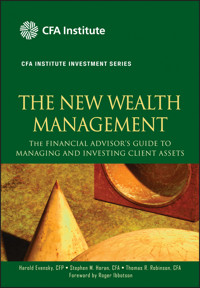
Mainstay reference guide for wealth management, newly updated for today's investment landscape
For over a decade, The New Wealth Management: The Financial Advisor's Guide to Managing and Investing Client Assets has provided financial planners with detailed, step-by-step guidance on developing an optimal asset allocation policy for their clients. And, it did so without resorting to simplistic model portfolios, such as lifecycle models or black box solutions. Today, while The New Wealth Management still provides a thorough background on investment theories, and includes many ready to use client presentations and questionnaires, the guide is newly updated to meet twenty-first century investment challenges. The book
- Includes expert updates from Chartered Financial Analyst (CFA) Institute, in addition to the core text of 1997's first edition endorsed by investment luminaries Charles Schwab and John Bogle
- Presents an approach that places achieving client objectives ahead of investment vehicles
- Applicable for self-study or classroom use
Now, as in 1997, The New Wealth Management effectively blends investment theory and real world applications. And in today's new investment landscaped, this update to the classic reference is more important than ever.
Sie lesen das E-Book in den Legimi-Apps auf:
Seitenzahl: 960
Veröffentlichungsjahr: 2011
Ähnliche



















CONTENTS
Acknowledgments
Foreword
Preface
Chapter 1 : The Wealth Management Process
The Client Relationship
The Client Profile
Wealth Management Investment Policy
Portfolio Management, Monitoring, and Market Review
Parting Comments
Resources
Chapter 2 : Fiduciary and Professional Standards
Fiduciary Duty
Professional Standards
Providing Wealth Management Services
Parting Comments
Resources
Chapter 3 : Client Goals and Constraints
Goal Setting
Risk Objective
Constraints
Evensky & Katz Cash Flow Strategy
Parting Comments
Resources
Chapter 4 : Risk is a Four-Letter Word
Risk Tolerance
Behavioral Finance and Related Issues of Behavioral Psychology
Heuristics and Biases
Mental Math
Framing
Parting Comments
Resources
Chapter 5 : Data Gathering and Analysis
Measuring Risk Tolerance
Measuring Capital Needs
Parting Comments
Resources
Chapter 6 : Client Education
Mini-Educational Program
The Investment Process
Asset Allocation
Modern Portfolio Theory
Investment Risk
Parting Comments
Resources
Chapter 7 : Mathematics of Investing
Return Measures
Risk Measures
Covariance and Correlation
Higher Moments
Performance Measures—Return Relative To Risk
Fixed Income Risk Measures
Parting Comments
Resources
Chapter 8 : Investment Theory
Early History
Fundamentals—Graham and Dodd
Modern Portfolio Theory
Capital Market Theory
Other Asset Pricing Models
Random Walk
Efficient Market Hypothesis
Asset Allocation
Time Diversification
Chaos Theory
Parting Comments
Resources
Chapter 9 : Asset Allocation
Why Bother? Determinants of Portfolio Performance (BHB)
Value of Asset Allocation Decisions (HEI)
The Importance of Managing Asset Allocation—The Past Decade
The Alternative To A Managed Asset Allocation Policy
Asset Allocation Implementation Strategies
Parting Comments
Resources
Chapter 10 : Portfolio Optimization
Optimizer Inputs
Asset Class Constraints
Sensitivity Analysis
Selecting An Efficient Portfolio
Rebalancing
Downside Risk
Parting Comments
Resources
Chapter 11 : Taxes
Tax Reduction Versus Wealth Accumulation
Gains Versus Income
Unsystematic Risk Versus Capital Gains Taxes
Tax-Adjusted Returns and Accumulations
Stocks, Bonds, and Tax-Deferred Accounts
Tax Efficiency and Asset Allocation
Tax-Aware Investment Decisions
Variable Annuities
Strategies For Deferring Gains On Low-Basis Stock
Parting Comments
Resources
Chapter 12 : Retirement Planning
Accumulation Phase
Distribution Phase
Parting Comments
Resources
Chapter 13 : Investment Policy Statement
Investment Policy Statement
Parting Comments
Resources
Chapter 14 : Portfolio Management
Short-Term Asset Allocation
Direct Versus Indirect Investments
Strategy: Active Versus Passive
Equity Analysis and Strategies
Fixed Income Analysis and Strategies
Alternative Investments
Parting Comments
Resources
Chapter 15 : Performance Appraisal and Evaluation
Measuring Return
Composite Construction
After-Tax Performance Measurement
Benchmarks
Risk Measures
Performance Appraisal Measures
Performance Attribution
Parting Comments
Resources
Chapter 16 : Selecting Investment Managers
Individual Asset Managers
Pooled Investment Vehicles
Mutual Fund Classifications
Information Sources
Screens and The Selection Process
Monitoring The Manager—Evensky & Katz Policy
Parting Comments
Resources
Chapter 17 : Philosophy, Process, and People
Philosophy
Process and People
Parting Comments
Resources
About the Authors
About the CFA Institute Investment Series
About the CFA Program
Index
CFA Institute is the premier association for investment professionals around the world, with over 101,000 members in 134 countries. Since 1963 the organization has developed and administered the renowned Chartered Financial Analyst® Program. With a rich history of leading the investment profession, CFA Institute has set the highest standards in ethics, education, and professional excellence within the global investment community and is the foremost authority on investment profession conduct and practice.
Each book in the CFA Institute Investment Series is geared toward industry practitioners along with graduate-level finance students and covers the most important topics in the industry. The authors of these cutting-edge books are themselves industry professionals and academics and bring their wealth of knowledge and expertise to this series.
Copyright © 2011 by CFA Institute. All rights reserved.
Published by John Wiley & Sons, Inc., Hoboken, New Jersey.
Published simultaneously in Canada.
No part of this publication may be reproduced, stored in a retrieval system, or transmitted in any form or by any means, electronic, mechanical, photocopying, recording, scanning, or otherwise, except as permitted under Section 107 or 108 of the 1976 United States Copyright Act, without either the prior written permission of the Publisher, or authorization through payment of the appropriate per-copy fee to the Copyright Clearance Center, Inc., 222 Rosewood Drive, Danvers, MA 01923, (978) 750-8400, fax (978) 646-8600, or on the Web at www.copyright.com. Requests to the Publisher for permission should be addressed to the Permissions Department, John Wiley & Sons, Inc., 111 River Street, Hoboken, NJ 07030, (201) 748-6011, fax (201) 748-6008, or online at http://www.wiley.com/go/permissions.
Limit of Liability/Disclaimer of Warranty: While the publisher and authors have used their best efforts in preparing this book, they make no representations or warranties with respect to the accuracy or completeness of the contents of this book and specifically disclaim any implied warranties of merchantability or fitness for a particular purpose. No warranty may be created or extended by sales representatives or written sales materials. The advice and strategies contained herein may not be suitable for your situation. You should consult with a professional where appropriate. Neither the publisher nor authors shall be liable for any loss of profit or any other commercial damages, including but not limited to special, incidental, consequential, or other damages.
For general information on our other products and services or for technical support, please contact our Customer Care Department within the United States at (800) 762-2974, outside the United States at (317) 572-3993 or fax (317) 572-4002.
Wiley also publishes its books in a variety of electronic formats. Some content that appears in print may not be available in electronic formats. For more information about Wiley products, visit our web site at www.wiley.com.
Library of Congress Cataloging-in-Publication Data:
Evensky, Harold.
The new wealth management : the financial advisor’s guide to managing and investing client assets / Harold Evensky, Stephen M. Horan, Thomas R. Robinson.
p. cm. — (CFA Institute investment series; 28)
Rev. ed. of: Wealth management. ©1997.
Includes bibliographical references and index.
ISBN 978-0-470-62400-5 (cloth); ISBN 978-1-118-03689-1 (ebk); ISBN 978-1-118-03690-7 (ebk); ISBN 978-1-118-03691-4 (ebk)
1. Portfolio management. 2. Financial planners. 3. Investment advisors. I. Horan, Stephen Michael. II. Robinson, Thomas R. III. Evensky, Harold. Wealth management. IV. Title.
HG4529.5.E955 2011
332.6—dc22
2010053526
Harold:
To all my wonderful associates at E&K, my two amazing co-authors, and to Deena, who makes it all worthwhile
Stephen:
To Connie and Cayse
Thomas:
To Linda
ACKNOWLEDGMENTS
We would like to thank the many individuals who played important roles in producing this book.
The CFA Institute Investment Series was developed under the leadership and guidance of Robert R. Johnson, CFA, now senior managing director of CFA Institute. Most of the titles in the series are developed out of the CFA Program curriculum. The CFA Program is a generalist program in investment analysis and portfolio management and emphasizes the highest ethical and professional standards for the investment profession. Over time, the number of CFA Program candidates and CFA Institute members who practice in the private wealth area has increased, calling for additional educational content in this important area. The private wealth content in the CFA Program has increased as well, and this new edition of Harold Evensky’s Wealth Management is designed to be a practical guide to implementing many of the concepts found in the CFA Program to private wealth practice.
Christopher Wiese managed the process of acquiring the rights to the earlier edition and guided the manuscript through all stages of production. Tina Sapsara kept the authors on task and edited the manuscripts to a uniform style. We also appreciate Deena Katz adding her expertise for our capstone chapter.
FOREWORD
The New Wealth Management is a new edition of the book Wealth Management, originally written by Harold Evensky. Fourteen years may be a long time to wait between editions, but the new edition is more of an overhaul than a mere update. Two co-authors have also been added to the mix, Stephen Horan and Thomas Robinson; both are accomplished authors in their own right. The current book builds on the strong foundation of the earlier edition while encapsulating the many advances and examples of rethinking that have been accomplished during the intervening time.
CFA Institute has participated in the financial revolution in many of its publications. The New Wealth Management is a part of the CFA Institute Investment Series. Most readers are probably familiar with Stephen Horan, because he has been the manager of the education and private wealth management content for the series. He is a professor, frequently published author, and the editor of the CFA Institute book Private Wealth: Wealth Management in Practice. He brings extensive knowledge and an ability to implement it. Thomas Robinson is managing director of the CFA Institute Education Division. He is also a regularly published author in the fields of accounting and financial planning, as well as an accomplished professor. He has had extensive speaking and consulting experience relating to the issues that come up in this book. CFA Institute is fortunate to have these two very active contributors who are so well-versed in the issues that financial practitioners face.
The combination of the renowned Harold Evensky with CFA Institute support makes for a great book. The writers are not only excellent expositors, but also at the forefront of the field. In this book, they include the latest advancements but still make the book practical for the financial advisor. Advisors need to know not only the latest techniques, but also how to communicate with their clients.
Of course, I am partial to some of the discoveries that I have been involved in. The first edition certainly took the holistic approach to investing, in which each individual client’s specific circumstances are considered and asset allocation portfolios are customized to the client’s needs. But now we have a life-cycle approach to use to determine the appropriate asset allocation for each individual. The approach makes use of a “life balance sheet” that uses human capital theory to consider both the net employment capital and the financial assets as two separate but related sources to fund the lifetime retirement and other expenditure needs.
Now that the life-cycle approach is more developed, we can start with the readily valuable data from a family’s earnings, financial wealth, age, cash flow needs, retirement plans, and so on. These data are then supplemented with information about the nature of the client’s employment, risk questionnaires, and capital market assumptions. The theoretical framework of the life cycle approach was barely available at the time the initial edition was published. Now, we really can take a holistic approach to investing that considers not only the nature of capital markets, but also the client’s circumstances and needs, as well as the personality characteristics that make each client unique.
The importance of the asset allocation decision has also been further clarified in the intervening time between the editions. No longer do we merely think that asset allocation policy explains more than 90 percent of performance. We know now that asset allocation policy usually explains 100 percent of the typical return level because most active management does not actually add any alpha. This is particularly true on average, by definition, because in aggregate all money managed can only sum to a broad market return.
The differences among various manager returns are also only partially explained by asset allocation policy manager differences. Roughly half of the differences in the variation of returns among money managers comes from asset allocation policy differences, whereas the remaining half of the variation of returns among managers is explained by differences in asset allocation timing, security selection, and fees.
Even the time-series variation of returns has three parts: participation in the overall market movement (instead of just holding cash), each portfolio manager’s asset allocation policy differences from the overall market or peer group, and the variation in returns caused by the active management of each portfolio manager’s specific timing, security selection, and fee level. It is the first two parts that explain about 90 percent of the variation in time-series returns of a typical portfolio. But the major part of portfolio variation comes from the market movement, in which most funds participate. Most of us performed well in the bull market of 2009, whereas most of us performed poorly in the bear market of 2008.
I have only touched on a few of the ideas in the book. I hope, though, that this Foreword has whetted your appetite for all the ideas that are inside. These include discussions on risk and taxes, as well as such implementation topics as goal setting, client education, and manager selection. Harold Evensky, Stephen Horan, and Thomas Robinson have done a great service for the financial advisor.
Roger Ibbotson
Chairman and CIO, Zebra Capital Management
Professor in Practice, Yale School of Management
PREFACE
Short-term clients look for gurus. Long-term clients want sages. There are no gurus.
—Harold Evensky
Welcome to The New Wealth Management. What you are about to read is a blend of a textbook, an investment process road map, lessons, opinions (lots of opinions), and recommendations based on the experience of practitioners and recent research.
It is easy for a professional, interested in portfolio or asset management, to find and accumulate a library appropriate to the subject (references to the best will be provided throughout this book). There is a continuing stream of books published on the evaluation, selection, and management of individual stocks and bonds. However, for the holistic practitioner managing private wealth and responsible for orchestrating a portfolio of multiple managers, the selection is limited. The only guidance has been to attend professional conferences and network with like-minded professionals. The New Wealth Management, first published as Wealth Management in 1997, was written to address this need. This edition captures the recent advances and thinking that have evolved since the first edition. And there has been quite a bit.
Perhaps a brief profile of the practitioners envisioned as the audience for this book will assist you in determining if this book is for you.
Those whose clients are individuals, pensions, or trusts with significant investable assets whose primary goal is to earn reasonable returns for the risk they are prepared to take.Those who advise clients on the development and implementation of an investment policy.Those who assist clients in the selection of multiple managers, exchange-traded funds (ETFs), or mutual funds.Those who monitor and manage multiple asset class investments for client portfolios.Those who call themselves financial planners or provide financial planning services.If you are involved in advising clients regarding investing or managing multiple asset class portfolios for clients, this book has been written for you even if your primary profession is as a comprehensive financial planner, investment advisor, accountant, insurance specialist, securities broker, trustee, or lawyer.
WEALTH MANAGERS AND MONEY MANAGERS
One of the most confusing issues for the public (and many professionals) is distinguishing between the profession of money management oriented toward managing assets for institutions or others that may have already determined an appropriate asset allocation and the profession of wealth management geared toward individuals who need assistance in both asset allocation and asset selection. In order to proceed without further semantic confusion, we will define these terms as they are used in this book.
Wealth managers bear little resemblance to money managers for institutions, such as mutual funds or pension funds. Wealth management is more comprehensive, customized, and complex. Appreciating the differences is particularly important for practitioners, especially for those who hope to transition their careers from an institutional setting.
Exhibit P.1 summarizes some of the more striking differences. Money managers are professionals responsible for making decisions regarding the selection of individual bonds and stocks for a portfolio. The money manager offers the client an expertise, a philosophy, and a style of management.
EXHIBIT P.1 Wealth Management versus Money Management
Wealth ManagementMoney ManagementScopeComprehensiveLife balance sheetFocusedFinancial assetsManagement approachCustomizedOrientation toward client goalsAfter-tax wealth accumulationStandardizedOrientation toward relative returnsPeriodic pretax returnsClient profileComplexity of the individualDiversity of client goalsLimited investment sophisticationPsychological/behavioral profileFew constraintsHomogeneousHigh investment sophisticationPsychology neutralInvestment constraintsDynamicFinite or multistageTax awareStaticInfiniteTax neutralWealth management is more comprehensive because the scope of advisement extends far beyond the management of a fixed sum of financial assets. The wealth manager incorporates a client’s implied assets, such as expected retirement benefits and the value and character of the earnings stream, into the analysis. The portfolios of a government employee and an investment banker will probably look very different. Moreover, the nature of their financial goals (such as retirement, a vacation home, or travel) is likely to differ. These elements combine to form what can be thought of as a life balance sheet that calls for unique solutions.
How then does the customization required of the wealth manager differ from that of the money manager? The difference relates not to the resources or the demographics of the clients but rather the differences in their goals. Wealth management clients’ goals vary over a wide spectrum, whereas money manager clients’ goals typically do not. If money managers present themselves to the market as experts in the investment of large-cap domestic equities, they may well define their goal as providing a risk-adjusted return superior to the S&P 500 index. Hence, all investors selecting that money manager should have, by definition, the same goal at least with respect to their use of that manager.
Money managers inform the public of their expertise and philosophy and invite investors to trust them with investment dollars. It is the investor’s responsibility to determine how much of the portfolio to allocate to a particular asset class (e.g., intermediate-term corporate bonds) and the money manager’s responsibility to do a competent job of managing the funds in that class.
For example, the money manager might have expertise in intermediate-term corporate bond management and a philosophy that value can be added by the manager’s unique analytical ability to discover value through the analysis of underlying but unappreciated credit qualities. Money managers’ focus is on the asset class of their expertise. Their efforts are devoted to the process of successfully implementing their philosophy. In the case of the corporate bond manager, it may be through a detailed study of bond indentures, corporate earnings statements, and corporate earnings prospects.
The practice of a money manager is focused and institutional. Money managers are focused on the implementation of their philosophy, called an investment mandate. Their goal is to maximize return. They are an institution in that they expect to be measured against other institutional managers in their asset class. The money manager is also more likely to be managing assets for other institutions, whereas the wealth manager is usually managing wealth for individuals.
Much of the confusion in separating these two professions results from the fact that many practitioners perform elements of both roles (e.g., asset allocation and individual security selection). Nevertheless, each is a separate responsibility and requires different areas and levels of expertise.
As a result, the wealth management approach is entirely different. It requires customized solutions to address clients’ unique needs. The approach also requires a change in mind-set. Mutual funds compete for business by advertising their return—usually relative to competitors or an index. Investors may chase these historical returns when left to their own devices. Ironically, this is not what individual investors are most concerned about. Their primary concern is their ability to accumulate, after taxes, adequate assets to meet their financial goals. Achieving this requires a unique solution for each client.
Wealth managers address the complexity of individuals with diverse goals and often limited investment sophistication. They understand that individuals tend to react to risk in ways that traditional institutional models fail to recognize. The bottom line is that the client defines the practice, and dealing with individuals requires a very different analysis than dealing with a pension fund investment committee.
After all, individuals are unique. Their life circumstances and tolerance for risk tend to change over time. It’s a rare individual who does not reevaluate his or her appetite for risk after a portfolio drops in value by 30 percent. Unlike a mutual fund or pension fund with an infinite time horizon, individuals and families have multiple time horizons. Retirement planning, for example, can be divided into two distinct phases of accumulation and distribution.
It is also important to incorporate the influence of taxes. Taxes affect not only the types of assets that might be appropriate for clients but also the types of accounts or taxable entities that are best used.
As a fundamentally unique profession, wealth management requires a broad skill set of the practitioner.
WEALTH MANAGERS AND ASSET MANAGERS
These are new marketing titles that have blossomed as a result of the media hype associated with the popularization of the research of Brinson, Hood, and Beebower and others regarding the importance of asset class diversification. Along with the proliferation of inexpensive optimizers and packaged model portfolios, the marketing appeal of becoming an asset manager has been overwhelming for many practitioners. In theory, an asset manager differs from a money manager in that the former is focused on multiple asset class portfolios, whereas the latter concentrates on individual securities in a single asset class.
Unfortunately, in reality, many self-proclaimed asset managers are neither competent to implement recommendations based on optimizers nor trained to intelligently evaluate and select from the multitude of predesigned models offered to practitioners by the middleman packagers. Many self-proclaimed asset managers are not professionally educated to adequately integrate the unique needs of the client with the portfolio design. The title “asset manager” suggests a professional, but it may mask an untrained salesperson.
A typical recruiting ad touts “By automating this tedious and recurring process, advisors can spend less time on back-office tasks and more time building their businesses” or “Complete Turnkey System Allows Your Brokers to Be Totally Dedicated to Marketing and Sales!” Practitioners falling into this classification should either read further and strive to become wealth managers or return to the field of their primary expertise.
WEALTH MANAGER—A NEW PROFESSION
Most professionals whose practices have evolved into what we call “wealth management” or “private wealth management” are experienced financial planners or investment advisors focused on serving individuals.
The wealth manager’s efforts are devoted to assisting clients in achieving life goals through the proper management of their financial resources. While the money manager may not necessarily know if a client is male or female, single or married, a doctor, lawyer, or candlestick maker, the wealth manager must know all of this, as well as the client’s dreams, goals, and fears. The wealth manager designs a client-specific plan. In doing so, the wealth manager is concerned with data gathering, goal setting, identification of financial (and nonfinancial) issues, preparation of alternatives, recommendations, implementation, and periodic reviews and revisions of the client’s plan.
The practice of the wealth manager is holistic and individually customized. It is holistic because there is very little about the client’s global fiscal life that is not important information. It is customized because success is measured not by performance relative to other managers (the wealth manager does not try to maximize returns) but rather by the client’s success in meeting life goals.
INVESTMENT PLANNING TODAY
Client needs come in an almost endless array of combinations. There is no generic client for the wealth manager. Much of the popular literature offers two forms of modeling guidance for investors—multiple-choice and aged-based investing. Both are carried over from the institutional concept of a model portfolio.
A major function of the wealth manager is to advise clients on the allocation of their investments across different asset classes and across different taxable entities. In order to place the contents of this book in perspective, consider the simplistic advice that is currently proffered to the investing public.
Multiple-Choice Investing
One form of asset allocation advice is based on scoring the results of a simple investor questionnaire. The process may be so basic that investors simply have to select, from among a series of descriptions, the single phrase that most closely represents their goal. The following is an example from a simple questionnaire:
My objective is to have minimal downside risk.My objective is long-term growth of capital and an income stream.Other more sophisticated questionnaires may have from 5 to 25 questions. The following are questions taken from a nine-question quiz offered by a multiple-fund company:
I have funds equal to at least six months of my pay that I can draw upon in case of an emergency. “Yes” scores 1 point; “No” scores 0.Does the following statement accurately describe one of your views about investing? “The only way to get ahead is to take some risks.” “Yes” scores 1 point; “No” scores 0.All too often these multiple-choice questions are a perfunctory attempt to satisfy an advisor’s legal requirement to “know your client.” That said, questionnaires can be a useful tool to collect data about a client’s fiscal life and even personality type that may provide insights regarding his or her risk tolerance. Even so, simplistic questionnaires fall short of being able to provide a reliable, replicable process on which to base an investor’s asset allocation.
Age-Based Investing
An increasingly popular offering is to relate the portfolio allocation decision to the client’s stage of life: age-based investing. As we will frequently remind the reader, this is a useful concept for a sociologist but dangerous if applied to the unique needs of individual clients. The age-based concept tends to institutionalize the belief that age is the paramount, if not the sole, criterion to be considered when designing an investment portfolio.
One of the most popular formulas, designed to provide a stage-of-life allocation:
This is certainly an easy technique:
AgeStockBonds4060%40%554555802080In fact, this is such an easy rule of thumb that it has become one of the most often-quoted suggestions in the popular media and was once equated with the concept of life-cycle investing. Since then, the field of life-cycle investing has matured to take a more holistic view of the client, incorporating an understanding of the client’s earning potential, investment goals, risk tolerances, and risk exposures.
Unfortunately, the popular press is not the only supporter of age as the simplistic default solution. The examples that follow, from a college investment text, reflect a similar academic institutionalization of age as the major portfolio allocation criterion. Although the text refers to investors as “preferring” and “favoring” or being “principally concerned with” certain goals, most readers are likely to conclude that an investor’s age should be the primary determinant of portfolio allocations.
Middle-aged clients (middle 40s) are seen as transitioning their portfolios to higher-quality securities, including “low-risk growth and income, preferred stocks, convertibles, high-grade bonds, and mutual funds.”
Investors moving into their retirement age are described as having portfolios that are “highly conservative [emphasis in original], consisting of low-risk income stock, high-yielding government bonds, quality corporate bonds, bank certificates of deposit (CDs), and other money market investments.”
We will reserve for later a discussion about the wealth manager’s concepts of “higher-quality,” “low-risk,” and “conservative.” They differ significantly from the usage here. Suffice it to say, these canned approaches for planning the financial welfare of our clients are woefully inadequate.
The following example of two demographically and sociologically similar families will set the stage for the balance of the book and place in perspective the positive difference professional guidance can make for our clients.
EXAMPLE P.1: The Browns and the Boones
The Browns, husband and wife, live in Denver, are working professionals, are both 57 years old, are in good health, and expect to retire together when they reach 62. Our other married couple, the Boones, also live in Denver, are working professionals, are 57 years old, are in good health, and expect to retire together when they reach 62. Both couples consider themselves moderately conservative. Neither the Browns nor the Boones have any desire to leave an estate.
With this information about demographically twin couples, let’s see how successfully multiple-choice and life-cycle solutions would serve the Browns and the Boones.
First, we must determine the recommended investment allocations. For this example, we have used the published recommendations of a large investment advisory firm, a large accounting firm, and a major trust company, along with the recommendation determined by the “100” formula for clients meeting the profile of the Browns and Boones. Exhibit P.2 summarizes these recommendations.
EXHIBIT P.2 Asset Allocation Recommendations for the Browns and the Boones, Multiple-Choice and Age-Based Models
StocksBondsInvestment advisory firm30%70%Large accounting firm8020Trust company5050100 – Age4357Note that the recommendations are significantly different between sources but are the same for the Browns and the Boones, as they have similar ages and planned retirement dates.
Now envision personal circumstances that would lead a wealth manager to recommend radically different allocations for the Browns and the Boones. Mr. Brown has a defined-benefit pension, while his wife and the Boones have defined-contribution plans. Mrs. Boone is very comfortable with risk, but her husband is a bit more cautious, as are the Browns. Their goals may be subject to differing inflation rates: the Browns plan to retire to a small house in a planned retirement community, while the Boones want to travel extensively. Standardized solutions fail miserably to provide useful guidance for such variations. Multiple-choice solutions are simplistic and unprofessional, making them a poor way to plan for a client’s future. As noted earlier, age-based investing, as a concept, may work well for a sociologist dealing with large populations. However, translated to the micro level of individual clients, it results in families consisting of 2.3 children and 1.8 parents.
WHAT COMES NEXT
The balance of The New Wealth Management discusses issues of importance to the wealth manager. The depth and nature of coverage of these issues will vary significantly.
Some areas assume an existing familiarity with the subject and only highlight specific issues (e.g., client goals and constraints). Other discussions assume a familiarity but also assume that a review may be helpful (e.g., the mathematics of investing). When there are existing references readily available on the subject, The New Wealth Management provides an overview and will guide you to appropriate references (e.g., development of an investment policy). Some issues are well covered by other texts; however, there are particular aspects that deserve special attention. In these instances, in addition to referencing other work, The New Wealth Management focuses on these special issues (e.g., asset allocation and sensitivity analysis). For issues that are not covered by traditional texts, this book covers the subject in more depth (e.g., behavioral finance). In all areas, we have provided additional resources so that you may read further on a subject you find of interest.
We have attended innumerable professional meetings and read uncounted articles and books on subjects related to the practice of wealth management. All too often, we’ve been left with the thought “That’s nice; now what do I do with it?” If there has been one overriding goal in the preparation of this book, it has been to avoid leaving you, the reader, with that thought. The New Wealth Management provides immediate and practical assistance for the practitioner. It includes far more than theory and philosophy. At the practice management level, we include detailed examples of risk tolerance questionnaires and data gathering guides. For use in investment implementation and management, we include specific recommendations for fund selection criteria and asset class rebalancing criteria. Throughout are examples and vignettes that practitioners should find helpful in client presentations and meetings. At a professional level, The New Wealth Management includes many recommendations regarding what we consider investment myths (e.g., tax management, income portfolios, and intuitive optimization). Our conclusions may contradict the strong convictions of many readers, but we don’t intend to pick a fight. You may take our recommendations for what they are worth to you. The purpose is to assist the reader in developing a clear philosophy and process that will work in your practice.
As you can see, The New Wealth Management is eclectic. It is neither an academic textbook nor a comprehensive practitioner manual. It is some of both, and more. It most closely resembles a series of essays on the most important issues for a wealth manager. These essays are integrated, by general subject matter, into a series of chapters. The chapters generally follow the wealth management process. Our goal is to assist the reader in becoming a better and more profitable (emotionally and financially) wealth manager. So, make the book work for you. Skip, jump, or plow straight on through; there are no rules, only what works for you.
CHAPTER 1
THE WEALTH MANAGEMENT PROCESS
The responsibility of advisors revolves around both helping families to keep doing the “right” thing and providing them with as much comfort as possible in doing so.
—Jean Brunel
We discussed in the Preface that wealth management geared toward individuals is fundamentally different from money management for institutions. Money managers are focused on the portfolio, whereas wealth managers are focused on the client; therefore, wealth management is a more comprehensive, customized, and complex approach that captures a broad array of issues and interactions that asset managers can often safely ignore. Exhibit 1.1 presents a series of important elements of the wealth management investment process. This chapter provides an overview of that process and is a road map for the rest of this book, which establishes a framework for an effective wealth management practice. We provide a brief introduction of these ideas in this chapter to give an overall perspective, and leave more detailed treatment for the relevant chapters that follow.
EXHIBIT 1.1 The Wealth Management Investment Process
The wealth management investment process can be organized into four general, interrelated categories.
1. Client relationship. The start of any wealth management process is establishing a solid client relationship built on communication, education, and trust. These elements are represented in the bottom-left part of Exhibit 1.1.
2. Client profile. As alluded to earlier, understanding your client in a private wealth management context is complex and based on many factors, some of which are represented by the parallelograms across the top of the chart.
3. Wealth management investment policy. Using the relationship and profile factors as inputs, developing a wealth management investment policy is at the heart of the wealth management process.
4. Portfolio management, monitoring, and market review. Represented by the systems to the right, implementation, monitoring, and review processes are iterative in nature. That is, they are recurring processes that rely on ever-changing information—such as changes in performance, client circumstances, and market conditions. Many behavioral tendencies exhibit themselves in this part of the process, especially in response to volatile market conditions.
It is important to recognize that this process is independent of a client’s wealth level. Although the relevant issues and optimal solutions are often related to net worth (e.g., the use of trusts, the management of estate taxes, philanthropy), the fundamental process remains unchanged.
THE CLIENT RELATIONSHIP
Because everything is client driven, developing a strong relationship with the client is critical to gathering the appropriate data and helping the client understand what the plan is intended to accomplish. Let’s begin on the left side at the bottom-left section of Exhibit 1.1. You may have already noticed from the schematic that the overall wealth management investment process is recursive and ongoing. Developing a client relationship is also iterative, because the wealth manager is continually collecting data from the client and working with other allied professionals, such as attorneys and accountants. The wealth manager uses this information to educate the client about the process in general, possible investment alternatives, and the purpose of chosen investment strategies.
Lesen Sie weiter in der vollständigen Ausgabe!
Lesen Sie weiter in der vollständigen Ausgabe!
Lesen Sie weiter in der vollständigen Ausgabe!
Lesen Sie weiter in der vollständigen Ausgabe!
Lesen Sie weiter in der vollständigen Ausgabe!
Lesen Sie weiter in der vollständigen Ausgabe!
Lesen Sie weiter in der vollständigen Ausgabe!
Lesen Sie weiter in der vollständigen Ausgabe!
Lesen Sie weiter in der vollständigen Ausgabe!
Lesen Sie weiter in der vollständigen Ausgabe!
Lesen Sie weiter in der vollständigen Ausgabe!
Lesen Sie weiter in der vollständigen Ausgabe!
Lesen Sie weiter in der vollständigen Ausgabe!
Lesen Sie weiter in der vollständigen Ausgabe!
Lesen Sie weiter in der vollständigen Ausgabe!
Lesen Sie weiter in der vollständigen Ausgabe!
Lesen Sie weiter in der vollständigen Ausgabe!
Lesen Sie weiter in der vollständigen Ausgabe!
Lesen Sie weiter in der vollständigen Ausgabe!
Lesen Sie weiter in der vollständigen Ausgabe!
Lesen Sie weiter in der vollständigen Ausgabe!




