


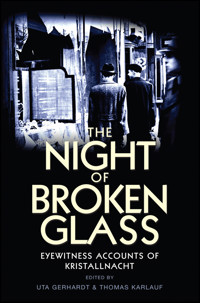
The Night of Broken Glass E-Book
15,99 €
Mehr erfahren.
- Herausgeber: John Wiley & Sons
- Kategorie: Geisteswissenschaft
- Sprache: Englisch
November 9th 1938 is widely seen as a violent turning point in Nazi Germany's assault on the Jews. An estimated 400 Jews lost their lives in the anti-Semitic pogrom and more than 30,000 were imprisoned or sent to concentration camps, where many were brutally mistreated. Thousands more fled their homelands in Germany and Austria, shocked by what they had seen, heard and experienced. What they took with them was not only the pain of saying farewell but also the memory of terrible scenes: attacks by mobs of drunken Nazis, public humiliations, burning synagogues, inhuman conditions in overcrowded prison cells and concentration camp barracks. The reactions of neighbours and passersby to these barbarities ranged from sympathy and aid to scorn, mockery, and abuse. In 1939 the Harvard sociologist Edward Hartshorne gathered eyewitness accounts of the Kristallnacht from hundreds of Jews who had fled, but Hartshorne joined the Secret Service shortly afterwards and the accounts he gathered were forgotten - until now. These eyewitness testimonies - published here for the first time with a Foreword by Saul Friedländer, the Pulitzer Prize historian and Holocaust survivor - paint a harrowing picture of everyday violence in one of Europe's darkest moments. This unique and disturbing document will be of great interest to anyone interested in modern history, Nazi Germany and the historical experience of the Jews.
Sie lesen das E-Book in den Legimi-Apps auf:
Seitenzahl: 586
Veröffentlichungsjahr: 2021
Ähnliche



















CONTENTS
Cover
Endorsement
Title Page
Copyright
Editorial Note and Acknowledgements
Foreword
Introduction: ‘Thus Ended My Life in Germany’
9 November 1938
Notes
Part I The Terror
Hugo Moses
New York, October 1939
Notes
Siegfried Merecki
Notes
Rudolf Bing
Notes
Toni Lessler
Notes
Sofoni Herz
10 November!!!
The following days of protective custody
We move again!
Notes
‘Aralk’
Marie Kahle
Notes
Part II In The Camps
Karl E. Schwabe
Notes
Gertrud Wickerhauser Lederer
Notes
Karl Rosenthal
Notes
Georg Abraham
Notes
Hertha Nathorff
10 November 1938
11 November 1938
12 November 1938
13 November 1938
14 November 1938
16 November 1938
Monday, 14 November 1938
17 November 1938
20 November 1938
24 November 1938
30 November 1938
2 December 1938
3 December 1938
4 December 1938
5 December 1938
8 December 1938
12 December 1938
15 December 1938
16 December 1938
17 December 1938
20 December 1938
24 December 1938
New Year’s Eve 1938
Notes
Carl Hecht
Notes
Ernst Bellak
Notes
Part III Before Emigration
Martin Freudenheim
Alice Bärwald
Siegfried Wolff
9 November 1938
Notes
Margarete Neff
Notes
Fritz Rodeck
Vienna, 10 November 1938
Mass arrests
Burning synagogues
Innsbruck, 10 November
… and the Aryans?
‘Atonement measures’
The Jewish situation at the beginning of 1939
Notes
Fritz Goldberg
Notes
Harry Kaufman
Notes
Afterword
The sociologist Edward Y. Hartshorne and the Harvard Project
The context of the prize competition
‘Nazi Madness’ – The book project
Re-education
Notes
Bibliography
End User License Agreement
Guide
Cover
Table of Contents
Endorsement Page
Title Page
Copyright
Editorial Note and Acknowledgements
Foreword
Introduction: ‘Thus Ended My Life in Germany’
Begin Reading
Afterword
Bibliography
End User License Agreement
List of Illustrations
Introduction
Figure 1:
Prize advertisement
Figure 2:
Competition guidelines
Afterword
Figure 3:
The caption to Diagram B in Hartshorne’s article on Nazi propaganda shows how co…
Figure 4:
The table of contents and outline of
Nazi Madness
, the book that Hartshorne was …
Pages
a
b
iii
iv
vii
viii
ix
x
xi
1
2
3
4
5
6
7
8
9
10
11
12
13
14
15
16
17
19
20
21
22
23
24
25
26
27
28
29
30
31
32
33
34
35
36
37
38
39
40
41
42
43
44
45
46
47
48
49
50
51
52
53
54
55
56
57
58
59
60
61
62
63
64
65
66
67
68
69
70
71
72
73
74
75
76
77
78
79
80
81
82
83
84
85
86
87
88
89
90
91
92
93
95
96
97
98
99
100
101
102
103
104
105
106
107
108
109
110
111
112
113
114
115
116
117
118
119
120
121
122
123
124
125
126
127
128
129
130
131
132
133
134
135
136
137
138
139
140
141
142
143
144
145
146
147
148
149
150
151
152
153
154
155
156
157
158
159
160
161
162
163
164
165
166
167
168
169
170
171
172
173
174
175
176
177
178
179
181
182
183
184
185
186
187
188
189
190
191
192
193
194
195
196
197
198
199
200
201
202
203
204
205
206
207
208
209
210
211
212
213
214
215
216
217
218
219
220
221
222
223
224
225
226
227
228
229
230
231
232
233
234
235
236
237
238
239
240
241
242
243
244
245
246
247
248
249
250
251
252
253
254
255
256
257
258
259
260
275
276
277
278
279
280
Praise for The Night of Broken Glass
‘The testimonies about the pogrom of November 9 and 10, 1938 and its sequels, assembled in this volume, describe what the authors deemed to be the height of Nazi barbarism. In reality, these events were but the faintest of preludes to what was about to happen to the Jews in Germany and in occupied Europe. Nonetheless, these reports carry a poignancy of their own that overwhelmingly evokes the suffocating and terror filled atmosphere of Jewish everyday existence in the Reich during those November days and the immediate pre-war months.’
Saul Friedlander, Pulitzer Prize winner and author ofThe Years of Extermination: Nazi Germany and the Jews, 1939-1945
‘This riveting book prints a collection of 21 eyewitness accounts by German Jews of the terrible night of 9 November 1938, when, on the orders of Adolf Hitler and his propaganda minister Joseph Goebbels, bands of stormtroopers all over Germany and Austria burned down more than 1,000 synagogues and smashed up some 7,500 Jewishowned shops. The value of these testimonies lies above all in their detail and immediacy. Mostly they confirm the picture we already have from other sources, though few are as vivid as these.’
The Guardian
‘An exceptional array of eyewitness accounts ... this fascinating collection honours the Holocaust’s victims, as well as the sociologist who preserved their memories.’
Times Literary Supplement
‘This selection of poignant eyewitness accounts of Kristallnacht, originally collected by the Harvard sociologist Edward Hartshorne in 1939 and subsequently forgotten, provide a unique and harrowing insight into the terrible events of the night of 9 November 1938.’
The International History Review
‘Taken together, these survivors’ voices bring the focus back onto what is essential: human lives, their preservation and loss.’
Forward Magazine
‘heartrending testimony of Nazi racial hatred.’
Tribune
THE NIGHT OF BROKEN GLASS
Eyewitness Accounts of Kristallnacht
Edited by Uta Gerhardt and Thomas Karlauf
Translated by Robert Simmons and Nick Somers
polity
First published in German as Nie mehr zurück in dieses Land © Ullstein Buchverlage GmbH, Berlin. Published in 2009 by Propyläen Verlag
This English edition © Polity Press, 2012This paperback edition published by Polity Press, 2021
The translation of this work was funded by Geisteswissenschaften International – Translation Funding for Humanities and Social Sciences from Germany, a joint initiative of the Fritz Thyssen Foundation, the German Federal Foreign Office, the collecting society VG WORT and the Börsenverein des Deutschen Buchhandels (German Publishers & Booksellers Association).
Polity Press65 Bridge StreetCambridge CB2 1UR, UK
Polity Press350 Main StreetMalden, MA 02148, USA
All rights reserved. Except for the quotation of short passages for the purpose of criticism and review, no part of this publication may be reproduced, stored in a retrieval system, or transmitted, in any form or by any means, electronic, mechanical, photocopying, recording or otherwise, without the prior permission of the publisher.
ISBN-13: 978-1-5095-5260-3
A catalogue record for this book is available from the British Library.
The publisher has used its best endeavours to ensure that the URLs for external websites referred to in this book are correct and active at the time of going to press. However, the publisher has no responsibility for the websites and can make no guarantee that a site will remain live or that the content is or will remain appropriate.
Every effort has been made to trace all copyright holders, but if any have been inadvertently overlooked the publisher will be pleased to include any necessary credits in any subsequent reprint or edition.
For further information on Polity, visit our website: www.politybooks.com
EDITORIAL NOTE AND ACKNOWLEDGEMENTS
In August 1939, Harvard University organized a prize competition with the title ‘My Life in Germany Before and After 30 January 1933’, for which more than 250 submissions were received from all over the world. The bundle of documents has been preserved since 1958 in the Houghton Library at Harvard in 25 boxes under the signature bMS Ger 91; the alphabetical list of the 263 authors can be viewed at http://oasis.lib.harvard.edu/oasis/deliver/~hou01275. In 1940, Edward Hartshorne, one of the three initiators of the competition, made a selection from the reports on the November pogroms to which he gave the title Nazi Madness: November 1938. This work was not published; the plan did not advance beyond editorial preliminaries. The bundle of documents was, however, preserved among Hartshorne’s papers.
Of the 34 manuscripts that Hartshorne chose from this more limited group, the editors have selected 21. Not included are 13 shorter, purely descriptive, texts ranging from one to nine pages in length. These are extracts from the recollections of Elisabeth Braasch (Harvard file 35), Ernest Frank (66), Benno Kastan (104), Kurt Meissner (154), Mara Oppenheimer (171), Margarete Steiner (226) and Annemarie Wolfram (247; with 25 pages of the only longer text that was not included here); the authors of six other texts could not be identified, because the excerpts are not attached to names and Hartshorne used the original numbering of 1939–40. No concordance of the original and the Harvard numbering exists that would make a simple correlation possible.
The texts were edited in accordance with the copies Hartshorne had made and compared with the originals. In doing so, it turned out that the secretary, Mrs Wilson, was extremely reliable (misspellings such as Xirkusgasse, Tuerkuscher Tempel, or Rathaus instead of Bethaus were rare exceptions). Here the editors would like to express special thanks to Professor Dr Detlef Garz. He made available to us the microfilms in the Harvard holdings that were prepared in connection with a research project carried out by the Carl von Ossietzky University in Oldenburg in the second half of the 1990s; the project, led by Detlef Garz, which seeks to make a systematic evaluation of all the reports, has been pursued at the University of Mainz since 2002.
The passages regarding 9 November that Hartshorne chose are for the most part taken from longer reports (Carl Hecht’s was the only report he planned to reproduce in toto, and even then with the exception of two introductory paragraphs); however, he made no cuts within the selected reports. The editors of this volume have followed the same policy. The Rosenthal manuscript represents an exception; its transcript is found complete in Hartshorne’s papers; because its 128 pages would have exceeded this volume’s limits, the editors have decided to include only pages 9–51. In the case of the Abraham manuscript, two introductory paragraphs were restored in order to make it easier for the reader to understand; two sentences at the end of the Schwabe and Rodeck manuscripts were omitted because in each case they opened a new subject.
As Hartshorne conceived it, the text would follow the chronology of events and be divided into three parts, each consisting of seven reports.
The name of Herschel Grynszpan (Grynspan, Grünspan, etc.) was standardized, as was that of the legation secretary vom Rath (often given in the manuscripts as von Roth) and that of the propaganda minister (often given as Göbbels); acronyms such as NSDAP, SS, SA, etc. were also adapted to the usual form (i.e., without full stops). On the other hand, stylistic peculiarities, including Austrianisms, were retained in the reports from Vienna, along with the occasional use of English expressions (e.g., ‘concentration camp’). Excessive use of emphasis by means of the use of underlining, capital letters, and spaced-out words was reduced in the interest of legibility and replaced by italics. Subtitles were retained only when their meaning was made clear by the passages selected. Occasional additions by the editors appear between square brackets.
The numbers given at the beginning of each text correspond to the original 1939–40 numbering with which Hartshorne worked, while the numbers between parentheses refer to the current Harvard numbering. Information in the brief biographies preceding each text is taken from the cover sheets of the originals, from the accompanying letters, and the texts, as well as from the editors’ own research. It often proved impossible to discover what happened to the contributors later on, or even their date of death. However, it can be broadly assumed that, with the exception of Siegfried Wolff, who emigrated to Holland and was murdered in Auschwitz in 1944, all the authors survived the war, since they had been able to leave the European continent in time.
The number of footnotes had to be kept to a minimum. Basic information regarding the events of 9 November will be found in the introduction; individual names and contexts are explained only on their first occurrence. The footnotes were produced by Thomas Karlauf. The editors thank the Buchenwald and Sachsenhausen Memorials for information on individual prisoners. The editors owe special thanks to Robin Hartshorne, who made the materials from his father’s papers available to us and gave us access to many documents that were used in preparing the afterword. Finally, we would also like to thank Christian Seeger of Propyläen Verlag, who spontaneously supported the project and shepherded it into print with his usual care.
Uta Gerhardt and Thomas KarlaufHeidelberg and Berlin, June 2009
FOREWORD
The testimonies to the pogrom of 9 and 10 November 1938 and its sequels, assembled in this volume, describe what the authors deemed to be the height of Nazi barbarism. In reality, these events were but the faintest of preludes to what was about to happen to the Jews in Germany and in occupied Europe. Nonetheless, these reports carry a poignancy of their own that overwhelmingly evokes the suffocating and terror-filled atmosphere of Jewish everyday existence under the Reich during those November days and the immediate pre-war months.
These texts were written one or two years at most after the events and the countless details they relate, often vividly rendered, fit into the overall historical picture that we know so well today. Minor mistakes of interpretation in fact add to the sense of complete authenticity carried by each of these testimonies. They tell of the organized nature of these ‘outbursts of popular anger’, of the relentless and thuggish savagery of the SA, SS and Hitler Youth involved in the orgy of destruction and humiliation; they tell of the sheer perversity of the perpetrators and of their inventiveness: an old lady, for example, forced under SA supervision, hammer in hand, to herself destroy all the precious objects in her apartment; and much worse of course. But many of the witnesses also stress that Germans in different walks of life appeared embarrassed by the savagery of the regime and, at times, did not hesitate to express their empathy for the suffering of their Jewish neighbours. The voices of some of these German supporters (Marie Kahle and her family, among others) are included in the volume.
A few of the narratives offer lighter moments in the midst of the overall gloom. For instance, one cannot but be pleased in imagining the adventurous escape of Rudolf Bing and his wife from their house in Nuremberg as they slid down from their bedroom window on tied sheets while the mob was breaking down their front door. Generally, however, the narratives dwell on quite different scenes: the groups of Jews huddled in the waiting-room of the Berlin Bahnhof am Zoo, because these railway-station waiting-rooms remained some of the rare public places to which access was not yet forbidden to Jews; the endless queues of Jewish women in front of foreign consulates, as male Jews in their tens of thousands had been arrested and shipped off to camps – Buchenwald, Sachsenhausen and Dachau. Much has been written about camp existence, even during the pre-war period, yet the wave of sudden arrests of Jews, about 40,000 of them, created new and unexpected conditions in which the sadism of the SS guards found an ideal outlet. The constant beatings for every and any reason, the hours-long roll-calls in freezing weather, the repeated ‘exercises’, which on each occasion left a few of the old and sick inmates dead, the cramped barracks, the lack of food, the torturing thirst and the one constant fixation: How fast would getting a visa lead to release from the camp and allow quick departure from the country?
At times, a few inmates themselves drifted towards very problematic choices. Thus, Kurt Lederer, a Viennese physician, arrested and sent to Buchenwald before November 1938, improvised a small ‘subcamp’ in one of the buildings, in which, with the help of the camp authorities, he kept mentally ill inmates to avoid additional chaos among the prisoners; at one point, he was in charge of 150–60 people. As controlling the mentally ill without adequate medicine became increasingly difficult, one of the SS guards offered help: the physician could choose twenty of the most difficult cases and hand them over. He did. Ultimately, some thirty-five patients disappeared: they were ‘killed in the bunker’. Did the physician foresee this outcome? Thus, even in these early testimonies, we at times approach that ‘grey zone’ which Primo Levi described many decades later when reflecting on human behaviour in the death camps.
In this volume, over and above the bare facts, readers will discover an extraordinary array of details about Jewish attitudes, perceptions, and reactions during these fateful months. They will grasp a wealth of aspects defining the atmosphere that suffused the world of central European Jewry in the penultimate phase of its existence, moments before its final doom.
Saul Friedländer
INTRODUCTION: ‘THUS ENDED MY LIFE IN GERMANY’1
Thomas Karlauf
9 November 1938
At about 9.30 on the morning of 7 November 1938 Herschel Grynszpan, a 17-year-old Polish Jew, entered the Hôtel de Beauharnais at 78 rue de Lille, which had since 1814 been the site of the Prussian, later the German, embassy in Paris. The porter’s wife was the first person he met in the courtyard. He said he had an important document to deliver and wanted to speak to an embassy secretary. Frau Mathes directed him to the corresponding door. Grynszpan rang and repeated his business to the aide who opened the door. After he had sat for a short time in the waiting room, he was shown into the office of the legation secretary, Ernst vom Rath.
A few minutes later the aide heard loud cries. He raced back and found the legation secretary lying wounded in the corridor. While two of his colleagues saw to the wounded man, the aide led away the assassin, who had put down his revolver and put up no resistance, and handed him over to the police officer posted in front of the embassy. The severely injured vom Rath was taken to the nearby Alma Clinic, where he was immediately operated on.
Herschel Grynszpan’s parents had emigrated from western Russia to Germany in 1911 and settled in Hanover. After the reconstitution of Poland at the end of the First World War, they acquired Polish citizenship, but remained in Hanover, where his father first worked as a tailor and later eked out a living selling junk. In the summer of 1936, when he was fifteen years old, Herschel fled these impoverished conditions and travelled through Belgium to Paris, where he was taken in by one of his father’s brothers.
In late October 1938, Grynszpan received terrible news. On 31 March, the Polish government had announced that all Poles who had lived abroad for more than five years would lose their Polish citizenship. New passport regulations were issued to that effect on 30 October. This measure was aimed above all at Polish Jews living in Germany and would have left them stranded there. The Reich Foreign Office sought to prevent this from happening by expelling Polish Jews before the deadline. On 27 and 28 October, the police and the SS arrested about 16,000 Jews throughout the Reich, transported them to a point on the Berlin–Poznan railway line just short of Zbąszyń, and then herded them over the Obra River. The Polish authorities denied them the right to cross the border, so they wandered about for days in the no-man’s land between Germany and Poland, in pouring rain and without food or a roof over their heads. Grynszpan’s parents were among these deportees.
‘My heart bleeds when I think about our tragedy,’ Herschel said in a note he left for his uncle on the morning of the assassination. ‘I have to protest in such a way that the whole world hears my protest, and that is what I intend to do.’2 Then he bought a revolver in a gun shop and took the metro to the German embassy. The rumours suggesting that Grynszpan’s attack might have had a private motive, since both he and vom Rath frequented homosexual milieus, have no foundation in fact.3 It was pure chance that Grynszpan was sent to the office of vom Rath, who just happened to be on duty on Mondays.
The following morning, Professor Georg Magnus, the director of the University Surgical Clinic II and his chief physician, Dr Brandt, arrived in Paris. The two doctors, sent as an ‘expression of the Führer’s sympathy, made a visible impression on Herr vom Rath’, wrote the German ambassador, Graf Welczek, in the report that he prepared for the Foreign Office that evening.4 Vom Rath’s condition, which Magnus and Brandt had described in their first bulletin as promising, deteriorated rapidly in the course of the day. Hitler, who by sending his personal physician had shown his unfailing instinct for the explosiveness of a situation, immediately promoted the young diplomat to the rank of Gesandtschaftsrat I. Klasse (legation councillor first-class), two floors up, even though he had only recently been appointed a legation secretary.
Grynszpan’s desperate act immediately reminded people of the Gustloff case which had occurred only a few years earlier. On 4 February 1936, David Frankfurter, a medical student, had fired five revolver shots at the Nazi party’s regional group leader, Wilhelm Gustloff, in his apartment in Davos, killing him as a protest against Germany’s policy regarding Jews. Gustloff’s body was transported with great ceremony from Switzerland to Schwerin, where Hitler attended the burial. In his speech, the Führer blamed international Jewry for the crime and described Gustloff as a ‘holy martyr’ and ‘the first genuine martyr for National Socialism abroad’.5 However, because the Winter Olympic Games were to begin in Garmisch-Partenkirchen two days after Gustloff’s assassination, no anti-Jewish reprisals were taken at that time.
In November 1938, there were neither Olympic Games nor foreign powers whose reactions had to be taken into account. On the contrary, after the Munich Agreement, in which the western powers had only five weeks earlier caved in and accepted the transfer of the Sudetenland to the German Reich, the National Socialist regime was more powerful than ever. Many people in Germany were awaiting the opportunity finally to strike and initiate a great, nationwide action against the Jews.
On the basis of the first reports from Paris, the Propaganda Ministry had advised the press to give the assassination ‘the greatest attention’ and to emphasize that this act ‘was certain to have the most serious consequences for Jews in Germany’. On 8 November, the tension was ratcheted up another notch, and the next day the German News Bureau announced that vom Rath was expected to die.6 In Berlin, ‘an oppressive anxiety like that felt before a storm’ prevailed that morning, as the journalist Ruth Andreas-Friedrich noted in her diary. When she asked Heinrich Mühsam, a colleague who had been dismissed and whom she had stopped to see on her way to work, whether vom Rath was likely to die, he replied: ‘Of course he will die. Otherwise the whole thing would make no sense … Don’t you know that political incidents usually occur only when everything has been prepared down to the last detail?’7
When at about 4.30 p.m. on 9 November vom Rath finally succumbed to his injuries, practically the entire state and party leadership had assembled in Munich. On the preceding evening, Hitler had inaugurated the annual commemoration of the failed putsch of 1923 by giving a speech in the Bürgerbräukeller. The programme for 9 November included an ‘informal gathering of the NSDAP leadership’ at the City Hall, whose concluding high point was to be the swearingin of new SS units in front of the Feldherrenhalle at midnight. Just how the news of the death of vom Rath – who was now referred to only as an envoy or party member – reached Munich by telephone between 5 p.m. and 6 p.m. is not absolutely clear. What is clear is that at the party leadership’s dinner in the Rathaus, Hitler had an intense conversation with Goebbels, who was seated next to him.8 Immediately afterwards, Hitler surprised the other guests by leaving and having himself driven to his apartment on the Prinzregentenplatz, where he prepared for the midnight ceremony. He obviously considered it more prudent not to be directly connected with the speech that Goebbels was about to deliver.9 He could count on his propaganda minister. Hitler’s preference for blanket verbal authorization, leaving precise intentions open to interpretation, was ‘typical of the unstructured and non-formalized style of reaching decisions in the Third Reich’.10
At this time Goebbels was on top form. On 10 November, when Ernst vom Rath’s life still hung by a thread, Goebbels wrote ‘If only we could release the wrath of the people right now’, as if he couldn’t wait for the diplomat to die.11 Did the cynical Goebbels really believe in the wrath of the people? Didn’t he see it instead as an instrument that had only to be correctly manipulated? An SD memo of January 1937 concerning the situation of Jews in Germany had stated that ‘the wrath of the people is the most effective means of depriving Jews of their sense of security… . This is all the more comprehensible from a psychological point of view because Jews have learned a great deal from the pogroms of recent centuries and fear nothing more than a hostile mood that can turn against them at any time.’12 In November 1938, ‘the wrath of the people’ (Volkszorn) was one of Goebbels’s favourite expressions. When the right moment comes, he noted on the day after the riots, it would be necessary to ‘let things take their course’.13
Goebbels knew that by instigating a pogrom he could score points with Hitler. A large-scale action against the Jews would help him, put him once again at the centre of things and strengthen his position (which had been weakened by his affair with the actress Lida Baarova) in the delicate power mechanism of the Third Reich. Among all the Nazi paladins, Goebbels certainly had the keenest ear for Hitler’s obsession with driving Jews out of Germany by any means. As they sat cosily with the old guard in Hitler’s favourite café the previous evening, discussing ‘all possible questions’ until 3 a.m., the two of them had probably already arrived at an agreement on their options with regard to the attack in Paris.
In the particular situation of 9 November, Goebbels sensed a unique opportunity to steal a march on his greatest rival, Hermann Göring, who had taken over one office after another and since 1936 had enjoyed enormous power as plenipotentiary for the Four-Year Plan. Göring had recently proven his ruthlessness in the Blomberg–Fritsch affair and in the annexation of Austria; but during the Sudeten crisis of late September, he had for the first time been among those who hesitated and urged caution. Since then his star had been on the decline. Göring had repeatedly spoken out against anti-Jewish demonstrations because they only further aggravated the Reich’s economic difficulties, particularly with regard to the currency problem. ‘Gentlemen, I have had enough of these demonstrations,’ he said indignantly and with his characteristic theatricality during the extraordinary meeting he called two days after the pogroms. ‘They do not harm the Jews, but rather me, because as the final authority I am responsible for the entire economy.’14
Four years earlier, in the run-up to the Nuremberg party rally where the ‘race laws’ were promulgated, there had already been conflict between authorities regarding the ‘Jewish question’. Under the motto ‘This city must become free of Jews (judenfrei)’, almost every German community had come up with its own perversities, and the attacks on Jews had been threatening to get out of hand. On 20 August 1935, Hjalmar Schacht, then the Reich’s Minister of Economic Affairs, had called a meeting of leaders at which he complained about the ‘serious damage to the German economy being done by the exaggerations and excesses of anti-Semitic propaganda’.15 Consequently, interior minister Wilhelm Frick issued a statement informing regional governments that ‘individual actions against Jews … must absolutely stop.’16 However, the head of the Gestapo, Reinhard Heydrich, had already decreed that ‘in order to collect information regarding Jews in Germany … a Jewish registry should be drawn up.’17 In the regulations issued in August 1935, three basic tendencies of the November pogroms are already clearly foreshadowed: the centralization of state intervention, the prevention of spontaneous actions and the protection of German economic interests.
All the steps taken served one and the same goal, about which there was general agreement: the Jews had to be expelled. ‘Jews have to be expelled from Germany, indeed from Europe as a whole,’ Goebbels wrote after a long conversation with Hitler at the end of November 1937. ‘It will take a while, but it will and must happen. The Führer has made up his mind on this point.’18 The question was only in what way this goal could best be achieved without inflicting too much damage on Germans. Moreover, the state and party leadership were confident that in implementing the necessary measures they could count on the support of the population.
At the previously mentioned meeting with the minister for economic affairs in August 1935, Adolf Wagner, the Gauleiter of Munich-Upper Bavaria, acting as the Führer’s representative, put on record his view that 80 per cent of the population called for ‘a solution to the Jewish question in line with the party’s programme; the Reich government has to respond to this demand, otherwise it will suffer a loss of authority.’ To reassure other participants in the meeting who were less inclined to take immediate action, he added that ‘this need not happen all at once.’19
With the annexation of Austria in March 1938, the ‘Jewish question’ acquired a new dynamic, and suddenly everything had to move very fast. Of the approximately 520,000 Jews who had been living in Germany in 1933, only about 360,000 were still in the country; now there were in addition some 190,000 Austrian Jews (of whom about 170,000 lived in Vienna). The Germans immediately increased the pressure. In a very short time, they not only implemented in Austria all the laws and regulations that had for the past five years made life increasingly difficult for Jews in the Old Reich, but also introduced numerous new rules to coerce the Jews to hand over all their possessions and then leave the country. In the spring of 1938, there were further, even more violent, riots and, in the context of the so-called ‘June action’, 1,500 Jews were sent to concentration camps. When at the international conference on refugees organized by the United States in Evian in July, all of the thirty-two participating states declared more or less openly that they could not increase their immigration quotas, the German press commented scornfully on the conference’s failure and let it be known that, since no other country would accept the Jews, no meddling in the question of how Germans dealt with the ‘Jewish problem’ would be tolerated. In August, the first Central Office for Jewish Emigration was set up under the direction of Adolf Eichmann.
It was against the background of the stepping-up of anti-Jewish measures in Austria and the successful expulsion of the 16,000 Polish Jews at the end of October, the prestige won in Munich, the inaction by the international community, and also the growing pressure among party members, especially in the ranks of the SA and the Hitler Youth, to finally get rid of the Jews that, on the evening of 9 November, Hitler unleashed his propaganda minister. The fanatical thirty-minute hate speech that Goebbels delivered (and of which no verbatim record has been preserved) before the party bigwigs who had gathered in the great hall of the Munich Rathaus was received, as Goebbels himself noted in his diary, with thunderous applause: ‘They all immediately dashed to the telephones. Now the people will act.’20
In his speech, Goebbels had made it clear that the Nazi party would have to ‘organize and implement’ everything, but should not ‘outwardly appear to be the instigator of the demonstrations’.21 The district and local group leaders and SA leaders throughout the Reich were instructed to set the corresponding actions in motion – and these instructions were understood to mean also that ‘Jewish blood should flow.’22 In the meantime, Hitler received the national leader of the SS and the head of the German police in his apartment on Prinzregentenplatz. Himmler was obviously surprised. Although he had himself given an inflammatory anti-Jewish speech to the SS Standarte ‘Deutschland’ the preceding evening – ‘We will force them out with unparalleled ruthlessness’23 – he found it annoying that Goebbels had been quicker to seize the opportunity and had been able to use the Paris attack to further his own interests. In this awkward situation, Himmler fell back on his position as supreme protector of order: a clever tactic that led to the SS – and in particular the head of the secret police and the SD, Reinhard Heydrich – emerging from the events of November as the great winners. When Heydrich, who had been awakened in his hotel room around 11.30 p.m. so that he could examine reports from the Munich Gestapo, asked how the police and the SS should respond, Hitler told him – on Himmler’s advice, according to Ian Kershaw24 – that the SS should keep out of it, but that the police should ensure that the pogrom was carried out in an orderly way.
Heydrich did not have much time to transform his orders into specific actions. His telegraph to all police chiefs, which went out around 1.20 a.m. – ‘Flash, urgent, pass on immediately!’ – was completely unambiguous. The police forces received orders not to hinder the ‘demonstrations’ likely to occur throughout the Reich, and to intervene only if German property was endangered. ‘Businesses and apartments belonging to Jews are only to be destroyed, not plundered.’ The police actions were to be led by the local state police departments or by security police inspectors, who were also expected to see to it that ‘as soon as the events of this night allow the use of the regular officials’, as many Jews as ‘could be accommodated in the available holding cells’ were immediately arrested. At first, only male Jews who were healthy, not too old, and if possible, wealthy, were to be arrested and transported to the concentration camps concerned after consultation with camp officials.25 Barely 64 hours had passed since the shooting in Paris.
On the morning of 10 November, synagogues all over Germany were put to the torch. The fire brigade was allowed to intervene only if the fires threatened to spread to neighbouring buildings. Thousands of apartments were demolished during that night, and thousands of Jewish businesses were smashed to bits in the course of the following day. The broken glass that piled up in the streets gave the night the ironically euphemistic name of Kristallnacht, ‘the night of broken glass’. It is estimated that 400 people were murdered or driven to suicide. About 40,000 Jews were arrested, and 30,000 of them were sent to Dachau, Buchenwald or Sachsenhausen,26 where they were subjected to the cruellest harassment. Those who were lucky enough to be able to prove that they had the necessary visas and were about to emigrate were released; the number of Jews who died in concentration camps as a result of the ‘November action’ is estimated to be about 1,000. Whereas in the first half of 1938 only about 14,000 Jews had emigrated from Germany, the number of emigrants now rose dramatically. By the end of 1939, about 100,000 Jews had left Germany, and another 100,000 had left Austria. Most of those who remained were poor or old.
During lunch in the Osteria in the Schwabing area of Munich, Goebbels gave the Führer a report. ‘He approves of everything. His views are very radical and aggressive.’27 Others were less enthusiastic; Göring, who had travelled back from Berlin the previous night and had not been informed, telephoned Hitler to complain about the enormous economic damage that had been incurred. While Goebbels was busy winding down the actions before ‘mob rule took over’28 and instructing the press to play down the events – ‘no big headlines on page one, no pictures for the time being’29 – Göring was preparing for the Saturday morning meeting, at which the next steps to be taken against the Jews were to be coordinated with account taken of economic considerations. The declared goal of the 12 November meeting, which lasted several hours and in which representatives of all the departments concerned participated – over a hundred persons from the interior, finance, economic affairs and justice ministries, from the Foreign Office, the Reichsbank, and so on – was the complete exclusion of Jews from German economic life. The idea of the new measures was to isolate them and put them under pressure so they would be forced to leave Germany rapidly and in large numbers. Heydrich had had Eichmann specially brought in from Vienna in order to report on his experiences there.
The decisions made on 12 November can once again be traced in essence back to Hitler himself. In 1936, in his memo on the Four-Year Plan, he had already demanded that ‘the whole of Jewry be held responsible for all the damage individual examples of this criminality have done to the German economy and thus to the German people’.30As retribution for Gustloff’s murder, he suggested that Jews be subjected to collective punishment, but at the time this plan was not realized because of bureaucratic reservations expressed by the ministries, and especially because of Göring’s concerns. Now Göring took up the idea and on 12 November issued an order to the effect that the Jews, as ‘atonement’ for their hostile attitude toward the German people, should pay a fine of one billion Reichsmarks. The no less obscene idea that the Jews themselves not only had to see to it that the damage was repaired but also that all monies proceeding from insurance claims were to be confiscated by the Reich was also Hitler’s; it occurred to him while he was lunching with Goebbels at the Osteria. Göring implemented this proposal in his own ‘Order on the restoration of the appearance of the streets by Jewish businesses’.
Whereas the two speakers at the 12 November meeting, Göring and Goebbels, sought to outdo each other in outlining perverse means of harassment – should Jews continue to be able to walk in German forests? What restrictions should be put on their use of railway sleeping cars? – Heydrich reminded them of the question they were there to discuss. He asked whether, in view of the fact that it would probably be eight or ten years before the last Jews left Germany, it wouldn’t make sense to provide them with a special badge. Göring ridiculed this suggestion – ‘A uniform!’ – and recommended for his part the construction of ghettos, which Heydrich rejected, however, pointing to the impoverishment and criminality to which that would lead. This went on, back and forth, for hours: in its brutality, cynicism and bureaucratic laziness in conceiving regulations whose sole goal was to destroy the lives of hundreds of thousands of people, the record of the meeting on 12 November 1938 was every bit the equal of the Wannsee conference in January 1942.31
In the early afternoon, as the meeting was about to end, Göring indulged in a grim prediction of what German Jews could expect: ‘If within any foreseeable future the German Reich is involved in some conflict with another nation, it goes without saying that here in Germany we will think first of all of settling accounts with the Jews.’ Two and a half months later Hitler, in his notorious, often-cited speech delivered on 30 January 1939, which he later liked to claim was given on the day war broke out, said almost the same thing, but with significantly more aggressiveness and the crucial difference that he then immediately named ‘world Jewry’ as the instigator of a possible war: ‘If international Jewish financiers inside and outside Europe should succeed in plunging nations once again into a world war, then the result will be not the bolshevization of the world and thus the victory of Jewry but rather the annihilation of the Jewish race in Europe.’32 It was this poisonous symbiosis of madness and calculation that made it possible for the death of a legation secretary to become the pretext for the greatest organized pogrom in modern history.
‘I am reminded of what an Aryan in a Düsseldorf cinema experienced,’ we read at the end of the memoirs of Harry Kaufman, a young man who was able to emigrate in late 1938. ‘It was in 1937, when people were not yet so firmly convinced that Jews were to blame for everything. An insurance company was showing a promotional film about the consequences of a traffic accident. After the accident took place, on the screen there appeared in large letters the question: “And who is to blame for this?” A joker in the cinema shouted: “The Jews!” People laughed so hard that for several minutes you couldn’t hear a word.’33 The mirth in the cinema gives us a good idea of the country’s mood on the eve of the pogroms: most people didn’t know what to make of anti-Semitic agitation. It probably wouldn’t do any harm to reduce somewhat the influence of Jews in economic life, as the government had already been successfully doing for years, and maybe it would actually be best for the Jews to leave Germany, sooner or later. But why this fervour, this strident rabble-rousing? After all, the Nazis’ conspiracy theories were sometimes positively ludicrous. The joker in the cinema had put it in a nutshell.
How the November pogroms were received by the German people and to what extent they approved of them is still a subject of controversy. Can the indifference that according to sources characterized the great majority of the population already be seen as an indication of ‘passive complicity’ (Kulka/Rodrigue), or does the awkward silence point instead to an ‘embarrassed distance’ (Frank Bajohr)?34 In endeavouring to arrive at a balanced judgement it should not be forgotten – as Peter Longerich recently emphasized again – that in the Third Reich there was no such thing as public opinion built on the free expression of personal views. Under National Socialism, ‘public opinion’ always meant ‘the public opinion staged, controlled and manipulated by the regime’. In this area, ‘in which the guiding principles and interpretive models were reproduced’, it was very dangerous to confide one’s views to another person unless one was sure that this other person shared them.35
As a result, there are few documents that provide reliable answers to the question as to what most Germans thought in November 1938. The government-commissioned reports on the situation and public opinion, including reports made by local offices regarding the success of the measures taken, are sources that have to be evaluated critically, as are the ‘Deutschland-Berichte der SOPADE’ produced by the leadership of the Social Democratic Party in exile in Prague. Although the idealists in exile tended, for understandable reasons, to greatly overestimate Germans’ covert resistance to Hitler, we nonetheless have to agree with their general conclusion that ‘the riots were strongly condemned by the great majority of the German people.’36 But this condemnation was nowhere expressed in open protests.
The collection of materials published last year by the Wiener Library made a significant contribution to our understanding of the initial impression from the point of view of the victims.37 Immediately after the outbreak of the pogroms, the Jewish Central Information Office in Amsterdam had begun to collect all the information it could get its hands on in order to find out exactly what had happened and which Jewish communities were affected in what way by the catastrophe. The exchange of personal communications, names and dates was intended to help put an end to uncertainty concerning the survival of relatives and friends.
At its outset, the present book also reaches back seventy years, but has an entirely different background. On 7 August 1939, nine months after the pogroms, the New York Times reported, under the headline ‘Prize for Nazi Stories’, that scholars at Harvard University were seeking eyewitness accounts of life in Germany before and after 1933 and to this end had organized a competition with prizes totalling one thousand dollars. Anyone who could report, on the basis of his own experiences, on how everyday life had changed after Hitler’s seizure of power, was eligible to enter the contest. These reports could be presented anonymously or under a pseudonym, and were to be handled with strict confidentiality – ‘but they must be authentic’.
‘My Life in Germany Before and After 30 January 1933’ – that was the name given the prize competition, and the detailed invitation, written in German, to submit entries which was subsequently distributed all over the world by Jewish information offices and aid associations outlined the project very exactly. The life stories should be about eighty pages long, ‘as simple as possible, direct, complete, and vividly recounted’. Only ‘real occurrences’ should be described, and therefore anyone who had ‘a good memory, a gift for sharp observation and a knowledge of people’ could take part, even if he had never written anything before. ‘Quotations from letters, notebooks, and other personal writings give your description the desired credibility and completeness.’ Those who did not win a prize could also be sure that their ‘work could be very useful for the study of the new Germany and National Socialism’. The deadline for submissions was 1 April 1940.
Figure 1: Prize advertisement
More than 250 manuscripts from all over the world were received in Cambridge. Of these, 155 came from the United States, 96 of them from New York alone; 31 authors gave return addresses in Great Britain, and 20 sent their contributions from Palestine. Six manuscripts were mailed in from Shanghai, the only territory in the world where no visa was required and where a Jewish enclave had therefore rapidly grown up. Moreover, not only Jews who had emigrated from Germany responded to the call. For example, a Silesian confectioner who had been hired as a cook by the merchant navy and who was now confined in a British camp as an ‘enemy alien’ expressed his enthusiasm for the new Germany, as did an au-pair girl from Berlin who happened to be in America when war broke out – but these texts were exceptions. The great majority of those who submitted reports were Jews who had left Germany and Austria after the pogroms of November 1938.
Most of them had lived in large cities; 61 came from Berlin and 39 from Vienna. The liberal professions, lawyers and doctors, university lecturers and members of the writing community were overrepresented; however, in addition to representatives of the wealthy bourgeoisie, salesmen and people who had eked out a living with occasional jobs also wrote contributions. About a quarter of the accounts came from women.
The participants’ motives varied as much as the social milieus from which they came. With the first-place prize of 500 dollars, an emigrant could survive for several months in most countries, and more than one participant described winning a prize as his ‘last hope’. Others had literary ambitions; even though it was expressly mentioned that this was not a literary contest and that the judges had ‘no interest in philosophical considerations’, a few complete novel manuscripts were submitted. The organizers helped some of these authors by putting them in contact with publishers and editors; some participants, disappointed that their contributions neither received a prize nor were published, demanded that their work be returned to them. In individual cases, the researchers at Harvard also tried to do something for those who had been interned by the British and transferred to camps in Australia or Canada.
The chief motive of most of the participants was, as the Berlin publicist Wolf Citron put it, ‘to say farewell to Germany by working through and recapitulating what was experienced’. No one did so as radically as Moritz Berger, 21, who gave his account the title ‘Revenge’ and ‘dreamed of being a bomber pilot and reducing his home city to ruins’.38 However, all the accounts agreed that the unrestrained brutality of National Socialism on the night of 9 November 1938 represented the greatest breach of civilization in western history, and that it was, for a German Jew, simply unthinkable ever to live in that country again. ‘Nie mehr zurück in dieses Land’ (‘Never back to that country’), wrote the Berlin doctor Hertha Nathorff one week after the pogrom, ‘once we have left it alive.’ Several authors concluded their memoirs by adopting the prize competition’s title, summarizing the irreversibility of the events in the sentence: ‘So endete mein Leben in Deutschland’ (‘So ended my life in Germany’).
Figure 2: Competition guidelines
Most of the contributors had complied with the guidelines and submitted typescripts of 50–100 pages; some sent only 3–5 pages, others thick bundles of several hundred pages. About 12 per cent of the contributions were written in English, and a few were handwritten. The evaluation of the total of more than 10,000 pages was at first very promising. The texts were assessed by research assistants according to a specially designed 19-page schema, and at the same time so-called ‘thumbnail summaries’ were made. But after the prizes had been awarded, the process came to a halt. This had to do not only with global political developments – on 10 May 1940, five weeks after the submission deadline, the Germans began the war on the western front – but also with the fact that the three initiators of the project – the psychologist Gordon Allport, the historian Sidney Fay and the sociologist Edward Hartshorne – had differing interests.39
Hartshorne, the youngest of the three and at the same time the soul of the whole project, was the only one who followed through on it beyond the final report. In August 1941, he sent his publisher, John Farrar, a manuscript that was intended to wake up American readers and bore the working title, ‘Nazi Madness: November 1938’. The core of Hartshorne’s book was to be a selection of especially impressive descriptions excerpted from the more than 250 autobiographies submitted to the Harvard competition, which he had read through. He was particularly interested in accounts on Reichskristallnacht (‘The Night of Broken Glass’) and the recollections of persons who, in the wake of the riots, had been interned in Buchenwald, Dachau or Sachsenhausen. The example of 9 November, he believed, was particularly well-suited to document the regime’s mendacity because it was not, as Goebbels had tried to persuade the world, a ‘boiling over of the people’s soul’, but rather a well-prepared action centrally directed by the Nazi party and the SS.
When Hartshorne entered the American Secret Service (the later OSS) on 1 September 1941, the project came to an end. Through various postings within the American army, Hartshorne came in May 1945 to Marburg as an officer of the occupying forces. On the evening of 28 August 1946, he was the victim of an assassination attack and died from his injuries two days later.
In 1948, Sidney Fay gave the collection of autobiographies that had been submitted in the prize competition in 1939–40 to Harvard’s Houghton Library, where they were classified in alphabetical order and numbered 1 to 263; sixteen accounts from this collection have since been published.40 However, all traces of the book that Hartshorne had prepared for publication in the summer of 1941 were lost. He had studied the text over a period of many weeks and repeatedly rearranged the excerpted passages in an effort to give them the greatest possible impact. In a provisional final version, ‘Nazi Madness: November 1938’ was to consist of about 500 pages of excerpts from 34 autobiographies. But where was the manuscript?
For over half a century, ‘Nazi Madness’ lay unnoticed in a cardboard box that grew ever dustier over time and finally ended up in Berkeley, California. In her research on Hartshorne’s biography, Uta Gerhardt heard of this bundle of papers in the 1990s; in the summer of 2008, the editors saw it for the first time and prepared it for publication.41 They are convinced that, on the one hand, the density and authenticity of the carefully elaborated memoirs, and on the other hand, the singular history of their genesis make this collection a document of the greatest importance for modern history.
There is no such thing as non-judgemental memory. The judges in the Harvard competition set the necessary standards and demanded precision and vividness from the authors. It is evident from the texts how difficult it must have been for many writers to describe, objectively and with a steady hand, the atrocious events that had taken place only a year earlier and that had destroyed their material existence and identity as German Jews. But it is not only the immediate proximity of the events that takes our breath away in many passages. Underlying all the accounts is the certainty that Jewish life in Germany came to an end on 9 November 1938. As we now know – and this is the uncanny thing about the texts – this day was in reality a kind of dress rehearsal for the murder of millions of Jews in all parts of German-occupied Europe. These accounts document, as it were, the end before the end – and stop for just a moment the turning wheel of history.
Notes
1.
From Harry Kaufman’s account, cf. pp. 231–5.
2.
Quoted from Saul Friedländer,
Nazi Germany and the Jews
, vol. 1,
The Years of Persecution 1933–1939
, New York, 1997, p. 268. Cf. Trude Maurer, ‘Abschiebung und Attentat. Die Ausweisung der polnischen Juden und der Vorwand für die
Kristallnacht.
’ In Walter H. Pehle, ed.,
Der Judenpogrom 1938. Von der ‘Reichskristallnacht’ zum Völkermord
. Frankfurt am Main, 1988, pp. 52–73.
3.
In the hearings preparatory to his show trial in 1942, Grynszpan referred to these rumours and implied that he had had a homosexual relationship with vom Rath; this spared him being judged by the People’s Court. But he was killed anyway – probably in the same year, in Sachsenhausen concentration camp. On the details of Grynszpan’s fate and the preparations for the trial, see Hans-Joachim Döscher,
‘Reichskristallnacht’. Die Novemberpogrome 1938
. Munich, 2000, pp. 159–84.
4.
Facsimile in Döscher, op. cit., p. 79.
5.
Max Domarus, ed.,
Hitler. Reden und Proklamationen 1932–1945
. Leonberg, 1988, vol. 2, p. 574 f.
6.
Instructions to the press quoted from Peter Longerich,
‘Davon haben wir nichts gewusst!’ Die Deutschen und die Judenverfolgung 1933–1945
. Berlin, 2006, p. 124.
7.
Ruth Andreas-Friedrich,
Der Schattenmann. Tagebuchaufzeichnungen 1938–1945
. Berlin, 1947, p. 28 f.
8.
For the most detailed account, see Angela Hermann, ‘Hitler und sein Stosstrupp in der “Reichskristallnacht”
.’
In
Viertelsjahrshefte für Zeitgeschichte
56(4) (October 2008), pp. 603–19; here, p. 606 f.
9.
Hitler neither referred to the attack in his speech on the evening of 8 November in the Bürgerbräukeller nor spoke about it during the state funeral for Ernst vom Rath on 17 November in Düsseldorf. See ‘Die Fiktion eines spontanen Ausbruchs des Volkszorns gebot Schweigen’; Friedländer, op. cit., p. 300.
10.
Ian Kershaw,
Hitler
. London, 2008, p. 461.
11.
Die Tagebücher von Joseph Goebbels. Im Auftrag des Instituts für Zeitgeschichte und mit Unterstützung des Staatlichen Archivdienstes Rußlands
, ed. Elke Fröhlich. Munich, 1993 ff., part 1, vol. 6, p. 178, entry for 9 November 1938.
12.
Zum Judenproblem. Januar 1937
. Quoted from
Die jüdische Emigration aus Deutschland. 1933–1941. Die Geschichte einer Austreibung
.
Eine Ausstellung der Deutschen Bibliothek Frankfurt am Main, unter Mitwirkung des Leo Baeck Instituts
. New York and Frankfurt am Main, 1985, p. 216.
13.
Goebbels,
Tagebücher
, part I, vol. 6, p. 180, entry for 10 November 1938.
14.
Quoted from Döscher, op. cit., p. 133.
15.
Quoted from
Die jüdische Emigration aus Deutschland
, op. cit., p. 71.
16.
Ibid., p. 68.
17.
Ibid., p. 69 f.
18.
Goebbels,
Tagebücher
, part I, vol. 4, p. 429, entry for 30 November 1937.
19.
Quoted from
Die jüdische Emigration aus Deutschland
, op. cit., p. 71 f.
20.
Goebbels,
Tagebücher
, part I, vol. 6, p. 180, entry for 10 November 1938.
21.
According to the Supreme Court of the Nazi Party, in a decision issued on 13 February regarding the question of how Goebbels’s speech and the carrying out of the orders were to be understood. It was necessary to call upon the party’s court in order to fabricate a state of emergency and thus spare the perpetrators a criminal proceeding. Quoted from
Der Prozess gegen die Hauptkriegsverbrecher vor dem Internationalen Militärgerichtshof (IMT), Nürnberg 1948
, vol. 32, pp. 20–9.
22.
Ibid.
23.
Quoted from Friedländer, op. cit., p. 292.
24.
Kershaw, op. cit., p. 458. ‘Disorder and uncontrolled violence and destruction were not the SS’s style.’
25.
Facsimile in Döscher, op. cit., pp. 95–7.
26.
Dachau: 10,911 deliveries; Buchenwald: 9,845 deliveries; Sachsenhausen an estimated 6,000–10,000 deliveries.
27.
Goebbels,
Tagebücher
, part I, vol. 6, p. 182, entry for 11 November 1938.
28.
Ibid.
29.
Instructions to the press quoted in Longerich, op. cit., p. 125.
30.
Quoted from Avraham Barkai, ‘ “
Schicksalsjahr 1938
”. Kontinuität und Verschärfung der wirtschaftlichen Ausplünderung der deutschen Juden.’ In Pehle, op. cit., p. 99.
31.
It is all the more astounding that the stenographic record has still not been published
in toto
. The literature cites the partial record presented to the International Military Court in Nuremberg: IMT, op. cit., vol. 28, p. 499 ff. Cf. Döscher, op. cit., p. 123 f., there pp. 133–44.
32.
Domarus, op. cit., vol. 3, p. 1058.
33.
Harry Kaufman, unpublished manuscript (Houghton Library, Harvard University, bMS Ger 91, File 108); extracts from memoirs in this volume, pp. 231–5.
34.




