


37,99 €
Mehr erfahren.
- Herausgeber: John Wiley & Sons
- Kategorie: Fachliteratur
- Serie: The AFP/Wiley Fund Development Series
- Sprache: Englisch
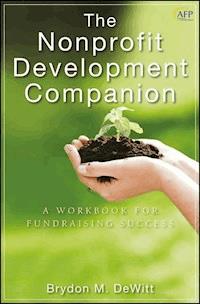
A comprehensive workbook covering all aspects of successful nonprofit development One of the most significant factors in the success of any marketing and fundraising program is the ability and willingness of the organization to take the time to develop an integrated development plan with realistic budgets, timelines, and areas of responsibility. The Nonprofit Development Companion examines all aspects of successful development and includes useable templates and examples that can be adapted for application within any nonprofit organization. * Covers a specific element in each chapter, including mission, strategic planning, case for support, marketing/communications, use of volunteers, fundraising program, recordkeeping system, CEO, governing board, and development staffing * Includes templates and samples to provide specific examples to use right away * Offers a new approach to nonprofit fundraising and marketing Based on sound development principles, this book gives you the step-by-step guidance you need to build and run a successful development program.
Sie lesen das E-Book in den Legimi-Apps auf:
Seitenzahl: 329
Veröffentlichungsjahr: 2010
Ähnliche



















Copyright © by Brydon DeWitt. All rights reserved.
Published by John Wiley & Sons, Inc., Hoboken, New Jersey.
Published simultaneously in Canada.
No part of this publication may be reproduced, stored in a retrieval system, or transmitted in any form or by any means, electronic, mechanical, photocopying, recording, scanning, or otherwise, except as permitted under Section 107 or 108 of the 1976 United States Copyright Act, without either the prior written permission of the Publisher, or authorization through payment of the appropriate per-copy fee to the Copyright Clearance Center, Inc., 222 Rosewood Drive, Danvers,MA 01923, (978) 750-8400, fax (978) 646-8600, or on theWeb at www.copyright.com. Requests to the Publisher for permission should be addressed to the Permissions Department, JohnWiley & Sons, Inc., 111 River Street, Hoboken, NJ 07030, (201) 748-6011, fax (201) 748-6008, or online at www.wiley.com/go/permissions.
Limit of Liability/Disclaimer ofWarranty: While the publisher and author have used their best efforts in preparing this book, they make no representations or warranties with respect to the accuracy or completeness of the contents of this book and specifically disclaim any implied warranties of merchantability or fitness for a particular purpose. No warranty may be created or extended by sales representatives or written sales materials. The advice and strategies contained herein may not be suitable for your situation. You should consult with a professional where appropriate. Neither the publisher nor author shall be liable for any loss of profit or any other commercial damages, including but not limited to special, incidental, consequential, or other damages.
For general information on our other products and services or for technical support, please contact our Customer Care Department within the United States at (800) 762-2974, outside the United States at (317) 572-3993 or fax (317) 572-4002.
Wiley also publishes its books in a variety of electronic formats. Some content that appears in print may not be available in electronic books. For more information aboutWiley products, visit our web site at www.wiley.com.
Library of Congress Cataloging-in-Publication Data
DeWitt, Brydon M.
The nonprofit development companion: a workbook for fundraising success/Brydon M. DeWitt.
p. cm. – (The AFP/Wiley fund development series; 194)
Includes index.
ISBN 978-0-470-58698-3; ISBN 978-0-470-90654-5 (ebk); ISBN 978-0-470-90656-9 (ebk);
ISBN 978-0-470-90657-6 (ebk)
1. Nonprofit organizations. 2. Fund raising. I. Title.
HD62.6.D49 2010
658.15′224—dc22
2010016374
10 9 8 7 6 5 4 3 2 1
To my wife, Lou,
who has been my partner,
my support, and my love
throughout my adult life.
Contents
Cover
Title Page
Copyright
Dedication
The AFP Fund Development Series
The Association of Fundraising Professionals
2010–2011 AFP Publishing Advisory Committee
Preface
Foreword
Acknowledgments
Chapter 1 How Does Development Mean?
Development is Marketing
Development is Holistic
Development Includes Fundraising
The Development Team
The Components of Successful Development Programs
Chapter 2 A Clear and Compelling Mission
Creating/Re-Creating Your Mission Statement
Using the Mission Statement
The Good, the Bad, and the Ugly
In Summary
Chapter 3 Building Ownership through Planning
Elements of Successful Planning
Establishing the Strategic Planning Committee
Conducting the Strategic Planning Committee Meetings
Managing the Plan and Achieving Your Objectives
Planning for a Capital Campaign
In Summary
Chapter 4 Creating the Case for Support
The Internal Case Statement—Basic Development Tool
What the Internal Case Statement Includes
The Process of Creating the Internal Case Statement
Tips for the Writer
Preparing Presentational Case Statement Materials
In Summary
Chapter 5 Telling Your Organization's Story
The Definition and Purpose of Marketing
What's in a Name?
Get to Know Your Target Audiences
Getting The Word Out
Using Your Available Human Resources
Writing The Marketing and Communications Action
Internal Marketing and Communications
Being Prepared for Crisis Management
In Summary
Chapter 6 The Fundraising Program
Planning to Succeed
The Annual Fund—Acquiring, Keeping, and Growing Donors
Raising Major Gifts
Planned Giving—Another Way to Raise Major Gifts
Capital Campaigns
The Role of Special Events in Development
Keeping the Friends You Have Made
In Summary
Chapter 7 Research and Recordkeeping
“Make The Juice Worth The Squeeze”
Where Am I, And What Do I Do?
The Continuing Process of Evaluating And Planning
General Principles of Prospect Identification, Research, and Rating
In Summary
Chapter 8 The Organization and Use of Volunteers
Why Do We Volunteer?
What Volunteers Bring to Your Organization
Methods for Developing Volunteer Involvement and Leadership
Selecting The Right Person for The Job
Extending The Invitation
Recognizing and Thanking Volunteers
Dealing With Recalcitrance
In Summary
Chapter 9 Building and Keeping an Effective Governing Board
The Principal Functions of The Board
Beginning to Build A Strong Board
Creating and Guiding The Process—The “Committee on Board Wellness”
The CEO and The Board—Who's in Charge Here?
Keeping it in The Family—Thoughts on Board Relations
The Special Character of Foundation Boards
In Summary
Chapter 10 Your Organization's Real Chief Development Officer
“Trickle Down Development”
The CEO and the Components of Development
The CEO and Major Gifts Program
Providing Leadership in Stewardship
In Summary
Chapter 11 The Development Professional
Why Are Development Professionals Needed?
If Development Professionals are So Important, Why Aren't They Appreciated?
The Development Chief and the CEO
How to Find Your Ideal Development Professional
In Summary
About the Author
AFP Code of Ethics
A Donor Bill of Rights
Index
The AFP Fund Development Series
The AFP Fund Development Series is intended to provide fund development professionals and volunteers, including board members (and others interested in the nonprofit sector), with top-quality publications that help advance philanthropy as voluntary action for the public good. Our goal is to provide practical, timely guidance and information on fundraising, charitable giving, and related subjects. The Association of Fundraising Professionals (AFP) and Wiley each bring to this innovative collaboration unique and important resources that result in a whole greater than the sum of its parts. For information on other books in the series, please visit:
http://www.afpnet.org
The Association of Fundraising Professionals
The Association of Fundraising Professionals (AFP) represents over 30,000 members in more than 207 chapters throughout the United States, Canada, Mexico, and China, working to advance philanthropy through advocacy, research, education, and certification programs.
The association fosters development and growth of fundraising professionals and promotes high ethical standards in the fundraising profession. For more information or to join the world's largest association of fundraising professionals, visit www.afpnet.org.
2010–2011 AFP Publishing Advisory Committee
CHAIR: D. C. Dreger, ACFRE
Director of Campaigns/Americas, Habitat for Humanity International
Angela Beers, CFRE
Director of Development, Devereux Pocono Center
Nina P. Berkheiser, CFRE
Principal Consultant, Your Nonprofit Advisor
Linda L. Chew, CFRE
Development Consultant
Stephanie Cory, CFRE, CAP
Director of Development, The Arc of Chester County
Patricia L. Eldred, CFRE
Director of Development, Independent Living Inc.
Samuel N. Gough, CFRE
Principal, The AFRAM Group
Larry Hostetler, CFRE
Director of Marketing and Fund Development, Sierra Vista Child & Family Services
Audrey P. Kintzi, ACFRE
Director of Development, Courage Center
Steven P. Miller, CFRE
Director of Individual Giving, American Kidney Fund
Robert J. Mueller, CFRE
Vice President, Hospice Foundation of Louisville
Maria Elena Noriega
Director, Noriega Malo & Associates
Paula K. Parrish, CFRE
Director of Advancement, Fort Worth Country Day
Michele Pearce
Director of Development, Consumer Credit Counseling Service of Greater Atlanta
Leslie E. Weir, MA, ACFRE
Director of Family Philanthropy, The Winnipeg Foundation
Sharon R. Will, CFRE
Director of Development, South Wind Hospice
Timothy J. Willard, PhD, CFRE
Vice President for Development, Ranken Technical College
John Wiley & Sons, Inc.:
Susan McDermott
Senior Editor (Professional/Trade Division)
AFP Staff:
Rhonda Starr
Vice President, Education and Training
Reed Stockman
AFP Staff Support
Preface
Our country is rich with an assortment of nonprofits that address a host of societal needs. Most have begun because one entrepreneur with a caring heart and an idea engaged friends, neighbors, and relatives to understand and become involved in creating organizations to improve the human condition. Some are fortunate to have access to those with knowledge of development while a great many do not. As a result, these very worthwhile organizations have difficulty moving beyond the founding stage to growth that will enable them to fulfill their missions.
Because of an awareness and concern that a large number of valuable nonprofits do not have the budget to access development materials and training, I began writing the Development Companion newsletter in the fall of 1996. Each issue is topic specific—annual fund, board development, and so forth—with useable tools for chief executives, development officers, and board members to utilize in beginning or strengthening their programs to raise friends and funds. This free resource is sent by e-mail to more than 600 subscribers in several states. More recently, my firm has created the Development Companion Online web-based subscription service as a means to provide greater access to development resources at affordable rates.
This book is a logical progression of my commitment to delivering information and tools to as many nonprofit board members, staff members, and students of development who will choose to acquire the knowledge. The chapters are based on the fundamental parts of successful development, with appropriate examples and templates that can be adapted for each organization's needs.
This work is also meant to be a celebration of the nonprofit world and the individuals who dedicate their lives and their talents to serving others. May all of us who are fortunate to serve as nonprofit leaders and development professionals remember and appreciate the great calling that is ours.
Brydon M. DeWitt
Richmond, Virginia
October, 2010
Foreword
There are basic principles of nonprofit development and management. Not wishy-washy, unfocused generalizations, but clear and defined goals which, although they may vary in implementation, are nevertheless markers in a nonprofit's progression toward credibility, sustainability, and effectiveness.
Some of these include, but are by no means limited to, strategic vision and clearly defined objectives; a case for support; well-developed plans for marketing, communications, and fundraising; and staff, board, and volunteer development.
I read Brydon M. DeWitt's The Nonprofit Development Companion at the conclusion of the Association of Fundraising Professionals International Conference, attended by knowledgeable do-gooders, fundraisers, and other staff from a vast array of nonprofit organizations. If I had asked any of these people about the ideas included in Brydon's book, most would have said that they knew the basics discussed in this book, because the ideas in it are practically universal.
However, it is another matter indeed to find a book that lays these principles out in a straightforward and interesting way. This book does just that, with Brydon's central point clearly stated in the first chapter: “Everyone associated with your organization and everything your nonprofit does has a positive or negative impact on your ability to be successful.”
Brydon spent a couple of years trying to instill that principle in me when I first came into the development field almost fifteen years ago. As a novice fundraiser for Trezevant Manor and its foundation in Memphis, Tennessee, I was paired with Brydon and learned many valuable lessons from him firsthand, while shaping the development program. Through our collaboration at that time, and through our communications in the years following, he has consistently made that central point. Brydon is, at his very core, a teacher.
There are many books available that will drill down into one particular part of development: direct mail, volunteer management, budgeting. This is not one of those books. It is not a weighty, plodding, and excessively detailed book, destined to sit on your office shelf and gather dust. It is instead a clear, concise, and comprehensive guide to managing the nonprofit development effort. It is a book to be read by nonprofit staff and passed on to board members. It keeps the big picture at the forefront of your efforts.
I plan to keep multiple copies of this book on hand for lending or giving away, knowing that the message is sound and comprehensible. It is a map for a development journey, written by one who has traveled the road many times. There are Brydon's personal stories to illustrate and make a point. There are the “must-do” stops along the way. There is something in this reading for everyone: a needed reminder for the seasoned veteran or a guidebook for one setting out for the first time. Brydon provides sensible direction and signposts along the way.
Follow this map, and you will get both where you want to go and where you need to be.
Dan Murrell
Director of Planned Giving
University of Memphis
Acknowledgments
For one who has been blessed with many friends, mentors, and colleagues, it is difficult to list but a few who have enabled the writing of this book. It is important to mention early teachers and longtime encouragers. Bob Nelson and Bob Parrish of Robert E. Nelson and Associates, Robert Stuhr, and Cal Stoney of Gonser Gerber Tinker Stuhr provided the basic knowledge of development and gave me the room to grow. Eugene Klompus, a former client and good friend, gently nagged me for years to write a book and is thrilled for that to have come to pass. Ruth Modlin Ellett and Louis Markwith, friends and colleagues of long standing, may have given me the final shove to write. Many others not listed here have also contributed in numerous ways to the creation of this work, and I thank all of them.
Chapter 1
How Does Development Mean?
If you have not done so before, it is time to begin thinking of development as a comprehensive concept—to move from the simple “what” understanding of the term to a more all-embracing “how”. Doing otherwise can threaten your ability to move your nonprofit toward its fullest potential. Development is a process that helps an organization define itself, communicate its mission and needs, and involve its logical constituency in helping fulfill its mission and reach its potential. This concept encourages us to begin at the source of our organizational energy—the mission—and to reflect on how well our current programs, budget, staffing, and public outreach are in concert with it. Further, it causes us to review the mission statement to determine if it still meets current needs, calls us to plan and set objectives that will enable us to work toward fulfilling the mission, and requires the organizational leadership to commit to action to accomplish the objectives upon which they have agreed.
Lesen Sie weiter in der vollständigen Ausgabe!
Lesen Sie weiter in der vollständigen Ausgabe!
Lesen Sie weiter in der vollständigen Ausgabe!
Lesen Sie weiter in der vollständigen Ausgabe!
Lesen Sie weiter in der vollständigen Ausgabe!
Lesen Sie weiter in der vollständigen Ausgabe!
Lesen Sie weiter in der vollständigen Ausgabe!
Lesen Sie weiter in der vollständigen Ausgabe!
Lesen Sie weiter in der vollständigen Ausgabe!
Lesen Sie weiter in der vollständigen Ausgabe!
Lesen Sie weiter in der vollständigen Ausgabe!
Lesen Sie weiter in der vollständigen Ausgabe!
Lesen Sie weiter in der vollständigen Ausgabe!
Lesen Sie weiter in der vollständigen Ausgabe!




