


43,99 €
Mehr erfahren.
- Herausgeber: John Wiley & Sons
- Kategorie: Fachliteratur
- Sprache: Englisch
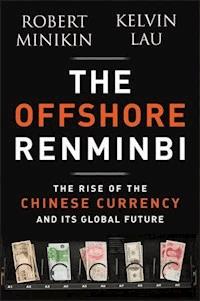
The rise of the renminbi and what it means for forex markets
Chinese authorities have ambitious plans to "internationalize" the renminbi, transforming it from a tightly controlled domestic legal tender into a global currency for international trade, held by both private and public sector asset managers. The Offshore Renminbi examines this impending currency revolution, outlining why the emergence of China as a major economic power will likely soon be matched by a transformation of the renminbi's role in the global financial system. It explains how new markets for "offshore" renminbi are developing outside mainland China since the country is not yet ready to fully open up its economy to international capital flows, and the regulations that govern them.
The potential growth for the renminbi market is vast, thanks to China's role in the global trading community. The early stages of the internationalization effort were small-scale, but momentum has greatly increased over the past 18 months, making this book more relevant than ever. These developments offer new opportunities (and challenges) for corporate treasurers and investors, as China's profound economic success and growing prominence in global trade may transform offshore renminbi into a new global reserve currency and a legitimate competitor to the U.S. dollar.
- Explores how the "internationalization" of the renminbi is likely to yield a new global currency to rival the U.S. dollar
- Examines "offshore" renminbi and the host of new financial markets they have created, from a spot FX market to Dim Sum bonds in Hong Kong
- Covers broad themes of interest to general readers and policymakers, as well as more detailed issues of practical and direct importance to corporate treasurers and investors
The Chinese government has ambitious plans to make the renminbi a global currency. The Offshore Renminbi explains the complexities of this strategy and the dramatic implications for the global FX markets.
Sie lesen das E-Book in den Legimi-Apps auf:
Seitenzahl: 346
Veröffentlichungsjahr: 2012
Ähnliche



















Contents
Foreword
Preface
List of Acronyms and Key Terms
Chapter 1: The New Global Role for the Renminbi
A Longstanding—but Failing—Path
Allowing Renminbi Markets to Flourish
Political Tailwinds for Internationalisation
Challenges and Consolidation Risks
The Renminbi in a Multipolar World
Chapter 2: Linking the Offshore and the Onshore Renminbi Markets
International Transactions in a Domestic Currency
The Starting Point for Renminbi Internationalisation
Investability: Opportunities and Challenges
Timing Convertibility
PBoC and Exchange Rate Policy
The Advantages of the Offshore Renminbi
Chapter 3: The Birth and Evolution of the Offshore Renminbi Market in Hong Kong
A Chronological Look at Key Policy Liberalisations
More on Renminbi Trade Settlement in the Post–Big Bang Era
From Renminbi Trade Settlement to Offshore Renminbi Deposits
Chapter 4: New Markets—New Jargon, New Opportunities
The Chinese Yuan in FX Spot
A New Diversity of Forward Markets
Opportunities in the CNH Markets
Tracking Returns in CNH Deposits
The Dim Sum Bond Market Matures
Chapter 5: Geographical Expansion of the Offshore Renminbi Universe
From Hong Kong to Haiwai through Trade
Renminbi in London and the Hub-and-Spokes Model
Direct Renminbi Cooperation with Mainland China
Shanghai’s Aspiration and Infrastructure Overhaul
Hong Kong Is Still in Pole Position
Chapter 6: Drivers for Internationalisation
Public Policy: “Replacing” USD
Economics: China’s Role in the Global Economy
For Investors: Appreciation—but, More Importantly, Diversification
For Corporations: Fairer and More Transparent Pricing
For Official Reserve Managers: A New Route to Stability?
Chapter 7: The Rise of the Renminbi and Its Policy Implications
The Renminbi’s Rise: A Threat to the Hong Kong Dollar?
The Renminbi’s Rise: A Regional FX Anchor
The Renminbi’s Rise: The SDR and the IMF
The Renminbi’s Rise: The US Dollar in a Multipolar World
Afterword: The Life Overseas with the Rising Renminbi
Appendix: The CNH Timeline
Bibliography
About the Authors
Index
Copyright © 2013 by John Wiley & Sons Singapore Pte. Ltd.
Excerpts from “Special Report—The CNH FX, Rates and Dim Sum Bond Markets,” first published 5 October, 2010; “Special Report—The Super-Cycle Report,” first published 15 November 2010; “Special Report—CNH Supports CNY Reserve-ification,” first published 10 January 2011; “The Renminbi Insider—Growing Up,” first published 15 February 2012; “The Renminbi Insider—On the Move,” first published 3 May, 2012; © Standard Chartered Bank (Hong Kong) Limited, 2010, 2011, 2012. Reprinted with permission.
Published by John Wiley & Sons Singapore Pte. Ltd.
1 Fusionopolis Walk, #07-01, Solaris South Tower, Singapore 138628
All rights reserved.
No part of this publication may be reproduced, stored in a retrieval system, or transmitted in any form or by any means, electronic, mechanical, photocopying, recording, scanning, or otherwise, except as expressly permitted by law, without either the prior written permission of the Publisher, or authorization through payment of the appropriate photocopy fee to the Copyright Clearance Center. Requests for permission should be addressed to the Publisher, John Wiley & Sons Singapore Pte. Ltd., 1 Fusionopolis Walk, #07-01, Solaris South Tower, Singapore 138628, tel: 65–6643–8000, fax: 65–6643–8008, e-mail: [email protected].
Limit of Liability/Disclaimer of Warranty: While the publisher and author have used their best efforts in preparing this book, they make no representations or warranties with respect to the accuracy or completeness of the contents of this book and specifically disclaim any implied warranties of merchantability or fitness for a particular purpose. No warranty may be created or extended by sales representatives or written sales materials. The advice and strategies contained herein may not be suitable for your situation. You should consult with a professional where appropriate. Neither the publisher nor the author shall be liable for any damages arising herefrom.
Other Wiley Editorial Offices
John Wiley & Sons, 111 River Street, Hoboken, NJ 07030, USA
John Wiley & Sons, The Atrium, Southern Gate, Chichester, West Sussex, P019 8SQ, United Kingdom
John Wiley & Sons (Canada) Ltd., 5353 Dundas Street West, Suite 400, Toronto, Ontario, M9B 6HB, Canada
John Wiley & Sons Australia Ltd., 42 McDougall Street, Milton, Queensland 4064, Australia
Wiley-VCH, Boschstrasse 12, D-69469 Weinheim, Germany
ISBN 978-1-118-33925-1 (Cloth)
ISBN 978-1-118-33926-8 (ePDF)
ISBN 978-1-118-33927-5 (Mobi)
ISBN 978-1-118-33928-2 (ePub)
Foreword
Talk about being in the right place at the right time. Right at the eye of a building storm; the epicenter of a currency’s ascension. And to be a ripple maker.
Having been in the financial industry for over 25 years spanning different continents, watching from close range the renminbi’s internationalisation foray—and Hong Kong’s transformation into an offshore renminbi financial centre—has to be one of the most exciting watershed developments. My colleagues and I have had the privilege to be at the heart of all these actions, not only as witnesses but also as contributors, each playing an active role in facilitating and shaping the global ascent of the Chinese currency. It could be as small as ensuring that a customer gets the needed renminbi to settle a cross-border payment; educating a local exporter on the benefits of invoicing in the Chinese currency; or advising a multinational corporate on ways to raise Dim Sum funds and repatriating them into the mainland. It may also entail working with on- and offshore authorities on broadening and deepening the offshore renminbi market, designing and integrating settlement platforms, and developing new products.
The whole experience of helping the offshore renminbi market develop is both fascinating and humbling. It has been fascinating seeing how smoothly the renminbi, through successive policy liberalisations and its seamless fusion with offshore market forces, has gradually eased into its new but certainly more natural form—a currency with a status that better matches China’s growing economic importance. And then there is the eye-popping pace of growth in the various markets, be it the rise in renminbi trade settlement volume to more than 10 percent of total China trade in Q1–2012 or the CNY 190 billion worth of total issuance of Dim Sum bonds in Hong Kong in 2011.
One can also be easily humbled by the renminbi’s transformative power on the global business and market landscape. Longstanding market practices are being challenged—for example, multinational corporates are starting to move away from USD-invoicing, while more and more central banks around the world are beginning to allocate a small part of their reserve holdings to the renminbi. The redenomination of commodities into renminbi could well be the next big wave transforming the international trade and financial ecosystem. On a more local scale, Hong Kong is finding its monetary conditions increasingly influenced by onshore lending cycles, and its deposit base steadily shifting toward a greater mix of renminbi.
Reading this book on the rise of offshore renminbi authored by my colleagues Kelvin and Robert, one could get a strong sense that the powerful forces allowing renminbi internationalisation to flourish are converging. An assortment of economic, financial, and policy tailwinds are set to carry the renminbi to further places beyond Hong Kong, into the hands of corporate treasurers, sovereigns, institutional investors, and households. These forces, as they gather pace, will help the offshore renminbi market ride through any inevitable bumps uncovered along the way.
The timing of Beijing pursuing renminbi internationalisation, in particular, seems impeccable. With the world still reeling from the financial crisis in the West, the search is on for the next major currency that is international, influential, and dependable. The prevailing crisis is set to bring about structural changes that could be game-changing. For many, this presents a once-in-a-lifetime opportunity. Acting as a catalyst, the crisis has accelerated the shift of economic power from the West to the East, with the latter being led by China, placing it under the spotlight as an increasingly important growth engine of the world economy for years if not decades to come. To duly perform this role, China must transform to a more sustainable and domestic-oriented growth model. The continued orderly opening up of its capital account and the internationalisation of its currency are, in the eyes of Beijing, crucial parts to this grand scheme.
Hong Kong has been the right place for renminbi to gain an initial footing offshore. For decades, Hong Kong has been a conduit connecting the mainland with the rest of the world—via trade, investment flows, and effective financial solutions. Not only is Hong Kong already equipped with a full package of financial hardware and software, but it is also designated by Beijing as the offshore renminbi center. It acts as both a testing ground and a firewall. Hong Kong has a unique role to play—to support China as it liberalises its currency in an orderly but well-paced manner, and to help shape such development through free-market forces. Hong Kong, in turn, stands to benefit from the enormous opportunities brought about by the process.
I am very delighted that Robert and Kelvin have taken on this initiative to author a book dedicated to the offshore renminbi. They are among the best in town on this research area, and are certainly most qualified to write about this new chapter of global currency development. Their hands-on experience spanning both the early and rampant years of offshore market development, together with their complementary areas of expertise in macroeconomics, currency, and market-oriented dynamics, make this one of the most comprehensive and authoritative books you will find out there. And the ripples have just begun.
Benjamin Hung
Chief Executive Officer
Standard Chartered Bank (Hong Kong) Ltd.
Preface
The Hong Kong trams are a longstanding and much-loved part of the territory’s street-scene. For over a hundred years they have made stately progress across Hong Kong Island even as the shacks around them have been torn down, replaced by low-rise buildings and finally gleaming towers. The trams themselves are not much changed since their introduction, although today they often sport vivid advertising livery. As we draw together the contents of this book in July 2012, a bright blue and green tram wends its way through the Hong Kong streets, not advertising high-end luxury brands or financial services (which is typical) but touting an unusual message. It congratulates China’s Ministry of Finance on the latest successful sale of its renminbi government bonds in Hong Kong. The regular, annual sales of Chinese government bonds are fast developing into a familiar feature of the landscape of the new “offshore renminbi” financial markets—those that use the Chinese currency outside of mainland China itself.
The enthusiasm of Hong Kong for the development of this new market should not be seen as surprising. It cements the city’s status as a major global financial centre and gives it a key role as a conduit between the mainland and the rest of the global financial system. However, in writing this book we want to give an overview of the issue that explains the importance of the development not just for Greater China and Asia but also the global economy. The tram’s advertising highlights an important step in the development of the renminbi bond market in the Hong Kong market—what has become known as the Dim Sum bond market. But in this book we outline how the new “offshore renminbi” is the basis for a much broader range of flourishing new financial markets that are of value to corporate treasurers, asset managers and individual investors. Finally, we briefly assess the public policy implications of the renminbi’s new global role as the global financial architecture is redrawn in response to profound shifts in the global economic balance of power. Will all of the trams in San Francisco soon be congratulating China’s Ministry of Finance on the sale of its renminbi bonds on the West Coast of the United States?
This book is, to a large extent, a response to the vast diversity of questions we have been asked since the acceleration of the pace of renminbi reforms in July 2010. We have travelled globally and spoken to a wide range of audiences as we outlined the developments in renminbi internationalisation. Working within research at the oldest note-issuing bank in Hong Kong, we have been well-placed to track the institutional reforms (not all of which have been announced to the media), to track the resulting shifts in transaction flows and analyse relative value opportunities in the new markets. It has been particularly exciting to watch entirely new financial markets spring into life. When we1 forecast the level that a major foreign exchange crosses (such as USD-CNY) in the future, then often our first reference point is simply where it closed yesterday. We assess how the incoming news will drive changes in the exchange rate. When new offshore renminbi markets opened (such as USD-CNH spot and forwards) there was simply no “yesterday” as a point of comparison. This proved a particularly challenging environment for analysts—and market makers at their trading desks.
Also exciting has been the opportunity to name the entirely new markets. Although economic data releases and market pricing are often transitory developments, this has given us the opportunity to make a more permanent mark on the financial markets. Here we2 have had an important initial success, dubbing the renminbi bond market in Hong Kong the Dim Sum bond market.
The name was, in fact, voted by a committee of sorts—on September 14, 2010—at a half-day seminar hosted by Standard Chartered where 170-odd corporate clients were asked to help name the new offshore renminbi bond market. They were given two choices: Dim Sum and Kung Fu. The former won, as we all know by now, but it was also a lopsided win. The name was first used in a publication on September 22, 2010, by Standard Chartered Global Research, a report appropriately titled “Adding Dim Sum to the Menu.” With additional help from some timely media reporting, the name went viral and global. The rest, as they say, is history.
But why “Dim Sum” to begin with? It came from a brainstorming session in preparation for the aforementioned seminar. Among the dozen of names long-listed, research-nominated Dim Sum was an instant favourite, as it encompasses all the key qualities of this new offshore renminbi bond market, then exclusively available in Hong Kong. Dim Sum’s Cantonese root in southern China is the perfect representation of the “renminbi in Hong Kong” concept. It is a unique culinary art form that comes with a great variety of shapes and sizes. Because of its usually bite-sized portion, we have over the years come across other interpretations of the namesake that have to do with its perceptive small issuance sizes (at its initial stage of development).
Issuance of Dim Sum bonds has since extended beyond Hong Kong, and the name has followed, much as one often finds dim sum on Chinatown menus globally. The name CNH—which originated from “CNY deliverable in Hong Kong”—is now similarly due for a timely redefinition. First proposed by the Bank’s transaction banking colleagues, we at research have pioneered a change in what the H stands for in “CNH,” from “Hong Kong” to Haiwai (meaning “overseas” in Chinese), to better reflect the true nature of the market that is becoming more and more international. Hopefully, this book will play some role in educating a broader, global audience on the new offshore renminbi markets, accelerating CNH’s transformation in becoming truly Haiwai.
We would like to thank those who have helped us think about this topic and prepare the book. Within Global Research at Standard Chartered Bank, we extend our thanks to Callum Henderson, Eddie Cheung, Li Wei, Nicolas Kwan, Sandeep Tharian, Shen Lan, Stephen Green, Thomas Harr, and Will Oswald. More widely within the bank, we extend our thanks to Ben Hung, Bethy Tam, Boey Wong, Charles Feng, Frankie Au, Joe Ng, Michael Vrontamitis, Rita Liu, Tee Choon Hong, Tony Yang, and Yan Chan. We would also like to thank Standard Chartered Bank for permission to reproduce copyrighted material. All royalties from the book will go to Seeing Is Believing, the charity devoted to tackling avoidable blindness.
Kelvin Lau and Robert Minikin
21 July 2012
1More specifically, Robert Minikin.
2More specifically, Kelvin Lau.
List of Acronyms and Key Terms
A
ASEAN Association of Southeast Asian Nations—regional co-operation organisation
ASEAN plus Three ASEAN plus China, Japan, and South Korea
B
The Basic Law Outlines key elements of the Hong Kong SAR administration and its way of life over the first fifty years following the colonial handover
Basis swap Cost of accessing funding over and above pure interest rate differentials (reflects balance sheet constraints)
BSAs Bilateral swap arrangements—agreement between overseas central banks and PBoC that provides backstop offshore renminbi liquidity
BOCHK Bank of China (Hong Kong)—“The Clearing Bank” in Hong Kong
C
CBRC China Banking Regulatory Commission—supervisor and regulator for China’s banks
CCS Cross Currency Swap—cost of swapping funding in one currency for that of another, over and above the pure interest rate differentials between the two currencies
CEPA Closer Economic Partnership Arrangement—agreement to promote mainland China and Hong Kong economic linkages
CGB China government bonds
Chiang Mai Initiative Network of bilateral swap arrangements providing finance for ASEAN plus Three economies
CFETS China Foreign Exchange Trading System
“The Clearing Bank” in Hong Kong Offers general offshore renminbi settlement and clearing services in Hong Kong alongside facilities for netting out of FX positions
Lesen Sie weiter in der vollständigen Ausgabe!
Lesen Sie weiter in der vollständigen Ausgabe!
Lesen Sie weiter in der vollständigen Ausgabe!
Lesen Sie weiter in der vollständigen Ausgabe!
Lesen Sie weiter in der vollständigen Ausgabe!
Lesen Sie weiter in der vollständigen Ausgabe!
Lesen Sie weiter in der vollständigen Ausgabe!
Lesen Sie weiter in der vollständigen Ausgabe!
Lesen Sie weiter in der vollständigen Ausgabe!
Lesen Sie weiter in der vollständigen Ausgabe!
Lesen Sie weiter in der vollständigen Ausgabe!
Lesen Sie weiter in der vollständigen Ausgabe!




