


81,99 €
Mehr erfahren.
- Herausgeber: John Wiley & Sons
- Kategorie: Geisteswissenschaft
- Sprache: Englisch
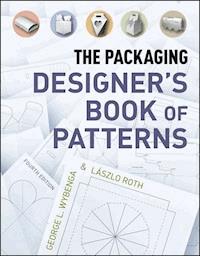
The essential packaging design resource, now with more patterns than ever!
For more than two decades, The Packaging Designer's Book of Patterns has served as an indispensable source of ideas and practical solutions for a wide range of packaging design challenges.
This Fourth Edition offers more than 600 patterns and structural designs—more than any other book—all drawn to scale and ready to be traced, scanned, or photocopied. Online access to the patterns in digital format allows readers to immediately use any pattern in the most common software programs, including Adobe Photoshop and Illustrator. Every pattern has been test-constructed to verify dimensional accuracy. The patterns can be scaled to suit particular specifications—many are easily converted to alternate uses—and most details are easily customizable. Features of this Fourth Edition include:
- More than 55 new patterns added to this edition—over 600 patterns in all
- A broad array of patterns for folding cartons, trays, tubes, sleeves, wraps, folders, rigid boxes, corrugated containers, and point-of-purchase displays
- Proven, scalable patterns that save hours of research and trial-and-error design
- Packaging patterns that are based on the use of 100% recyclable materials
- Includes access to a password protected website that contains all 600+ patterns in digital form for immediate use
Comprehensive and up to date, The Packaging Designer's Book of Patterns, Fourth Edition enables packaging, display, and graphic designers and students to achieve project-specific design objectives with precision and confidence.
Sie lesen das E-Book in den Legimi-Apps auf:
Seitenzahl: 115
Veröffentlichungsjahr: 2012
Ähnliche




















Contents
Cover
Title Page
Copyright
Preface to the Fourth Edition
Foreword
Alphabetical List of Patterns
1: Introduction
MODERN PAPERMAKING
PRINTING, FINISHING, AND DIE-CUTTING
2: The Folding Carton
HISTORY OF THE FOLDING CARTON
THE TRAY-STYLE CARTON
THE TUBE-STYLE CARTON
COSMETICS, PHARMACEUTICALS, AND PROMOTIONAL PACKAGING
UNUSUAL APPROACHES TO CARTON AND BOX CONSTRUCTION
Trays
Tubes
Sleeves, Wraps and Folders
3: The Set-Up or Rigid Paper Box
4: Corrugated Containers
THE STRUCTURE OF CORRUGATED BOARD
DESIGNING A CORRUGATED BOX
PRINTING ON CORRUGATED BOARD
5: Point-of-Purchase Displays
Glossary
Bibliography
Index
Cover image: Background © sgame/iStockphoto; top images © courtesy of the author
Cover design: Michael Rutkowski
This book is printed on acid-free paper.
Copyright © 2013 by John Wiley & Sons, Inc. All rights reserved.
Published by John Wiley & Sons, Inc., Hoboken, New Jersey.
Published simultaneously in Canada.
No part of this publication may be reproduced, stored in a retrieval system, or transmitted in any form or by any means, electronic, mechanical, photocopying, recording, scanning, or otherwise, except as permitted under Section 107 or 108 of the 1976 United States Copyright Act, without either the prior written permission of the Publisher, or authorization through payment of the appropriate per-copy fee to the Copyright Clearance Center, Inc., 222 Rosewood Drive, Danvers, MA 01923, 978-750-8400, fax 978-646-8600, or on the web at www.copyright.com. Requests to the Publisher for permission should be addressed to the Permissions Department, John Wiley & Sons, Inc., 111 River Street, Hoboken, NJ 07030, 201-748-6011, fax 201-748-6008, or online at http://www.wiley.com/go/permissions.
Limit of Liability/Disclaimer of Warranty: While the publisher and author have used their best efforts in preparing this book, they make no representations or warranties with the respect to the accuracy or completeness of the contents of this book and specifically disclaim any implied warranties of merchantability or fitness for a particular purpose. No warranty may be created or extended by sales representatives or written sales materials. The advice and strategies contained herein may not be suitable for your situation. You should consult with a professional where appropriate. Neither the publisher nor the author shall be liable for damages arising herefrom.
For general information on our other products and services, or technical support, please contact our Customer Care Department within the United States at 800-762-2974, outside the United States at 317-572-3993 or fax 317-572-4002.
Wiley publishes in a variety of print and electronic formats and by print-on-demand. Some material included with standard print versions of this book may not be included in e-books or in print-on-demand. If this book refers to media such as a CD or DVD that is not included in the version you purchased, you may download this material at http://booksupport.wiley.com.
For more information about Wiley products, visit our Web site at http://www.wiley.com.
Library of Congress Cataloging-in-Publication Data:
The packaging designer's book of patterns / George L. Wybenga, Lászlo Roth. - Fourth Edition. pages cm Includes bibliographical references and index. ISBN 978-1-118-13415-3 (pbk.); 978-1-118-40830-8 (ebk.); 978-1-118-40831-5 (ebk.); 978-1-118-41908-3 (ebk.); 978-1-118-42084-3 (ebk.); 978-1-118-42630-2 (ebk.) 1. Packaging-Design. 2. Paperboard. I. Roth, Lászlo. TS195.4.R683 2012 688.8–dc23
2012015489
Preface to the Fourth Edition
When originally published in 1991, this book was the first definitive collection of patterns and structural designs for paperboard packaging, point-of-purchase displays, and other three-dimensional graphic products. That first edition contained over 450 patterns and structural designs that were intended to be adapted for packaging.
This fourth edition continues to be the most definitive collection of patterns available, but it now contains well over 600 patterns. The designer may choose among hundreds of alternative carton and box structures, which may be used as they are, modified, or adapted to create exciting new structures. The patterns are accompanied by a description of the historical and technical origins of the materials and methods used. Special attention is given to computer-aided design as an engineering tool that offers new insights into carton and box design and manufacturing.
Paperboard packaging has a profound impact on the global economy. In 2011, the global paper packaging market was estimated to be worth $236 billion. The increasingly consumer driven market will continue to grow globally, especially in North America, China, and India as eco-friendly solutions, technological improvements, and improving paper barrier properties continue to gain greater consumer acceptance.
The packaging materials industry serves every major retail environment. If it is to continue to thrive, it must also continue to be creative and innovative. It must be market oriented and must continually supply new methodologies and new solutions to environmental problems. Along with sensitivity to environmental problems, creativity should be the designer's most important consideration. This workbook may be used not only as a reference for structural design but also as a source of exercises in learning to stimulate creative skills. The cartons shown in this book are designed to depict generic styles whenever possible. Each illustration is accompanied by the name that is commonly used to describe the style.
Some of the packages currently in use are patented or have patent-protected features for use on proprietary packaging machinery. Where appropriate, patented features are indicated. The reader is advised that patented features are protected by patent law and may not be used in practice without the express permission of the patent holder. For information about patents, contact the U.S. Patent Office.
Readers can access digital versions of all patterns by visiting www.wiley.com/go/packagingpatterns and entering the username DieLine58 and the password Jetty433 (both case sensitive).
Foreword
The Packaging Designer's Book of Patterns has been the reference guide for students and faculty in the Packaging Design Department at The Fashion Institute of Technology since the first edition. In fact, there are few professional resources that have been as valuable an asset as this book. There are multiple copies floating around a classroom on any given day, students search out copies when they did not bring their own to school, faculty regularly refer to the content of each revised edition as they guide students through the design process, alumni treasure their book as the go-to resource and design professionals across the globe look forward to each revised edition with the latest patterns.
Packaging design is a complex endeavor. While effective packaging design includes color, typography, and graphics, structure is among the most essential and influential components. The structure in the final produced design can ultimately lead to a products marketing success. In fact, research has proven that a packaging's structure is one of the most influential factors in attracting a consumer and creating brand recognition. The most effective structures are designed to satisfy many prerequisites including security, protection, compatibility with other structures within a system, ability to identify the brand, adaptability to the retail environment, and in-use and storage requirements.
The desire to satisfy the complex structural design goals of a packaging assignment is influenced by many factors and choices made by designers. The packaging structure's pattern and the proven ability for that pattern to be produced and reproduced are critically important. With the hundreds of patterns that can serve as the framework for the packaging's structure, the choices for a designer can be overwhelming and endless. Many patterns are intricate, complicated, or unusual. Even the structures that appear to be the simplest layout can be challenging for a designer to visualize, assemble or construct. Skills such as precision and attention to detail are among those required in recreating the patterns for a packaging structure.
This book, therefore, with the most up-to-date, highest quality, innovative, comprehensive and proven patterns enables packaging designers to achieve their project specific design objectives with precision. George Wybenga's research into every possible paperboard structure used in packaging design, along with his ability to deconstruct and recreate these structures into usable patterns, saves designers and their clients thousands of hours in research and labor. These patterns enable designers to create packaging designs–and ultimately serve their clients' needs–with confidence. Since the patterns detailed throughout are easily created using paperboard–when designed appropriately–this book supports the sustainable goals that should be at the core of any packaging design project.
Marianne Rosner Klimchuk Associate Chairperson Packaging Design Department Fashion Institute of Technology
Alphabetical List of Patterns
Trays
Anchor Lock Tray
Arthur Lock or Jones Lock Tray
Beers-Style Tray with Raised End Panels
Closable Simplex-Style Tray
Corner Lock Tray with Tear-Away Features on Lid Sides and Front
Corner Lock Tray with Top Labeling Flaps
Dispenser Pack
Double End Wall, Single Side Wall Tray
Double Lock Tray
Double Side Wall and Double Bottom Tray
Double-Wall Tray with Double-Wall Lid
Double-Walled Octagon Style Tray with Foot Locks
Fold-Over Cover
Foot-Lock Double Wall Tray
Four-Corner Beers-Style Tray - Infold/Outfold
Four-Corner Brightwood-Style Tray-Infold/Outfold
Four-Corner, Beers-Style Tray
Frame View Tray (Variation 1)
Frame View Tray (Variation 2)
Frame View Tray (Variation 3)
Frame View Tray (Variation 4)
Frame View Tray with Cover and Lock Tab
Frame View Tray with Doubled Cover
Frame View Tray with Insert
Frame View Tray with Lid with Lock Tabs
Full Telescoping Tray with Lock Corners
Glue Corner Tapered Tray
Glue or Heat-Sealed Tapered Tray with Flange
Glued Corner Tapered with Top-Lock Tab
Glued-up Tray with Protective End Panels and Tapered Side Panels
Hexagon-Style Tray
Ice Cream Carton
Kliklok® “Charlotte” Stripper Lock Tray with Hinged Cover and Anchor Lock and Side Locks
Klikweb-Style Tray
Lesen Sie weiter in der vollständigen Ausgabe!
Lesen Sie weiter in der vollständigen Ausgabe!
Lesen Sie weiter in der vollständigen Ausgabe!
Lesen Sie weiter in der vollständigen Ausgabe!
Lesen Sie weiter in der vollständigen Ausgabe!
Lesen Sie weiter in der vollständigen Ausgabe!
Lesen Sie weiter in der vollständigen Ausgabe!
Lesen Sie weiter in der vollständigen Ausgabe!
Lesen Sie weiter in der vollständigen Ausgabe!
Lesen Sie weiter in der vollständigen Ausgabe!
Lesen Sie weiter in der vollständigen Ausgabe!
Lesen Sie weiter in der vollständigen Ausgabe!
Lesen Sie weiter in der vollständigen Ausgabe!
Lesen Sie weiter in der vollständigen Ausgabe!
Lesen Sie weiter in der vollständigen Ausgabe!
Lesen Sie weiter in der vollständigen Ausgabe!
Lesen Sie weiter in der vollständigen Ausgabe!
Lesen Sie weiter in der vollständigen Ausgabe!
Lesen Sie weiter in der vollständigen Ausgabe!
Lesen Sie weiter in der vollständigen Ausgabe!




