


24,99 €
Mehr erfahren.
- Herausgeber: Thieme
- Kategorie: Fachliteratur
- Sprache: Englisch
Profit from a wealth of experience in interactions with your patients!
The Patient-Practitioner Relationship in Acupuncture is written for acupuncturists and practitioners in the fields of alternative medicine searching for:
- effective ways of connecting better with their patients in all their diversity, and
- the skills necessary to guide patients through emotional, psychological, and spiritual difficulties as part of the healing process.
Dr. Hammer bases his work on the universally accepted and fundamental role the therapeutic relationship plays in the practitioner's ability to heal and his lifelong observation that both the patient and the practitioner benefit from this vital relationship.
Drawing from his long and extensive personal and professional experiences and writing in an easily understandable and at times anecdotal style, the author avoids psychological jargon as much as possible. The material is presented independent to pathology and is organized into two parts: The first part outlines the basic tenets of the therapeutic relationship, and the second, main part presents individual, issue-oriented chapters addressing the varied life situations, personalities, and emotional reactions with which the acupuncturist or practitioner is confronted in everyday practice.
Let this handy reference become your constant and reliable companion on your path to:
- enhancing your propensity and innate talents to heal,
- improving your therapeutic skills within the scope of your practice, and
- gaining confidence in your interactions with your patients.
Das E-Book können Sie in Legimi-Apps oder einer beliebigen App lesen, die das folgende Format unterstützen:
Seitenzahl: 194
Veröffentlichungsjahr: 2008
Ähnliche



















To Paul Hammer, my beloved son
Library of Congress Cataloging-in-Publication Data is available from the publisher.
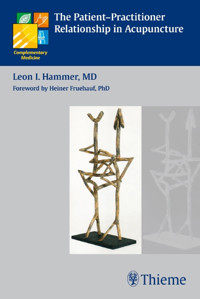
Artist: Jaqueline Bühler, Basel, [email protected]: “Von einem zum andern”(From one to the other)p. 5: “Die Unzertrennlichen” (Inseparable)p. 83: “Harmonisches Paar”(Harmonious couple)
© 2009 Georg Thieme Verlag,Rüdigerstrasse 14, 70469 Stuttgart,Germanyhttp://www.thieme.de
Thieme New York, 333 Seventh Avenue,New York, NY 10 001, USAhttp://www.thieme.com
Cover design: Thieme Publishing GroupTypesetting by Ziegler + Müller,text form files, Kirchentellinsfurt, GermanyPrinted in Germany by Offizin AndersenNexö Leipzig GmbH, Zwenkau
ISBN 978-3-13-148841-1 1 2 3 4 5 6
Important note: Medicine is an ever-changing science undergoing continual development. Research and clinical experience are continually expanding our knowledge, in particular our knowledge of proper treatment and drug therapy. Insofar as this book mentions any dosage or application, readers may rest assured that the authors, editors, and publishers have made every effort to ensure that such references are in accordance with the state of knowledge at the time of production of the book.
Nevertheless, this does not involve, imply, or express any guarantee or responsibility on the part of the publishers in respect to any dosage instructions and forms of applications stated in the book. Every user is requested to examine carefully the manufacturers’ leaflets accompanying each drug and to check, if necessary in consultation with a physician or specialist, whether the dosage schedules mentioned therein or the contraindications stated by the manufacturers differ from the statements made in the present book. Such examination is particularly important with drugs that are either rarely used or have been newly released on the market. Every dosage schedule or every form of application used is entirely at the user's own risk and responsibility. The authors and publishers request every user to report to the publishers any discrepancies or inaccuracies noticed. If errors in this work are found after publication, errata will be posted at www.thieme.com on the product description page.
Some of the product names, patents, and registered designs referred to in this book are in fact registered trademarks or proprietary names even though specific reference to this fact is not always made in the text. Therefore, the appearance of a name without designation as proprietary is not to be construed as a representation by the publisher that it is in the public domain.
This book, including all parts thereof, is legally protected by copyright. Any use, exploitation, or commercialization outside the narrow limits set by copyright legislation, without the publisher's consent, is illegal and liable to prosecution. This applies in particular to photostat reproduction, copying, mimeographing or duplication of any kind, translating, preparation of microfilms, and electronic data processing and storage.
Foreword
The sage healers of ancient times were able to heal the heart of humanity, and thus prevent disease from arising. Today s doctors only know how to treat disease when it has already manifested in physical form, and don t know anymore how to work with the heart. This situation can be compared to the process of pruning tree branches while neglecting the tap root, or to working downstream without awareness of the properties of the wellspring. Is this not an ignorant way to go about the business of medicine? If you wish to bring about real healing, you must first and foremost treat a person s heart. You must bring the heart on the right path, so that it can be filled and sustained by a universal sense of truth. You must get it to a place where it can safely abandon all doubting and worrying and obsessing in senselessly looping patterns, where it can let go of any anxiety provoking imbalances, and where it is willing to surrender all “me, me, me” and all “this is his/her fault!” Try and awaken the heart to acknowledge and regret all the wrong that one has done, to lay down all selfish attachments, and to transform one s small and self-centered world for the glorious universe wherein we are all one, and wherein there is nothing to do but praise its existence. This is the master method of the enlightened physician—healing through the heart. Or, in different words from the ancient record: the enlightened doctor intervenes before physical disease manifests, while the average physician springs into action only after disease has become apparent. To treat before this stage, this is the terrain of healing the core—the heart; to treat afterwards, this is the realm of dietary therapy, herbal therapy, acupuncture, and moxibustion. Although there are these two types of therapeutic paths, there is really only one core law of healing: All disease comes from the heart.
Thus the 16th century Korean master physician Hur Jun synthesizes a lifetime of clinical insight on the importance of treating the heart in Dongyi baojian(Precious Reflections by an Eastern Physician). I can think of no better quotation to introduce this modest yet vitally essential volume by Leon Hammer.
Today as during the time of Hur Jun, the profession of Chinese medicine has become a technique-oriented métier. Dr. Hammer's book on the client–practitioner relationship in acupuncture, therefore, may strike us as the personal musings of an accomplished psychiatrist turned Chinese medicine practitioner that are not directly related to the mainstream of our field. Nothing could be further from the truth. As with his classic publications on Chinese medicine psychology and pulse diagnosis, The Patient–Practitioner Relationship in Acupuncture is the work of a seasoned clinician who transmits with great urgency and trademark humility the virtues, skills and attitudes that are indispensable for any genuine engagement with the timeless art of Chinese medicine.
While Dr. Hammer has repeatedly demonstrated his generosity to younger generations of Chinese medicine practitioners by relating his clinical knowledge and experience in prolific detail, this volume exhibits more of a zen-like quality. The reader finds a booklet by a wise and compassionate physician who describes with great clarity and simplicity the essentials of his craft, in this case the sacred space of the client–practitioner interaction. Wu Tang, the 18th century compiler of Fever School therapeutics, once wrote of this essence in the preface of his landmark Wenbing tiaobian (Systematic Differentiation of Warm Diseases): “Medicine is the way of compassion–led by wisdom and humility, assisted by courage, and completed by compassion.” By transmitting and palpably modeling to us the unassuming quality of a traditional Chinese medicine saint, Leon Hammer reminds all of us of the deep commitment that brought us to this profession in the first place—the desire to care for others, in the most whole and complete way possible. For me, this book represents an authentic echo of Sun Simiao's 7th century description of the great physician (Dayi jingcheng):
The great physician serves to live in harmony with nature, and teaches his patients to do the same. He will stay calm and completely committed when treating disease. He will not give way to personal wishes and desires, but above all else hold and nurture a deep feeling of compassion. He will be devoted to the task of saving the sacred spark of life in every creature that still carries it. He will strive to maintain a clear mind and be willing to hold himself to the highest standards. He will consider it to be his sacred mandate to diagnose sufferings and treat disease. He will not be boastful about his skills and not driven by the greed for material things. Above all, he will keep an open heart. As he moves on the right path, he will receive great happiness as a reward without asking for anything in return.
Heiner Fruehauf, PhDFounding ProfessorSchool of Classical Chinese MedicineNational College of Natural MedicinePortland, Oregon
Preface
This book for acupuncturists on the therapeutic relationship is not focused on pathology; only on the issues we encounter with other human beings, none of whom is without some part of themselves that is a problem to them as well as to others.
Acupuncturists may question the need to read a work on the therapeutic relationship. After all, by law they are only required to make a Chinese Medicine diagnosis, prescribe herbs, and place the needles in appropriate acupuncture points. This is their legal “scope of practice.” The “Traditional” Chinese Medicine model arising from mainland China discourages encountering people on any platform other than one that involves inserting needles, dispensing herbs, and allied techniques such as massage, exercise, and nutrition. Emotional issues, with rare exceptions, are referred out.
However, acupuncturists work with people, not charts or manikins. And people who work with “energy” have a special obligation to consider all of the implications that enter into the transfers of energy between the specific role of the therapist and the role of the patient.
While the implementation of some of the principles in this book may require at times a referral to a more professionally trained psychologist, the principles themselves are necessary ingredients in the successful encounter between any two human beings. This is especially true if one is “helping” and the other is being “helped.” My goal is not to teach psychotherapy, but to enhance the practitioner's propensity and innate talent to heal.
When practitioners make any form of contact with someone seeking help, they have entered into a therapeutic relationship that inevitably involves all of the contents of this book. Those who think otherwise do so at their own risk, and do so even more at the patient's risk. There is no escape from this reality in the successful practice of this profession.
Leon I. Hammer, MD
Acknowledgments
With regard to the subject of this book I am especially grateful to Augusta Schlesinger, PhD, a courageous 76-year-old woman who made a remarkable metamorphosis from retired housewife to become the founder of the Bureau of Child Guidance in the New York City school system and courts. She was my first therapist from 1946 until her death in 1951. She is the model for the content of this book.
I also owe a deep debt of gratitude to the William A. White Institute of Psychiatry and Psychoanalysis in New York, where I received my psychoanalytic training, and to my teachers Clara Thompson, MD, Gerard Chernowski, MD, Eric Fromm, PhD, Ernst Schactel, PhD, Harry Bone, PhD, Harry Stack Sullivan, MD, Florence Powdermaker, MD, Asya Kadis, PhD, Anina Brandt, PhD, Ana Gourevitch, PhD, and Ralph Crowley, MD.
I am also indebted to Alexander Lowen, MD, John Pierakos, MD (bioenergetics), and to Fritz Perls, MD (gestalt therapy), all of whom I studied with in my post-psychoanalytic training.
For the present I am grateful to Pamela Smith, AP, and Hamilton Rott, AP, who made helpful suggestions; to Candice Nelms who wrote an introductory sheet for the publisher; and to all those who over the years challenged me to answer their questions.
I also wish to acknowledge Jaqueline Buehler, a Swiss artist, for her generosity in contributing her marvelous sculptures for the cover and the section openers of this little book.
I am grateful to Thieme for accepting this book for publication, and most of all I wish to acknowledge Angelika Findgott's sensitive and intelligent guidance in this project, for which I am endlessly grateful. As my editor she made this process a joy, and her creativity turned a rough manuscript into a highly readable and well-organized book. Thank you.
Table of Contents
Introduction
Section I
1 Basic Conditions or Tenets—An Overview
Respect
Boundaries
Readiness for Change
Expectations
Values
2 Conditions for Healing, Growth, and Change
Confronting the Best and the Worst
Confronting the Irrational
Confronting Psychic Pain: Negative and Positive
Taking a Risk
Action and Tough Love
Revision of Early Trauma through Positive New Experience
3 The Practitioner's Role
Significance
A Model
Physician Know Thyself
Winning–Losing: The Power Struggle
The Therapeutic Failure and Resolution
4 Issues Relevant to Any Therapeutic Relationship
The Contract
Contact
Interaction and Communication
Instructions (Essential Qualities)
Alternatives
Separation and Termination
5 Conclusion
Section II—Questions and Answers
Betrayal and Attachment: What Can Practitioners Do When a Patient Resists Treatment that is Working?
How Should Practitioners Talk to Patients about Psychological Problems and Processes in the Context of CM Thinking and Treatment?
How Can Practitioners Guide and/or Support Patients through Psychological Events and Challenges?
How Can Practitioners Recognize and Deal with a Situation that is Beyond Their Knowledge or Capacity to Handle and Requires Assistance and Referral to Other Health Care Providers Including Hospitalization?
How Can Practitioners Deal Constructively With a Patient's Distrust, Skepticism, Disappointment, Criticism, and Anger Directed at Them?
How Should Practitioners Handle the Cessation of Treatment and/or Relationship?
How Should Practitioners Cope with “Difficult” Patients?
How Should Practitioners Handle Issues of Money and Missing Appointments?
How Can Practitioners Handle Inappropriate Sexual Approaches by Patients?
How Should Practitioners Handle Friendship with Patients In and Out of the Clinical Setting?
How Should Practitioners Handle Patients Who Put Them on a Pedestal?
How Should Practitioners Deal with People Who Are Insufficient in Specific Life Functions, Which in Themselves Will Create Further Emotional Problems?
How Can Practitioners Provide Nourishment to People Who Lacked it Early in Life?
How Should Practitioners Respond to Issues of Transference and Counter-transference
How Can Practitioners Extract the Essential or Correct from the Less Important or Incorrect?
How Can Practitioners Extract the Positive from What Seems Negative—Native Brilliance, or a Skill Acquired?
Should Practitioners Use Western Counseling Techniques and Approaches, or CM, or Both?
How Can Practitioners Safely Combine Lifestyle Management and CM Diagnosis?
When Should Practitioners Inform Important Others, Spouse, Parents, Relatives, and Other Therapists?
How Should Practitioners Advise Patients Who Are Doing Too Many Things, Seeing Too Many Practitioners?
How Can Practitioners Recognize Who is at Risk?
Epilogue
Notes
References
Index
Introduction
The following book for acupuncturists on the therapeutic relationship is presented with the intention of avoiding psychological jargon as far as possible. Therefore, words such as transference, counter-transference, and resistance are avoided, and the information is offered in everyday language. I will refer to the acupuncturist-therapist as “therapist” or (Chinese Medicine—CM) “practitioner.”
According to the dictionary1 “therapy” is defined as the “remedial treatment of mental or bodily disorder … designed or serving to bring about rehabilitation or social adjustment.” However, therapy also involves a healing interaction with other living beings, for which there are universal precepts for relationships, which are covered in the following chapters.
There is also an inevitable amount of repetition since many subjects such as empathy and intuition overlap. Let us celebrate the lack of rigid organization and the dividend of reiteration as a blessing rather than a curse, since it is with repetition that we learn.
I have organized the book into two sections. The first section covers the basic tenets of a therapeutic relationship independent of context, and is based upon my training and experience as a psychiatrist-psychoanalyst. Having practiced both Chinese Medicine and psychiatry-psychoanalysis, I can categorically assert that the problems encountered in each are essentially the same even if the presentations seem widely different.
The second section of the book applies specifically to issues that confront acupuncturists in particular and is drawn from questions elicited from practitioners and students of acupuncture and from my own experience. In this regard, one necessary stabilizing guide throughout all the emotional maelstroms that an acupuncturist may encounter in the therapeutic relationship is their CM diagnosis and the management intervention. Throughout the often confusing and chaotic presentations that patients may make from appointment to appointment, the one steady and enduring quotient will be the CM formulation, which will include, for example, a diagnosis and plan to address the cause of the chaos that threatens the practitioner's objectivity and the therapy. That operational concept and its application should be the practitioner's central focus while he or she applies all that follows in this book to maintaining a working relationship.
In my work, I have experienced both failures and successes. Looking back, especially on the failures, I can see that I have been blessed with the ability to carry on, for which I take no credit and for which I am eternally grateful. Not all of us are so blessed and it is my good fortune to express that gratitude by trying to help others do the same.
General Remarks About the Therapeutic Relationship
The therapeutic relationship has gained recognition as one ineluctable facet of any program attempting to relieve deeply troubled people of their pain and help them to redirect their lives. It is a sympathetic confrontation; a situation in which two human beings work together to remove, for one of them, a critical impasse in their life. Inevitably, both participants are the beneficiaries of this working relationship.
It is also a means of conserving human life; thus, it follows the humanistic tradition. We offer it in distinct opposition to two other traditional ways of dealing with society's “wounded”: to destroy them, or to ignore them. The latter is, perhaps, the more common way, and as brutal as the first, for nothing, not even hate, is so much the antithesis of love as apathy; nothing so disheartening to the struggling individual.
The therapeutic relationship takes an optimistic view of human beings, cherishes their potential and the innate drive to realize themselves at their best. Theology, psychology, and the healing arts all direct human beings to psycho-spiritual growth.
We all begin life with a series of fantasies that we are compelled to test despite the wisdom of those who would gainfully advise us otherwise. The best you the practitioner can do is evoke and listen to these fantasies. Your gentle responses will be ignored at first, but not forgotten. They will not be discarded until they have been tested in the laboratory of life. That is one reason why the therapeutic relationship may be discontinuous as a patient suffers through one delusion after another, seeking help when each experiment fails and he or she is strong enough to try the next. You cannot stop the process; only become a resourceful part of it.
Furthermore, the patient comes with the expectation that you will make it possible for them to continue the lifestyle that has made them ill without paying the consequences. The ability to make a connection between the presenting problem and a lifestyle is within the scope and skill of the practitioner, and the remainder of this book will help you make it possible. You encounter a person at an impasse, in a vicious conceptual cycle that leads nowhere except to pain, and at each stage the problem must be conceptually reframed to break that cycle and move on to a greater truth. This person wishes only to stay “intact” while they maintain life-giving “contact,” as will be explained in this book and elsewhere.2 In the following chapters are guidelines to forming and maintaining the bond necessary to achieve the goal of providing life-giving “contact,” while breaking the cycle of pain and moving on to a new fulfilling reality.
Section I
Section I
1 Basic Conditions or Tenets—An Overview
Respect
Boundaries
Readiness for Change
Expectations
Values
2 Conditions for Healing, Growth, and Change
Confronting the Best and the Worst
Confronting the Irrational
Confronting Psychic Pain: Negative and Positive
Taking a Risk
Action and Tough Love
Revision of Early Trauma through Positive New Experience
3 The Practitioner's Role
Significance
A Model
Physician Know Thyself
Winning–Losing: The Power Struggle
The Therapeutic Failure and Resolution
4 Issues Relevant to Any Therapeutic Relationship
The Contract
Contact
Interaction and Communication
Instructions (Essential Qualities)
Alternatives
Separation and Termination
5 Conclusion
1 Basic Conditions or Tenets—An Overview
Respect
As we will see below in some detail, respect is the foundation of any successful relationship and foremost in our considerations of a therapeutic relationship. Just as the essence of a therapeutic relationship is contact, so the essence of that contact is the therapist's respect, profound and unequivocal, for the person who depends on them. The mark of a civilized human being, we know, is the respect with which they treat the “weak.” This is because respect is the basis of feelings of worth, self-esteem, and trust. A person who is respected comes to respect him- or herself; and when respect for another person is required from them, they begin to know that they have a place in the world, and to see themselves as part of a whole.
Example
A young woman was raised with the notion that she would stay with her parents until death. Not respected as a growing adult, discouraged from normal social relations, not even conscious of her own need to explore and develop socially, she retreated into a grandiose celestial love affair with Christ (a personal affair whose intimate details she was too embarrassed ever to reveal). At 23, she dressed like a dowager. Her parents built an extension to the house for her to live out her life in relative seclusion. She became increasingly depressed and frightened.
Only when she began treatment and saw that the therapist regarded her with respect as an intelligent, capable, and attractive young woman, did she abandon her grandiose phantom love affair and give up her special tie to Jesus. She was also able to give up the intellectual pretensions that were part of her role as her parents’ ideal little girl. Once accorded proper respect, freed of her parents’ demands, and freed from her compensatory affair with the Lord Jesus, she was able to develop naturally. She abandoned grandiosity, got as job as a waitress, was efficient and charming, and began to lead a life appropriate to her age. She finally left home and associated with people her own age, making a life of her own.
Respect is tested repeatedly, in life and in the therapeutic situation by people who we either do not like or who antagonize us. Some people have a talent for arousing hostility by their words or actions, by their lack of consideration or thoughtlessness. How do we deal with these people? In life we have the option of avoiding these people, and in therapy we have the option of referring them to others when we fail to retain respect, despite all efforts to separate the offensive aspects of their being from those we can gainfully work with.
First, we must admit to ourselves and allow ourselves the full range of our negative reactions, and if necessary we must share them with others—colleagues and supervisors—a subject that we will discuss in more detail later (and always mindful of confidentiality). After venting one's anger to oneself and others we must identify the offending behavior to the “patient” in the context of the positive aspects of his or her being.
Example
A patient repeatedly made inappropriate remarks to teachers, peers, and to his acupuncturist, offending everyone. He seemed to know the exact thing to do or say at the moment when it could do the greatest damage and arouse the greatest response.
This obviously lonely person was able to obtain attention as a child by irritating his parents, who otherwise ignored him. Maintaining “contact” with significant others is a basic requirement for survival when one is most vulnerable. In order to stay “intact,” he resorted to a strategy that achieved contact and attention at home, but that did not work outside his family circle.




