


30,99 €
Mehr erfahren.
- Herausgeber: John Wiley & Sons
- Kategorie: Fachliteratur
- Sprache: Englisch
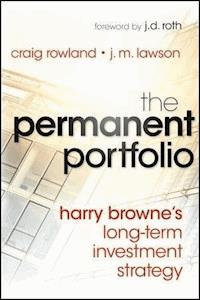
An up close look at an investment strategy that can handle today's uncertain financial environment Market uncertainty cannot be eliminated. So rather than attempt to do away with it, why not embrace it? That is what this book is designed to do. The Permanent Portfolio takes you through Harry Browne's Permanent Portfolio approach--which can weather a wide range of economic conditions from inflation and deflation to recession--and reveals how it can help investors protect and grow their money. Written by Craig Rowland and Mike Lawson, this reliable resource demonstrates everything from a straightforward four-asset Exchange Traded Fund (ETF) version of the strategy all the way up to a sophisticated approach using Swiss bank storage of selected assets for geographic and political diversification. In all cases, the authors provide step-by-step guidance based upon personal experience. * This timeless strategy is supported by more than three decades of empirical evidence * The authors skillfully explain how to incorporate the ideas of the Permanent Portfolio into your financial endeavors in order to maintain, protect, and grow your money * Includes select updates of Harry Browne's Permanent Portfolio approach, which reflect our changing times The Permanent Portfolio is an essential guide for investors who are serious about building a better portfolio.
Sie lesen das E-Book in den Legimi-Apps auf:
Seitenzahl: 553
Veröffentlichungsjahr: 2012
Ähnliche



















Contents
Cover
Series Page
Title Page
Copyright
Foreword
Preface: Life Is Uncertain
Acknowledgments
About the Illustrator
Chapter 1: What Is the Permanent Portfolio?
A Simple Idea
A Simple Allocation
Simply Great Results
Chapter 2: The 16 Golden Rules of Financial Safety
Rule #1: Your Career Provides Your Wealth
Rule #2: Don't Assume You Can Replace Your Wealth
Rule #3: Recognize the Difference between Investing and Speculating
Rule #4: No One Can Predict the Future
Rule #5: No One Can Time the Market
Rule #6: No Trading System Will Work as Well in the Future as It Did in the Past
Rule #7: Don't Use Leverage
Rule #8: Don't Let Anyone Make Your Decisions
Rule #9: Don't Ever Do Anything You Don't Understand
Rule #10: Don't Depend on Any One Investment, Institution, or Person for Your Safety
Rule #11: Create a Bulletproof Portfolio for Protection
Rule #12: Speculate Only with Money You Can Afford to Lose
Rule #13: Keep Some Assets Outside the Country in which You Live
Rule #14: Beware of Tax-Avoidance Schemes
Rule #15: Enjoy Yourself with a Budget for Pleasure
Rule #16: Whenever You're in Doubt about a Course of Action, It's Always Better to Err on the Side of Safety
Investing and the Rules of Life
Recap
Chapter 3: Permanent Portfolio Performance
Growth, No Large Losses, and Real Returns: The Holy Trinity
Only Real Returns Matter
Looking at Total Performance Over Time
Recap
Chapter 4: Simple, Safe, and Stable
Simplicity
Safety
Stability
Making the Most of Your Investments
Expect the Unexpected
Recap
Chapter 5: Investing Based on Economic Conditions
When Diversification Fails
A Different Way to Diversify
Four Economic Conditions
Four Economic Conditions + Four Assets = Strong Diversification
How the Portfolio Works with Economic Conditions
Recap
Chapter 6: Stocks
Benefits of Stocks
Risks of Stocks
Volatility
Owning Stocks
Recommended Stock Index Funds
Which Type of Index Fund to Use?
Why Use an Index Fund?
Avoid Actively Managed Stock Funds
Indexing Is a Marathon
Beware of Trading Costs
Large-Cap and Small Cap-Stocks
International Stock Funds
A Warning About Company Stock
No Index Funds—What to Do?
Recap
Chapter 7: Bonds
Benefits of Bonds
Risks of Bonds
Volatility
Bonds and Deflation
Owning Bonds
Bonds to Buy
Buying Bonds
Other Bond Risks—The Case for Treasury Bonds
Bonds to Avoid
Flight to Safety
Earning Money Multiple Ways
Bond Risk Matrix
Bond Funds and Retirement Plans
Recap
Chapter 8: Cash
Benefits of Cash
Risks of Cash
Volatility
Owning Cash
Cash Risks—The Case for Treasury Bills
Cash to Avoid
Cash Risk Matrix
Cash and Retirement Plans
Recap
Chapter 9: Gold
Benefits of Gold
Risks of Gold
Volatility
Causes of Inflation
Gold Protects During Extreme Events
No Interest, No Dividends, No Problem
Why Do Central Banks Hold So Much Gold?
Owning Gold
Buying Gold
Buying and Storing Gold at a Bank
Gold Funds
Assets to Avoid
Limit Gold Bullion Sales Taxes
Other Considerations
Recap
Chapter 10: Implementing the Permanent Portfolio
Key Concepts
Four Levels of Protection
Level 1—Basic—All Funds
Level 2—Good—Funds, Bonds, and Gold
Level 3—Better—Funds, Bonds, and Gold
Level 4—Best—Funds, Bonds, Gold, and Geographic Diversification
All In, or Wait?
Other Portfolio Ideas
Final Considerations
Recap
Chapter 11: Portfolio Rebalancing and Maintenance
Two Primary Purposes of Rebalancing
Rebalancing Maintains Firewalls
How to Rebalance: Rebalancing Bands
Withdrawals and Rebalancing
Timing Can Influence Rebalancing
Adding New Money to the Portfolio
Allocating Dividends
Different Approaches to Rebalancing
Emotional Aspects of Rebalancing
Rebalancing and Taxable Accounts
Recap
Chapter 12: Implementing the Permanent Portfolio Internationally
The World Is Not Flat
Applying the Same Principles Across Countries
Various Country Options
Canada
Europe
United Kingdom
Australia
Asia, Middle East, and the Rest of the World
Developing Country Investing
Recap
Chapter 13: Taxes and Investing
Simplicity Is Often the Best Tax Strategy
Tax-Free Savings Vehicles
Types of Taxable Events
Ordering of Assets and Tax Planning
Retirement Accounts and the Permanent Portfolio
Individual Retirement Accounts
Pensions, Social Security, and Other Plans
Tax-Loss Harvesting
Final Thoughts on Taxes
Recap
Chapter 14: Institutional Diversification
What Is Institutional Diversification?
Why Institutional Diversification?
Identity Theft
Natural Disasters
Terrorism
Cyber Attack
How to Divide Your Money
Recap
Chapter 15: Geographic Diversification
Then and Now
What Is Geographic Diversification?
What Assets Should Be Kept in a Foreign Account?
Why Geographic Diversification?
Geographic Diversification and a Warning for U.S. Citizens
Even Politicians Do It
The Reality Risk Spectrum
Types of Geographic Diversification
Overseas Gold Storage Options
New Zealand
Australia
United States
Switzerland
Intermediaries for U.S. Citizens
Swiss Gold Storage Services for U.S. and Non-U.S. Citizens
Safe Deposit Boxes
Geographic Diversification Matrix
Disclosing Accounts—U.S. Citizens
Emergency Options
Other Options
Recap
Chapter 16: The Variable Portfolio
Why a Variable Portfolio?
Three Rules for the Variable Portfolio
Modifying the Permanent Portfolio
Can You Really Ever Beat the Market?
Recap
Chapter 17: Permanent Portfolio Funds
The Permanent Portfolio Fund
Global X Permanent ETF
Recap
Chapter 18: Conclusion
Recommended Resources
Books
Podcasts
Websites
About the Authors
Index
Copyright © 2012 by Craig Rowland and J. M. Lawson. All rights reserved.
Published by John Wiley & Sons, Inc., Hoboken, New Jersey.
Published simultaneously in Canada.
No part of this publication may be reproduced, stored in a retrieval system, or transmitted in any form or by any means, electronic, mechanical, photocopying, recording, scanning, or otherwise, except as permitted under Section 107 or 108 of the 1976 United States Copyright Act, without either the prior written permission of the Publisher, or authorization through payment of the appropriate per-copy fee to the Copyright Clearance Center, Inc., 222 Rosewood Drive, Danvers, MA 01923, (978) 750-8400, fax (978) 646-8600, or on the Web at www.copyright.com. Requests to the Publisher for permission should be addressed to the Permissions Department, John Wiley & Sons, Inc., 111 River Street, Hoboken, NJ 07030, (201) 748-6011, fax (201) 748-6008, or online at http://www.wiley.com/go/permissions.
Limit of Liability/Disclaimer of Warranty: While the publisher and author have used their best efforts in preparing this book, they make no representations or warranties with respect to the accuracy or completeness of the contents of this book and specifically disclaim any implied warranties of merchantability or fitness for a particular purpose. No warranty may be created or extended by sales representatives or written sales materials. The advice and strategies contained herein may not be suitable for your situation. You should consult with a professional where appropriate. Neither the publisher nor author shall be liable for any loss of profit or any other commercial damages, including but not limited to special, incidental, consequential, or other damages.
For general information on our other products and services or for technical support, please contact our Customer Care Department within the United States at (800) 762-2974, outside the United States at (317) 572-3993 or fax (317) 572-4002.
Wiley also publishes its books in a variety of electronic formats. Some content that appears in print may not be available in electronic books. For more information about Wiley products, visit our web site at www.wiley.com.
Library of Congress Cataloging-in-Publication Data:
Rowland, Craig, 1971-
The permanent portfolio : Harry Browne's long-term investment strategy / Craig Rowland, J. M. Lawson. – 1st ed.
p. cm.
Includes index.
ISBN 978-1-118-28825-2 (cloth); ISBN 978-1-118-33156-9 (ebk);
ISBN 978-1-118-33377-8 (ebk); ISBN 978-1-118-33488-1 (ebk)
1. Portfolio management. 2. Investments. I. Lawson, J. M., 1970- II. Title. HG4529.5.R69 2012
332.6—dc23
2012015383
Foreword
Investing is complicated. It's difficult. You need expert help if you're going to build your wealth so that you can retire on time. Or at least that's what you've been told.
There's a vast financial industry with a vested interest in convincing you that to be a successful investor you have to:
The truth is that none of this matters. The truth is that smart investing is simple. And easy.
I believe that most investors are better off putting their money into low-cost index funds. (An index fund is a mutual fund that tracks the broad movements of a stock-market index, such as the S&P 500.) Over the long term, this passive investing approach has been shown to produce above-average returns for patient investors. Why? There are many reasons, but primarily because investing in index funds costs much less than nearly any other method.
In fact, Stanford University professor William Sharpe famously demonstrated that passive investing with low-cost index funds must produce better results than traditional investing. The average return of both methods is the average return of the market. But because traditional investing costs so much, investors taking that path necessarily see smaller returns on their investments. (To read more, see http://tinyurl.com/sharpe-rocks.)
But there are other ways to explore passive investing besides index funds.
Three years ago, I read a book called Fail-Safe Investing by Harry Browne. This tiny volume, first published in 1999, champions a method of passive investing that Browne called the Permanent Portfolio. And while it's a little more complicated than simply investing in index funds, the ideas are still fairly simple.
According to Browne, the Permanent Portfolio should provide three key features: safety, stability, and simplicity. He argues that your permanent portfolio should protect you against all economic futures while also providing steady returns. It should also be easy to implement.
There are many ways to approach safe, steady investing, but Browne has some specific recommendations:
To use the Permanent Portfolio, you simply divide your investment capital into four equal chunks, one for each asset class. Once each year, you rebalance your portfolio. If any part of your portfolio has dropped to less than 15% of the whole, or grown to over 35% of the total, then you reset all four parts to 25%.
That's it. That's all the work involved.
Because this asset allocation is diversified, the entire portfolio performs well under most circumstances. Browne writes:
“The portfolio's safety is assured by the contrasting qualities of the four investments—which ensure that any event that damages one investment should be good for one or more of the others. And no investment, even at its worst, can devastate the portfolio—no matter what surprises lurk around the corner—because no investment has more than 25% of your capital.”
Browne's arguments sounded crazy at first – far too simplistic! – but with time, I've come to believe he's on to something. In fact, over the past three years I've gradually realized that what I need to is move from investing in index funds to establishing a permanent portfolio for myself. Why haven't I done so?
The high price of gold, for one. Plus, I've never really been sure how to implement Browne's Permanent Portfolio in real life. I mean, what are the actual steps for making it happen? Fail-Safe Investing is a good book, but it's long on theory and short on actual details. I'm not a professional investor; sometimes I need to have somebody hold my hand.
That's where this book comes in.
The Permanent Portfolio is an easy-to-access how-to manual for putting Browne's investment strategy into practice. This book doesn't just cover the theories behind this method; it also gives details for putting the theories to work in the Real World.
Nobody knows where the economy is headed. Nobody knows if economic prosperity looms on the horizon – or if we're in for decades of rampant inflation. And because nobody knows what's ahead, nobody knows the best way to save for retirement (or any other purpose).
But with the Permanent Portfolio, you don't have to see the future. You don't need a crystal ball to divine the best place to put your money. Instead, you hedge your bets against all possibilities. Sexy? Nope. Safe? You bet. And now that Craig Rowland and J.M. Lawson have explained exactly how to put the Permanent Portfolio into practice, I intend to do so. Perhaps you will, too.
J.D. Roth July 2012
Preface: Life Is Uncertain
What if everything you had been told about investing was wrong? What if investment predictions were just for entertainment purposes and had no connection to what actually happens in the markets? What if no one really had any idea what was going to happen tomorrow, much less next year?
This situation is the scourge of investors. When we think the economy is doing great, it suddenly turns sour. The bad market that lingers on forever suddenly turns upward. The sure-thing investment we heard about from our broker goes bust. Instead of building our savings, it feels more like it's being taken at the point of a gun. Life is uncertain, and that includes the investment markets.
But perhaps we're just looking at the problem of investing the wrong way. If the investing world is so uncertain and unpredictable, why not build an investing strategy around this idea? Why not strike out the notion that the future can be predicted and instead invest in a way that assumes surprises are normal?
That's what this book is about: investing for surprises. Or perhaps we should say investing for how the real world actually works.
Several decades ago, the late financial author Harry Browne created an ingenious investing strategy that is strikingly simple, yet extremely sophisticated. This investment strategy was called the “Permanent Portfolio,” and it was designed to be set up one time and maintained with minimal effort permanently. The strategy was not designed around predicting the future or outsmarting other investors. Instead, it embraced the idea of the unpredictable, the unknowable, and the surprises that the real world always seems to generate. It assumed that nobody can predict the future and that protecting your life savings with an all-season investment strategy should be the primary goal.
How has this approach worked in practice? Very well. Over the last 40 years the strategy has returned between 9 and 10 percent a year. Even more remarkably, the worst loss it has ever had in a single year was only around –5 percent. This even includes the recent 2008 financial crisis during which the portfolio was basically flat while the stock market sank over 36 percent in value. Even better, the portfolio now has over 30 years of empirical data behind it from those who have used it to weather all types of markets (good, bad, and ugly). But despite these extremely impressive results, the portfolio is incredibly simple to implement. At the basic level, it's just four investment asset classes. That's it. This book will tell you how to implement this simple portfolio and avoid investing mistakes that are extremely expensive and are probably putting your life savings at risk right now.
In addition, you will also learn about different implementation options that can fit any situation. You'll also be exposed to some important topics such as storing part of your life savings in a foreign account to protect against natural and/or manmade disasters.
Finally, you will learn about many common pitfalls in the investing world such as the risks associated with active management, investment industry costs, dangerous assumptions in much of what passes for conventional investment wisdom, and how to actually enjoy investing without it being a constant source of worry.
Uncertainty is what makes life interesting. When you learn how to make market uncertainty your friend, you will find that you are on your way to both better investment returns and a more peaceful state of mind. If it sounds implausible that uncertainty could be the basis for a relaxed approach to investing, then please read on. Investing can be relaxing and stress free and we'll show you how to make it that way.
Together, we are melding our own experiences and insights into a strategy that, despite being three decades old at this point, provides a robust investing framework even today. Our goal is to provide you with exposure to ideas about diversification that you may not have come across before, along with a higher degree of skepticism toward the investment industry.
There is a way to save and invest that will allow you to reach your goals safely and it's in this book. We will do our best to make the trip interesting and useful. Thank you for joining us.
Acknowledgments
I would like to thank the following people, who have helped tremendously in creating this book:
Newt Rumble, CPA for reviewing of tax related information and state/ local tax treatment questions; Mike Barber for his input on Canadian implementation ideas; Dan Mohr, CPA for proofreading and tax accountant review of information presented; Loren Dohm for proofreading and input.
I would also like to acknowledge Otto Hueppi, managing director for Swiss American Advisors, for providing information and insight into Swiss banking opportunities today for Americans. Additionally, Bron Suchecki at the Perth Mint for his information on the background and history of the mint, knowledge of the gold industry, and review of the chapter on the overseas gold allocation methods. Mike O'Kane, head bullion trader at the New Zealand mint for providing background information on gold storage options in New Zealand. Claudio Grass at Global Gold, AG for providing background on non-banking gold storage options in Switzerland. Frank Trotter, President of Everbank, for background information on gold storage options for U.S. bank custody accounts.
Andy Knippenberg, of John Wiley & Sons, who put us in contact with the publisher. Also at Wiley, Tiffany Charbonier for keeping things organized on the administrative side; Meg Freeborn, Development Editor, for speedy edits and content advice; Senior Production Editor Donna Martone, and Executive Editor Bill Falloon, Wiley Executive Editor, for accepting our proposal and helping to bring it to publication.
Andy Bryant for our conversations relating to investing, business, and market theory. J. D. Roth, operator of the blog “Get Rich Slowly” (www.getrichslowly.org), who provided book proposal advice and wrote the Foreword.
Thanks also to Matthew Wilson and Jeff Sponaugle, both for proofreading and input from an investor's point of view and C. J. Domerchie for his backstories on subjects that were relevant to the book. Thanks for being great friends as well.
John Chandler is also acknowledged for many interesting conversations on the formulation of the Permanent Portfolio strategy and background into Harry Browne and his ideas. Our exchanges through the years have always been educational.
Thank you Pamela Wolfe Browne, Harry Browne's widow, for allowing me to host his investing podcasts all these years and continue to keep his investing ideas alive.
Kendall Earl for being so patient while I worked on this project.
Brian Rowland, for proofreading and exchanging ideas on content. Also to Brian and Keith for being great brothers. Thanks to Mom and Dad for raising me well despite my own efforts to thwart them, several of which almost succeeded.
To all the blog and internet forum participants that have provided so many interesting and fun conversations on the topic of the Permanent Portfolio all these years.
C. R.
As a co-author of what I hope will be a readable and useful guide to personal investment management, I can only echo all of Craig's acknowledgements above. No book covering as many topics as this one comes together without the collaboration of many minds and the contributions from many people, and I offer my thanks and appreciation to all who helped us along the way.
Writing a book like this one takes a lot of time and energy. When you have three small children at home and a full-time job as I do, it would be impossible to undertake a project like this one without a partner who cares about you and believes in what you are doing. My wife Crystal has been instrumental in encouraging me and supporting me as this book has come together, and I want to especially thank her. Her love has been a consistent inspiration to me.
J. M. L.
About the Illustrator
Special thanks to illustrator Chad Crowe. When we decided we wanted an illustrator, we were looking for someone that could do drawings to poke fun at the industry in the style of How to Lie With Statistics, which is a classic book. Of the many dozens of submissions, Chad stood clearly above them all.
Chad is an immensely talented illustrator that has done drawings for many periodicals including The Washington Post and The Wall Street Journal. He was able to take our concepts and turn them into hilarious cartoons on time and on budget. Check out his website at www.chadcrowe.com.
Chapter 1
What Is the Permanent Portfolio?
Golden Beginnings
The Permanent Portfolio is an investment strategy designed to grow and protect your life savings under any set of economic conditions. It will work during good and bad markets, and it will even work in markets experiencing extremely serious and unexpected events.
The idea for the portfolio was first proposed in the 1970s by the late Harry Browne, who had gained fame by betting against the dollar with his first book How You Can Profit from the Coming Devaluation. The premise of that book, published in 1970, was that the United States would soon break the last vestiges of the gold standard and the resulting inflation would be so bad that gold and certain other hard asset prices would skyrocket. Harry Browne therefore advised readers to purchase assets like gold and silver, and to invest in strong currencies like the Swiss franc as hedges against inflation.
As it turned out, in 1971 President Nixon in fact did break the gold standard and the results were spectacular. Starting from $35 an ounce at the time of Nixon's announcement, gold ended the decade near $850 an ounce (over $2,200 in 2012's dollars). Assets like silver and the Swiss franc experienced very high returns as well.
That market call was quite good and there was now a real need to protect those profits once the bad inflation of the 1970s ended.
A Simple Idea
In response to the need to diversify their profits, Harry Browne and his team, which included Terry Coxon, John Chandler, and Charles Smith, began working out early versions of a new strategy. This strategy would allocate their money not just into assets like gold, but into stocks, bonds, natural resources, and cash as well. Further, unlike Browne's prior bets on the market moving in a certain direction, the new strategy would avoid market timing entirely and be completely passive—something almost unheard of in the investing world at the time outside of a few lone voices.
Browne's new strategy would be called the Permanent Portfolio. The original strategy held the following:
This mix of assets was reached after extensive research into market history, economics, and the potential for a passive strategy to perform well under any environment. This research even included computer analysis, which at the time in the late 1970s wasn't yet in wide use due to the expense involved. Harry Browne, who was interested in the emerging personal computer technology, even did the programming necessary to conduct the research.1
As the Permanent Portfolio idea began to take shape, readers of Harry Browne's newsletter—Harry Browne's Special Reports—were puzzled by his recommendation to consider owning stocks and bonds in a portfolio (which had done poorly in the 1970s inflation). Yet, Browne stuck to his advice that strong diversification would be a good long-term strategy.
Harry Browne and Terry Coxon then wrote a book in the early 1980s, Inflation-Proofing Your Investments, that (contrary to its title) presented a comprehensive review of this new way of thinking about investing that would do well when inflation came back under control. This is actually a pretty remarkable thing for an investment advisor to do. He built his career in the 1970s advocating hard asset investing (like gold) to fight inflation and all of the sudden he advises readers to sell a portion of their hard assets and buy something completely opposite like stocks or bonds? This was heresy!
Well, Browne turned out to be exactly right. In fact, gold soon did settle down by the early 1980s from the previous highs as inflation came under control and the stock market took off in response.
Over time, Browne simplified the Permanent Portfolio to make it easier to implement and more balanced. This effort culminated in Harry Browne's 1987 book Why the Best Laid Investment Plans Usually Go Wrong. This book, which is probably one of the best ever written on the flaws in many popular investment strategies, reduced the portfolio down to the core components that are still in use today.
A Simple Allocation
Now that the background of the strategy has been discussed, we can look more closely at the approach that evolved into the following deceptively simple asset allocation:
The allocation above is the strategy in its most basic conceptual form. Now, how you implement these 25 percent allocations is just as important as the allocation itself. This book will help you understand how to do that.
Simply Great Results
Don't let the apparent simplicity of the allocation fool you. Even though it appears simple, it is far from simplistic. The allocation actually reflects a sophisticated understanding of economics and financial history. It is this understanding of economics and financial history that allows it to perform so well under so many market conditions and provide strong diversification.
If you walk away from this book with anything, it should be the idea that you do not need a complicated investment strategy to do well in the markets. In fact, it's just the opposite. A simple strategy will often outperform complicated ones over time. It will do it with less risk, less management, lower costs, and more profits to compound. The Permanent Portfolio still remains not only one of the most simple asset allocations you are likely to encounter, but also one of the best in terms of risk versus return.
Note
1. Personal interview with John Chandler, Harry Browne's former newsletter publisher and colleague.
Chapter 2
The 16 Golden Rules of Financial Safety
Golden Rules and Uncertainty
Over the years, Harry Browne developed a set of rules he used to guide his own investing decisions and offered them as general guidelines for all investors in his book Fail-Safe Investing. Browne called these maxims the 16 Golden Rules of Financial Safety. These Golden Rules are integral to the design of the Permanent Portfolio and represent timeless advice borne out of witnessing all manner of events in the markets. This chapter provides a summary of the rules that will be helpful in understanding the philosophy behind the Permanent Portfolio.
First, know that the markets are uncertain. There is no way to escape this basic premise. You must accept the idea that the markets are uncertain just as the rest of life is. Yet, investors often find the most trouble through the innocent belief that they have somehow conquered uncertainty. Ironically, it is only when an investor learns to embrace uncertainty rather than trying to conquer it that a strategy can be adopted to deal with it realistically.
Lesen Sie weiter in der vollständigen Ausgabe!
Lesen Sie weiter in der vollständigen Ausgabe!
Lesen Sie weiter in der vollständigen Ausgabe!
Lesen Sie weiter in der vollständigen Ausgabe!
Lesen Sie weiter in der vollständigen Ausgabe!
Lesen Sie weiter in der vollständigen Ausgabe!
Lesen Sie weiter in der vollständigen Ausgabe!
Lesen Sie weiter in der vollständigen Ausgabe!
Lesen Sie weiter in der vollständigen Ausgabe!
Lesen Sie weiter in der vollständigen Ausgabe!
Lesen Sie weiter in der vollständigen Ausgabe!
Lesen Sie weiter in der vollständigen Ausgabe!
Lesen Sie weiter in der vollständigen Ausgabe!
Lesen Sie weiter in der vollständigen Ausgabe!
Lesen Sie weiter in der vollständigen Ausgabe!
Lesen Sie weiter in der vollständigen Ausgabe!
Lesen Sie weiter in der vollständigen Ausgabe!
Lesen Sie weiter in der vollständigen Ausgabe!
Lesen Sie weiter in der vollständigen Ausgabe!
Lesen Sie weiter in der vollständigen Ausgabe!




