


9,99 €
Mehr erfahren.
- Herausgeber: 50Minutes.com
- Kategorie: Fachliteratur
- Serie: Management & Marketing
- Sprache: Englisch
Boost competence and efficiency in your company
This book is a practical and accessible guide to understanding the Peter Principle, providing you with the essential information and saving time.
In 50 minutes you will be able to:
• Understand the theory behind the Peter Principle and how it can affect the performance of your company
• Identify the different levels of competence among your workers and learn how to recognize signs of incompetence
• Recognize the structure of promotions in your company and avoid inefficiency
ABOUT 50MINUTES.COM | Management & Marketing
50MINUTES.COM provides the tools to quickly understand the main theories and concepts that shape the economic world of today. Our publications are easy to use and they will save you time. They provide elements of theory and case studies, making them excellent guides to understand key concepts in just a few minutes. In fact, they are the starting point to take action and push your business to the next level.
Das E-Book können Sie in Legimi-Apps oder einer beliebigen App lesen, die das folgende Format unterstützen:
Seitenzahl: 23
Veröffentlichungsjahr: 2015
Ähnliche












The Peter Principle
Key information
Name: the Peter Principle.Uses: human resource and performance management, development of human potential.Why is it successful? Its success is uncertain because it depends on the individuals and the organisations.Key words:Competence: knowledge and know-how required for maximum efficiency in a given positionEfficiency: synonymous with excellence, the ability of an employee to perform certain tasks with limited resources (time, money, etc.)Hierarchy: authority structure within an organisationPromotion: appointing a worker to a higher level within an organisation.Introduction
When considering the Peter Principle, it is particularly important to realise that this model, though enlightening in many given situations, comes from a satirical book and, therefore, must be used with caution to when establishing scientific facts. In the context of increasingly strong hierarchies within organisations, there is the question of internal promotion. Should the competence of an employee be the dominant criterion for determining hierarchical ascension? How can this level of competence be measured? Does an efficient employee necessarily make for a good organiser?
Definition of the model
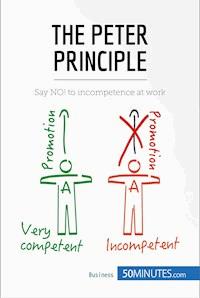
The Peter Principle states that if an employee is working efficiently at a given hierarchical level, he will be promoted to the next level above and so on, until he reaches the level where he is inefficient. If he cannot be demoted, this means that all structures naturally evolve towards a balance of greater inefficiency.
Although, at first glance, the principle may seem absurd, it does raise some issues regarding human resource management. Who should be promoted for the good of both the individual and the company? And under what conditions should this be done in order to increase overall efficiency?
Theory
Laurence Johnson Peter (Canadian educator and psychologist, 1919-1990)
After graduating in 1958 from Western Washington State College, Laurence J. Peter, originally from Vancouver, quickly became a teacher while pursuing studies in psychology and education sciences, in which he obtained a doctorate degree in 1963. He then directed the Evelyn Frieden Center and acted as an adviser for programs that experienced difficulties at the University of Southern California in 1966.
His first book, Prescriptive Teaching, was published in 1965 but it was not until the publication of The Peter Principle (1969), written in collaboration with Raymond Hull (Canadian writer, 1919-1985), that he became well-known.
The hypotheses of the Peter Principle
The Peter Principle, like all economic models, is based on hypotheses that are useful to investigate. If we only look at the most important, these include (but are not limited to):




