


3,99 €
Mehr erfahren.
- Herausgeber: il Ciliegio Edizioni
- Kategorie: Geisteswissenschaft
- Sprache: Englisch
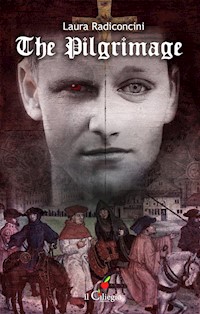
It is the year 1353 and Europe has been ravaged by the Black Death. The monk Adso is leading a group of survivors on a pilgrimage to a shrine in Tuscany, but things are not what they seem: he is a little too pale under his cowl and appears to always be fasting. Plus, many of his followers conceal dark secrets and few are innocent. Whatever their reasons for making the journey, the same fate awaits them all at its end: a hungry welcome from a powerful clan of Byzantine vampires. Yet among the pilgrims there is someone who touches Adso's unbeating heart and makes him doubt his very nature and the deadly mission he is meant to carry out.
Das E-Book können Sie in Legimi-Apps oder einer beliebigen App lesen, die das folgende Format unterstützen:
Veröffentlichungsjahr: 2018
Ähnliche




















The Pilgrimage
by Laura Radiconcini
Credits
Copyright 2017 Edizioni Il Ciliegio S.a.s.
Via A.Diaz 14E 22040 Lurago d’Erba (CO)
Tel/Fax. 031696284
www.edizioniilcliegio.com
English version
Laura Radiconcini
Cover graphics
Iacopo Donati
Layout
Antonella Monterisi
ISBN 978-88-6771-548-0
All rights reserved.
This book cannot be reproduced in any way except as specifically permitted by the publishers.
List of Characters
A) Humans
Michael Keroularios, Patriarch of Constantinople in 1056
The pilgrims
Aligi: a young pilgrim, atoning for his father’s sins and with something to hide.
Alina: a beautiful horsewoman from Arezzo, mysteriously connected to Aligi. She will join the pilgrimage later.
Omodeo: an arbalester from Genoa, still mourning Fulco, the man he loved and died at Crecy.
Ada: a wet nurse, who has lost her child.
Duccio & Baldo: a butcher and his brother. Baldo is simpleminded but, as it is often the case, extremely perceptive.
Cosimo: a notary, who isn’t shy of messing with the wills entrusted to him and now is planning murder.
Velia & Masino: a rich woman from Montalcino, widowed twice, and her henpecked son.
Guerrino: an apothecary, who fears the vengeful ghost of a woman he wronged.
Vanna: a midwife, who meddles too much.
Bonizella: a merchant’s widow, harboring a dark secret.
Leonello: a mediocre painter looking for work, with his apprentice.
Other pilgrims, unnamed. Among them two embroiderers, a baker, a farrier, a beekeeper, a cheese maker…. and, not human:
Morello: a horse
B) Vampires
Adso: the fake monk guiding the pilgrims to Saint Sertorius’ Shrine. Formerly a Dominican novice, he is now a lure for his brood.
Leo: “Abbot” of the Order of Saint Sertorius and leader of the Amakoi.
Stephanos: his immortal bodyguard.
Ruby: an attractive female. She can sense the Sky Stones and lusts after Adso.
Dominic: a trusted member of the Amakoi who saves Adso’s life.
Julian: the Order of Saint Sertorius’ Cellarer.
Godenzo: a priest turned vampire, who can put humans to sleep.(He was able to do this even when human and preaching).
Raissa: a gorgeous seductress.
Nada: her sister.
Dragan, their sire.
A nomad: who has something to reveal.
Other members of the Amakoi clan, unnamed.
Prologue
Constantinople, AD 1056
“Let the visitor in as soon as he arrives,” Patriarch Michael Keroularios said, or, better, whispered to his secretary. It was night already, but a creature like Leo could take care of his affairs only in the darkness, as the Patriarch well knew.
Forgive me Lord if I allow the devil’s spawn to sully Hagia Sophia’s holy walls, but the salvation of our empire and our very faith depend on it …
Sometimes the burdens the Patriarch had to carry on his shoulders were almost unbearable. However, the Emperor was too ill to do his part, while trouble after trouble descended on the Bosporus. And now there was the irreparable separation from Rome and its rampaging heresies, the internal strife that followed, seeping inside Constantinople itself and, finally, this subtle and deadly menace that put every life and every soul at risk. At least for this last one he could do something – had, in fact, already done something – and, God willing, the solution he had found could even help with the bigger problem.1
Not much later Leo was allowed into his cabinet. He looked like a man, very pale but with scarlet lips. Average in size, he had dirt blond hair and would have been unremarkable, but for the impression of barely contained strength he exuded, a strength that could be unleashed in a blink of his very dark eyes… eyes the Patriarch had better not to look into, because he feared the hypnotic powers the monster possessed.
“Stephanos is not with you?” he asked, surprised not to see the faithful shadow who usually protected the back of his dangerous guest.
No, Most Reverend Father,” and there was a hint of irony in the respectful address, “he is busy preparing for our journey. Because, as you demanded of us, we are almost ready to leave. The rival covens have been destroyed, according to your desires and to your satisfaction, I hope. Your witnesses have seen that nothing remained of them but ashes. And thank you for the gift of Greek Fire, it has been most useful.”2
The Patriarch shuddered, thinking of the secret Imperial weapon that was not meant to be shared. But in this case the exception had been for the greater good.
“Can we be sure that nobody escaped?” he asked.
“Nobody, Most Reverend Father.” This was not completely true, a few did escape, but the scared immortals must have fled to the depth of the Balkans by now and wouldn’t be returning any time soon. And now it was time for the Churchman to deliver what he had promised.
“Very well, Leo, I’ll give you the stone but, remember, you can use it only after you have left the Empire and are in Italy. From where, because you must not forget the rest of our agreement, you’ll send to me and to whomever will be Patriarch after me regular reports about what happens in Rome, that den of iniquity. You will do everything in your power to undermine the unworthy moron who sits on Saint Peter’s throne and his successors, if they persist in their errors. Is there an oath that is sacred to your species?”
”May I see Hell in this century if I forget our agreement.” Was Leo’s firm answer, accompanied by a cold smile.
The Patriarch went behind a hidden door and come out with a small silver casket. From it he drew out a lump of grey stone, rough and irregular in shape.
“The Sky Stone” he said solemnly.
Later on, sitting in the forgotten Roman crypt where he and his brethren concealed themselves from the daylight, Leo contemplated what would one day be called a meteorite, thinking how best to make use of it. Just a tiny sliver in contact with the skin was enough to nullify the curse of the sun. That it worked he already knew, because the Patriarch had lent him a miniscule sample and Leo himself had pushed a trembling warrior in the sunlight and had seen that he was immune, did not burn. Only the Devil knew how the Church had discovered the stone’s power and procured a piece of it, to use as the opening bait for the negotiations with Leo’s coven. Today the deal had been eventually concluded to their mutual satisfaction. More than anything else, what had convinced the vampire was the fact that, had he refused the proposal and the conditions attached, the stone would have been offered to another rival clan, and that would have been completely unacceptable
Now Leo would have iron rings made – nothing conspicuous, to be sure – with little fragments set on the inside, touching the finger’s skin. Finally free to move around during the day, free also of the weakness vampires experienced even when not directly under the sunlight, the members of his coven would be the most powerful among immortals, with Italy and all Western Europe at their disposal. They would be invincible. Amakoi.
Chapter 1
San Galgano
Italy, AD 1353
Adeserted stretch onthe Via Francigena3
Hot and satisfying, the man’s blood soothed Adso’s throat, filling his body with pleasure. He allowed himself to rest for a while, basking in the warmth radiating from his belly, thinking of nothing. Sated… and waiting. Then the usual pain began, the nausea, the compulsion to vomit. A part of his brain told him to count: one, two, three… If he could reach sixty, he would not empty his stomach… sixty. The pain ebbed; the nausea was no more. Completely recovered and moving in a blur he disposed of the two bodies - the one he had drained and the one he had been forced to kill, to avoid leaving witnesses to his feeding. Two would-be pilgrims who were arriving at San Galgano after dusk, but would never reach it, nor return home. He hid the coins they had with them inside his tunic and, walking now at a human pace, went back to the monastery’s guesthouse.4
Now he had to feign sleep for the rest of the night.
Lying completely still on his pallet, but remembering to breath slowly and deeply, Adso could not prevent himself from wondering why he had to feel sick for a minute every time he fed. No other vampire suffered this strange phenomenon, as far as he knew. Not that he had asked anybody, he always tried to be alone when he took blood. It had started shortly after he was transformed and still continued, so many years later. If it was meant to be his punishment, then so be it, Adso sighed; he fully deserved it. His perfect memory didn’t permit him to forget the human life he had lost in blood and lust ….
The days of his novitiate. He had been happy then, even glad, eventually, to have ended up in Saint Peter, the monastery that graced the alpine valley adjacent to the one where he was born. The life at home hadn’t been easy. It is never easy for a bastard son. His father’s wife hated him - offspring of a fling with a scullery maid – her ire constantly directed at Adso because he was healthy and strong and her children were sickly. His father had protected him, though, until he died far too young, having secured his son’s future with the Church.
Adso would have liked to be a Franciscan, but his father had not admired those friars, vowed to poverty and sometimes leaning on heresy. So he donated generously and his bastard son became a novice in the Dominican monastery of Saint Peter of Verona, who was one of the first martyrs of the Order.
Content and naïve, dreaming of becoming a preacher, like the best Dominicans, he had thrown himself in his new life, doing his best at any task he was given, menial or not. He studied, learned, and, due to his good voice, became the valued soloist of the monastery’s chorus. Since he already knew how to read and write, had a smattering of Latin and a head for numbers, more often than not he was given clerical duties, working alongside the cellarer.
And then, one day, while cleaning the documents’ room and putting the precious parchments in order, he saw a scribed draft, and his world collapsed.
Simony. There was not another word for it. Simony. The sale of what was sacred. The draft he had seen was not meant for his eyes. It was a note conceived for confessors and preachers, suggesting how much money to ask penitents who had sinned and wanted to secure years of indulgence. Pope Boniface the 8th, in proclaiming the Holy Year 1300, had offered Plenary Indulgence to anybody who made a pilgrimage to Rome. Hordes of people reached the Eternal City and left generous offerings at Saint Peter’s bronze feet. At the end of the year, an enormous amount of money had been collected and that must have set people thinking, Adso realized. Why only in Rome, why wait for another holy year?
He had rushed to the privy, gagging. When he had recovered a little, the full extent of what he had seen overwhelmed him.
Adso did not question the issue of indulgences per se, while the idea of calculating them in months and years seemed slightly ludicrous. He doubted that God counted time like men did, whether their souls be in Heaven, Hell or Purgatory. In any case indulgences had to be earned by penances and good deeds, not by paying money. He wondered what else had escaped him, how many unholy actions were regularly committed, unbeknownst to him. Louder and louder the words of Saint Peter Apostle to Simon Magus resonated in his mind:
“Thy silver perish with thee, because thou hast thought to obtain the gift of God with money. Thou hast neither part nor lot in this matter, for thy heart is not right before God. …. For I see that thou art in the gall of bitterness and in the bond of iniquity...”
After a night of torment he realized he could not be part of this blasphemy. He would not. He must depart. Immediately, before pronouncing the vows that would make him a monk forever. And so he had left, with no place to go, with no money or prospects, leaving behind a comfortable and secure life.
.…….
It was dawn, and people were stirring, so the vampire was now free to ‘wake’ from his faked slumber. It was time to resume his play-acting. He went to collect the few pilgrims he had already secured and guided them to Prime, inside the church. Visitors were exempt from participating in pre-dawn Matins, of course, and he also had missed it this time, due to his hunting. He had been getting very thirsty and had needed to feed. After the prayers, when his little flock was eagerly headed to the guests’ refectory, he whispered to them that he was remaining in the church for a while.
“Brother, don’t weaken yourself with too much fasting,” half-joked Duccio, the butcher. “We have to walk a lot more.”
Baldo, his brother, was looking at Adso with an intent expression on his usually vacant face. He was a simpleton and still, some of his glances made the vampire uneasy. It was almost as if the boy could see behind his façade. Children and innocents sometimes saw what adults could not see, but no matter, Baldo was almost dumb, and surely couldn’t explain his suspicions, should he have any.
Finally alone in the church, Adso knelt again, enjoying perfect stillness, something that was natural for him and he could seldom afford. In his mind he started to count the followers he had gathered so far: The butcher and his brother, a fine choice. The rich widow and her son, with her friend, the notary. The woman and the notary were as thick as thieves and thoroughly unpleasant. He was sure that nobody was going to mourn them.
Stop this, he told himself. I should not dwell on the moral qualities of those I bring to Saint Sertorius’ shrine. Humans are our destined prey and my “brothers” are thirsty. In fact, he mused, in the last few years we have fasted almost like real monks do.
Indeed it was so. With the human population severely curbed by the plague, it was necessary to leave space and time for its reproduction. Therefore Leo, in his wisdom, had put everybody on rations. As for drinking from the people who were ill and dying, bleah, they all had had to do it: it was allowed and vampires certainly could not be infected, but the taste was foul. Only recently Adso and other members of the Amakoi Guard had resumed harvesting mortals.
He rose and went back to the guest house. Hopefully, the refectory would have emptied by now, so nobody needed to know that he had not eaten there. A group of pilgrims, led by a parish priest had been left stranded, because the man got sick – not the plague again, fortunately - and he was sure he could convince some or all of them to follow him.
Fulco’s calloused hands, roughened by the crossbow’s constant use, but so tender when caressing me. His ardent mouth taking in my manhood, savoring it… then one hand comes up to grasp the base of my shaft, the other strokes my sac and I am undone, crying loud and spurting into my beloved’s throat. Bliss. He gulps everything down and, raising his face, graces me with his impish grin. The grin morphs into a grimace, though, while the sweet planes of his face dissolve and now it is Fulco’s skull that I see, the skull of my dead lover.
Omodeo awoke, drenched in sweat. Realizing he had sat up in a panic, he lay down again, trying to calm himself, to control his breath. Would he ever find peace? Almost every night the memories of his lost happiness came to taunt him, along with his guilt, because he had lain low on the plain of Crecy under his friend’s corpse, seven years and a lifetime ago. Hoping to look dead, not mourning his beloved, not dying by his side, but using him as a shield.
They, the hired Genoese crossbowmen fighting along the French army, had been in the forefront of the battle line, but their quarrels had not reached the English. Their strings were damp and they had misjudged the range, so the English archers with their long bows - so powerful that they could stop a mounted knight in full armor - had butchered them. Those Genoese who tried to retreat were cut down by the French themselves, as traitors. But Omodeo and Fulco had been among the first to fall. He only wounded, his lover dead.
And, in that supreme moment, Omodeo had thought only of saving his own ass.
“You and I are like the Sacred Band of Thebes,” Fulco had said to him one night, after passionate lovemaking. “Paired warriors who were also lovers. And therefore invincible, the Thebans believed, because lovers would fight more fiercely and cohesively than just mere comrades with no intense bonds.”
This had indeed proved true for decades, until Philip the Macedon had massacred them all at Cheronea.
Fulco was well born and well schooled. He knew Latin and Greek and had read Plutarch, but some indiscretion of an obvious nature had made him leave his family and join the crossbowmen’s mercenary battalion. He was also handsome, witty and a daredevil. When they met, Omodeo had been overwhelmed, forgetting everything he had believed before, forgetting that, according to the Church, they were committing an unforgivable sin.
It did not matter: seduced, owned, he was desperately in love for the first time in his life. With a man. They kept their liaison concealed from their comrades – so-called Greek love not being appreciated in the ranks - and came together only when they could do it safely, suffering frustrated desire more often than not. But it had been wonderful all the same, until their Cheronea had come, at Crecy.
At Cheronea, however, the three hundred warrior-lovers had all died together - none wanting to survive his companion - while he, Omodeo, had outlived his partner with his own craven weakness. He had crept away hours after the battle, silent and fast, because scavengers in human form were coming to depredate the fallen. To his eternal shame, he never learned what had happened to Fulco’s remains.
In the seven years that followed he had bitterly repented his cowardice. Unable to use the cross bow anymore - because his badly healed wound had left his right arm damaged - he had survived due to his past earnings as a mercenary. He went back to Italy, but he was always unhappy, despondent, and thinking of seeking his end, desiring it. When the pestilence came, he thought it would finally terminate his inner torment. Seeking death, and hoping to atone for his past, he had joined the corpse carriers, those who buried the bodies of people killed by the plague. No such luck. He didn’t fall ill, and he survived. Not even the Black Death had wanted him.
And now he was here in San Galgano, with the idea of joining a group of pilgrims going to some shrine, since it was a popular gathering place. After Fulco, he had sinned no more, not even with women. He had not repented for having loved him, though, and never confessed it. So he was surely damned, albeit he believed that his real and only sin had been his behavior at Crecy. Still, he felt a need to speak with God, to be finally absolved by Him, if not by a priest.
Somebody else entered the communal room, a youth, nervous and alone, carrying a sack with his belongings. Well dressed, short and slender, he had pageboy dark hair escaping from his beret. He went to sit on a bench in the farthest corner of the room. Omodeo, disinterested, turned his eyes elsewhere, so he did not catch the transfixed expression on Brother Adso’s pale face as he looked at the newcomer.




