


18,99 €
Mehr erfahren.
- Herausgeber: John Wiley & Sons
- Kategorie: Fachliteratur
- Sprache: Englisch
Every human is born with multifarious potential. Why, then, do parents, schools and employers insist that we restrict our many talents and interests; that we 'specialise' in just one? We've been sold a myth, that to 'specialise' is the only way to pursue truth, identity, or even a livelihood. Yet specialisation is nothing but an outdated system that fosters ignorance, exploitation and disillusionment and thwarts creativity, opportunity and progress. Following a series of exchanges with the world's greatest historians, futurists, philosophers and scientists, Waqas Ahmed has weaved together a narrative of history and a vision for the future that seeks to disrupt this prevailing system of unwarranted 'hyper-specialisation.' In The Polymath, Waqas shows us that there is another way of thinking and being. Through an approach that is both philosophical and practical, he sets out a cognitive journey towards reclaiming your innate polymathic state. Going further, he proposes nothing less than a cultural revolution in our education and professional structures, whereby everyone is encouraged to express themselves in multiple ways and fulfil their many-sided potential. Not only does this enhance individual fulfilment, but in doing so, facilitates a conscious and creative society that is both highly motivated and well equipped to address the complexity of 21st century challenges.
Sie lesen das E-Book in den Legimi-Apps auf:
Seitenzahl: 532
Veröffentlichungsjahr: 2019
Ähnliche



















Table of Contents
COVER
PROLOGUE
PREFACE
Chapter 1: Introduction
Chapter 2: A Timeless People
Patronage
Laymen
Women
The ‘Other’
Encouragement
The Myth of the ‘Specialist’
Chapter 3: Shapers of Our World
Leaders
King-makers
Revolutionaries
Intellectuals
Educators
Mystics
Explorers
Scientists
Artists
Entrepreneurs
Humanitarians
Chapter 4: The Cult of Specialisation
The Evolution of Specialisation
The Modern Education Crisis
Employee Disillusionment
Work–Life Imbalance
Survival
Twenty-First Century Complexity
Machine Intelligence and the Relevance of Humans
Chapter 5: Reconditioning the Mind
Individuality
Curiosity
Intelligence
Versatility
Creativity
Unity
Revolution
Chapter 6: An Alternative System
Society
Education
Occupation
Programming Our Future
Chapter 7: Twenty-First-Century Polymaths
A Vanguard of Disruptors
Conversations with Living Polymaths
Chapter 8: Owners of Our Future
POLYMATHY THROUGH TIME AND SPACE
SELECT BIBLIOGRAPHY
ABOUT THE AUTHOR
ACKNOWLEDGMENTS
INDEX
SUPPLEMENT IMAGES
END USER LICENSE AGREEMENT
Guide
Cover
Table of Contents
Begin Reading
Pages
i
ii
iv
v
vi
ix
x
xi
xiii
xiv
xv
xvi
1
2
3
4
5
6
7
8
9
10
11
12
13
14
15
16
17
18
19
20
21
22
23
24
25
27
28
29
30
31
32
33
34
35
36
37
38
39
40
41
42
43
44
45
46
47
48
49
50
51
52
53
54
55
56
57
58
59
60
61
62
63
64
65
66
67
68
69
70
71
72
73
74
75
76
77
78
79
80
81
82
83
84
85
87
88
89
90
91
92
93
94
95
96
97
98
99
100
101
102
103
104
105
106
107
108
109
110
111
112
113
114
115
116
117
118
119
120
121
122
123
124
125
126
127
128
129
130
131
132
133
134
135
136
137
138
139
140
141
142
143
144
145
146
147
148
149
150
151
152
153
154
155
156
157
158
159
160
161
162
163
164
165
166
167
168
169
170
171
172
173
174
175
176
177
178
179
180
181
182
183
184
185
186
187
188
189
190
191
192
193
194
195
196
197
198
199
200
201
202
203
204
205
206
207
208
209
210
211
212
213
214
215
216
217
218
219
220
221
222
223
224
225
226
227
228
229
230
231
232
233
234
235
236
237
238
239
240
241
242
243
244
245
246
247
248
249
250
251
252
253
254
255
256
257
258
259
260
261
262
263
264
265
266
267
268
269
270
271
272
273
274
275
276
277
278
279
280
281
282
283
285
286
287
288
289
290
291
292
293
294
295
296
297
298
299
300
301
302
303
304
305
306
307
308
309
310
311
312
313
314
315
316
317
318
319
320
321
322
323
324
“Wonderful”A.J. Jacobs, Editor-at-large
Waqas has written a wonderful book that is a mix of history, philosophy, science, self-help and manifesto. We need more polymaths. We need more thinkers whose curiosity wanders across disciplines. This book is a good step in that direction.
A.J. Jacobs, four-time bestselling author and Editor-at-large, Esquire
Masses of good stuff, and I don't know anyone else who is saying it with anything like the range and thoughtfulness with which [Waqas is] saying it … with any luck, it will set the world on fire!
Iain McGilchrist, author, The Master and his Emissary
This revolutionary book has filled one of the great voids in the history of knowledge … Waqas is fast emerging as a young Leonardo da Vinci’.
Nasser D. Khalili, scholar and Founder, The Khalili Collections
Himself exceptionally well-read, well-travelled and multi-talented, [Waqas] is well placed to tackle the subject in a way that is not only vastly educational but also refreshingly inspirational.
Edward de Bono, originator of ‘lateral thinking’ and bestselling author, Six Thinking Hats
I am too stunned to comment on this book … I am transformed and transcended; I will never be the same again.
F. Story Musgrave, astronaut, NASA scientist and ‘World's top ranked Renaissance Man' (AskMen.com)
An erudite, masterful and entertaining study by a great writer and thinker. This is the only book of its kind and essential reading for the coming decade. We need this book and the kinds of people it celebrates now more than ever.
Daniel Levitin, musician, neuroscientist and bestselling author of The Organized Mind
Absolutely fascinating … a sparkling, wide-ranging, polymathic work!
Benjamin Dunlap, Former President, Wofford College and one of TED's ‘50 Remarkable People'
A fine book that ought to be translated into many languages … Waqas has made the character of the book aptly reflect its title.
Hamlet Isakhanli, Founder, Khazar University
Erudite and most enlightening - an indispensable addition to every educational institution worldwide … [Waqas] has appositely responded to an urgent need.
Ashok Jahnavi Prasad, considered the world's most academically qualified intellectual
Thoughtful, enthusiastic and refreshingly inclusive … written in a lively, accessible style.
Peter Burke, historian and author, A Social History of Knowledge
Well done … an interesting and definitely thought-provoking experience.
Vaclav Smil, interdisciplinary scholar and author, Energy and Civilization: A History
To impress my wife…
THE POLYMATH
UNLOCKING THE POWER OF HUMAN VERSATILITY
WAQĀS AHMED
This edition first published 2018
© 2018 Waqās Ahmed
Registered office
John Wiley & Sons Ltd, The Atrium, Southern Gate, Chichester, West Sussex, PO19 8SQ, United Kingdom
For details of our global editorial offices, for customer services and for information about how to apply for permission to reuse the copyright material in this book please see our website at www.wiley.com.
All rights reserved. No part of this publication may be reproduced, stored in a retrieval system, or transmitted, in any form or by any means, electronic, mechanical, photocopying, recording or otherwise, except as permitted by the UK Copyright, Designs and Patents Act 1988, without the prior permission of the publisher.
Wiley publishes in a variety of print and electronic formats and by print-on-demand. Some material included with standard print versions of this book may not be included in e-books or in print-on-demand. If this book refers to media such as a CD or DVD that is not included in the version you purchased, you may download this material at http://booksupport.wiley.com. For more information about Wiley products, visit www.wiley.com.
Designations used by companies to distinguish their products are often claimed as trademarks. All brand names and product names used in this book are trade names, service marks, trademarks or registered trademarks of their respective owners. The publisher is not associated with any product or vendor mentioned in this book.
Limit of Liability/Disclaimer of Warranty: While the publisher and author have used their best efforts in preparing this book, they make no representations or warranties with respect to the accuracy or completeness of the contents of this book and specifically disclaim any implied warranties of merchantability or fitness for a particular purpose. It is sold on the understanding that the publisher is not engaged in rendering professional services and neither the publisher nor the author shall be liable for damages arising herefrom. If professional advice or other expert assistance is required, the services of a competent professional should be sought.
Library of Congress Cataloging-in-Publication Data is Available:
ISBN 978-1-119-50848-9 (hardback) ISBN 978-1-119-50851-9 (ePub) ISBN 978-1-119-50852-6 (ePDF)
Cover design: Wiley
Cover Image: © FineArt/Alamy Stock Photo
PROLOGUE
MARKING 500 YEARS SINCE THE DEATH OF LEONARDO DA VINCI, THE ARCHETYPICAL POLYMATH
Leonardo, the uomo universale (universal man), is most people's idea of a polymath.
Painting, sculpture, architecture, stage design, music, military and civil engineering, mathematics, statics, dynamics, optics, anatomy, geology, botany and zoology – Leonardo pursued most of these at a level that warrants mention in any history of these subjects. Professionals in many of these fields see Leonardo in themselves, claiming him for their ideal.
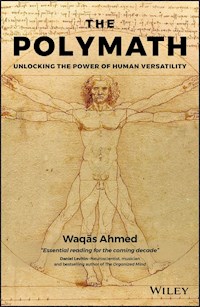
It is entirely appropriate that the cover of Waqās Ahmed's The Polymath should be Leonardo's Vitruvian Man, the outstretched figure inscribed in a square and circle, based on the The Ten Books on Architecture by Vitruvius. It is Leonardo's visual hymn to the essential oneness of human beings, the world and the cosmos. It is often used opportunistically in advertising and elsewhere to endow something routine with apparent profundity. Here, however, it is central to Ahmed's endeavour.
Given how we now classify and compartmentalise intellectual and practical pursuits, we tend to see Leonardo's diversity. He saw unity. The unity was that of the fundamental organisation of the physical world, which fell under the embrace of ‘the principles of mathematics, that is to say number and measure – termed arithmetic and geometry, which deal with discontinuous and continuous qualities with the utmost truth’. Behind the myriad diversity of forms in nature lay a set of coherent and consistent laws about how form fitted function in the context of natural law. These universal laws could be extrapolated from behaviours of light, the motion of solids and fluids, the mechanics of the human body and from every phenomenon that involved action, either as a process or as a result. As an example, he saw the vortex motion of water as expressive of the same rules as the curling of hair. We now assign the former to dynamics, the latter to statics. He saw across boundaries that we now use to separate branches of knowledge. My personal discovery of Leonardo's unity is recounted in my recent Living with Leonardo, which tells of a personal journey that began with a degree in science and culminated in the world's most expensive work of art, the Saviour of the Cosmos.
Leonardo's mathematical polymathy was of a particular kind, but I do think it likely that most polymaths see more unity in their diversity than we can readily discern. They are better at seeing relationships, analogies, commonalities, affinities, relevancies, underlying causalities, structural unities. It is of course difficult in our modern world for an artist to work as a professional engineer – something that was accepted in the Renaissance, even if uncommon. Any polymath today cannot but be aware of the jealously guarded professional boundaries that need be crossed. Institutional structures, erected most diligently in the nineteenth century, leave no doubt where these boundaries are. They are designed to keep outsiders out and insiders in. Massive bodies of professional knowledge certify the status the specialists, supported by forests of jargon and barricades of acronyms. The high demands of modern disciplines are real but they are also serve as protective ramparts against everyone who does not belong.
Polymathy in modern societies runs the risk of shallowness and amateurism. We are aware of the stigma that a polymath is a ‘jack of all trades and a master of none’. But there is an older expanded version, ‘A jack of all trades is a master of none, but often better than a master of one’. So many of the great innovations in the arts and sciences arose when outside wisdom was brought to bear on a discipline that had become complacent in its own criteria. Biology in the era of DNA was reformed by the arrival of physicists and chemists. Copernicus's sixteenth-century revolution was driven as much by concepts of beauty as innovatory observation. In 1905 Einstein wrote with eloquent brevity about a vision of space, time and energy, founded upon radical intuition, rather than undertaking a comprehensive review of what was right and wrong in modern astronomy and physics as then constituted. He was an insider who managed to stand outside.
There is of course a danger in conquesting someone else's territory without due respect and humility. I see this with Leonardo studies. Modern professionals in, say, engineering, assume they can solve the problem of understanding Leonardo through their privileged and narrowly focussed knowledge, transposing Leonardo into the modern world as ‘a man ahead of his time’. The result is distortion. Something similar occurred when the artist David Hockney claimed that painters have long used optical devices to assist their depiction of nature – an idea with which I have much sympathy. This opened the door to experts in modern optics, not least in lenses, who had scant interest in the nature of early optical instruments and what the business of picture-making was like at the time. In characterising the past, we need to be alert to the arrogance of the present.
True polymathy involves a unique and improbable blend of incorrigible ambition, undeterability, imagination, openness, and humility. It cannot be the same as it was in Leonardo's day. However the principle of seeing something as if it were something else – seeing it as belonging in other than its normal conceptual place – is more vital now than ever if we are to nurture the cultures of mutual understanding that are necessary for the survival of the human race.
Martin KempEmeritus Professor of the History of Art, Oxford University
PREFACE
A mind that is stretched by new experiences can never go back to its old dimensions
– Oliver Wendell Holmes Sr.
My interest is in the pursuit of the optimal life. That is, in developing a mind and experiencing a life that is the richest it can be. So while this book proposes a new way of thinking, it also sets out a new way of being human, a new way of living – different from that which has been set out for you as ‘normal’ by forces that claim to know better. It calls for an extraction of the soul from the current paradigm, like an astral projection, and a visit to the realms of history and possibility. It must all begin by living the conscious, mindful life, by switching the mind on to think more often and more effectively – about the objects and their connections, the whole and the particular, the philosophical and the practical – so that you can become all you can be: the complete you.
I was not commissioned to write this. It was purely a personal intellectual odyssey until recently when I realised it became too important a thing not to share with the world. As such, work on it was woven between a range of experiences – physical, emotional, intellectual, spiritual and otherwise – each giving me a unique insight into the topic at hand.
After all, you are what you experience. Each and every thought, emotion and inflow of knowledge will either subtly or fundamentally impact your perspective on any given thing over time. This is not just intuitive speculation, but a neuroscientific fact. Your evolving nature manifests in your connectome - the complex, ever-changing circuitry unique to each brain. As such, I was both proactive and reactive in researching and writing this book. I didn't ‘immerse’ myself in the subject, except for intermittent periods. Complete immersion would have risked the sort of narrow-minded specialisation that this book ultimately seeks to challenge. Conscious of this, I allowed the knowledge from all other facets of my life over a five-year period to fuse, clash and connect with pre-existing material in my mind. Hence I remained open as to my approach, structure, content and conclusion, until the very end.
I saw the Butterfly Effect in action as each thought, idea or fact fundamentally altered the position and nature (or even existence) of previous ones. I came to understand the dynamic fluidity of ideas and opinions. I did not begin with a thesis and look to post-rationalise, as is the common method. Instead, from start to finish, this book was an exploratory adventure that, at any given point, revealed extraordinary – at times transformational – insights about the mind and the world.
The past five years have thus provided me with much more of ‘an education’ than my entire school-university life. It was during this period, in my late twenties, that I wrote most of this book. I was never unconscious of the immense responsibility that came with it being the first-ever book in the English language on the subject. The insights I include in these pages are thus from a wide range of experiential and intellectual sources; comprising the words of prophets, sages, scientists, historians, philosophers, artists, polymaths and – through scripture – God himself. Having a young, limited mind, I rely heavily on such wisdom – my endeavour was to curate, synthesise and communicate.
As they read through the book, some critics may be eager to identify my method of inquiry with something they're familiar with so they ‘know where I'm coming from’ – is he a traditional postmodernist, or perhaps a Nietzschean perspectivist? Is he employing the philosophy of Daoist Zhuangzi or the Jainist Anekantavada? Is he from the school of Ibn Khaldun or Al Ghazali? The answer is simultaneously all of the above, and neither. Like postmodernism, my thought is not an easy beast to pin down, but unlike it, it acknowledges the possibility of Truth or Ultimate Reality and recognises the multiple ways of pursuing and experiencing it. In this way, I am not indirectly demeaning other cultures and world views by reducing them to mere mental constructs, as most postmodernists, orientalists and materialists do. Indeed if this book does anything of worth, it encourages people to see ideas (and indeed individuals) as hybrid, nuanced, multi-faceted constructs in their own right rather than as automatic members of pre-existing categories.
For a true exploration of the topic, given its wondrous nuances, I knew it was as important to be a futurist as much as an historian, a mystic as much as a rationalist, a storyteller as much as a scholar, a doer as much as a thinker. I recruited whatever methods and tools I felt were necessary. The raison d’etre of this book is as much the provocation of thought as it is a call to action. So I urge you, the reader, to immerse yourself in the world that the book seeks to create for you, to reflect seriously on its content, integrate it into your existing knowledge, assess its applicability and relevance to your own life, thereby storing it in the long-term memory, ready for use in future thinking. This is the process of internalisation, without which knowledge fails its most important role: to enrich the mind.
This book has certainly given me a blueprint for what little there may be left of my future. Anyone that knows me can see that I live my life according to the thinking and lifestyle outlined in these pages; my work in various fields have both influenced and been influenced by the process of writing it. But this is no longer about me. Of much greater importance is your readiness to commence your journey to self-actualisation. And if this book contributes even an atom’s weight to that preparation, then all the credit is God’s and only the shortcomings are my own.
I'm well aware that after publishing this book I may often come back to it a different man, with different insights, at various points of my life. If I were to revisit this book having learnt Mandarin, lived with a Samoan clan, studied zoology, learnt to play the lute and competed in a triathlon, I'm sure my insights would be different, if not more evolved. At the point at which I have significantly more to add or amend, I may look at revising this work, or building on its ideas in a separate volume – or perhaps someone better qualified will do me the honour.
The sheer complexity of this subject implies that its investigation must be an ongoing pursuit rather than a mission accomplished. As Leonardo da Vinci said: ‘art is never finished, only abandoned’. In the same vein – while by no means with the same authority, nor for a moment considering this a work of art – I'm letting this go for now.
Waqās AhmedOctober 2018
Chapter 1Introduction
She was black. And poor. Still she rose remarkably from a life of discrimination and abuse in 1950s America to become a key figure in the civil rights movement. She was at the heart of the struggle, a prominent campaign organiser who worked for both Martin Luther King Jr. and Malcolm X prior to each of their assassinations. Even after the historic Civil Rights Act of 1964, this young radical would continue to be at the forefront of the fight for social justice and women's rights.
Her continuing interest in social causes led her to take a job as a globe-trotting journalist, first for The Arab Observer in Cairo and then the Ghanaian Times in Accra. Extensive travels allowed her to satisfy her linguistic curiosity, and she would come to know a variety of European, Middle Eastern and West African languages. By the end of her life, she was considered an eminent historian of African-American affairs, with 30 honorary doctorates and a professorship at a major American university.
Accomplishment in politics, journalism, history and languages is a familiar, albeit impressive, career route. But what if I told you that the same young lady was also a professional Calypso dancer, a Tony Award–nominated theatre actress and an acclaimed film director who also happened to write a Pulitzer Prize–nominated screenplay? And all these accomplishments are not even what she's most famous for.
Ultimately, she was known as a literary giant – an outstandingly popular and critically acclaimed poet, playwright and novelist with 30 bestselling titles of fiction and non-fiction to her name. She published several volumes of poetry, for which she was nominated for the Pulitzer Prize and were especially popular among African American women, which have also been recited to mark key events in modern history such as the inauguration of a US president, the death of Michael Jackson and the 50th anniversary of the United Nations. But it is her autobiography – published in several volumes – that is arguably her most important work, and is considered a significant contribution to the understanding of African American experience in the twentieth century. And yes, we're still speaking of the same lady!
In awe of her accomplishments, I contacted, her requesting an interview for this book. To my dismay, she passed away shortly after. Known to us as the great Maya Angelou, this poetess, playwright, author, singer, composer, dancer, actor, filmmaker, journalist, polyglot, historian and activist was a breed of multifaceted human that is now worryingly in danger of becoming extinct: the polymath.
This book is about the full realisation of human potential. As such, it calls for a revolution of the mind, led by an age-old species of human known as polymaths, sometimes (although erroneously) referred to as “Renaissance men”. The most concise way to define them is:
Humans of exceptional versatility, who excel in multiple, seemingly unrelated fields.
That’s the superficial definition. Put differently, polymaths are multi-dimensional minds that pursue optimal performance and self-actualisation in its most complete, rounded sense. Having such a mindset, they reject lifelong specialisation and instead tend to pursue various objectives that might seem disparate to the onlooker – simultaneously or in succession; via thought and/or action. The inimitable complexity of their minds and lives are what makes them uniquely human. As such, they have shaped our past and will own our future. This book explains how.
While one might be able to argue a certain neurobiological distinction to standard Homo sapiens (we now know there is a correlation between behaviour, personality and the size and structure of the brain) the reference to a ‘species’ or ‘breed’ in this context is largely metaphorical. So who actually qualifies as a polymath? Although there are many versatile people who operate – to varying extents and with mixed success – in different fields, the point at which the versatile operator, or the dabbling dilettante, becomes a true polymath depends on the level of accomplishment or mastery attained in each field taken with the sheer variety of fields altogether.
Let us take the case of the notorious nineteenth-century Italian adventurer Giacomo Casanova. By the age of 25, he'd already had short but lively careers as a court lawyer, soldier in the Venetian army, violinist for the San Sanuele theatre, professional gambler, physician to Venetian noblemen and clergyman in Rome. Following a period of scandal, imprisonment, escape and social climbing on the Grand Tour around Europe, he gained a reputation among Parisian nobility as an alchemist, became a spy for the French government, sold lottery schemes to European governments and then spent his last years in Bohemia as a librarian in Count Waldstein's household, where he wrote the illustrious memoirs that would make his name synonymous with womanising. What a colourful life! But do Casanova’s illustrious pursuits qualify him as a polymath? Or did he fall short, spreading himself too thin and failing to make any real contribution in most of the fields in which he operated?
Or what of American fraudster Ferdinand Waldo Demara, who assumed various identities over a lengthy career as a serial impostor in the mid-twentieth century. Without the necessary qualifications, he worked deceitfully (but indeed successfully) as a ship’s doctor, a civil engineer, a sheriff's deputy, an assistant prison warden, a doctor of applied psychology, a hospital orderly, a lawyer, a child-care expert, a Benedictine and Trappist monk, a newspaper editor, a cancer researcher and a teacher. Here was a man of great variety; but did he demonstrate the necessary depth as well as breadth to be called a polymath?
Technically, the polymath usually excels in at least three seemingly unrelated fields (‘poly’ being more than two). But in reality, to suggest that someone ‘has excelled in’ or ‘is accomplished in’ a particular field would be a relative statement. Accomplishment – just like happiness, success and intelligence – comes in various forms, and is a generally subjective state of being. Conventional manifestations of accomplishment, however, usually include any one or a combination of the following: critical acclaim, popular recognition, financial success, publication or exhibition of works, qualification or award, demonstrated skill and experience. But even assessing accomplishment simply in terms of a profession or academic discipline is a rather insular and limited way of viewing the polymath. A human being is much more than her “profession” or field. Many-sidedness comes in many forms. So the real polymath has a type of mind and approach that is far more substantial and holistic, as we will explore later.
In any case, one must be careful not to throw around the label of ‘polymath’ too loosely; there is a difference between simply being multitalented and being a genuine polymath, just as there is a difference between being intelligent and being a proven genius. A multitalented individual does not necessarily utilise or bring to fruition those talents to accomplish things in the fields that correspond to each talent. That said, few people realise that the term applies to a host of different types of individuals, including those that may not have been thought of as polymaths before.
In all cases the prerequisite, as mentioned earlier, is an ‘exceptional cross-domain versatility’, but the greatest, most influential, most self-actualised polymaths are essentially self-seeking, holistically minded, connection-forming humans characterized by a boundless curiosity, outstanding intelligence and wondrous creativity.
Of course, every human is born with multifarious potential. Why, then, do parents, schools and employers insist that we restrict our many talents and interests; that we ’specialise’ in just one? We've been sold a myth, that to ‘specialise’ is the only way to pursue truth, identity, or even a livelihood. Yet specialisation is nothing but an outdated system that fosters ignorance, exploitation and disillusionment and thwarts creativity, opportunity and progress.
Following a series of exchanges with the world's greatest historians, futurists, philosophers and scientists, this book weaves together a narrative of history and a vision for the future that seeks to disrupt this prevailing system of unwarranted ‘hyper-specialisation’. Indeed, it reveals that the true specialist is actually a polymath.
There is another way of thinking and being. Through an approach that is both philosophical and practical, we will set out a cognitive journey towards rediscovering and unlocking your innate polymathic state. Going further, this book proposes nothing less than a cultural revolution in our education and professional structures, whereby everyone is encouraged to express themselves in multiple ways and fulfil their many-sided potential. Not only does this enhance individual satisfaction, but in doing so, facilitates a conscious and creative society that is both highly motivated and well equipped to address the complexity of twenty-first-century challenges.
To take the reader on that journey, this book will follow a very particular structure. To begin, we need to understand that in different societies and at different times, polymaths have always existed and indeed were some of the most influential figures in world history, instrumental in shaping the modern world. This is particularly important, as today we live in a highly specialised society which discourages (almost suppresses) the polymath, as well as any memory of her existence. While this status quo suits a select few (who are happy to divide and conquer by using specialisation as a tool of control), it comes at the expense of human fulfilment, intellectual freedom and societal progress.
Most importantly, sapiens will simply vanish unless we cultivate the mind in a way that makes us indispensable to Project Earth. With machine intelligence and the so-called technological singularity looming (not to mention nuclear, environmental and economic catastrophes that are more imminent), the world has little choice but to see a revival of the polymath, as it is only this species of multifaceted, complex, creative, versatile and inimitable human that will have any value or relevance in a highly complex, automated, super-intelligent future.
So what to do? First, we must all recondition our minds to be able to think and operate like the polymath, adopting the timeless traits and methods demonstrated by countless polymaths throughout history. We must then identify those polymaths still living to seek out lessons on how to unleash our own polymathic potential and resist the hyper-specialisation forced upon us by the system.
Finally, we must seek to change the system itself – its prevailing culture, educational curricula and pedagogy, social structures, institutions, work environment and indeed its general worldview – and replace it with one that breeds and encourages polymathic minds and ushers in a new global generation of polymaths. It is only these optimally functioning, highly creative, self-actualised minds that can take stewardship of the future and steer humanity towards a progressive tomorrow. It requires nothing less than a revolution that is both cognitive and cultural; the following chapters aim to awaken your consciousness, so that you, too, might join it.
Let us be clear from the start: polymaths are not members of an exclusive club, order or society – every human has the potential to become one. In fact, ‘becoming’ is perhaps less accurate than ‘reverting’. We are all inherently multifaceted beings and clearly demonstrate this disposition during childhood; whether or not we remain that way into adulthood is determined by a cornucopia of cultural, educational, political and economic influences. So for the individual, to be a polymath is in essence to be true to your primordial self; it is to unlock the glimmering potential of an otherwise slumbering mind. The first part of that process is to compute and internalise a fundamental fact: that polymaths are a timeless people.
Chapter 2A Timeless People
The polymath is as old as the Homo sapien himself. The capricious nature of early human life, in which human knowledge was limited yet the challenges and opportunities so great, would have demanded exceptional versatility and creativity. Zoologist and ethnologist Desmond Morris, in his popular book The Naked Ape, confirmed that the human is by nature the most non-specialised, adaptive, opportunistic animal of all. So it's not surprising that the leading world historian Felipe Fernández-Armesto postulated that ‘the further back you go the more polymathy there was, because, until fairly recently sub specie aeternitatis, domains were undefined and expertise in one field would not have inhibited interest in another … an expert stargazer could be a healer or hunter or whatever he or she seemed apt for.’
In such early societies, most humans would have made it their business to become ‘practical generalists’ – that is, to acquire a wide range of knowledge and skills which had a practical value for their survival. This often meant that one person would have the knowledge of a botanist or physician (to know which plants harm, heal or are edible), the skills of a hunter (to provide for themselves and their families), the creativity of an architect or engineer (building a safe house or shelter on the correct terrain using the right materials) and the mind of an artist (to entertain and enlighten his family or community through games, shows and visual artwork). There was no division of labour – everyone was everything they could be.
Of course, everyone had his or her particular strengths and inclinations, which were recognised, encouraged and drawn upon for the sake of the family, community or tribe. A functionalist society did inevitably develop. But there is no evidence of a culture of lifelong micro-specialisation. Moving on from traditional societies, the polymath was integral to the creation of the early civilisations and the resultant ‘high culture’ responsible for the great artistic and scientific accomplishments of ancient history. Considering great ancient edifices such as the pyramids of Egypt and Central America, the ziggurats (staged tower temples) of Iraq, the palace of Knossos in Crete, the fortress at Mycenae in mainland Greece and the grid-planned cities of Harappa and Mohenjo-daro on the Indus, popular writer and historical investigator Graham Hancock believes that the great monuments built during these times are in themselves evidence that the architects were polymaths:
If you look at the achievements of the Ancients, you will find that only polymaths could have created them. Even if we don't have biographies of the individuals concerned, we can deduce from their handiwork that these were not a team of narrow specialists but rather a group of people that were multiply able in many different disciplines.
There's no better example of this than Imhotep, the architect of the step pyramid at Saqqara and the first of the historically recorded polymaths. Most historians agree Imhotep was a contemporary of the legendary King Djoser (probably the best known pharaoh of Egypt's Third Dynasty). Imhotep was a commoner who received a relatively liberal education and according to his biographer ‘grew up an erudite, versatile man, a sort of Aristotelian genius, who took all knowledge for his province’. His genius, it seems, was quickly identified and rewarded as he rose up the ranks and eventually gained the attention of King Djoser himself. It was this close relationship with the king that allowed Imhotep both the flexibility and resources to be able to explore the diversity of his interests and exhibit the multitude of his talents.
Impressed by his potential, Djoser appointed Imhotep as his trusted minister, or vizier. It was in this role that he flourished most, involving as it did a variety of cross-disciplinary duties. His jurisdiction ‘extended over the various departments of state’, including ‘the Judiciary, the Treasury, War (Army and Navy), the Interior, Agriculture, and the General Executive’. It was a sort of twenty-first-century prime ministerial or chief executive role, and there are many examples given by historians of Imhotep's skilled statesmanship in areas of economy, foreign relations and public engagement.
Imhotep's newly found status and power allowed him to pursue activities beyond his conventional stately duties. His polymathic urge pushed him towards his greatest talents: architecture, medicine, spirituality, science, poetry and philosophy. As an engineer and architect, Imhotep made some phenomenal breakthroughs. With his works fast appearing around the region, Imhotep became known for being one of the first to use columns in his buildings. His impressive ability to design, compose and work with stone (he had built many buildings around the region of Saqqara) won him an ambitious project to design the Saqqara step pyramid for King Djoser. This provided Imhotep with the opportunity to display his abilities not only as an architect, but also as a sculptor, astronomer and inventor. He designed the Djoser Pyramid to be the world's first completely stone-dressed building of such magnitude. The result was a staggering 200-foot- tall stone pyramid which revolutionised the architectural world of the time and set a precedent for successive Egyptian dynasties. Furthermore, it is considered by researchers such as Robert Bauval as ‘an astronomical “manual” in stone’ for its hidden celestial alignments.
As a physician, Imhotep's achievements are recognised as being equally, if not more, groundbreaking. He is known to have identified and cured over 200 diseases and written numerous treatises on medicine. He is credited with the invention of the papyrus scroll and has been identified as the author of what would become known as the Edwin Smith papyrus – a medical treatise remarkable for being uncharacteristically devoid of supernatural notions, and which contains a series of landmark anatomical observations, ailments and cures, including the use of honey for wounds and the use of raw meat to stop bleeding. Imhotep's reputation as a skilled and innovative physician played an instrumental role in earning him his demigod status for centuries after his death. Physician Sir William Osler said it was Imhotep who was the real ‘Father of Medicine … the first figure of a physician to stand out clearly from the mists of antiquity’. Imhotep's legacy in the medical profession can be seen in the origins of the Hippocratic oath (an oath taken by all physicians upon practising) in which it refers to Asclepius – the god that the Greeks associated with Imhotep – as a god to be sworn by.
Beyond this, Imhotep played an important role as chief lector priest (a priest of the higher class) with permanent duties and spiritual engagements such as sacrificial ceremonies and mummy funeral processions. He often represented the king (the ultimate high priest of the kingdom) at events, a position he could only have been elevated to if in possession of the appropriate skills and respect. Imhotep also produced works in philosophy and poetry. His ideas were famously referred to in poems such as ‘I have heard the words of Imhotep and Hordedef with whose discourses men speak so much’ and he is accredited with various proverbs, including the famous ‘Eat, drink and be merry, for tomorrow we may die’. The rareness of such diverse overachievement seems to have overwhelmed the people of his time – who perhaps saw this as an indication of his divinity – and he became the only commoner ever to be elevated to divine status and to be depicted as part of the pharaoh's statue.
As a practising physician, architect and astronomer who also made tremendous contributions to Egyptian society and culture as a priest, inventor, poet, philosopher and statesman, Imhotep was one of the first recorded polymaths. His official titles according to the inscription of his tomb include:
Chancellor of the King of Egypt, Doctor, First in line after the King of Upper Egypt, Administrator of the Great Palace, Hereditary Nobleman, High Priest of Heliopolis, Builder, Chief Carpenter, Chief Sculptor, and Maker of Vases in Chief.
Patronage
Like Imhotep, polymaths have, in most cases throughout history, had a platform – namely in the form of a social or professional position – which provided them with opportunities to explore and contribute to multiple fields. Their job intrinsically allowed (or sometimes required) them to be polymathic. A typical example of such a platform that has existed for much of social history is the position of the courtier. These were intellectuals and artists who acted as advisers, administrators or entertainers at the royal courts. Not only did a vibrant and flamboyant court attract polymaths, but it also created an atmosphere that actively fostered and encouraged the multitalented. Given important positions in office, these courtiers relied upon the patronage of their monarch. Their all-round brilliance was either an innate attribute which was favoured and encouraged by the patron, or was fortuitously unleashed through the arbitrary commissioning of various projects relating to different fields.
In Western history, the archetype of such court culture existed in Renaissance Italy. Here, Baldassare Castiglione in his Book of the Courtier outlined the ideal and status of the ‘perfect courtier’: ‘He [the courtier] will have the knowledge and ability to serve them [their princes] in every reasonable thing’. Importantly, royal patrons were not afraid to commission the same individual for various unrelated tasks, as trust in the overall ability of the individual was more important to them than ‘efficiency’, ‘specialisation’ or the division of labour. In this context, it was the position of the courtier that allowed the polymath to thrive at the heart of the establishment.
This was the case with the man considered to be the world's most celebrated polymath: Leonardo da Vinci. This great maestro began as a painting and engineering apprentice at a Florentine guild, and went on to become one of the foremost practitioners in both fields. At least two of his paintings – Mona Lisa and The Last Supper – are considered among the greatest masterpieces of all time. Other works, such as the Virgin at the Rocks and the more recently attributed Salvator Mundi, painted in his signature sfumato style, are also hailed by art critics as paintings that define Renaissance art. As a sculptor, he designed and built the famous but ill-fated Sforza Horse. He also served as a royal stage and costume designer, an event organizer and interior designer and was active during at least two royal weddings. He was named ‘family architect and general engineer’ for Cesare Borgia and designed Mario de Guiscardi's suburban villa. During the siege of Pisa he made topographical sketches, designs for military machines and fortifications for the Signoria of Florence and the Lord of Piombino and also worked as a military engineer for the Venetian Republic during its attempts to resist Ottoman invasion.
A lifelong note-taker, the entire collection of Leonardo's notes forms an exceedingly wide-ranging – albeit seemingly sporadic – thesis containing investigations into philosophy, optics, geometric perspective, anatomy and aviation. Only some of his notebooks have survived, but according to Martin Kemp, the world's foremost authority on Leonardo, they would have constituted around 50 books of academic length – a complete body of universal knowledge uniquely presented in striking visual form.
He underwent anatomical studies with the professor of anatomy at the University of Pavia and mathematical studies with mathematician Fra Luca Pacioli. He made hydraulic and geological studies of the valleys in Lombardi and of Lake Iseo and devised his own flying machine and conducted experiments in human flight. Ultimately, excelling as a painter, sculptor, musician, stage and costume designer, inventor, anatomist, aviator, engineer, military strategist and cartographer, Leonardo was the archetypical polymath. Kemp calculated that if he was asked to ‘assemble a Leonardo’ today, he'd need 13 different professionals!
Patrons such as Sforza and Borgia were happy to allow Leonardo to explore and create in any of the fields that he felt he could contribute to. Their aim was simply to glorify and protect their reign, and if one multitalented individual could help multifariously toward that aim, he would be encouraged. Such polymathy was certainly widespread in Renaissance Europe, and allowed Leibniz to thrive at the House of Hanover and Copernicus to make contributions to the court of Warmia. Around the world, whether in the form of the Persian hakeem, West African griots, the Chinese junzi, or the Mayan itz'at, the tradition of the multipurpose, polymathic courtier existed in most eras of premodern history.
While scholarship was historically supported by royal patronage at the respective courts, other bodies such as religious institutions, ‘mystery schools’, secular academic universities and amateur societies played a major role in supporting the polymath at different points in history. Particularly during the early Middle Ages (often referred to as the ‘Golden Age of God’) we saw many theologians – Christian priests, Jewish rabbis, Hindu and Buddhist punditas and Muslim ‘alims – become the most widely learned individuals of their time; the likes of Bede, Albertus Magnus, Konrad of Megenberg, Psellos and Bar Hebraeus being clear examples in the Christian world, and Abhinavagupta, Chavundarya, Sankardeva, Dikshita and Zanabazar in the East. As Islamic civilisation was particularly well developed during this time, Muslim theologians demonstrated an intellectual versatility beyond any other group. The likes of al-Ghazali, al-Razi and al-Tusi were scholars of religion as much as they were physicians, poets and philosophers. The polymathic culture was so embedded in the Islamic world that even Christian and Jewish polymaths such as Maimonides, Hunayn ibn Ishaq and Abraham ibn Ezra thrived under it.
Laymen
It does not take a qualified historian or a ‘conspiracist’ to conclude that power, wealth, influence and therefore knowledge (whether esoteric or exoteric) have always been confined to a select few in practically every society known to man. And it was these custodians of knowledge who, because of their exclusive access to an abundance of intellectual resources as well as a great degree of professional flexibility, often had the greatest propensity to explore their various talents and interests. The majority of recorded polymaths in history have thus come from – or at least eventually joined – the elite class of their time. In other words, scholars and artists have generally only risen to prominence if they were allowed to by their ruling princes. Politicians, economists, writers, artists, lawyers and soldiers were permitted to excel only if their work accorded with and promoted the status quo. So throughout history, it was principally with the blessing and patronage of kings, emperors, caliphs, dictators and, indeed, governments that multiple talented individuals have been granted the licence to flourish in their entirety.
Although overwhelmingly the case, this, however, is not entirely true. In an era dominated by the ‘great man’ historical narrative, one is compelled to dig into ‘people's’ histories to investigate the extent of learnedness and polymathy among the masses. The craving for intellectual development does not correlate with social or financial standing – it is a universal human trait. Aside from the obviously countless unsung ‘practical generalists’ (see page 7) who must have existed in every culture throughout human history (especially in traditional societies), we must also acknowledge that intellectual erudition or ‘encyclopaedic generalism’ was always prevalent among many of the working class. This ought not to be surprising; being deprived of knowledge, lay people crave and pursue it most eagerly. Some are conditioned by propaganda, excessive work hours and vacuous distractions but most are underestimated in terms of the sheer impressiveness of their erudition. Indications of this are littered throughout the literature, if one but only looks.
American writer Henry Theroux famously recalled coming across a farmer in rural America who had a Greek version of Homer's Iliad in his back pocket while ploughing the field. In China, Fung Ta-tsung, a writer from the Sung period noted that ‘every peasant, artisan and merchant teaches their son how to read books’. He further recorded that ‘even herdsmen and wives who bring food to their husbands at work in the fields can recite the poems of the men of ancient times’.
Jonathan Rose revealed in his seminal work, The Intellectual Life of the British Working Classes, that the desire for and pursuit of intellectual freedom was not exclusively a ‘bourgeois’ concept, and that the British working class or ‘the masses’ were much more well read about a wide variety of subjects than they are traditionally given credit for. He provided various examples, ranging from how artisans published theological and literary works following the sixteenth-century Reformation to how an autodidactic (self-learning) culture developed among weavers in eighteenth-century Scotland. The now celebrated painter, poet, political activist and religious commentator William Blake, for example, was one of the few from this artisan tradition who came later to be recognised as a polymath. Many polymaths from the past have been lost in the pages of history, simply because they were not considered worthy of recognition or ‘in alignment’ by those who commission histories.
Women
What about women? Why isn't there a popular female version of the ‘Renaissance man’? Unfortunately, the monopolisation of knowledge through history is as true with gender as it is with class. A long history of chauvinism has resulted in outrageously few recorded female polymaths vis-à-vis their male counterparts. It is men who repeatedly show up as ‘polymaths’ and ‘Renaissance men’ in our records. One of the reasons for this is that while many female polymaths did exist they were omitted from the records or simply overlooked by those (overwhelmingly men) who wrote and recorded history. This is because most (though certainly not all) societies in human history have been largely male-dominated.
While it is true that historians are principally responsible for ignoring (or simply concealing) the polymathic achievements of women over the years, the unfortunate reality remains that very few female polymaths actually did exist in the public sphere. This has less to do with their ability or propensity to polymathise (in fact the opposite was probably the case) and more to do with cultural norms and the barriers imposed on them by the restrictive societies of their time.
With some exceptions such as the Kemetic royalty, bluestockings of Enlightenment Europe, the Al-Muhaddithat of early Islam and courtesans of Tang China, women were seldom included in intellectual and professional circles prior to the modern age. While the male courtier, for example, was traditionally respected as well mannered, multitalented, widely educated and cultured, his female counterpart, the courtesan – while in many cases being equally cultured and multitalented – was automatically (and often inaccurately) associated with sexual promiscuity. The Japanese geisha, many of whom were artistic polymaths, are examples of this gender bias.
Modern Hollywood suffers from a similar phenomenon. The versatility of men is welcomed, whereas women are too often branded according to sex appeal. Hedy Lamarr, for example, one of the most popular Hollywood film actresses in the 1940s, was also a talented inventor. She devised a frequency-hopping system to prevent torpedoes from being jammed, which is still used today in Bluetooth devices. Academy Award winner Natalie Portman was also a mathematics prodigy. There are several such examples.
Going back to the grassroots, women have traditionally lived a domestic life through much of human history and so contributions to society, scholarship and culture in multiple fields - let alone one - became less possible for them. Cultural critic and feminist scholar Gayatri Chakravorty Spivak explained this:
The prospect of polymathy has not been available to women, because women funnily enough have been defined as private persons. Even I, who had a relatively liberal upbringing in a highly educated and cultured family in India, believed that women did not have academic personalities. The ones that achieved in one field became, to quote Derrida, ‘honorary males’. Even if she does go on to become polymathic, she's then detested by other women because of ideological issues and so on. It's a very sad thing.
Even in domestic life, the female's ability to be polymathic has nonetheless been adequately demonstrated, juggling between various tasks such as child rearing, food preparation, educating, entertaining, farming and processing. In traditional South Asian culture, for example, ghargrasti (literally translating as ‘house management’) is essentially a multifaceted role in its own right that requires effective switching between various cognitive aptitudes, strands of knowledge and emotional and intellectual attributes. These may have included cooking and cleaning, handling household finances, raising and educating children, skilfully managing social relationships, being steadfast in caring for the family, entertaining guests appropriately and maintaining one's own appearance among many other tasks. Indeed, various studies have now come to show that women are in fact better multitaskers and adjustors than men. ‘The ability and practice of epistemological shifting [needed by the polymath] does exist among women’, says Spivak, ‘but it has not been allowed to enter the public sphere’.
Women prior to the modern period, particularly in Europe, were marginalised from most forms of social, professional and intellectual life. The Enlightenment itself was ludicrously male dominated. It was, however, acknowledged by British philosopher Alfred North Whitehead that uneducated, well-travelled women during this period were actually often more cultured, wiser and better-informed than their husbands, as male education after the Industrial Revolution was merely the installation of inert (disconnected, useless) ideas designed to prepare them for a particular job rather than to understand the world.
Many female polymaths lived in the shadow of their husbands or lovers. This was particularly true during the French Enlightenment, when the wives and lovers of many intellectuals often served as their salon hostesses, translators or researchers, but who in many cases made notable contributions in their own right. Marie Lavoisier, wife of French nobleman and chemist Antoine Lavoisier, was a linguist, chemist and artist who translated her husband's books as well as illustrated them. She also travelled with him as his researcher and ran salons where she would entertain other prominent figures such as Benjamin Franklin. But she was too female to be acknowledged as a polymath.
Émilie du Chatâlet was the lover of Voltaire, who once said of her that she is ‘a great man whose only fault was being a woman’. She was a mathematician, physicist and translator who also wrote a critical analysis of the Bible, developed a system of financial derivatives to pay off her debts, wrote a variety of discourses on philosophy and linguistics and became an activist in support of female education. Yet she's still known primarily as ‘Voltaire's lover’.
Although there are numerous examples of acknowledged and acclaimed female scholars, artists and leaders from around the world, very few have been known publically to have accomplishments in multiple domains. Examples such as Ban Zhao, Lubna of Corboba, Hildegard von Bingen, Anna Maria von Schurman, Maria Agnesi and Florence Nightingale – whom we'll explore in the following chapter – are rare. Even as women began to enter the public sphere professionally in the modern era, they had to work twice as hard as men, and specialisation and single-field focus was seen as the way to go about proving themselves worthy.
The idea of the ‘bluestocking’ (or the ‘learned lady’) in Europe only came to being in the late eighteenth century. Women's academic institutions only sprung up worldwide in the later nineteenth and early twentieth centuries, when the Seven Sisters colleges in the United States, Girton and Bedford colleges in the UK, Tsuda College in Japan, and Lahore College for Women in India became among the first established, as were new co-ed universities such as the University of Chicago and the London School of Economics. And so, unfortunately, we'll find a disproportionate focus on male polymaths in much of this book, even if the notion is equally applicable (and indeed pertinent) across genders.
The ‘Other’
Like women and the laymen, polymaths from societies other than Anglo-European have been neglected or omitted from the pages of history. Even the best of historians have always been prone to certain cultural and political biases – whether deliberate or unintentional – meaning that their versions of ‘world history’ are restricted to a very one-dimensional perspective. The reality is that most history texts were either directly commissioned by the ruling authorities of the time or were indirectly influenced by the prevailing doctrine.
Over the past 400 years, for example, most historical references to non-Western events, people, culture and thought have come from what Edward Said famously referred to as the ‘Orientialist’ perspective – that is, either cherry-picked, downplayed, or consisting of derogatory stereotypes and inaccurate generalisations about the ‘Other’. Said referred to numerous examples from Western literature to demonstrate this tendency, which came about due to the development of a peculiar superiority cult.
The notion of ‘Western civilisation’ – as the inheritor of Greek thought, Roman law and Anglo-Saxon adventurism – was propagated as the ‘central force for progress’ following the Renaissance and then taught and studied by the elite in Europe as ‘the classics’ since the Enlightenment. All other (often grander) civilisations such as the Indian, Islamic, Babylonian, Chinese, Egyptian and Mayan were thus degraded and generalised, collectively falling into the ‘Oriental’ category, while Native Indian, Pacific Island, African and Aboriginal societies fell into the category of ‘savages’. The Western ‘historical method’ – like its sibling the ‘scientific method’ – thus assumed superiority vis-à-vis all other forms and methods of retelling history by indigenous historians worldwide. As a result, very few Western historians genuinely and proportionately integrated various cultures and histories into their own historical world narrative. This bias, of course, has not always been exclusive to the West – it is a feature, to one extent or another, of any dominant society or empire at each epoch in history. Every major empire had the hubris to consider itself the centre of the world.
Ideas that originate outside the West and do not accord with the current paradigm are often derided as ‘pseudo-history’, ‘pseudo-science’ or ‘philosophical mumbo-jumbo’. And while some remarkable works from around the world have been brought to us, even the best translations often fall short of capturing the true essence and cultural nuances of these works. Efforts specifically made to ‘anglicise’ certain works only serve to reinforce the lack of understanding between cultures. Even the most ‘educated’ of people today are therefore often only educated in one of the myriad of perspectives that exist worldwide – they merely scratch the surface of knowledge.




