


28,99 €
Mehr erfahren.
- Herausgeber: John Wiley & Sons
- Kategorie: Fachliteratur
- Serie: The Portable MBA Series
- Sprache: Englisch
A totally revised new edition of the bestselling guide to business school basics
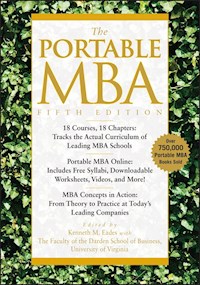
The bestselling book that invented the "MBA in a book" category, The Portable MBA Fifth Edition is a reliable and information-packed guide to the business school curriculum and experience. For years, professionals who need MBA-level information and insight-but don't need the hassle of business school-have turned to the Portable MBA series for the very best, most up-to-date coverage of the business basics.
This new revised and expanded edition continues that long tradition with practical, real-world business insight from faculty members from the prestigious Darden School at the University of Virginia. With 50 percent new material, including new chapters on such topics as emerging economies, enterprise risk management, consumer behavior, managing teams, and up-to-date career advice, this is the best Portable MBA ever.
- Covers all the core topics you'd learn in business school, including finance, accounting, marketing, economics, ethics, operations management, management and leadership, and strategy.
- Every chapter is totally updated and seven new chapters have been added on vital business topics
- Includes case studies and interactive web-based examples
Whether you own your own small business or work in a major corporate office, The Portable MBA gives you the comprehensive information and rich understanding of the business world that you need.
Sie lesen das E-Book in den Legimi-Apps auf:
Seitenzahl: 824
Veröffentlichungsjahr: 2010
Ähnliche



















The PORTABLE MBA
FIFTH EDITION
Kenneth M. Eades
Lynn A. Isabella
Timothy M. Laseter
Peter L. Rodriguez
Paul J. Simko
Ian Skurnik
Copyright © 2010 by Kenneth M. Eades, Lynn A. Isabella, Timothy M. Laseter, Peter L. Rodriguez, Paul J. Simko, and Ian Skurnik. All rights reserved.
Published by John Wiley & Sons, Inc., Hoboken, New Jersey.
Published simultaneously in Canada.
No part of this publication may be reproduced, stored in a retrieval system, or transmitted in any form or by any means, electronic, mechanical, photocopying, recording, scanning, or otherwise, except as permitted under Section 107 or 108 of the 1976 United States Copyright Act, without either the prior written permission of the Publisher, or authorization through payment of the appropriate per-copy fee to the Copyright Clearance Center, Inc., 222 Rosewood Drive, Danvers, MA 01923, (978) 750-8400, fax (978) 646-8600, or on the web at www.copyright.com. Requests to the Publisher for permission should be addressed to the Permissions Department, John Wiley & Sons, Inc., 111 River Street, Hoboken, NJ 07030, (201) 748-6011, fax (201) 748-6008, or online at http://www.wiley.com/go/permissions.
Limit of Liability/Disclaimer of Warranty: While the publisher and author have used their best efforts in preparing this book, they make no representations or warranties with respect to the accuracy or completeness of the contents of this book and specifically disclaim any implied warranties of merchantability or fitness for a particular purpose. No warranty may be created or extended by sales representatives or written sales materials. The advice and strategies contained herein may not be suitable for your situation. You should consult with a professional where appropriate. Neither the publisher nor author shall be liable for any loss of profit or any other commercial damages, including but not limited to special, incidental, consequential, or other damages.
For general information on our other products and services or for technical support, please contact our Customer Care Department within the United States at (800) 762-2974, outside the United States at (317) 572-3993 or fax (317) 572-4002.
Wiley also publishes its books in a variety of electronic formats. Some content that appears in print may not be available in electronic books. For more information about Wiley products, visit our web site at www.wiley.com.
Library of Congress Cataloging-in-Publication Data:
The portable MBA / Kenneth M. Eades, Lynn A. Isabella, Timothy M. Laseter,
Peter L. Rodriguez, Paul J. Simko, and Ian Skurnik. — 5th ed.
p. cm.
ISBN 978-0-470-48129-5 (cloth)
1. Management. 2. Marketing. 3. Accounting. 4. Personnel management.
I. Eades, Kenneth M.
HD31.C6134 2010
658—dc22 2009049299
List of Downloadable Materials
Online and in this book:
Downloadable Exhibits 1.1–1.4: PepsiCo Financial Statements and Financial Ratios
Downloadable Exhibit 5.3: Estimate of the Value-Added of Replacing a Standard Machine with an Upgraded Machine
Downloadable Exhibit 5.4: Hypothetical Example of Value Creation
Downloadable Exhibit 5.5: Hypothetical Example of Value Destruction
Downloadable Exhibit 5.7: Illustration of Value Creation and Destruction: Market-to-Book Ratios as the Reinvestment Proportion and Return on Capital Spread Vary
Downloadable Exhibit 5.8: Illustration of Value Creation and Destruction: Market-to-Book Ratios as the Life of the Project and Its Return on Capital Spread Vary
Downloadable Exhibits 5.9 and 5.10: Net Present Value Calculation of a Bond’s Cash Flows from the Standpoint of the Issuer
Downloadable Exhibit 10.1: Percentage Change Income Statements
Downloadable Exhibit 10.2: Common-Size Vertical Income Statements
Downloadable Exhibit 10.3: Percentage Change Balance Sheets
Downloadable Exhibit 10.4: Common-Size Vertical Balance Sheets
Downloadable Exhibit 10.5: Percentage Change Statements of Cash Flow
Downloadable Exhibit 10.6: Summary of Other Key Financial Ratios
Downloadable Exhibits 10.8–10.12: Forecasts and Firm Valuation Estimation
Preface
The first edition of The Portable MBA was published January 1, 1990. Many changes have occurred across the business landscape over the ensuing two decades, and we have updated our readers about the more salient events with each new edition of this book. In fact, much has happened since 2004 when the fourth edition was published, and we will put those extraordinary events in perspective in the second section of this Preface. Before discussing the past five years of business history, however, there are a number of improvements in this revision that you should know about.
The Fifth Edition
Whether you already have a master of business administration (MBA) degree and are looking for a refresher or you are thinking about entering an MBA program in the near future, you will find this book to be a highly useful resource. To start with, The Portable MBA allows you walk the walk of learning the concepts of business. Reading through these chapters and working through the examples provided is the best way for you to get a sneak preview of the feature-length production. Many of the chapters include examples that are available for you to use live on John Wiley & Sons’ web site. Simply go to the web site (www.wiley.com/go/portablemba5e) and click the example of interest to see how the numbers were created. Change an assumption for the problem and see how it affects the final answer. True learning comes from the doing, not the watching, and these live examples allow you to experience some of the analytical work required of MBA students. The more you can reinforce concepts by putting them into action, the better you will be able to use those concepts to improve your decision-making skills and to become a more effective leader in the world of business.
While you are on the web site, you will have the opportunity to meet the author team by observing us teach in our classrooms. Our hope is that these videos will serve to give a personal touch to the words we have written in the chapters that follow. Also, you will gain an appreciation for the classroom experience for an MBA program. We will have more to say about the experience of earning an MBA in the next chapter.
As part of our desire to put you in the MBA experience, many of the chapters show how the materials presented relate to specific courses in top-rated programs. For example, Chapter 5, Financial Management, presents the content of a core course in corporate finance, which is part of all MBA programs, albeit under different titles. At the University of Chicago there are two courses, Introductory Finance and Corporation Finance, that cover the theory and practice of finance. At Harvard the courses are called Finance I and Finance II. Stanford’s principles course is entitled Managerial Finance, whereas the University of Virginia’s Darden School offers Financial Management and Policies as the first course in finance. These same comparisons are provided for accounting, operations, economics, and so on. This information will help you appreciate how business school curricula differ and how they are similar.
And finally, we have provided information about career paths after earning an MBA. Many chapters give a summary of MBA career opportunities to give you a feel for the type of position an MBA might accept as a first job after graduation. For example, there are a host of MBA-level positions in the finance industry, including both the banking and corporate sectors, that provide interesting and rewarding career opportunities. We provide similar information for marketing, strategy, and general management. The final chapter of the book is dedicated to giving hints and guidance about finding a job, which itself is a valued skill taught by the top-ranked programs. We thank Everette Fortner, Executive Director of Corporate Relations, Darden School of Business, University of Virginia, for contributing the final chapter and the various MBA Career sections.
We want to emphasize that every MBA program is unique. There are 463 universities in the United States that offer an MBA degree or the equivalent that are accredited by the Association to Advance Collegiate Schools of Business (AACSB), and each program has its own strengths and particular set of characteristics that make it different. Therefore you should think of this book as the chance to gain a strong appreciation for the knowledge base that serves as the foundation for the value of an MBA degree. We believe that as you read through the book, it will spark within you a curiosity for how this knowledge is communicated within the classroom and how those principles would be enhanced by having a room full of peers involved in a lively discussion about the topic. The interaction and discussion within a classroom as to how the topic relates to the students’ own experiences and interests are where much of the value of the MBA degree is realized. To capture that value, you will need to enroll as a student in an MBA program and live the experience. If you make that choice, we will have succeeded in playing a part in a decision that we believe will prove to be one of the best in your life.
2004–2009
Since the previous edition of this book, we have experienced some of the biggest swings in fortune in the history of the industrial age. Individuals and companies alike have seen the best and worst of times. The past five years of the stock market tell much of the story. The Standard & Poor’s 500 index is a measure of the performance of the U.S. stock market. This index is composed of 500 stocks of the largest companies in the economy that have their shares traded on public exchanges such that the prices can be observed every day. The S&P 500 index began the period at $1,112 and ended at $909, approximately an 18 percent decline over the five-year period. At its peak value in 2007, the S&P was up 40 percent, from which it plummeted 57 percent to its low point in the fall of 2008 before rebounding 34 percent in the spring of 2009.
The stock market is a window to the economy, and the view that began to emerge in 2008 was particularly dismal. The U.S. economy had been rocked by the bursting of a real estate bubble that was fueled by low interest rates and faulty lending practices in the mortgage market. What happened subsequently has been labeled as the subprime mortgage crisis. The crisis was created by a perfect storm of economic factors that resulted in a domino effect that surprised even the most experienced market analyst. A key factor was the subprime mortgages that were granted to people with substandard credit quality. In other words, they did not have sufficient earning power to reliably make the monthly payments. Many of these mortgages were structured with interest rates that were scheduled to rise over time, making it less likely that the borrowers could consistently make the payments. And finally, the situation was exacerbated by aggressive lending practices that often allowed the borrower to buy a house with little or no down payment; that is, borrowers were given 100 percent of the value of properties. Thus, if homeowners got far enough behind in their payments, they had little or nothing to lose by allowing foreclosure on the house.
Exhibit P.1 Standard & Poor’s 500 Index, January 1, 2004–May 11, 2009
The subprime crisis arrived after years of rising real estate prices. MSNBC reported in 2005 that “Despite rising concern about skyrocketing prices—mainly in coastal states—the housing market showed few signs of a slowdown. Sales hit a new record level and prices surged at double-digit rates in many areas.”1 Eventually, however, the housing market ran out of steam and housing prices began to fall. At the same time the economy entered a general slowdown, which put pressure on the subprime borrowers’ ability to make their monthly payments. As the default rates began to rise and houses were foreclosed, financial institutions such as banks that held the mortgages began to experience losses.
The fall of the housing market would have by itself created a significant financial crisis. But most of the damage would have been confined to the individuals who borrowed the money and the banks that lent the money. In 2008 it became clear, however, that the crisis was touching a wide range of financial institutions that had nothing to do with the original mortgages. Through financial engineering, mortgages had become a significant investment vehicle for individuals and institutions around the world. Basically this was achieved by bundling lots of mortgages together in portfolios and then selling claims on the portfolios as investment securities for individual and institutional investors.
Because so many Americans had been buying houses over a protracted period of time, there was an astonishing amount of these mortgage-backed securities on the balance sheets for a wide variety of financial institutions, including mutual funds, banks, investment banks, insurance companies, and hedge funds. In addition, the balance sheets of most of these financial institutions had become swollen with debt, much like the individuals’ balance sheets were burdened with mortgage debt and credit card debt. Therefore, when the losses on the subprime mortgages began to be realized, it created significant losses for a whole host of financial institutions in the United States and around the world. Banks such as Bear Stearns and Lehman Brothers ultimately failed, while others received financial assistance from the federal government under the Troubled Asset Relief Program (TARP).
The crisis was truly global in nature. Although the U.S. financial industry suffered the largest losses, banks in Europe, Asia, and elsewhere were also affected by the loss in value of their investments. The result was a global decline in wealth as stock markets in Amsterdam, London, Frankfurt, Paris, Tokyo, Singapore, Hong Kong, and Mumbai tumbled to reflect the loss of earning power of the world’s corporations. As banks struggled to keep afloat, the credit markets dried up across the globe and corporations as well as individuals found it difficult to borrow money for any purpose. Americans who had become used to routinely accessing credit lines for consumption and investment purposes now had to rely on their savings, much of which had been decimated by the stock and bond market declines.
In the midst of the market crash, the United States became aware of the largest investor fraud every committed by an individual. Bernard Madoff was running a hedge fund with a reported value of $65 billion, when he suddenly admitted that the fund had been operating as a Ponzi scheme for almost 30 years. Rather than investing the funds he collected from investors, he had been using the new funds as payment to existing investors and as money for his family’s lavish lifestyle. Madoff’s fraud affected a large number of individuals, corporations, and charitable organizations. Many of the individuals lost their entire life savings, and charities were forced to shut down as entire endowments were lost. As we said in the fourth edition, once again we find that “the misdeeds of a few have done great damage to many.”
As of the writing of this book, we are well into the recession and the outlook for the economy remains uncertain. Some economists are pointing to signs that the rate of economic decline has begun to slow, meaning that the bottom of the recession is in sight. However, with the unemployment rate at 8.9 percent, the highest point in 26 years, most believe that it will take years before the economy can return to the prerecession unemployment rate of 4.5 percent. Many worry that the heightened role of the government will lead to a decline in innovation and operating efficiency, key ingredients to sustained growth. The national debt has risen to epic levels as the government has embarked on a strategy of investing in the economy to spur overall demand. Neither the short-term nor the long-term effects of this strategy are well understood.
We believe there are, however, good reasons for optimism. Foreclosure rates in many states have fallen. Spending appears to have been stabilized. The weak and volatile stock market has not prevented firms such as Rosetta Stone and Digital Globe from successfully completing their initial public offerings. These IPOs illustrate that there is investment capital available to support companies with promising business plans.
It is within these signs for optimism that we see many of the themes of this book. First and foremost is that business should be about values and value creation. Great companies are those that create and deliver value to customers, shareholders, employees, and the communities in which they do business.
Companies that succeed are those that meet the needs of the marketplace. Strategy begins with an understanding of what those needs are and how to meet them in a better or more distinctive manner than others. Building an enduring business requires innovation to sustain what makes the firm’s services or goods distinctive. Executing a business model depends on the active engagement and commitment of employees at all levels of the firm, but more particularly those in the middle, which we refer to as leading from the middle. In these times of uncertainty and upheaval, ensuring that everyone is engaged and involved, working together to move the company in new directions, is the job of those managers in the middle.
That all sounds pretty straightforward, but the lessons of the past few years are based on numerous examples of companies that lost sight of the basics. Clearly, management must have an acute understanding of risk as well as a culture for leading during times of uncertainty. Thus, new to this edition is a chapter dedicated to risk management. Moreover, in a business environment that is turbulent, management is tempted to stray from its core values. One of our major premises is that when a firm encounters turbulence is exactly when it most needs to rely on core values and strengths. If management fails to look to the interests of all the stakeholders and balance the benefits that accrue to each, ultimately this failure will weaken the company.
Much of our attention in this edition, as in previous ones, is focused on the basics. Most of what is in the following chapters represents the core content of a two-year full-time MBA program. One way for you to go beyond the basics is to utilize other books in the Portable MBA series. For a deeper dive into finance, for example, you should get The Portable MBA in Finance and Accounting, or for marketing, The Portable MBA in Marketing. The next step is to find an MBA program that fits your needs best and “walk the walk” of earning an MBA degree.
The past few years have added credibility to the quote “The only constant in life is change.” In fact, each time we revise The Portable MBA, we are reminded about the fast pace of change in the business world. It may be that you are reading this book because of the changes in your job that prompt you to have a renewed understanding of business, or perhaps you are considering an MBA degree as a means to change your career. In any case, you should remember that change will always be a part of business and part of your life. You could argue that change is why we need managers, because without change businesses could be run by computers! The principles of business will make you a better decision maker within this complex world and all of its challenges. We congratulate you for investing in yourself by reading this book, and we wish you good fortune on your journey into the new set of uncertain waters.
Note
1
.
www.msnbc.msn.com/id/10482623/
.
About the Authors
Kenneth M. Eades (Charlottesville, VA) is Professor of Business Administration and Area Coordinator of the Finance Department of the Darden Graduate School of Business at the University of Virginia. He has taught a variety of corporate finance topics, including capital structure, dividend policy, risk management, capital investments, and firm valuation. His research interests are in the area of corporate finance, where he has published articles in the Journal of Finance, Journal of Financial Economics, Journal of Financial and Quantitative Analysis, and Financial Management. In addition to Finance Interactive, a multimedia tutorial software in finance (Irwin/McGraw-Hill, 1997), he has co-authored two books: Case Studies in Finance (McGraw-Hill, 2010) and Case Studies in Financial Decision Making (Dryden Press, 1994). He has written numerous case studies as well as a Web-based, interactive tutorial on the pricing of financial derivatives. He has received the Wachovia Award for Excellence in Teaching Materials and the Wachovia Award for Excellence in Research. Mr. Eades is active in Executive Education programs at the Darden School and has served as a consultant to a number of corporations and institutions, including many commercial banks and investment banks, Fortune 500 companies, and the Internal Revenue Service. Prior to joining Darden, Professor Eades was a member of the faculties at the University of Michigan and the Kellogg School of Management at Northwestern University. He has a BS from the University of Kentucky and a PhD from Purdue University. His web site is http://faculty.darden.virginia.edu/eadesk/.
Lynn A. Isabella (Charlottesville, VA) is Associate Professor, Business Administration and Area Coordinator of the Leadership and Organizational Behavior area at the Darden School of Business, University of Virginia. She teaches courses in organizational behavior, leadership and change, and teams in Darden’s MBA, MBA for Executives, and Executive Education programs. As a researcher, she focuses on questions of developing one’s personal leadership expertise, leading change as a middle manager, and the events that shape individual careers and propel organizational change.
She is the co-author of two books (Alliance Competence and Leader and Teams: The Winning Partnership) and has published numerous articles in both scholarly and practitioner journals. She has also researched and authored over 70 case studies focused on U.S. and international companies and issues. Several pieces of original research as well as an international case study have received recognition (Academy of Management Best Paper Award, Wachovia Award for Research Excellence, and Wachovia Award for Excellence in Teaching Materials). As a management consultant, she has extensive international experience with companies worldwide helping them develop their global leadership talent and organizational effectiveness. She regularly works with companies in Central and Eastern Europe through the Bled School of Management, and has extensive experience in Latin and South America, China, Africa, and Western Europe. Before joining the Darden faculty in 1990, Professor Isabella was on the faculty of the Cox School of Business, Southern Methodist University, and taught at the Harvard Business School. She earned her DBA and MBA from Boston University, an EdM from Harvard University, and a BS in mathematics from Tufts University. Contact Professor Isabella at [email protected].
Timothy M. Laseter (Charlottesville, VA) serves on the faculty of the Darden Graduate School of Business at the University of Virginia, one of the top-ranked business schools in the country. He also holds adjunct or visiting appointments at IESE in Barcelona, the London Business School, Emory’s Goizueta Business School in Atlanta, and the Stern School at New York University. He teaches courses for MBAs and Executive Education programs addressing operations strategy, supply chain management, and product development.
Prior to launching his academic career, Laseter served as a partner with Booz Allen Hamilton. Founder of the firm’s global network of sourcing practitioners, he advised senior executives in a variety of industries, including automotive, computers, defense, energy, media, and telecommunications. During his 15 years with the firm, he gained a global perspective by transferring among a variety of Booz Allen offices, working out of Cleveland, London, New York, and McLean, Virginia. Engagements addressed a wide range of issues, including overall business strategy, organization, supply chain management, product development, sourcing, and related topics of operations strategy, and spanned the globe, including the United States, Europe, South America, and Asia. Prior to joining Booz Allen, Laseter worked at Siecor—at the time, a fiber-optics joint venture between Siemens and Corning. Earlier in his career he worked as a management consultant with Arthur Andersen and the McLean Group.
A prolific writer for business executives, he is the author of Balanced Sourcing (Jossey-Bass, 1998) and coauthor, with Ron Kerber, of Strategic Product Creation (McGraw-Hill, 2006). Additionally he has authored or coauthored dozens of practitioner articles and book chapters plus numerous academic cases and peer-reviewed articles. His research has been cited in a range of publications, including the Wall Street Journal, the New Yorker, Purchasing, and the Progressive Grocer. Laseter serves as a contributing editor for strategy+business and writes a recurring column on “Operating Strategies.”
Laseter earned a bachelor of science degree in industrial management from the Georgia Institute of Technology with high honors. He holds a master of business administration and a PhD in operations management from the Darden Graduate Business School at the University of Virginia and was a recipient of the Faculty Award for Academic Excellence.
Peter L. Rodriguez (Charlottesville, VA) is an Associate Professor of Business at the Darden Graduate School of Business Administration, University of Virginia, where he teaches courses on global macroeconomics and foreign direct investment in emerging economies. At the Darden School he serves as the Associate Dean for International Affairs and the Director of the Tayloe Murphy International Center. His research interests center on the effects and design of international trade and investment policies, economic development, and corruption. He has published articles in numerous peer-reviewed journals in economics and management, including the Academy of Management Review, Academy of Management Executive, Journal of Business Ethics, Journal of International Business Studies, Organization Science, Review of International Economics, and World Economy. He is active in Executive Education and has worked with many Fortune 500 companies. He is the recipient of numerous teaching awards from all institutions where he has taught, including Princeton University and Texas A&M University. Prior to his academic career, he worked as an associate in the Global Energy group at JPMorgan Chase. He holds a BS from Texas A&M University and an MA and PhD from Princeton University. His web site is http://faculty.darden.edu/rodriguezp/, and he may be reached via e-mail at [email protected].
Paul J. Simko (Charlottesville, VA) is Associate Dean for the MBA for Executives Program and Associate Professor of Business Administration at the Darden School of Business, the University of Virginia. His research centers on issues related to financial accounting information; he has received numerous national and university recognitions for his work. Professor Simko is particularly interested in topics related to how alternative accounting treatments affect firms’ earnings quality. His current research examines the incentives and consequences of earnings management, valuation issues pertaining to intellectual property rights, and the role short sellers serve as information intermediaries. He teaches the core Accounting for Managers course in the MBA and MBA for Executives programs, and elective courses in Financial Statement Analysis. Prior to joining the Darden School faculty in 2002, Professor Simko taught at Emory University, Indiana University, INSEAD, and the Helsinki School of Economics. He has a BS and MAcc from the University of Florida and PhD from the University of Texas at Austin. He has worked as a senior analyst with Citicorp and is a certified public accountant. His web site is at http://faculty.darden.virginia.edu/simkop/.
Ian Skurnik (Charlottesville, VA) is Associate Professor of Business Administration at the Darden School of Business, University of Virginia. His research and teaching focus on marketing, with an emphasis on psychological processes that underlie consumer cognition and behavior. Professor Skurnik is especially interested in how people use information in memory when making judgments and decisions. His research in these areas has been published in journals such as the Journal of Consumer Research and Journal of Personality and Social Psychology. He has taught the core Marketing Management course, as well as elective courses in Marketing Intelligence and Research, Consumer Behavior, and Research Methods. Prior to joining the Darden School faculty in 2006, Professor Skurnik taught at the Rotman School of Management, University of Toronto. He has a PhD from Princeton University. His web site is at http://faculty.darden.virginia.edu/skurnik/.
Introduction: The MBA Degree Experience
Ken Eades
Many people with a master of business administration degree say that their MBA education was transformational in its impact on their lives. If you ask them to describe their experience, however, you will hear stories that differ considerably from each other. In fact, no two people have the same experience, because there are 463 accredited MBA programs in the United States and each has a slightly different curriculum, student body demographics, location, specialties, teaching styles, and so on. MBA programs are offered in a number of formats, including one-year programs, part-time programs, and programs offered by distance (i.e., via the Internet). In the United States, however, most of the best-known MBA programs are delivered as full-time two-year programs. We believe the full-time two-year degree offers the best learning experience due to the high concentration of face-to-face learning in the classroom and the resulting intensity of the learning environment.
In the chapters that follow we present a curriculum experience that is typical for most of the full-time two-year MBA programs. Each chapter contains business principles and concepts for a particular business function or topic. This is the content of the MBA program, which is the glue that holds an MBA student’s experience together. As an MBA student, you will learn a language of business that will connect you to the university, the business school, the faculty, and fellow students for the rest of your life. We cannot overstate the importance of having a quality curriculum delivered by a first-rate faculty as the key ingredients of an MBA student’s experience. However, before we talk about the courses and the curriculum, this Introduction gives you a feel for the overall MBA experience—all the events that surround and contribute to learning, such as the classroom, the community, the career search, and life balance.
The Classroom
The amount of material relevant to developing a business leader has reached epic proportions. While there is a trend toward shortening MBA programs to reduce the time and cost associated with getting the degree, there has also been an explosion of information about business and management practices. Therefore, an MBA curriculum cannot begin to contain all you need to know about business, but rather represents the faculty’s careful choice of the most relevant and most impactful topics for a newly minted MBA entering the workforce. Nevertheless, all MBA programs share the trait of “10 pounds of material stuffed into a 5-pound bag.” This makes the daily schedule the biggest challenge facing an MBA student. Not surprisingly, much of the daily routine revolves around classes: preparing for classes and attending those classes.
The typical MBA class is fast paced and rich in content. This is where the action is. Whether it’s the professor moving the class through a new concept or students engaging in a debate about some aspect of the concept, there is a high degree of engagement and involvement. Teaching styles vary from the classic lecture format to a less structured discussion format. The most common discussion-based classes are those based on a case study.
In a case method class, the discussion is centered on the analysis of a case study that puts the student in the shoes of a manager facing specific challenges at a certain point in time for a particular company or organization. The task of the student is to come to class prepared to make recommendations for courses of action and to explain and defend those recommendations to the professor and the rest of the class. The professor’s role is to use various recommendations to facilitate a discussion among the students that brings out the key learning points for the day. In a more traditional lecture class, the professor will build on assigned reading and problems with a lecture and/or discussion about the topic. Every class is a highly valued learning opportunity, and MBA students are not shy about challenging the professor and each other to get the most out of their time together in class. Ultimately, each student is responsible for his or her own education and each student should strive to contribute to the many learning opportunities that arise in each class period.
The learning in the classroom occurs on several levels. There are the theory and the business principles being taught by the professor and presented in the assigned materials. Then there is the exchange of ideas among the students as they seek to explain these principles and put them to use within a business decision context. Ironically, much is learned from mistakes made by others and by yourself. Mistakes are cheap while you are a student, but become very expensive once you enter the workforce. You can learn more by using the classroom as an opportunity to take risks and to test new ideas in a low-cost environment. The classroom is also a unique opportunity to experience a wide range of opinions from a diverse group of individuals. The best MBA programs attract students with a wide variety of experiences from all points of the globe. Business is global, and learning from other cultures is critical to being successful in today’s world of international commerce and outsourcing.
In 1977 an acclaimed movie, The Paper Chase, portrayed life as a student at the Harvard Law School. Harvard is depicted as a cutthroat environment where students compete intensely to survive. Over the years we have found that MBA students are less focused on the grades they receive and more focused on the value they can gain from the program. Most MBA programs promote a collaborative environment based on teamwork that encourages student interaction and cross-fertilization of ideas. This sort of engagement allows students to develop relationships that are conducive to a tough-minded exchange of opinions inside and outside the classroom. Disagreement is based on facts and logic that ultimately lead to the best-informed decisions. Thus, a lesson learned by MBA students is how to disagree in a productive manner, which makes the classroom discussions safer and more productive.
Students devote a significant amount of time preparing for their MBA classes. Many programs assign students to study groups or learning teams at the outset in order to facilitate the learning process. In fact, it is common for many of the deliverables for courses to be team-based work. Students use these small groups as an important step in the class preparation process. After students work through the assigned materials on their own, they join their learning team to discuss their ideas as a group to learn from each other before attending the class and learning from the professor and the rest of the class. Thus, more time is spent preparing for class than the class itself, and much of the learning occurs during the preparation as well as during formal and informal discussions with students and faculty after class.
The Community
In addition to their academic community, MBA students also have a social community, which encompasses everything outside of academics. There is a natural sense of community among the students, faculty, and staff that develops quickly as a result of the day-to-day interactions of the education process. Becoming a part of the social community may take a little more effort over a slightly longer period of time, but it inevitably becomes an important part of the students’ overall experience. For example, MBA students find a number of ways to be involved with the university town or city through the restaurants, entertainment, and involvement with community projects.
In general, an MBA program is not a place for someone who prefers to work alone and avoid interaction with others. The intensity of the educational experience leads to friendships and relationships that endure for a lifetime. To an extent these relationships are an artifact of the many team-based projects utilized in the typical MBA curriculum. Most of the interactions, however, come from the people skills already possessed by the students when they arrive for the program. MBAs typically enjoy each other’s company in and out of the classroom. They look for opportunities to work together and socialize together. These are traits of people who typically seek careers in business. MBAs also typically bring a sense of giving back to the community in which they live, and MBA programs provide a variety of clubs and other organizations to facilitate such involvement.
Like any university setting, extracurricular activities are an important facet of an MBA’s daily life. Students arrive with a wide variety of interests about their future careers as well as their favorite charities and outreach programs. Most students join a number of clubs and organizations as part of their experience. For starters, there are many clubs based on the student’s career focus, such as a finance club, marketing club, consulting club, real estate club, not-for-profit club, and so on. These are natural affinity groups that are particularly useful networking opportunities to support job searches and to facilitate guest speakers or other events. Other clubs and groups are centered around ethnic or other affinities such as the National Association of Women MBAs, the Black Business Student Forum, a military association, an international business society, and others. And finally, students coalesce around common interests such as the outdoors club, the soccer club, or the community outreach society. These clubs and groups often create events that personally touch students, faculty, and staff and serve to enrich the overall experience in the growth and development of the student.
Once in the workplace, the relationships developed outside of class take on the added benefit of a powerful network that enhances careers and supports and creates business opportunities. Business schools have alumni bases that maintain strong ties over time because of the intensity of their shared experience and because of the commonality of their professional interests.
The Career Search
Choosing to leave a job and then pay the necessary tuition to earn an MBA makes it an expensive proposition. For most people, the two years as an MBA student represent the largest investment they will ever make in themselves, and they want the experience to be as rewarding as possible. The good news is that the data show that the benefits of an MBA strongly outweigh the costs. Forbes magazine conducts an annual analysis of MBA programs1 that shows that graduates from the top 20 programs are able to recoup the costs of their degrees within an average of 3.6 years. The costs included tuition plus the salaries forgone during the two years in the program. A higher salary should not be the primary reason for seeking an MBA, but there is no escaping the fact that the MBA degree meets the economic payoff test.
The MBA degree is a vehicle either to accelerate a career or to change careers. Either way there are very few who select a full-time program with the intention of returning to their previous jobs, which makes the selection of the new career path an important decision. The MBA is a pragmatic degree. It is designed to give expertise that is relevant and helps graduates add value to society. Therefore, getting the right job is just as important as getting the skills needed for the job, which makes the search for that first job a significant time commitment.
The competition for MBA talent during buoyant economies is keen. Newly minted MBAs from top-flight programs will be faced with many rewarding opportunities from which to choose. This is both a blessing and a curse, as the range of options creates a need to give time and energy to assessing each alternative. The recruiting process begins almost immediately upon admittance to an MBA program. Large corporations prefer to hire students as interns for the summer following their first year of the program. Therefore, a student is tasked with learning about companies during the first semester with the anticipation of being interviewed by companies during much of the second semester. The process repeats when students return for their second year of studies. With luck, a student will have already received a job offer from his or her summer internship. If not or if the student wants to change companies or career paths, the search for a permanent job offer might be ongoing during the entire second year of study.
During a recession, the job search process is more difficult and more time-consuming. For highly rated programs, the vast majority of students will succeed in finding a job. Unlike during a boom economy, however, they will rarely receive more than one offer and that offer may not align perfectly with their aspirations. This does not mean that the degree is less valued, and in fact the MBA demands premium respect in all economies. However, the pay and terms of the jobs found in a recession are likely to be noticeably less than the norm during a buoyant economy. The time spent finding the job will on average be much longer than when companies are aggressively filling positions to manage their growth objectives.
Regardless of the economic environment, an important part of the career search is learning about oneself. The best career choices come from an understanding of whether you work well in a large organization or prefer a more entrepreneurial environment. How important is the salary? The work hours? Travel? Are you willing to live outside the United States? Do you ultimately want to run your own company? All of these questions help you discover the best career and the best first job to assist you in reaching your goals.
It is not uncommon for students to return to school with little idea of what they will do next other than that it will be different than what they have done in the past. This is fully understandable, but competition for jobs is intense regardless of the economy, and no one can afford to start their career search too late in the game. In this book we offer descriptions of MBA careers as well as a chapter on what an MBA should do to find a job. We have added this information to this edition because of the importance of the job search in the life of an MBA student. Like anything else, doing the search well pays dividends and doing it poorly or not devoting sufficient time to it will likely result in an undesirable outcome.
A frequent topic of conversation in the halls of an MBA classroom building is the interview experiences of the students. The job search begins with refinement of the student’s curriculum vitae, which is the first source of information for companies to find students for their organizations. The campus interview is the key opportunity for students to distinguish themselves with a company and to learn whether the position is feasible for their personal objectives. Following the campus interview will be either a rejection letter or an invitation for a company visit for a round of interviews with management. These recruiting activities can at times be hectic and pose conflicts with studies, but they also provide invaluable experiences and extend the candidate’s professional networks. Even if an interview or company visit does not translate into a job offer, they can often provide the groundwork for the next job, which could present itself within a few years of graduation.
Life Balance
Being an MBA student is truly a full-time job. Finding a job is also a full-time job. Getting exercise, seeing your family, having fun, and just simply living your life cannot be put on hold for 21 months. Achieving the right balance among these competing forces is difficult. Most students find that they are constantly fighting to find the right balance and frequently readjusting to get back in sync.
Life balance challenges are not unique to being an MBA student. As business school faculty, we hear these same issues from executives in corporations who have fast-paced and demanding jobs. Therefore, it is a fallacy to think that the balancing act will disappear upon graduation. The key to success is to develop a discipline that recognizes the many demands on your time and makes the most out of the time allocated to studying, to recruiting, and to the rest of your life. Learning is hard work, and it requires a highly disciplined approach to managing your daily schedule. Some hints for success include:
Leverage your peers: many programs have preassigned learning teams that will serve to make your class preparation as efficient as possible.
Set a budget of time for class preparation and stick to it; you will rarely feel fully prepared or fully satisfied with an assignment.
Commit to regular exercise, sensible diet, adequate sleep, and personal downtime.
MBA students find it a constant challenge to balance their professional and personal lives. Most find the first few months of the program to be particularly challenging as they learn the hard way how to make use of every hour of the day. There is no typical day in the life of an MBA, but there are many examples available, such as the following blog written by an MBA student at the Richard Ivey School of Business at the University of Western Ontario:2
A Day in the Life …
by Chris Green
I am really busy these days. Here’s a taste:
6:50 A.M. Alarm goes off, and I slowly wake up from a deep sleep. It is hard to get up when it is so dark and cold outside. As I wait for the coffee machine I check my e-mail and the latest news headlines on Google News.
7:40 A.M. I gather my laptop, papers, and snacks and head out the door.
8:00 A.M.




