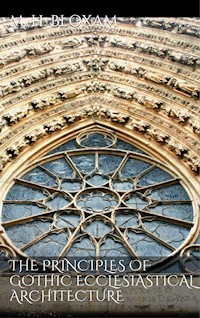
The Principles of Gothic Ecclesiastical Architecture - Matthew Holbeche Bloxam - E-Book

The Principles of Gothic Ecclesiastical Architecture E-Book

Matthew Holbeche Bloxam

0,0
2,99 €

oder
-100%
Sammeln Sie Punkte in unserem Gutscheinprogramm und kaufen Sie E-Books und Hörbücher mit bis zu 100% Rabatt.

Mehr erfahren.
Beschreibung

Amongst the vestiges of antiquity which abound in this country, are the visible memorials of those nations which have succeeded one another in the occupancy of this island. To the age of our Celtic ancestors, the earliest possessors of its soil, is ascribed the erection of those altars and temples of all but primeval antiquity, the Cromlechs and Stone Circles which lie scattered over the land; and these are conceived to have been derived from the Phœnicians, whose merchants first introduced amongst the aboriginal Britons the arts of incipient civilization. Of these most ancient relics the prototypes appear, as described in Holy Writ, in the pillar raised at Bethel by Jacob, in the altars erected by the Patriarchs, and in the circles of stone set up by Moses at the foot of Mount Sinai, and by Joshua at Gilgal. Many of these structures, perhaps from their very rudeness, have survived the vicissitudes of time, whilst there scarce remains a vestige of the temples erected in this island by the Romans; yet it is from Roman edifices that we derive, and can trace by a gradual transition, the progress of that peculiar kind of architecture called Gothic, which presents in its later stages the most striking contrast that can be imagined to its original precursor.

Das E-Book können Sie in Legimi-Apps oder einer beliebigen App lesen, die das folgende Format unterstützen:

EPUB

Veröffentlichungsjahr: 2015

Bewertungen
0,0
0
0
0
0
0
Mehr Informationen
Mehr Informationen
Legimi prüft nicht, ob Rezensionen von Nutzern stammen, die den betreffenden Titel tatsächlich gekauft oder gelesen/gehört haben. Wir entfernen aber gefälschte Rezensionen.


Matthew Holbeche Bloxam

The Principles of Gothic Ecclesiastical Architecture

UUID: f304e874-1db5-11e5-a9e4-4fc950d1ab4a
This ebook was created with BackTypo (http://backtypo.com)by Simplicissimus Book Farm

Table of contents

INTRODUCTION.

CHAPTER I.

CHAPTER II.

CHAPTER III.

CHAPTER IV.

CHAPTER V.

CHAPTER VI.

CHAPTER VII.

CHAPTER VIII.

CHAPTER IX.

CONCLUDING CHAPTER.

INTRODUCTION.

ON THE ORIGIN, PROGRESS, AND DECLINE OF GOTHIC OR ENGLISH ECCLESIASTICAL ARCHITECTURE.Amongst the vestiges of antiquity which abound in this country, are the visible memorials of those nations which have succeeded one another in the occupancy of this island. To the age of our Celtic ancestors, the earliest possessors of its soil, is ascribed the erection of those altars and temples of all but primeval antiquity, the Cromlechs and Stone Circles which lie scattered over the land; and these are conceived to have been derived from the Phœnicians, whose merchants first introduced amongst the aboriginal Britons the arts of incipient civilization. Of these most ancient relics the prototypes appear, as described in Holy Writ, in the pillar raised at Bethel by Jacob, in the altars erected by the Patriarchs, and in the circles of stone set up by Moses at the foot of Mount Sinai, and by Joshua at Gilgal. Many of these structures, perhaps from their very rudeness, have survived the vicissitudes of time, whilst there scarce remains a vestige of the temples erected in this island by the Romans; yet it is from Roman edifices that we derive, and can trace by a gradual transition, the progress of that peculiar kind of architecture called Gothic, which presents in its later stages the most striking contrast that can be imagined to its original precursor.The Romans having conquered almost the whole of Britain in the first century, retained possession of the southern parts for nearly four hundred years; and during their occupancy they not only instructed the natives in the arts of civilization, but also with their aid, as we learn from Tacitus, began at an early period to erect temples and public edifices, though doubtless much inferior to those at Rome, in their municipal towns and cities. The Christian religion was also early introduced,

Lesen Sie weiter in der vollständigen Ausgabe!

Lesen Sie weiter in der vollständigen Ausgabe!

Lesen Sie weiter in der vollständigen Ausgabe!

Lesen Sie weiter in der vollständigen Ausgabe!

Lesen Sie weiter in der vollständigen Ausgabe!

Lesen Sie weiter in der vollständigen Ausgabe!

Lesen Sie weiter in der vollständigen Ausgabe!

Lesen Sie weiter in der vollständigen Ausgabe!

Lesen Sie weiter in der vollständigen Ausgabe!

Lesen Sie weiter in der vollständigen Ausgabe!




















