


22,99 €
Mehr erfahren.
- Herausgeber: John Wiley & Sons
- Kategorie: Fachliteratur
- Sprache: Englisch
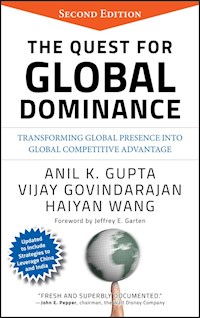
Anil K. Gupta, Vijay Govindarajan, and Haiyan Wang are among the most distinguished experts in the field of globalization. In The Quest for Global Dominance they present the lessons from their twenty-year study of over two hundred corporations. They argue that, in order for a company to create and maintain its position as a globally dominant player, executives must ensure that their company leads its industry in the following four essential tasks: * Identifying market opportunities worldwide and pursuing them by establishing the necessary presence in all key markets * Converting global presence into global competitive advantage by identifying and developing the opportunities for value creation that global presence offers * Cultivating a global mindset by viewing cultural and geographic diversity as an opportunity, not just a challenge * Leveraging the rise of emerging markets especially China and India to transform the company's growth prospects, global cost structure, and pace of innovation
Sie lesen das E-Book in den Legimi-Apps auf:
Seitenzahl: 475
Veröffentlichungsjahr: 2015
Ähnliche


















Contents
Cover
Content
Praise for The Quest for Global Dominance
Title Page
Copyright
Foreword
Preface
Acknowledgments
The Quest for Global Dominance
1. Rising Up to the Global Challenge
What Is Globalization?
What Is a Global Company?
What Is Driving Globalization?
Why Globalization Is Here to Stay
Implications for Companies
Conclusion
2. Building Global Presence
Choice of Products for Launching Globalization
Choice of Strategic Markets
Mode of Entry
Transplanting the Corporate DNA
Winning the Local Battle
Speed of Global Expansion
Conclusion
3. Lessons from the Globalization of Wal-Mart
Globalization Imperatives
Choice of Markets: Roads Taken Versus Roads Not Taken
Summing Up the Lessons
4. Exploiting Global Presence
Sources of Global Competitive Advantage
Creating Global Competitive Advantage: Action Implications
The Star Framework in Action
Conclusion
5. Cultivating a Global Mindset
Why Mindset Matters
What Is a Global Mindset?
The Value of a Global Mindset
Does Every Company Need a Global Mindset?
Does Every Employee Need a Global Mindset?
Cultivating a Global Mindset
Conclusion
6. Building a Global Knowledge Machine
Unpacking the Knowledge Management Agenda
Pathologies and Pitfalls in Knowledge Management
The Social Ecology of a Knowledge Machine: The Case of Nucor
Guidelines for Building an Effective Knowledge Machine
Conclusion
7. Dynamics of Global Business Teams
Why GBTs Fail
Defining Team Charter
Configuring the Global Business Team
Conclusion
8. Globalizing the Young Venture
Early Globalization–a Double-Edged Sword
To Globalize or Not to Globalize-Early?
Disciplined Pursuit of Early Globalization: The Case of Approva Corporation
Conclusion
9. Leveraging China and India for Global Dominance
The Reemergence of China and India
Major Challenges and Common Mistakes
Designing Robust Strategies for China and India
Notes
The Authors
Index
End User License Agreement
Pages
i
ii
iii
iv
v
vi
vii
ix
x
xi
xiii
xiv
xv
xvi
xvii
xviii
xix
xx
xxi
1
2
3
4
5
6
7
8
9
10
11
12
13
14
15
16
17
18
19
20
21
22
23
24
25
26
27
28
29
30
31
32
33
34
35
36
37
38
39
40
41
42
43
44
45
46
47
48
49
50
51
52
53
54
55
56
57
58
59
60
61
62
63
64
65
66
67
68
69
70
71
72
73
74
75
76
77
78
79
80
81
82
83
84
85
86
87
88
89
90
91
92
93
94
95
96
97
98
99
100
101
102
103
104
105
106
107
108
109
110
111
112
114
113
115
116
117
118
119
120
121
122
123
124
125
126
127
128
129
130
131
132
133
134
135
136
137
138
139
140
141
142
143
144
145
146
147
148
149
150
151
152
153
154
155
156
157
158
159
160
161
162
163
164
165
166
167
168
169
170
171
172
173
174
175
176
177
178
179
180
181
182
183
184
185
186
187
188
189
190
191
192
193
194
195
196
197
198
199
200
201
202
203
204
205
206
207
208
209
210
211
212
213
214
215
216
217
218
219
220
221
222
223
224
225
226
227
228
229
230
231
232
233
234
235
236
237
238
239
240
241
242
243
244
245
246
247
248
249
250
251
252
253
254
255
256
257
258
259
260
261
262
263
264
265
266
267
268
269
270
271
272
273
274
275
276
277
278
279
280
281
282
283
284
285
286
287
288
289
290
291
292
293
294
Guide
Cover
Table of Contents
Start Reading
List of Illustrations
Figure 1.1. Assessing Corporate Globality
Figure 1.2. “Simple” Versus “Complex” Globalization
Figure 2.1. A Framework for Choice of Products
Figure 2.2. A Framework for Choice of Markets
Figure 2.3. Alternative Modes of Entry
Figure 2.4. Greenfield Versus Cross-Border Acquisition
Figure 4.1. Drivers of Global Value: The Star Framework
Figure 4.2. The Global Battle Between ScanStar and GamMech: Analysis of Production Activities (1994)
Figure 4.3. The Global Battle Between ScanStar and GamMech: Analysis of Production Activities (1998)
Figure 5.1. What Is a Global Mindset?
Figure 5.2. How a Global Mindset Differs from a Parochial or a Diffused Mindset
Figure 5.3. Development of a Global Mindset
Figure 6.1. Potential Versus Reality of Knowledge Sharing: Survey Results from Three Large Global Corporations
Figure 6.2. How Social Ecology Shapes People’s Behavior
Figure 6.3. Drivers of Knowledge Management: Survey Results from Senior Executives Within Global Fortune 500 Companies
Figure 6.4. Unpacking the Knowledge Management Agenda
Figure 6.5. Nucor’s Knowledge Machine
Figure 7.1. A Framework for Designing and Managing High-Performing GBTs
Figure 7.2. Conditions Under Which GBTs Need an External Coach
Figure 7.3. Effective Team Process
Figure 8.1. Drivers of Early Globalization
List of Tables
Table 1.1. Global Integration: China Versus India
Table 1.2. Average Tariff Rates on Manufactured Products (Weighted Average; Percentage of Value)
Table 1.3. Liberalization in Investment Regimes
Table 1.4. Declining Costs of Air Transportation, Telecommunications, and Computers (in 1990 U.S. Dollars Unless Otherwise Indicated)
Table 1.5. Comparative Data on Economic Growth Rates of Different Groups of Countries (Annual Percentage Change in Real GDP)
Table 3.1. The Globalization of Wal-Mart
Table 3.2. Wal-Mart’s Growth During 1986-1991
Table 3.3. Wal-Mart’s Intensifying Growth Challenge
Table 3.4. The Evolutionary Path of Wal-Mart’s Global Expansion (1991-2007)
Table 3.5. Market Characteristics and Wal-Mart Store Size and Sales by Country
Table 3.6. Wal-Mart’s Financial Performance: United States Versus International
Table 7.1. The Challenge of Managing Global Business Teams
Table 9.1. China and India: A Look Back
Table 9.2. World’s Twelve Largest Economies
Table 9.3. Projected World Economic Structure
Table 9.4. The Rise of the BRIC Economies (Year When Each BRIC Country’s GDP Is Projected to Exceed That of the G6’s)
Table 9.5. Labor Cost Comparisons (Average Hourly Compensation Including Benefits for Production Workers, in US$)
Praise for The Quest for Global Dominance
“The reality of thinking and being global in mindset should be a no-brainer for all of us. But for those who believe that such is not the case, this book puts to rest any romantic or unrealistic views that we can sit back and bask in our prosperity. So it’s back to work on figuring out how to win globally, not locally or nationally, that will get you in the Hall of Fame for Business Leaders worldwide. You will find yourself referring often to The Quest for Global Dominance as you chart your course forward.”
—William F. Achtmeyer, chairman and managing partner, the Parthenon Group
“The Quest for Global Dominance is the best source of insight available for executives who want their companies to win in the face of global competition. It provides sound framework, practical advice, and dozens of helpful examples from companies around the world. For any company, from startup ventures to world leaders, this book tells managers what they must do in order to gain and keep a competitive advantage when rivals can come from anywhere and competition in an industry transcends borders.”
—Philip Anderson, INSEAD Alumni Fund Chaired Professor of Entrepreneurship, INSEAD
“A must-read for executives who expect to harness the accelerating trend of globalization. The authors make a compelling case for an accelerating rate of change based upon broad-based support for free trade, the increased economic power of developing nations, and the pervasive impact of enabling technology.”
—Alexander M. Cutler, chairman and chief executive officer, Eaton Corporation
“This book is not only visionary, but also very practical in thinking about globalization. It makes a compelling case for why globalization has to be at the very forefront of your plan to be able to build a foundation for a lasting business.”
—Desh Deshpande, chairman, Sycamore Networks
“A terrific book that effectively melds theories with successful practices of global companies and global strategy with the importance of organizational mindset and culture. Through an exceptional number of relevant, current, and real examples, the authors address the full range of issues, challenges, and opportunities that companies and practitioners face. This is a very readable, insightful, and compelling tool for building global competitive advantage.”
—Peter Dolan, former CEO, Bristol-Myers Squibb
“A terrific set of ideas on building a winning global firm with fresh insights into particularly crucial topics like global teams and launching born-global businesses. This is important and must-reading for savvy executives and students around the world.”
—Kathleen M. Eisenhardt, Ascherman Professor of Strategy, Stanford University, and codirector, Stanford Technology Ventures Program
“Rich with up-to-date examples, but also built on rigorous research, this book is a must for executives who are intent on going global.”
—Donald C. Hambrick, Smeal Chaired Professor of Management, Smeal College of Business, Penn State University
“This book provides fundamental inputs for managers who are leading modern global corporations within the new age. Above all, I am impressed with the focus on building a global knowledge ecology within these modern corporations. Globality truly becomes relevant and meaningful when seen in the light of knowledge development, taking us from learning within smaller individual ‘silos’ or ‘kingdoms’ to learning and knowledge accumulation in a global context. Overall, this is a great book and a must for the modern leader of the global firm.”
—Peter Lorange, president, IMD International, Lausanne, Switzerland
“In today’s ‘flat’ world, no company can remain immune to the forces of globalization. The Quest for Global Dominance explains how companies can not only face up to these forces but proactively exploit them. It emphasizes the importance of cultivating a global mindset, describes how to design an optimal global architecture, explains how to build a global knowledge machine while avoiding many of the pathologies and pitfalls, and shows how to transplant the corporate DNA across countries. The authors present their ideas clearly and support them with contemporary case studies. The Quest for Global Dominance is a superb and timely book, full of fresh ideas, that deserves to be widely read and that must be on the shelf of every practicing manager.”
—Costas Markides, Robert P. Bauman Professor of Strategic Leadership and chairman, Strategic and International Management Department, London Business School
“The velocity of change in the global arena has significantly accelerated. The Quest for Global Dominance provides the strategic imperatives to succeed in a global business.”
—John Menzer, vice chairman and chief administrative officer, Wal-Mart Stores, Inc.
“Globalization is undoubtedly a key imperative for business leaders the world over. The authors bring rich experience, a keen eye for detail, and strong conceptual abilities to their investigation of this phenomenon. The Quest for Global Dominance not only presents incisive and in-depth analysis but also inspires real-world, implementable solutions to the challenges faced by practitioners of management in today’s global village.”
—N. R. Narayana Murthy, chairman and chief mentor, Infosys Technologies Limited
“The Quest for Global Dominance presents the impact which globalization is having on countries, companies, and leaders in a fresh and superbly documented way. Above all, it raises the strategic implication of this in a fashion that should allow leaders to consider how to leverage their global presence and capability into a more successful leadership enterprise.”
—John E. Pepper, chairman of the board, the Walt Disney Company
“The authors of this book ‘get it.’ Based on the last 10 years, the next 20 will see continuing change and convergence of markets (globalization) and rapid evolution of business models (both globalization and virtualization). Managers must deal with these trends to survive and master them to flourish. The authors’ advice is sound and timely, and we would all do well to heed it.”
—Donald K. Peterson, former chairman and CEO, Avaya Inc.
“In a world of new opportunities and major challenges, The Quest for Global Dominance comes at the right time for those who not only want to stay in the game but also have the will to become an important actor in the massive transformation to occur. Global dominance is a must for industries and services, and this book explains why and what you should do to become a global leader in a specific segment. It’s a fascinating book, easy to read, and very useful to those willing to be global.”
—Didier Pineau-Valencienne, former president, Schneider S.A.
“Few topics continue to engage the attention of business leaders over centuries as the subject of how to of ‘global domination.’ From the ancient silk routes to the glory days of conflict between the Dutch, Spanish, Portuguese, and British fleets to control the trade routes, the preoccupation has been one of finding and holding on to the ‘choke points’ of the global system. The context of competition for a disproportionate global influence has changed over the centuries, but the basic managerial motive has not. Managers in multinational firms today face a new variant of this age-old battle for global domination. This book addresses the contemporary context within which this struggle is waged and the arsenal of tools that one has to master to win. The authors provide a very interesting blend of existing knowledge and new research to provide a new gestalt on globalization. By providing in one, very readable book the intellectual trail of where we are from, where we are, and where we are headed, the authors have captured for the busy executive an invaluable intellectual companion. It will force many to rethink their business strategies, personal managerial styles, and most importantly their capacity to leverage the most elusive of all resources—knowledge and emotional commitment of people around the world.”
—C. K. Prahalad, Paul and Ruth McCracken Distinguished University Professor, the University of Michigan Business School
“The authors of this book are among the masters on the subject of global strategy. In this book, they have succeeded in putting forth tight logic and leading-edge thinking in a manner that is highly practical. If you were to read only one book this year on how to assess and develop a global strategy for your business, this would be it.”
—John A. Quelch, senior associate dean and Lincon Filene Professor, Harvard Business School
“I found The Quest for Global Dominance to be an outstanding guide to building global presence and effectiveness based on the real, often painful, experiences of some best-practice companies and a few theoretical underpinnings. It helped put words and a framework around some of the experiences and learnings in my own international career. I often found myself nodding in agreement and saying how I would have loved to have read this before my first expat assignment. It goes well beyond merely stating the imperative—it explains how to make the transition from international/multinational models to true globalization. The book is particularly helpful in giving practical advice on managing the complex human dimensions of global businesses and global teams.”
—Peter F. Volanakis, president and chief operating officer, Corning Inc.
The Quest for Global Dominance
Transforming Global Presence into Global Competitive Advantage
Second Edition
Anil K. Gupta
Vijay Govindarajan
Haiyan Wang
Foreword by Jeffrey E. Garten
Copyright © 2008 by John Wiley & Sons, Inc. All rights reserved.
Published by Jossey-BassA Wiley Imprint989 Market Street, San Francisco, CA 94103-1741—www.josseybass.com
No part of this publication may be reproduced, stored in a retrieval system, or transmitted in any form or by any means, electronic, mechanical, photocopying, recording, scanning, or otherwise, except as permitted under Section 107 or 108 of the 1976 United States Copyright Act, without either the prior written permission of the publisher, or authorization through payment of the appropriate per-copy fee to the Copyright Clearance Center, Inc., 222 Rosewood Drive, Danvers, MA 01923, 978-750-8400, fax 978-646-8600, or on the Web at www.copyright.com. Requests to the publisher for permission should be addressed to the Permissions Department, John Wiley & Sons, Inc., 111 River Street, Hoboken, NJ 07030, 201-748-6011, fax 201-748-6008, or online at www.wiley.com/go/permissions.
Readers should be aware that Internet Web sites offered as citations and/or sources for further information may have changed or disappeared between the time this was written and when it is read.
Limit of Liability/Disclaimer of Warranty: While the publisher and author have used their best efforts in preparing this book, they make no representations or warranties with respect to the accuracy or completeness of the contents of this book and specifically disclaim any implied warranties of merchantability or fitness for a particular purpose. No warranty may be created or extended by sales representatives or written sales materials. The advice and strategies contained herein may not be suitable for your situation. You should consult with a professional where appropriate. Neither the publisher nor author shall be liable for any loss of profit or any other commercial damages, including but not limited to special, incidental, consequential, or other damages.
Jossey-Bass books and products are available through most bookstores. To contact Jossey-Bass directly call our Customer Care Department within the U.S. at 800-956-7739, outside the U.S. at 317-572-3986, or fax 317-572-4002.
Jossey-Bass also publishes its books in a variety of electronic formats. Some content that appears in print may not be available in electronic books.
Library of Congress Cataloging-in-Publication Data
Gupta, Anil K. The quest for global dominance : transforming global presence into global competitive advantage / Anil K. Gupta, Vijay Govindarajan, Haiyan Wang; foreword by Jeffrey E. Garten.—2nd ed. p. cm. Rev. ed. of: The quest for global dominance / Vijay Govindarajan, Anil K. Gupta. c2001. Includes bibliographical references and index. ISBN 978-0-470-19440-9 (cloth) 1. International business enterprises—Management. 2. Industrial management. 3. Organizational effectiveness 4. Comparative advantage (International trade) 5. Globalization—Economic aspects. 6. Competition, International. I. Govindarajan, Vijay. II. Wang, Haiyan. III. Govindarajan, Vijay. The quest for global dominance. IV. Title. HD62.4.G68 2008 658'.049—dc22
2008000872
Foreword
When the first edition of The Quest for Global Dominance was published, I recognized it as a major breakthrough in thinking about globalization and in helping business leaders develop invaluable insights about what they needed to do to win in the global marketplace. In plain but engaging language, the authors managed to pack in both a broad conceptual framework as well as critical strategic imperatives for those leaders who would make the globalization of their operations an invaluable asset rather than a complex albatross. I was particularly struck by the way the authors integrated both local and global factors in their analysis and also their keen awareness of the importance of intangible human assets in the success of any global strategy. The information was right on point, the case studies illuminating.
It did not occur to me that a second edition could do more than update the voluminous and important information contained in the original version. However, after I read it I could see that it has done that and much more.
In this new edition, you will find not only updates, not only many new examples, and not only a more confident analysis. There are three entirely new chapters. One analyzes the globalization of Wal-Mart logically and objectively and captures not only the lessons of success but also what can be learned from some serious setbacks. In another totally new chapter, the authors focus on the globalization of young companies, breaking new ground in understanding that these days a company may be born as a global operation and very quickly become successful and even challenge bigger firms that have been in the game for a long time. They also point out that early globalization can be a double-edged sword and that a young company that globalizes early in its life must build the necessary organizational capabilities to deal with added complexity and coordination needs. The insights here are valuable not just to companies that are start-ups or in their relatively early stages. The fact is that bigger and more established companies also need to understand the nature of new competition in the twenty-first century. And third, there is entirely new material on how to think about China and India. For all that has been written about these two countries, The Quest for Global Dominance provides information that is not only fresh but deeply strategic. This chapter alone is essential reading for any business leader interested in peering into the world as it is evolving, and it alone is worth the price of admission.
Most global business leaders today know that the market is no longer only a national one. But even the best and the most experienced of them are humbled by the challenges of creating the right kind of organization; acquiring, retaining, and motivating a global workforce; entering new markets in the most effective way; using global assets to foster innovation; and not being held back by the added complexities of operating in different markets with their local idiosyncrasies, their powerfully different cultures, and their different laws and regulations. This book manages to address all of these questions, effectively and without needless complications.
This book is important to a wide audience. It is essential to business leaders no matter what their focus—finance, technology, marketing, strategic planning, human resources. It is definitely a must-read-and-study for students interested in business and in globalization more generally. I’d also recommend it to regulators who want to understand what business leaders are likely to be doing and thinking in the years ahead.
The Quest for Global Dominance remains the best by far in its arena—the most comprehensive, the most insightful, the most readable, and simply the most important in the growing genre of what companies need to know as they expand their international horizons.
New Haven, Connecticut
Jeffrey E. Garten
January 2008
Jeffrey E. Garten is Juan Trippe Professor of International Trade, Finance, and Business and former dean of the Yale School of Management. Previously he was managing director of the Blackstone Group and U.S. Undersecretary of Commerce for International Trade.
Preface
The twin forces of ideological change and technology revolution are making globalization one of the most important strategic and organizational issues facing companies today. With every passing day, it is becoming more obvious that managers must view every industry as a global industry and every business as a knowledge business. As worldwide presence becomes an imperative rather than a choice, an increasing number of companies must confront the essential question: Our central purpose in writing this book has been to help managers address this question.
Lesen Sie weiter in der vollständigen Ausgabe!
Lesen Sie weiter in der vollständigen Ausgabe!
Lesen Sie weiter in der vollständigen Ausgabe!
Lesen Sie weiter in der vollständigen Ausgabe!
Lesen Sie weiter in der vollständigen Ausgabe!
Lesen Sie weiter in der vollständigen Ausgabe!
Lesen Sie weiter in der vollständigen Ausgabe!
Lesen Sie weiter in der vollständigen Ausgabe!
Lesen Sie weiter in der vollständigen Ausgabe!
Lesen Sie weiter in der vollständigen Ausgabe!
Lesen Sie weiter in der vollständigen Ausgabe!
Lesen Sie weiter in der vollständigen Ausgabe!
Lesen Sie weiter in der vollständigen Ausgabe!
Lesen Sie weiter in der vollständigen Ausgabe!
Lesen Sie weiter in der vollständigen Ausgabe!




