


Erhalten Sie Zugang zu diesem und mehr als 300000 Büchern ab EUR 5,99 monatlich.
- Herausgeber: Luath Press
- Kategorie: Geisteswissenschaft
- Sprache: Englisch
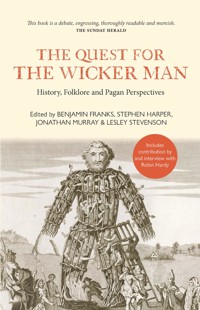
One of the greatest films ever to be made in Scotland, The Wicker Man immediately garnered a cult following on its release for its intense atmosphere and shocking denouement. This book explores the roots of this powerful, enduring film. With contributors including The Wicker Man director Robin Hardy, it is a thorough and informative read for all fans of this indispensable horror masterpiece.
Sie lesen das E-Book in den Legimi-Apps auf:
Seitenzahl: 306
Veröffentlichungsjahr: 2020
Das E-Book (TTS) können Sie hören im Abo „Legimi Premium” in Legimi-Apps auf:
Ähnliche




















In affectionate memory of Anthony J. Harper
First hardback edition 2006
First paperback edition 2024
ISBN: 978-1-913025-96-0
The author’s right to be identified as author of this book under the Copyright, Designs and Patents Act 1988 has been asserted.
Typeset in 10.5pt Sabon
© the contributors
Contents
Introduction: The search for The Wicker Man
Benjamin Franks, Stephen Harper, Jonathan Murray, Lesley Stevenson
The Genesis of The Wicker Man
Robin Hardy
The Wicker Man, May Day and the Reinvention of Beltane
Richard Sermon
Ritualistic Behaviour in The Wicker Man: A classical and carnivalesque perspective on ‘the true nature of sacrifice’
Paula James
Sacrifice, Society and Religion in The Wicker Man
Luc Racaut
Anthropological Investigations: An innocent exploration of The Wicker Man culture
Donald V. L. Macleod
The Folklore Fallacy: A folkloristic/filmic perspective on The Wicker Man
Mikel J. Koven
The Wicker Man–Cult Film or Anti-Cult Film? Parallels and paradoxes in the representation of Paganism, Christianity and the law
Anthony J. Harper
The Wicca Woman: Gender, sexuality and religion in The Wicker Man
Brigid Cherry
‘Do As Thou Wilt’: Contemporary Paganism and The Wicker Man
Judith Higginbottom
Music and Paganism with Special Reference to The Wicker Man
Melvyn J. Willin
Wicker Man, Wicker Music
Gary Carpenter
Interview with Robin Hardy
Jonathan Murray
Notes on Contributors
Index
Introduction: The search for The Wicker Man
Benjamin Franks, Stephen Harper, Jonathan Murray, Lesley Stevenson
The Wicker Man has been a hard film to categorise: part thriller, part detective story, part horror, with not a little humour and erotic titillation thrown in for good measure. Its enduring appeal and fascination for a variety of audiences continues even after the 30th anniversary of its UK theatrical release. In 2002 Scotland’s The Sunday Mail placed it as one of the top ten films with a Scottish theme1 and in 2003 the film was included in the top half of Channel 4’s 100 Greatest Scary Moments.2 In October 2004 it was placed sixth in Total Film’s top ten ‘Greatest British films’, beating the likes of Kind Hearts and Coronets (1949) and Lawrence of Arabia (1962).3
Its cultural impact has been significant. The creators of cult British TV comedy (now also a film) The League of Gentlemen (BBC2, 1999-2003; Bendelack, 2005) openly acknowledge their debt to The Wicker Man,4 whilst a recent episode of the ITV comedy-drama series, Distant Shores, starring Peter Davidson, was given over to an extended Wicker Man pastiche. An incoming authority figure, a doctor from the mainland, arrives on a remote Scottish island and falls under the misconception that the locals are planning to sacrifice him by burning him alive. The episode includes the villagers gathered together at a fête wearing masks; there are many barely veiled pagan references and the local laird makes a symbolic sacrifice by the sea. It reaches its climax at a festive gathering where the physician mistakes friendly attempts to embrace him by the locals, some carrying burning torches, for a concerted effort at capture, at which the panicked ‘innocent’ repeats Sergeant Howie’s injunction for divine intervention.
The Wicker Man’s climax has developed its own totemic power, and not just in the iconography of rock groups such as Iron Maiden;5 blazing sacrifice has also become a focal point for festivals across the Western world, including the Burning Man Festival in Nevada and the Butser Festival of Beltane in Hampshire. It has also become the highlight of the Wickerman Festival, an alternative music event held since 2002 near Kirkcudbright in South West Scotland, one of the original shooting locations for the film.6
This volume emerged from a cross-disciplinary conference, ‘The Wicker Man: Rituals, Readings and Reactions’, held at the University of Glasgow’s Crichton Campus in Dumfries on 14-15 July, 2003.7 The event was the ‘first ever academic conference’8 about the film and attracted speakers and participants from across Britain, Canada and the United States. The location was pertinent, as Dumfries lies close to Kirkcudbright, Creetown and Burrowhead, which were amongst the film’s most notable locations. The hosting institution, in addition to being part of the only Higher Education campus in the Dumfries and Galloway region, also had a range of staff from across the disciplines with a keen interest in the film.
The reaction to news that a conference was being planned on this theme was almost entirely positive. Academics from a range of specialisms – including Anthropology, Archaeology, Classical Studies, European Languages, Film Studies, History, Media Theory, Musicology, Philosophy, Religious Studies and Tourism Studies – offered to present papers, as did significant film practitioners: Robin Hardy, The Wicker Man’s director, and Gary Carpenter, the film’s associate music director. Local residents who had been extras three decades ago also attended and sent in mementos of their participation. There were a few less enthusiastic, but nonetheless fascinating, reactions. An anonymous poison-pen letter was sent to the organisers, warning of dire spiritual consequences in putting on such an event, whilst a publicity-hungry Catholic priest warned that the conference was bringing academic ‘credibility’ to the ‘occult’.9 The ability of the film to rouse religious passion and provoke debate remains unchanged after more than three decades. Thus it was felt to be appropriate to create a collection of papers that explored The Wicker Man’s different paradigms of the sacred; that investigated the spiritual and historical themes of the film (Christian, pre-Christian, Pagan and heathen), and how these had been interpreted and applied in contemporary cultural practices.
Inevitably in a collection dedicated to the exploration of The Wicker Man’s historical and anthropological themes, several contributors refer to two works that are of central importance to the film’s conception of paganism: Julius Caesar’s Gallic Wars and J. G. Frazer’s Victorian classic The Golden Bough. Where possible, the editors have sought to minimize any repetition or overlap of material relating to these sources; elsewhere, we have allowed the contributors to explain and analyze these texts at greater length in order to illustrate the complexity of Hardy and Shaffer’s relation to their historical material. Another caveat relates to the terminology used in this text, particularly such contentious terms as ‘Paganism’, ‘pagan’ and ‘Neo-Paganism’. The capitalised versions, ‘Pagan’ and its derivatives, are used to describe an identifiable set of spiritual practices or coherent set of beliefs concerning magic, pantheism and the moral principles thus derived. The upper case term is applied both to systematised pre- and non-Christian groupings from the pre-Industrial era, as well as to the new spiritual movements that developed from the 1950s and ’60s to the present. Some authors, however, prefer to use the term ‘Neo-Pagan’ for these post-war religious movements and this has been respected in their individual submissions. The lower case ‘pagan’ is mainly used to cover any unsystematised religious or mystical belief that lies outside standard monotheism. Thus, some of the cultural uses of The Wicker Man are Pagan as well as pagan. It is these appropriations and their historical roots that are the main themes of the collection.
The collection starts, suitably, with a contribution from The Wicker Man’s director and co-author, Robin Hardy, in which he discusses the motivations behind the film’s creation. In particular, Hardy emphasises that the two authors (himself and Anthony Shaffer), who used as their sources the works of James Frazer and the folk song collections of Cecil Sharp, had a shared interest in the questions raised by the old religions. Hardy also draws attention to how these elements were then integrated with the themes of ‘games-playing’ and manipulation, which The Wicker Man shares with Shaffer’s other works, in particular Sleuth (1970).
Richard Sermon’s chapter, ‘The Wicker Man, May Day and the Reinvention of Beltane’, introduces many of the topics developed in other contributions: in particular, the connections between motifs in the film and the historical record, and how the film’s referents have been re-interpreted in more contemporary cultural productions. In Sermon’s case, he examines how significant characteristics of the film relate to archaeological research into sacrificial rites and fire ceremonies, and how such rites and ceremonies have been adopted into more contemporary folk events in Europe and the Americas.
Whilst Sermon’s account concentrates on Celtic, nineteenth century Celtic Revival and modern Pagan practices, Paula James’ essay ‘Ritualistic Behaviour in The Wicker Man’ focuses its attention on the parallels between the film and Greco-Roman rituals structuring the preparation of human scapegoats. These include: the preliminary dressing of the victim in costume, the ceremony of the lustrum, in which the scapegoat is paraded around the community, and the symbolic importance of willow, which is figured in the film by the landlord’s daughter of the same name and the confining material of the burning cage. James places the film’s ritual allusions in the context of their historical origins and also discusses them in relation to their more modern connotations.
By contrast, Luc Racaut’s contribution, ‘Sacrifice, Society and Religion in The Wicker Man’, draws out the religious resonances and symbolic features of the film derived from the Early Modern period. Like Sermon and James, Racaut acknowledges the debt that the screenwriters, Hardy and Shaffer, pay to James Frazer’s The Golden Bough, but it is the use of Christian symbolism that is the crux of this essay. The role of martyrdom and its ceremonial re-enactment in the Eucharist are explained to highlight Howie’s traumatic, but nevertheless ambiguous, execution. Accounts of human sacrifice are a feature of French sectarian literature of the Early Modern period, and the political uses to which these accounts were put are compared to the power plays that unfold within The Wicker Man.
Rather than concentrate on different historical influences based broadly within the European context, Donald V. L. Macleod’s contribution draws upon the similarities between The Wicker Man and anthropological films investigating different non-Western communities. Macleod draws comparisons between Howie’s position within the film and the field anthropologist exploring non-occidental societies. Macleod also examines the parallels between the fictionally contrived action in a narrative feature film and the construction of ‘real events’ within anthropologic documentaries such as Nanook of the North (1922). Just as Howie’s investigation of Summerisle uncovers his own personal conflicts and prejudices, so too do ethnographic films, which, despite their apparent scrutiny of other forms of life, end up revealing the hidden presuppositions of the researcher and film-maker’s own culture.
In ‘The Folklore Fallacy’ Mikel Koven analyses the use of myths and legends within feature films in general, and the use of The Golden Bough within The Wicker Man more specifically. Koven suggests that there is a ‘folklore fallacy’ at work, in which the more the details from folklore are applied to a film to increase its veracity, the more problematic these elements become. In particular, Koven assesses the way in which the creators of The Wicker Man uncritically drew upon Frazer’s use of Caesar’s account of the Wicker Colossus in the Gallic Wars, interpreting it not as a folkloristic description, but as an accurate historical source. Such constructed accounts of human sacrifice, as in the context of France’s religious wars described by Racaut, served particular political purposes, and their subsequent use in fiction can reinforce or subvert much earlier value-laden messages. For Koven, the fallacy develops that, the more a culturally disparate medley of folklore elements appear in a given film in order to bolster its claims to verisimilitude, the less realistic becomes the ‘authentic’ combination of traditional beliefs and practices presented onscreen, as no society has, or could have, supported such a complex cross-cultural mix.
The tension between the authorial intention of making an anti-cult film and the popular reception and manipulation of the film’s themes in cultish terms is the subject of Anthony J. Harper’s contribution. Whilst Hardy and Shaffer wanted the audience to eventually side with traditional virtues, audiences have found alternative interpretations. Harper draws attention to the film’s interplay of ideas, in particular the debates between Howie, representing orthodox Christian values, and Lord Summerisle, representing the counter-cultural paradigm. It is this play of ideas, rather than the chilling final imagery, that Harper argues is the main reason for the film’s enduring appeal and the contested readings between its different audiences.
Brigid Cherry uses audience surveys to examine the way female film fans react to and appropriate the film in ways that potentially subvert authorial intentions. Cherry examines the features that particularly appeal to female audiences, such as the portrayal of female sexuality. Whilst this is a motif of many horror film classics, The Wicker Man challenges many of the standard features of the genre, by having the male lead represent virginity and allowing the expression of free female libidinal desire to go unpunished.
Judith Higginbottom also considers the reception of The Wicker Man, but focuses on it from the self-identifying Pagan perspective, which is defined and defended. Despite Hardy and Shaffer’s well-documented hostility to new age practices, Pagans and Wiccans have embraced the film, finding in it a positive representation of their rituals and beliefs. The Wicker Man’s portrayal of Paganism is compared favourably with that in other films; examples include works made by Pagans, such as the avant-garde cinema of Kenneth Anger, and those that endorse a tolerant approach to magical belief, such as Jacques Tourneur’s Night of the Demon (1957).
An acknowledgement and exploration of the explicitly Pagan perspective also infuses Melvyn J. Willin’s chapter, in his account of the use of music in The Wicker Man. Willin outlines the role which music plays in contemporary Pagan practices and rituals, and argues that the music featured in The Wicker Man is allied to Pagan ideals. Offering an account of the film’s soundtrack, Willin’s concern is to show how the music enhances the atmosphere of the film.
The influential role of The Wicker Man’s soundtrack is also addressed in an illuminating penultimate chapter by the film’s associate music director, Gary Carpenter. Carpenter addresses the selection process, the purposes which the various components of the soundtrack play within the film, and how the recorded music has developed a cultural life of its own.
In a book concerned with Paganism, with its key themes of regeneration and renewal, it is perhaps fitting to end where we began, with The Wicker Man director Robin Hardy. In an interview with conference co-organiser Jonathan Murray, Hardy explains his opinions of the performances given by Edward Woodward (Sergeant Howie) and Christopher Lee (Lord Summerisle), details the problems of film-making in 1970s Britain that influenced the film’s construction, describes its manipulation in the hands of the producers and distributors and outlines the work done by the film’s many advocates in enabling it to reach its audience. This is followed by a question and answer session with members of the audience present at The Wicker Man conference.
A second, complementary selection of papers from the conference is also available. This collection concentrates broadly on theoretical analyses of the motion picture; it is titled Constructing ‘The Wicker Man’: Film and Cultural Studies Perspectives and is published by University of Glasgow Crichton Publications.
The conference, and latterly this book, were only made possible through the efforts of a large number of people, including Steven Gillespie, Dr Helen Loney, Dr Donald Macleod, Prof Rex Pyke, Frank Ryan and Prof Rex Taylor. Special mention must be made of Nick Jennings and Tina Worsey, who administrated the conference so successfully, and the invaluable assistance of Dr Belle Doyle, formerly of the South West Scotland Screen Commission, for her advice, enthusiasm and expertise in setting up the parallel film festival. We are also grateful for the encouragement offered by Robin Hardy. In addition we wish to express our appreciation to all those who attended and supported the conference for their thoughtful and passionate participation, and to those organisations who provided sponsorship and commercial assistance (Canal+, Dumfries and Galloway Council, Dunfermline Building Society, South West Scotland Screen Commission and the University of Glasgow). Our thanks also go to Gavin MacDougall of Luath for his valuable assistance with this project, and to Tim West, also of Luath, for his thorough and helpful copy editing of the manuscript.
Bibliography
Anon, ‘Gents in a league of their very own’, The Gloucester Citizen, 16 January 1999, p. 15.
Anon, ‘The Best Scottish Films Of All Time’, The Sunday Mail, 25 August 2002, p. 16.
Channel 4, ‘100 Hundred Greatest Scary moments from film, TV, advertising and pop’, http://www.channel4.com/film/newsfeatures/microsites/S/scary/results_40-31_2.html [Accessed 2 February 2005].
100 Greatest Scary Moments (Channel 4), 25-26 October 2003. Distant Shores (ITV), 5 January 2005.
Dent, J., ‘Get Carter voted best British film’, The Guardian, 4 October 2004, p. 6.
Gibb, E., ‘A League of Their Own’, Scotland on Sunday, 3 December 2000, p. 2.
Hamer, R. (Director), Kind Hearts and Coronets (Warner, 1949).
Khan, S. and A. MacMillan, ‘Cult of Wicker Man sets tourism on fire: Film draws thousands to remote Scottish village for festival as remake is planned’, The Observer, 14 July 2002, p. 12.
Koven, M., ‘Keeping the appointment’, in Scope: An online journal of Film Studies, www.nottingham.ac.uk/film/journal/conrep/confreports_aug04.htm [Accessed 23 February 2005].
Lean, D. (Director), Lawrence of Arabia (Colombia Tri-Star, 1962).
Mcdonald, T., ‘Exorcist warns of occult dangers’, The Sunday Mail (Glasgow), 29 June 2003, p. 12.
Ramsay, H., ‘Actors get extra time’, The Mirror, 30 June 2003, p. 21.
Sermon, R., ‘The Wicker Man, May Day and the Reinvention of Beltane’, in The Quest for the Wicker Man, ed. B. Franks, S. Harper, J. Murray and L. Stevenson (Edinburgh: Luath, 2005).
Simpson, C., ‘More credits roll in for the Wicker Man as university makes it subject of serious debate’, The Herald (Glasgow), 2 January 2003, p. 6.
1 Anon, ‘The Best Scottish Films Of All Time’.
2 Ranked 34 in Channel 4, Greatest Scary Moments, October 25-26, one place behind The Sixth Sense (1999). See Channel 4, ‘100 Hundred Greatest Scary moments from film, TV, advertising and pop’.
3 See Dent, ‘Get Carter voted best British film’.
4 Anon, ‘Gents in a league of their very own’. See too Gibb, ‘A League of Their Own’.
5 See Sermon, ‘The Wicker Man, May Day and the Reinvention of Beltane’, in this volume.
6 Robin Hardy, the film’s director, was an early supporter of the Wickerman Festival; see Khan and MacMillan, ‘Cult of Wicker Man sets tourism on fire’.
7 For a review of the conference see Koven, ‘Keeping the appointment’.
8 Ramsay, ‘Actors get extra time’, p. 21. See too Simpson, ‘More credits roll’.
9 Mcdonald, ‘Exorcist warns of occult dangers’, p. 12.
The Genesis of The Wicker Man
Robin Hardy
I WAS HONOURED to be invited to ‘The Wicker Man: Rituals, Readings and Reactions’ conference10 to address a group of academics who have found so much of significance in a film we made thirty years ago, and made, I might add, with no more expectations for its reception than that it would be treated as an ‘intriguing entertainment’. That it would leave its audience with food for thought was indeed a bonus for which we hoped, but we would never have dreamed to what a degree that hope would be fulfilled. I am fascinated and impressed by the scope of possible reflections, ideas and reactions that have come out of this film.
I propose here to tell of the thought processes that brought my friend and business partner, Anthony Shaffer (Tony), and I to create the film the way it is, the main virtue of which was its originality. This, however, was also its main fault as far as the film distributors were concerned. It is fair to agree with Mike Deeley, successor to Peter Snell as CEO of British Lion, who in my opinion butchered the film and did everything to destroy or delay its success, that The Wicker Man was nevertheless much before its time.2 I want to describe the genesis of the project; in so doing I have to rely on memory, and I have to some extent to speak on behalf of Tony because he is no longer with us.
Tony and I met in 1962, when he was sent to New York by J. Walter Thomson, then the world’s largest and most influential advertising agency, to invite me to come to England and ultimately form a new television production company with him, which we called Hardy, Shaffer and Associates. Within five years our company, Hardy Shaffer, had branches in New York, Frankfurt, Paris, Milan, as well as London, and had become quite a big business.3
Over that same period of time, Tony’s twin brother, Peter, wrote Five Finger Exercises (1959), The Royal Hunt of the Sun (1964), Black Comedy (1965), White Lies (1967), The Battle of Shrivings (1970), and was starting on Equus (1973). Although probably not as trendy as John Osborne, Arnold Wesker and co., he is arguably the most successful and eloquent English-speaking playwright of our time.4 Tony, who had the same desire to write for the theatre, had written The Savage Parade (1963) and For Years I Couldn’t Wear My Black, a spoof on the advertising industry.5 Neither quite made it, although Tony’s talent was very evident. Peter, seeing his twin’s disappointment, and believing in his talent, proposed that Tony should retire from active work in our company and concentrate on writing. We all agreed on this course of action, but in return for my assuming the additional burden of running Hardy Shaffer without Tony, we agreed that we would make a feature film together. That film became The Wicker Man.
When Tony did write his next play, it was an instant hit. He first called it Anyone for Tennis?, but Michael White, the producer, didn’t care for the title (quite rightly) and it became Sleuth (1970). The importance of Sleuth as an antecedent to The Wicker Man is hard to exaggerate.6Sleuth is the quintessential games-player’s play. For those who are innocent of this dangerous obsession, games-playing, like gambling, is the diversion of those who would emulate the gods and intervene anonymously – however briefly – in the fate of another person. It is of course not to be confused with the playing of games on computers, manufactured for would-be amateur generals, politicians, tycoons, etc. The pawns in the games of which I speak must be human. John Fowles’ The Magus (1966), Terry Southern’s The Magic Christian (1959) and Alexandre Dumas’ The Count of Monte Cristo (1845) all deal in such games, sometimes better known as ‘revenges’. Throughout our long association, Tony and I indulged in a series of tit-for-tat games in which each sought to outdo the other.
One of the threads that informs The Wicker Man is ‘the game’, the hunter leading the hunted. But it is only one thread; there are others just as important. Tony and Peter Shaffer and I were great aficionados of the ‘Gothic’ horror films coming out of Hammer Films at the time.7 They were a cult if ever there was one. We enjoyed examining the camp world of black magic and glamorous women cast largely because of their long white necks and heaving bosoms; we admired charismatic actors like Christopher Lee, with his marvellous voice and hypnotic eyes.
Discussing one of these films one day, Tony and I remarked how extraordinary it was that witchcraft and all the mythology surrounding it is just a peek, as it were, into the coffin of the old religion, where the faith of our long-ago forefathers is among the undead.8 Centuries of Christian propaganda had driven it underground, perverted it in many cases, equated everything to do with it as evil, the work of the Devil. But the really astonishing thing, we concluded, is that so much of it survives out in the open and is part of our everyday life here and now. All our superstitions, dozens of nursery rhymes, but most important of all, the old religion, survive incorporated into Christianity, and certainly in Judaism. Christmas and Easter are redolent of Celtic Paganism. It took Frazer huge research to trace the series of steps humankind has taken, linking its variegated modern beliefs to their remarkably universal beginnings. Francis Ford Coppola has the Marlon Brando figure in Apocalypse Now (1979), at the end of the film’s long, long journey, skulking sleeplessly in the heart of darkness with – in case we miss the point – an open copy of The Golden Bough beside him.9 He is the king of the sacred grove who cannot sleep because there will always be another coming to win his crown. It is all in Frazer.
But first we needed a plot. Tony and Peter had written and published detective stories when they were at Cambridge. Tony was adept at spinning the web of deceit to confound the police; Sleuth’s anti-hero believes he has thought of everything. But what if, Tony then proposed, the police themselves – himself – are the victims? The clues the policeman finds, then, are indeed pertinent; but what neither he nor the audience can believe is that he is the victim and the crime has not yet occurred. That is the inspiration at the core of The Wicker Man.
Tony and I spent a whole, and, I must confess, very bibulous weekend figuring out how the plot would work, who would do what and to whom. As inky schoolboys we had both been forced to cram Roman history and Latin. It is, after all, one of the juicier reports from Germanicus’ dispatch to the Emperor on the barbarians that they sacrifice their enemies to their gods, in wicker men.10 We had promised ourselves to do a film together, a fitting curtain to our partnership in Hardy Shaffer, now to be wound up. Tony intended to write more for the theatre and I wanted to return to the USA, to mix writing fiction with journalism and television. Peter Snell, then, and now once more, ceo of British Lion Films, read the first draft of the screenplay of The Wicker Man and had the vision to see that the film could be an extraordinary breakthrough, a kind of antithesis of the Hammer Horror films which would be, if anything, more scary.11
While I was spending a spell in hospital recovering from illness and culling Frazer for more material, Peter got Christopher Lee to read the script. This resulted in our star, the perfect Lord Summerisle, being the film’s most ardent advocate from the start.12
Although much effort had gone into recreating a Pagan faith for our times, we had spent less thought on Howie’s Christian faith. We knew that the Church of Scotland had beliefs that, while profoundly Christian, did not work so well with the plot as would the faith of the Episcopalian Church. We needed to highlight the sacrifice part of the Communion service, the blessed blood and body of Jesus Christ that Howie consumes symbolically. Taking bread and wine from the priest could only take place in an Episcopalian church. Episcopalian churches do exist in Scotland, but they are rather rare, and yet we felt compelled to use one, for the potent imagery of Christ’s sacrifice. Edward Woodward, who played Howie so superbly, was a devout Christian. He was instinctively able to help me as director in interpreting the kind of faith his policeman character would certainly have possessed. There were things he just wouldn’t do, wouldn’t say: ‘Somebody of that faith would not do this’. One accepted Woodward’s intuitions – he was, after all, living the character.
How many people see the connection of this Communion with the Wicker Man scene at the end is questionable. But that brings me to the final thread that we believed would make this film unique in its way. We wanted people to join in the work of the detective. His journey through the film is sown with clues, if a viewer can only read them, but it is a film filled with puzzles for those who cannot. But yet we don’t cheat: there are always answers for the audience, if they look for them. Why are the pregnant women touching the trees? Why did the old people in the deaths registry have names from the Bible when everybody else is called after flora or fauna? Why does the woman in the ruined church have a baby at her breast but an egg in her free hand? All this puzzlement would be, we believed, part of the entertainment. As it happens, it is often what takes people back to see the film a second time, or to read the book. It is another factor in making The Wicker Man a film with a cult; at least that is what I believe.
Amongst the most important elements, and one that tended to be ignored by many critics who lauded The Wicker Man, was the music. Few realise that in the film, quite apart from its mood music, there are thirteen musical numbers which are sung and danced by the cast with the town band on screen. I always regretted this lack of recognition, which has, thankfully, ended in recent years. The work of the late Paul Giovanni as composer13 is among the finest contributions made to the film, and Peter Shaffer’s deft debowdlerisations set just the right tone of sexy lyricism.14
The music was a joy to research; Cecil Sharp’s folk music publications15 list many of the songs used, although some of the origins are blurred by the mists of time. Sharp was one of those eager Victorians who went around collecting things and annotating and making endless lists. He collected songs all over the British Isles and also in North America, where of course the immigrants had taken them; over hundreds of years they had varied slightly, rather like plants growing in different parts of the world but from the same origin. The trouble was that all these songs tended to be a bit sexy and had Pagan origins. Unfortunately, Queen Victoria, who was rather keen on folk songs, heard some and said that she wanted a complete collection of Sharp’s work, whereupon he went into a complete panic and bowdlerised the whole lot. They were then published in the official edition, which was presented to Her Majesty, who was apparently pleased to have them. But they remained in this new bowdlerised edition, so that Peter had to ‘un-bowdlerise’ them to make them work for the film, and I suspect he did further research on returning them to their original versions.
We are planning a new film in the same genre as The Wicker Man. It is called Cowboys for Christ, and will star Christopher Lee and Sean Astin, Sam in The Lord of the Rings trilogy (2001-03). It is not a sequel or a prequel to The Wicker Man, and shares none of the same characters. It can be said to be about American innocents abroad and what can befall them, and as such, it is fairly topical. There will shortly be a website for Cowboys for Christ, telling more.16
Some words of Benjamin Disraeli will serve equally well as an introduction to Cowboys for Christ as they did for the book of The Wicker Man: ‘Man is born to believe, and if no Church comes forward with its title deeds of truth, sustained in the traditions of sacred ages and by the convictions of countless generations, to guide him, he will find altars and idols in his own heart and in his own imagination’.
Bibliography
Ackerman, R. and Frazer, R., J. G. Frazer: His life and work and the making of ‘The Golden Bough’ (London: Palgrave MacMillan, 2001).
Anon, ‘Review: The Wicker Man’, Film Score Monthly, 7.8, October 2002, pp. 45-46.
Anon, ‘Review: The Wicker Man’, Music From The Movies, 35.6, 2002, pp. 69-70.
Bartholomew, D., ‘The Wicker Man’, Cinefantastique, 6.3, Winter 1977, pp. 4-18, pp. 32-46.
Bing, J., ‘Inside Move: Wicker pair scotches notion of pic as remake’, 17 April 2002, http://www.variety.com/index.asp?layout=upsell_article&articleID=VR1117865603&cs=1 [Accessed 10 January 2005].
Brown, A., Inside ‘The Wicker Man’: The morbid ingenuities (London: Sidgwick and Jackson, 2000).
Caesar, J., Gallic War: Conquest of Gaul (London: Penguin, 1982).
Chibnall, S. and Petley, J., eds., British Horror Cinema (London: Routledge, 2001).
Collis, C., ‘Up in smoke’, The Daily Telegraph (arts section), 23 May 1998, p. 1.
Frazer, J., The Golden Bough: A study in magic and religion (Mineola, NY: Dover, 2002).
Giankaris, C. J., Peter Shaffer (Basingstoke: Macmillan, 1992).
Harker, D., Fakesong: The manufacture of British ‘folksong’ (Milton Keynes: Open University Press, 1985).
Hutchings, P., Hammer and Beyond: The British horror film (Manchester: MUP, 1993).
Internet Movie Database, The, ‘Cowboys for Christ (2005)’, http://www.imdb.com/title/tt0323808/
Karpeles, M., Cecil Sharp. His life and work (London: Routledge, 1967).
Klein, D. A., Peter and Anthony Shaffer: A reference guide (Boston: G. K. Hall, 1982).
Lee. C., ‘A Letter From Lord Summerisle’, Cinefantastique, 6-7.4-1, Spring 1978, p. 60.
MacMurraugh-Kavanagh. M. K., Peter Shaffer: Theatre and drama (Basingstoke, Macmillan, 1992).
Meikle, D. with Koetting, C. T., A History of Horrors: The rise and fall of Hammer (Lanham MD/London: Scarecrow, 1996).
Shaffer, A., So What Did You Expect?: A memoir (London: Picador, 2001).
Sharp, C., English Folk-Song: Some conclusions, 4th ed (London: Wakefield, 1972).
_____, The Morris Book: A history of Morris dancing (London: Wakefield, 1974-5).
1 University of Glasgow, Crichton Campus, Dumfries, July 14-15 2003.
2 For further details of Deeley’s alleged obstruction, see Brown, Inside ‘The Wicker Man’, pp. 100-08, pp. 126-27, pp. 201-04; Bartholomew, ‘The Wicker Man’, pp. 38-42, p. 46.
3 See Brown, Inside ‘The Wicker Man’, p. 21.
4 Critical studies of Peter Shaffer include MacMurraugh-Kavanagh, Peter Shaffer; Giankaris, Peter Shaffer.
5 The alternative title of For Years I Couldn’t Wear My Black is Widow’s Weeds; it was not produced on stage until 1977.
6 While Peter Shaffer’s theatrical career has to date received more critical attention than that of his brother Anthony, some critical/biographical source material is available for the latter: see Klein, Peter and Anthony Shaffer; Anthony Shaffer, So What Did You Expect?
7 Hardy here refers to the studio whose prolific feature output between The Curse of Frankenstein (1957) and To the Devil a Daughter (1976) became, and to a significant extent still remains, synonymous with the idea of a distinctively ‘British’, or perhaps more properly, ‘English’, horror cinema. For further details, see Hutchings, Hammer and Beyond; Meikle and Koetting, A History of Horrors; Chibnall and Petley, British Horror Cinema.
8 See Bartholomew, ‘The Wicker Man’, pp. 10-13.
9 See Brown, Inside ‘The Wicker Man’, pp. 24-27. Scottish anthropologist Sir James Frazer (1854-1941) is best known for his seminal work The Golden Bough: A Study in Magic and Religion (4 eds., 1890-1922), an incredibly ambitious comparative study of religion and mythology in a global context. The immediate relevance of Frazer’s text(s) – The Golden Bough expanded from 2 volumes to 12 between 1890 and 1915 – to The Wicker Man relates to the author’s central hypothesis. This was that all known mythologies and religions (including Christianity) essentially developed from a single originary myth, a cult of fertility involving the worship and periodic sacrifice of a sacred king-figure, surrogate for a solar deity, who ‘died’ at harvest time, only to be reincarnated every spring. For further details, see Ackerman and Frazer, J.G. Frazer. See also Hardy’s comments in Bartholomew, ‘The Wicker Man’, pp. 10-11.
10 Germanicus Caesar (15 BC-AD 19) was a Roman general who campaigned extensively in northern Europe in the later years of his short life. Elsewhere, Hardy also notes the influence of ‘eyewitness’ reports in Julius Caesar’s The Gallic Wars (c. 58-51 BC) that Druidic cultures used wicker men to immolate human sacrificial offerings. See Bartholomew, ‘The Wicker Man’, p. 10.
11 Shaffer’s marked contemporary hostility to the classification of The Wicker Man as a ‘Hammer Horror film’ can be gauged from his comments contained in Bartholomew, ‘The Wicker Man’, p. 14; see also his retrospective comments quoted in Brown, Inside ‘The Wicker Man’, pp. 39-41.
12 See Bartholomew, ‘The Wicker Man’, pp. 32-34; Lee, ‘A Letter from Lord Summerisle’.
13 Giovanni’s creative contribution to The Wicker Man, with accompanying commentary from the composer himself, is detailed extensively in Bartholomew, ‘The Wicker Man’, pp. 34-36. A restored stereo version of Giovanni’s original score for the film was eventually released on compact disc by Silva Screen in September 2002: for further details, see Collis, ‘Up in smoke’. For critical response to this release, see Anon, ‘Review: The Wicker Man’, in Music From The Movies; Anon, ‘Review: The Wicker Man’, in Film Score Monthly.
14 See Gary Carpenter’s introductory comments to his contribution in the present volume.
15




