


17,99 €
Mehr erfahren.
- Herausgeber: John Wiley & Sons
- Kategorie: Fachliteratur
- Sprache: Englisch
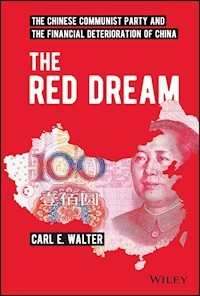
An eye-opening deep dive into the sources and consequences of how China has financed it's rise to global economic prominence In The Red Dream: The Chinese Communist Party and the Financial Deterioration of China, veteran finance executive Carl Walter uses his unique experience in Chinese finance to deepen his exploration of how the Chinese Communist Party finances its obsession with GDP growth and social control. Overwhelmingly debt-fueled, the party's financial strategy has driven an unsustainable growth in banking and state enterprise assets. Inevitably the party's own financial health is being severely weakened and China's future over the next decades put in doubt. You'll also find: * A discussion of the financial power of local governments and the Ponzi scheme created by their sale of land use rights * How China's entry into the World Trade Organization gave rise to today's China * How the party and China's regulators enable banks to present outstanding performance metrics * An exploration of the party's financial assets and liabilities since 1979 * Examples of financial crisis management and related costs incurred by China and the US * A look at Japan's experience as a potential guide for China future development An essential read for anyone interested in international economics, geopolitics, and finance, The Read Dream will also earn a place in the hands of finance professionals, bankers, policymakers, corporate strategists, and investors.
Sie lesen das E-Book in den Legimi-Apps auf:
Seitenzahl: 444
Veröffentlichungsjahr: 2022
Ähnliche



















Table of Contents
Cover
Title Page
Copyright
Dedication
Preface
List of Abbreviations
Chapter 1: From Turning Point to Turning Point
An Abrupt About-Face
The Golden Age: A Short Story
Underlying Conditions
The
Yin
and the
Yang
of the China Dream
Convergence
Notes
Chapter 2: The Shadow Fiscal System
China's “Centralized” State and Localized Financing
Aspirational Central Finances, Fiscal Collapse and the 1994 Budget Law
The Continual Local Scramble for Funds
Then There Was the Land but It Is Not Free, 1999–2007
Paving the Country Over
The Vulnerability of Local Governments, Banks, and Enterprises
Implications
Notes
Chapter 3: China's Banks and the Deposit Bonanza
China's State Banks and the “Tree” Model of Banking
Command Lending and Funding
Fintech and Other Challenges to Bank Deposits
Bank Capitalization
Implications
Notes
Chapter 4: Trees Can Grow to Heaven!
Evolution of Chinese Balance Sheet Management Techniques
Outcomes in Financial Engineering Chinese-Style
Channels to Support State Bank Performance Metrics
Implications
Notes
Chapter 5: Beautifying Bank Balance Sheets
Parking Assets—the Interbank Market and “Repos”
Flexible Loan Agreements
Local Government Bonds
Government “Guidance” Funds
Off-Balance-Sheet Items
Comments
Notes
Chapter 6: After 30 Years, Was Deng Xiaoping Right?
A Summary State Balance Sheet
Inefficient Investment Equals Extrabudgetary Funding
The Promise of the Stock Markets
Massive Growth in Deposits
“Opening” the Door to Foreign Investment
Excessive Reliance on Debt
Deterioration of State Finances
Summing Up
So Was Deng Right, Can Capital Markets Be Used in a Socialist Economy?
Notes
Chapter 7: China versus the United States: Comparing the Costs of Financial Crises
Summary Financial Crises, China and the United States
Comparisons of Crises
Macro Comparisons and the Role of Central Banks
Comparisons of State Net Worth
Comments
Notes
Chapter 8: Japanese Bubbles
Bubbles and Japan's Banking Crisis of the 1990s
Why Did Resolving Japan's Banking Crisis Take So Long?
More Points of Comparison, China versus Japan
Comparative Cashflow Chains
How Might the Party Change Its Spots?
The Value of Chinese State Industrial Enterprise Assets
Comments
Notes
Chapter 9: Chinese Balloons
The Party's Ruling Paradigm
Chinese Balloons
Convergence Revisited
Appendices
Appendix 1: Estimated China Government–Only Debt Obligations, 2009, 2015–2019
Appendix 2: The State Sector Balance Sheet
Selected Bibliography
Websites
Publications
Index
End User License Agreement
List of Tables
Chapter 1
Table 1.1 Distribution of budgeted revenues and expenditures by government l...
Table 1.2 Local government bonds: more risk, less risk weight.
Table 1.3 Household claims versus state assets, 2018.
Chapter 2
Table 2.1 Extrabudgetary and bank-sourced funding, 1979–1993.
Table 2.2 Financing sources for total state-approved capital investment, 198...
Table 2.3 Distribution of budgetary revenues and expenses by level of govern...
Table 2.4 Extrabudgetary revenues and bank-sourced funding, 1994–2007.
Table 2.5 Land sale gross revenues to local budgetary revenues (%), 2000–201...
Table 2.6 Local government land development costs, budgeted and final budget...
Table 2.7 Net local revenues from land use right sales, 2011–2014.
Table 2.8 The cost of state bank restructuring, 1998–2007.
Chapter 3
Table 3.1 On-balance-sheet local government–only borrowings, 2009–2017.
Table 3.2 Investor holdings of commercial bank bonds.
Chapter 4
Table 4.1 Evolution of asset management techniques for banks.
Table 4.2 Summary of estimated spun-off banking assets, 2010–2019.
Table 4.3 Estimated funding sources of state asset management companies.
Table 4.4 Trends in WMP issuance, investors, and asset composition, 2010–202...
Table 4.5 Use of WMP proceeds to invest in “real economy.”
Chapter 5
Table 5.1 Average monthly reverse repo transactions: moving securities out....
Table 5.2 Average monthly net bank repo lending and borrowing, 2007–2016
Table 5.3 More local government bonds less risk weight.
Table 5.4 Provincial budgetary revenues vs. debt expenses 2019.
Table 5.5 Outstanding wealth management products and their composition.
Chapter 6
Table 6.1 Summary consolidated balance sheet of the Chinese state sector.
Table 6.2 Investment financing sources and efficiency, 1978–1997.
Table 6.3 A-share listing-day performance 1998–2010.
Table 6.4 Categories and values of equity shares, 1995–2018.
Table 6.5 Household claims versus state assets, 2018.
Chapter 7
Table 7.1 Summary of crisis cost outcomes.
Table 7.2 Savings and loan failures, 1980–1988.
Table 7.3 Estimated cost of recapitalization of Big Four state banks, 1998–2...
Table 7.4 TARP subsidies only to US financial entities; summary of fair valu...
Table 7.5 China government balance sheet versus developed countries (2014)
(
...
Chapter 8
Table 8.1 State contribution to industrial output, 2017.
Appendix
Table A2.1 Summary balance sheet of the Chinese state sector, 1978–2018.
Table A2.2 Comparative government sector balance sheets.
List of Illustrations
Chapter 1
Figure 1.1 The breakthrough years, 1992–2008.
Figure 1.2 The “take” from capital investment alone to total loans, 1979–200...
Figure 1.3 Trends in banking assets and GDP, 1999–2020.
Figure 1.4 Total assets of selected Chinese and foreign banks, 2008 versus 2...
Figure 1.5 State net worth to total state assets and liabilities, 1978–2018....
Chapter 2
Figure 2.1 Central and local net budget surplus (deficit), 1981–1994.
Figure 2.2 Official final budgetary revenues and expenditures, 1979–2018....
Figure 2.3 Central debt issuance to total local fiscal transfers.
Figure 2.4 Land use rights sales revenues to local government budgets.
Figure 2.5 Trust company–arranged financing for land acquisition and predeve...
Figure 2.6 China total arable land, 1999–2008 (mou 100 mm).
Figure 2.7 Extrasystem funds (ESFs) to total loans, 1979–2005.
Figure 2.8 Comparative fiscal revenues of China, 1979–2009.
Chapter 3
Figure 3.1 Trends in Chinese bank asset growth, 2004–2020.
Figure 3.2 Total assets of selected Chinese and foreign banks, 2008 versus 2...
Figure 3.3 Market capitalizations of certain US and Chinese banks, 2008 and ...
Figure 3.4 Trends in retail and corporate deposits, 1997–2020.
Figure 3.5 Selected investment products, 2013–2020.
Figure 3.6 Institutional holders of retail deposits, 2009–2017.
Figure 3.7 Trends in wealth management products, 2007–2018.
Figure 3.8 P2P turnover, interest rate, and the Wenzhou rate, 2012–2021.
Figure 3.9 Cash flows into
Yu-e Bao
money market fund and beyond.
Figure 3.10 Bank debt instruments outstanding, 2003–2019.
Chapter 4
Figure 4.1 Cinda and Huarong AMC share performance.
Figure 4.2 AMC acquired bank loans, net bank losses.
Figure 4.3 Organization structure of Huarong AMC, 2017.
Figure 4.4 Trends in trust and ABS assets, 2010–2019.
Figure 4.5 Transfer of PBOC problem assets to Huida AMC.
Figure 4.6 The bank use of SPVs as a channel to sell NPLs as WMPs.
Table 4.6 Composition of nonstandard assets.
Figure 4.7 Bank issuers of WMP and size of investments.
Chapter 5
Figure 5.1 Bank loan and guarantee rollover, 2010–2012.
Figure 5.2 Principal holders of issued securities, 2019.
Figure 5.3 Local bonds in bank bond portfolios, 2013–2019.
Figure 5.4 Provincial bonds and LGFP placements to provincial GDP, 2019.
Figure 5.5 Interbank market bond trading volume and turnover, 2020.
Figure 5.6 Entrusted loans to RMB loans, 2006–2020.
Figure 5.7 Schematic of wealth management product asset pools.
Chapter 6
Figure 6.1 IPO price jumps 2010–May 2021.
Figure 6.2 Deposits, loans, and loan-to-deposit ratio, 1995–2020.
Figure 6.3 Loan-to-deposit ratio versus PBOC deposit reserve ratio, 1995–202...
Figure 6.4 Central and local government non-current obligations to GDP.
Figure 6.5 China augmented fiscal deficit to GDP.
Figure 6.6 State net worth to assets, liabilities to state net worth.
Chapter 7
Figure 7.1 Value of failed S&L and bank assets, 1980–1994.
Figure 7.2 Thrift resolution types by number of entities, 1980–1995.
Figure 7.3 Non-performing versus spun-off assets, 2010–2019.
Figure 7.4 Total banking asset comparison, United States and China, 2005–202...
Figure 7.5 Comparison of China central bank assets to GDP.
Chapter 8
Figure 8.1 Public sector balance sheets, Japan, China, 2017.
Figure 8.2 Nonfinancial and financial parts of China state sector.
Figure 8.3 SOE profit before tax to government bonds issued, 2000–2011.
Figure 8.4 Trends in state enterprise contribution to industrial output, 197...
Figure 8.5 Trends in capacity utilization by industry.
Figure 8.6 Shanghai market capitalization trends and share types, 1999–2019....
Figure 8.7 SOE book value versus market value, 1999–2019.
Guide
Cover Page
Title Page
Copyright
Dedication
Preface
List of Abbreviations
Table of Contents
Begin Reading
Appendices
Selected Bibliography
Index
Wiley End User License Agreement
Pages
iii
iv
v
xi
xii
xiii
xiv
xv
xvi
xvii
xviii
xix
xx
1
2
3
4
5
6
7
8
9
10
11
12
13
14
15
16
17
18
19
20
21
22
23
24
25
26
27
28
29
30
31
32
33
34
35
36
37
38
39
40
41
42
43
44
45
46
47
48
49
50
51
52
53
54
55
56
57
58
59
60
61
62
63
64
65
66
67
68
69
70
71
72
73
74
75
76
77
78
79
80
81
82
83
84
85
86
87
88
89
90
91
92
93
94
95
96
97
98
99
100
101
102
103
104
105
106
107
108
109
110
111
112
113
114
115
116
117
118
119
120
121
122
123
124
125
126
127
128
129
130
131
132
133
134
135
136
137
138
139
140
141
142
143
144
145
146
147
148
149
151
152
153
154
155
156
157
158
159
160
161
162
163
164
165
166
167
168
169
170
171
172
173
174
175
176
177
178
179
180
181
182
183
184
185
186
187
188
189
190
191
192
193
194
195
196
197
198
199
200
201
202
203
204
205
206
207
208
209
210
211
212
213
214
215
216
217
218
219
220
221
222
223
224
225
226
227
228
229
230
231
232
233
234
235
236
237
238
239
240
241
242
243
245
246
247
248
249
250
251
252
253
254
255
256
257
258
259
260
261
262
263
264
265
266
267
268
The Red Dream
The Chinese Communist Party and the Financial Deterioration of China
Carl E. Walter
This edition first published 2022
Copyright © 2022 by John Wiley & Sons, Ltd.
All rights reserved. No part of this publication may be reproduced, stored in a retrieval system, or transmitted, in any form or by any means, electronic, mechanical, photocopying, recording or otherwise, except as permitted by law. Advice on how to obtain permission to reuse material from this title is available at http://www.wiley.com/go/permissions.
The right of Carl E. Walter to be identified as the author of this work has been asserted in accordance with law.
Registered Offices
John Wiley & Sons, Inc., 111 River Street, Hoboken, NJ 07030, USA
John Wiley & Sons Singapore Pte. Ltd, 1 Fusionopolis Walk, #06-01 Solaris South Tower, Singapore 138628
Editorial Office
1 Fusionopolis Walk, #06-01 Solaris South Tower, Singapore 138628For details of our global editorial offices, customer services, and more information about Wiley products visit us at www.wiley.com.
Wiley also publishes its books in a variety of electronic formats and by print-on-demand. Some content that appears in standard print versions of this book may not be available in other formats.
Limit of Liability/Disclaimer of Warranty: While the publisher and authors have used their best efforts in preparing this work, they make no representations or warranties with respect to the accuracy or completeness of the contents of this work and specifically disclaim all warranties, including without limitation any implied warranties of merchantability or fitness for a particular purpose. No warranty may be created or extended by sales representatives, written sales materials or promotional statements for this work. The fact that an organization, website, or product is referred to in this work as a citation and/or potential source of further information does not mean that the publisher and authors endorse the information or services the organization, website, or product may provide or recommendations it may make. This work is sold with the understanding that the publisher is not engaged in rendering professional services. The advice and strategies contained herein may not be suitable for your situation. You should consult with a specialist where appropriate. Further, readers should be aware that websites listed in this work may have changed or disappeared between when this work was written and when it is read. Neither the publisher nor authors shall be liable for any loss of profit or any other commercial damages, including but not limited to special, incidental, consequential, or other damages.
Library of Congress Cataloging-in-Publication Data is Available:
ISBN 9781119896159 (Hardback)
ISBN 9781119896166 (ePDF)
ISBN 9781119896173 (epub)
Cover Design: Wiley
Cover Image: © Nerthuz/Getty Images:
For Lesley Yu Yicen
Preface
It's been a decade since I sat in Beijing spending a couple of summers thinking and writing about China's financial system. In those days Fraser Howie (my co-author on other Wiley books), who had started working at real jobs in Singapore, and I would laugh when we dug up bits and pieces of the story that were new to us. But access to a good library was one thing I lacked in Beijing and I was interested in understanding how the country's fiscal system interacts with its banks. A stint at Stanford in 2013 solved that problem. What I found changed my thinking about China and led eventually to the writing of this book during another stint at Stanford in 2021. So here goes another attempt to influence the way we look at China's history with the emphasis on financial history.
My reading in 2013 led to the conclusion that the basic source of extreme leverage in China's banks, enterprises, and the state itself is found in the fiscal arrangements of its self-reliant local governments. Self-reliance and inadequate budgetary income have driven inefficient capital investment especially in an overgrown real estate sector and its millions of empty and unfinished apartments. There is a shadow fiscal system at the local levels that is so deeply imbedded in how the party operates locally that even the most determined fiscal reforms have ultimately been rejected by its “immune” system. In short, local debt, the obverse side of which is bank and enterprise lending, cannot be explained only by reference to the last decade of overflowing liquidity or poor management or the party's interference; it has always been a major feature of China's fiscal system.
The second observation is that the party, which can do whatever it wants, has failed to adjust its aspirations to the level of fiscal revenues that the official system can generate. The party recognizes no constraints; the pull of the China Dream may be too strong. But there are constraints in the real world. Each year the party presents a new central and local budget for the coming year to the National People's Congress. But after approval, there is no one who holds the party at any level accountable for borrowing excessively outside of this budget not simply to meet a budget gap, but to build unplanned infrastructure and buildings. Who said every provincial capital could have a 100-story building or two? And who is going to fund such lending or live in the buildings and use the infrastructure when the population in 2100 is the same as it was in 1976?
Looking into the fiscal system reminded me that China, as a modern country, is at best 20 years old. It has come a very long way in two decades, but it remains an unfinished project much influenced by history. It would be fair to say that in 1979 China had no fiscal system. During the Republican Era in the 1930s work had begun to establish one but was interrupted by events. In any event, Nanking's reach did not extend far beyond the city's walls. After the revolution Soviet advisors gave it a try as part of their effort to establish a planned economy. That didn't work for reasons that are well documented. From 1957 to the start of the reform era at best Beijing depended on negotiations with provincial governments and state enterprises for whatever fiscal revenues it could generate. Any semblance of a technical fiscal system was purely propaganda for outsiders.
Looking at this brief history, what stands out is the self-reliance of local governments at all levels. Prior to the revolution it was said that regional governments were run by warlords, so it is not surprising that a look at China's fiscal system today reveals the existence of a shadow fiscal system. Local governments and their party secretaries then, as now, are responsible for what happens in their jurisdictions. With little in the way of revenue trickling down from higher administrative levels, they must fend for themselves. And it has always been this way.
This is where banks come in. During the 1980s local officials generated what Beijing called “extrabudgetary” or “extrasystem” revenues by pilfering bank branches and state enterprises, all of which were “owned” locally. The scale of such income in some years exceeded official revenues, sometimes by a multiple. In 1994 Beijing was able to pass a Budget Law that for the first time specified types of taxes and what government level collected which tax. In the face of opposition by the richer provinces, Beijing committed the “original sin,” promising the majority poor provinces central government fiscal transfers to make up for shortfalls and, as a result, prohibited them from fiscal borrowing; there would be no need. Ever since, and especially in recent years, Beijing has had to borrow to make good on this promise, and the banks bought the government bonds.
The Budget Law also walled off state enterprises, at least directly, from local raids on their bank accounts. At the same time, two important things happened as part of the economic reform effort. First, Beijing devolved capital investment in new enterprises and infrastructure out of the national budget and into the hands of state enterprises and local governments. This offered locals a new way to access banks since the bulk of such investment was officially designated as “self-raised” funds. The second event was the privatization from 1997 of people's homes and the development of a huge new industry—real estate—that now generates nearly one-third of the country's GDP. Developers cannot build new homes without land and land was something local governments had in spades. Experimentation created a process allowing the sale, not of land itself—that belongs to the Emperor—but of “land use rights,” a new and huge source of revenue for those localities with the best locations.
But with these new revenues also came the obligation to prepare the land for development. If the land was in the city center, then the local government had to resettle residents; remove buildings; and install power, water and sewers. If it was agricultural land, it was the same story, perhaps even more expensive. Over the first few years of this activity, arable land in China was reduced nearly 6 percent. All this cost significant amounts of money, more than offsetting revenues from sales of land rights. It was raised by securitizing bank loans into long maturity trust plans, then selling the plans to banks and rich individuals.
On an ongoing basis, the land business was a money loser; expenses have always exceeded revenues. As a result local governments got caught up in a constant fundraising process that can only be partially offset by sales. They must sell more land to meet earlier debt obligations. Real estate became a Ponzi scheme and this explains why there are 64 million unoccupied apartments, ghost towns and, not to forget, the bullet train network. Looking only at self-raised funds for capital investment prior to the post-2008 decade suggests that local debt equals somewhere around 25–40 percent of total banking loans or 40–60 percent of the all important bank funding source, corporate and household deposits.
This leads to the conclusion that the fundamental reason for China's excessive leverage in its banks and enterprises today is found in the decentralized fiscal arrangements of self-reliant local governments. The second point is that the party has failed to adjust its aspirations to the level of fiscal revenues the official system can generate or hold its local party officials to their official budgets. With this background it is not surprising that China's state banks have grown like “… trees reaching for Heaven.” Today the four largest are Globally Systemically Important Banks (GSIB) whose health impacts the world economy. The system's total assets are 3.5 times the country's GDP. They have grown to this scale organically and not through acquisitions and mergers as has JPMorgan Chase, their only rival in size. Their funding and scale of lending has been the result of China's policy of “opening up.” The country's entry to the World Trade Organization (WTO) in 2001 resulted in the creation of a middle class to rival that of the United States. And, as the world knows, Chinese, faced with few investment alternatives or a sound social security system, save their money in banks, state banks. This is the party's deliberate policy.
Chinese state banks have grown at a compound rate of 17 percent a year since 2008, yet they maintain strong performance metrics, including sustained low non-performing asset levels. The answer to such success is found in the shadow banking system that has grown up along with them. Products include wealth management, trust plans, asset-based securities, debt-equity swaps and more, all designed to enable the state banks to sculpt their balance sheets. Flexible accounting also adds its own support. How can these four banks create such huge piles of financial assets at such a rate in an economy that in 2008 totaled US$4.4 trillion as against that of the US at US$15 trillion? They lent to local governments, real estate, the railways and to the public, the only sectors that have true scale. And they lent with long maturities; the loans stacked up.
If one existed, an official consolidated balance sheet for the Chinese government sector would show the impact of the party's economic and financial decisions. Fortunately a rough, but instructive one can be developed from official sources and compared with work done earlier by Chinese analysts. The result shows China's state with total consolidated assets of only 952 billion yuan in 1978 and 123 trillion in 2008; not much really changed during those two decades. But by 2018 the balance sheet had exploded to almost 400 trillion yuan, quadrupling in just a decade. It is not surprising that in 2018 financial assets including foreign reserves made up two-thirds of total assets—investment takes time after all—and 89 percent of total liabilities and equity. One would think a deleveraging campaign could be quite successful looking at these numbers!
But with that number of liabilities the equity account owned by the party (no need to talk about a state here) has been crushed. In 1978 the party's stake in the state sector was nearly 90 percent; in 2018 it was 5 percent with minority shares of the same level—household and some foreign investment in A- and H-shares. Reviewing these assets the question must be asked, can the party meet its obligations to the household sector, which holds currency, deposits and equity in the state totaling 87 trillion? The answer is barely.
These results can be supported by calculating the costs associated with financial crises in China and the United States. There are two sets of crises that may work. The first is the US savings and loan crisis of 1980–1994, a crisis termed a “debacle” by the Federal Deposit Reserve Corporation. This is compared to China's bank restructuring effort of 1997–2005, an effort that was spectacularly successful. The second set relates to the global financial crisis of 2009. The costs to the United States of resolving this crisis are compared to China's response. For the two US crises, the Congressional Office of the Budget has calculated official cost figures and presented them to Congress. For China I have done cost calculations based on estimates derived from official data and shown in Chapter 4. For the first set of crises, the costs to total assets and recovery rates in the two countries are fairly comparable, but for China the cost to GDP of recapitalizing its banks was quite high, while for the United States it was only 4.3 percent. The cost to the United States of the cleanup after the mortgage crisis was nearly US$500 billion, constituting 33 percent of assets involved, but again only 3.4 percent of GDP. The recovery rate was similar to the savings and loan (S&L) crisis.
But China's strategy of preventing a financial crisis in advance by providing financial support to its major state banks and enabling almost continuous recapitalization has cost a fortune if compared to the original level of banking assets in 2009. From the start of the deleveraging campaign in 2016–2020, costs have amounted to 17 percent of total banking assets. The value of this pay-as-you-go support simply added up reaches nearly US$5 trillion or 42 percent of 2015's GDP. No estimate is possible for recoveries that would reduce the number. In both crises the costs to China have been similar. Where has this money gone?
The answer is that the financial system has absorbed shadow banking risk in all its nooks and crannies while bureaucrats at all levels push risk aside to get on with their jobs. No one knows or possibly can know just how much risk is out there. The regulators and some officials in Beijing from 2016 are making a stab at deleveraging, but this seems a distant second in importance to the volatile program to create “common prosperity” through a takeover of the private sector.
Unlike the earlier bank restructuring costs, this time China cannot inflate the costs away: they are too big. The other way out is a sustained deleveraging effort in combination with the bureaucracy and party backing away from the private sector. The growth stimulated there might then make it possible over time for deleveraging to take effect. But small Chinese banks on the periphery have already begun to fail, as has a major core part of the banking system, China Huarong. And the true costs of the party's deliberate bankruptcy of China Evergrande and China's real estate sector as a whole have yet to be exposed in the local government, banking, and trust systems, but they are there. And what of the collateral underlying the people's mortgages? Banks will be forced to ask for more as property values decline. In Japan the bursting of a massive real estate bubble seriously exacerbated a banking crisis in the 1980s. An old regulatory paradigm had first to be demolished by near-continuous bank failures before the Japanese government could fully understand the nature of the crisis and take substantive actions to end it. Earlier action might have stabilized the banking system and perhaps even alleviated the pains of the deflation that followed. China's political and economic system is very different from Japan's, but there are also some important similarities. And the obstacles thrown up by old thinking may prevent the country's leaders from seeing the extent of the financial crisis they have created.
I'm hoping that The Red Dream, like Red Capitalism a decade ago, will be seen as a constructive comment that sparks a conversation about how China has arrived today as the world's second largest economy and what the cost of this has been. There are many people and institutions I must thank who have helped me in the research that has gone into this book. First of all, I must thank the Shorenstein Asia Pacific Area Research Center (APARC) at Stanford's Freeman Spogli Institute for International Affairs. I have been fortunate to spend two stints at APARC, and without them this book would not have been possible. For this I must thank the sponsorship of Professors Jean Oi and Andy Walder, who have always found interest in my point of view. Also at Stanford I must thank Zhaohui Xue, the East Asia Library's Chinese studies librarian and the rest of the staff at the library there who always made me feel welcome. Stanford's East Asian Library is a real open-stack treasure of real and not digital materials. Speaking of Stanford, I'd also like to thank the wonderful staff at APARC as well as those at the Braun Music Center where I was inspired on a daily basis by the students I heard practicing. Stanford turned the writing of this book into a truly enjoyable experience.
Thanks go to Fraser for providing extensive comments on versions of several chapters and for help on charts; I wish he'd been along for the full ride. Thanks also go to Christine Wong, the expert on China's fiscal system, who looked at that chapter of the book. Christine was so generous with her time and shared many of her papers. I met Carsten Holz at Stanford in 2013. His 2001 paper on Chinese state bankruptcy inspired me to follow up. Carsten also read and commented on an early version of what became Chapter 6. I must truly thank Andy Walder, who commented extensively on all chapters; his comments enabled me to make real improvements and additions to my original plan. In 2013 I participated in a conference in Hong Kong where I met Don Chew, the publisher of the Journal of Applied Corporate Finance, a publication with a long pedigree in the financial world. Since then, Don has asked me to provide articles and I have gladly done so; it has been a wonderful cooperation because he is a great editor. Larry Goodman, president of the Center for Financial Stability, has always been interested in the things I am interested in and his support has always been positive. Thanks also go to Andy Andreasen and Josh Cheng, who have helped me think about things Chinese such as yellow millet (sic), to Andrew Zhang, who explained the Balloon Theory to me, and to Wren Hsu Ponder, who came up with the data I needed when I needed it. It was also great to catch up with Richard McGregor in Australia to go over the famous Boao Forum of 2009; I'm glad he was there.
I also need to thank all of the folks at Wiley who have so kindly published the last three of the books I have written (or co-written). This time in particular I would like to thank Syd Ganaden, Purvi Patel, Sharmila Srinivasan, Missy Garnett and Tami Trask for copyediting, and the people who do the cover artwork. It's always been easy working with Wiley and I certainly appreciate their support.
Special thanks go to my brother-in-law, Lloyd Yu, who allowed me to stay at his home during both of my stints at Stanford. Although I tried to balance my presence with restaurant meals, trips to BevMo and, when wanted, cleaning up the kitchen, little can compensate for a stranger, especially a brother-in-law! in the household. Lloyd's cooking and his magical backyard are nonpareil. Thanks also go to my Number 1 daughter Dorothy and her husband Roman Hasenbeck for putting me up after Lloyd put his house on the market. Both are great hosts and cooks and their cat, Fritz, a terrific, if trying, service animal! And what can I say about my wife, to whom I have dedicated the book? Lesley, my lifelong sweetheart, allowed me to disappear from our home in New York for several months while I worked on finishing this book at Stanford. It is impossible for me to even begin to thank her enough for her support and understanding.
I have traipsed across several research specialties in writing this book and am quite aware that I have made many errors of data interpretation and judgment. But these are mine and I look forward to receiving corrections.
Carl E. WalterStanfordMarch 2022
List of Abbreviations
ABS
asset-backed security
AIC
asset investment company
AMC
asset management company
BOJ
Bank of Japan
CBIRC
China Banking and Insurance Regulatory Commission
CDB
China Development Bank
CSRC
China Securities Regulatory Commission
CGB
China government bond
CIC
China Investment Corporation
COB
Congressional Office of the Budget
FDIC
Federal Deposit Insurance Corporation
FHA
Federal Housing Administration
FSLIC
Federal Savings and Loan Insurance Corporation
GSIB
Global Systemically Important Bank
IMF
International Monetary Fund
JGB
Japanese government bond
LGFP
local government financing platform
MOF
Ministry of Finance
NAO
National Audit Office
NPC
National People's Congress
NPL
nonperforming loan
PBOC
People's Bank of China
RTC
Resolution Trust Corporation
SAFE
State Administration for Foreign Exchange
SASAC
State Administration of State-owned Assets Commission
SOE
state-owned enterprise
SPV
special-purpose vehicle
WMP
wealth management product
WTO
World Trade Organization




