


18,99 €
Mehr erfahren.
- Herausgeber: John Wiley & Sons
- Kategorie: Fachliteratur
- Sprache: Englisch
Managing your own psychology is the hardest skill for any founder As acclaimed investor and entrepreneur Ben Horowitz once stated, managing your own psychology is the hardest skill for any founder or CEO. In The Resilient Founder: Lessons in Endurance from Startup Entrepreneurs, Mahendra Ramsinghani gathers insights from over a hundred founders to deliver an intuitive and insightful guide to understanding our psychology and navigating the psychological pressures of startup leadership. Venture backed companies are expected to grow at high velocity, raise large amounts of capital, build teams effectively to achieve unicorn, no decacorn status. Yet the journey is long, filled with uncertainties, extremities and black swan events. It can wear out the best and the brightest. On the outside, a CEO can demonstrate sheer bravado, an invincible spirit as they behead dragons in the business battlefield. And on the inside, they deal with their dark side, subconscious struggles, emotional barriers, shame or guilt. The role of a founder can be lonely, frustrating and filled with high-highs and low-lows - all of this leading to anxiety, depression even suicide. This book addresses the fundamentals of understanding our own inner workings and explores practical ways of overcoming our inner hurdles. Filled with simple, yet concrete strategies, lessons and insights, founders and business leaders can work with stress, anxiety, and other mental challenges presented by the life of an entrepreneur. In this book, readers will learn to: * Understand the basics of founder psychology, and how our inner workings can help or hurt us * The importance of building a healthy ego, leading to resilience * Draw on the lessons of established startup leaders on how to wrestle with their own mental and emotional challenges Written for founders, entrepreneurs and Chief Executive Officers, The Resilient Founder leads a gentle path to self-awareness, compassionate soul-care and inner wellbeing. Entrepreneur, Investor and author Brad Feld calls this book "dynamite". Case studies, philosophical perspectives and a generous dose of poetry is sprinkled across this book, which can be a companion for all those misfits, rebels and the crazy ones. For all those perpetually hitched on the roller coaster ride of entrepreneurial journey, this book is first of a kind to delve into the dark side and present a balanced approach to building your inner core as you build your company. This is no quick-fix guide, and we are perpetual work-in-progress. Today is Day One. Let us start the journey.
Sie lesen das E-Book in den Legimi-Apps auf:
Seitenzahl: 372
Veröffentlichungsjahr: 2021
Ähnliche


















Table of Contents
Cover
Title Page
Copyright
Dedication
Foreword
Acknowledgments
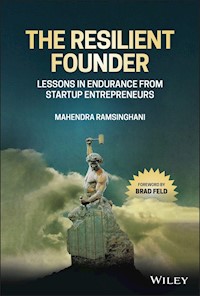
About the Cover
A Note to Readers
Introduction: The Despondent Founder
PSYCHOLOGICAL QUOTIENT – AN INTRODUCTION
MY HOPE FOR YOU
NOTES
Part I: Running to a Standstill
1 When Suicide Seems Like a Good Option
BREAKING THE TABOO: DISCUSSING SUICIDE
SELF-IMAGE AND INEPTITUDE
DOES OUR ATTITUDE DEFINE OUR OUTCOMES?
NOTES
2 Stepping Back from the Edge
LOOKING FOR CLARITY
NOTE
3 How External Events Trigger Negative Feelings
PERSISTENCE: THE DOUBLE-EDGED SWORD
FOUR TYPES OF STRESSORS
HOW IS THIS THOUGHT HELPING ME?
NOTES
4 Obstacles and Frustrations
BARRIERS TO ENTRY – THE OLD VERSUS THE NEW
RESOURCES VERSUS CONSTRAINTS
PROCESS VERSUS REWARDS
Part II: Understanding Our Psychology
5 Building Our Psychological Quotient
SEEKING A CRAZY KIND OF ADVENTURE
WHEN OUR EMOTIONS CLASH WITH LOGIC
THE THREE REGIONS OF INNER CONFLICT
NOTE
6 Ethics
BUILDING A START-UP WITH A SENSE OF MEANING
ETHICS, MORALITY, RIGHTEOUSNESS, AND SUPEREGO
7 Do the Right Thing
ETHICS AT WORK
GREATEST GOOD FOR THE GREATEST NUMBER
ETHICS AND SOCIAL CHANGE – LESSONS FROM COINBASE
BUILDING AN ETHICAL FRAMEWORK
8 Ego – The Emperor and the Slave
IMPULSES, EGO, AND SUPEREGO
WHY IS EGO NECESSARY IN BUSINESS?
THE EGO AND OUR SELF-IMAGE
NOTES
9 Working with Your Ego
A FOUNDER'S EGO IS ABNORMAL
WHO DOES YOUR EGO SERVE?
THE EGO IS NOT THE ENEMY
10 The Hidden Land of Desires and Motivations
MEET YOUR ID
THE DESIRE TO START SOMETHING UP
OUR HIDDEN DESIRES AND DRIVERS
THE DANGER OF UNMET DESIRES
NOTE
11 Logos and the Mind
THE ANALYTICAL ENGINE OF THE MIND
WHAT IS THE MIND?
THE THREE BROAD FUNCTIONS OF OUR MIND
12 Pathos: Belief Systems
OUR BELIEFS DRIVE OUR BEHAVIORS
OUR BELIEFS DICTATE OUR NARRATIVES
IS AMBITION A VICE OR VIRTUE? IT DEPENDS ON WHAT YOU BELIEVE
13 Putting It All Together
Part III: Reassembling the Furniture
14 Toward Building a Healthy Ego
WHAT IS A HEALTHY EGO?
ARE YOU ABLE TO CONTROL YOUR IMPULSES?
HOW DOES YOUR EGO PROTECT YOU WHEN YOU FEEL UNSAFE?
CAN YOU MASTER YOUR EGO?
NOTE
15 Psychotherapy: An Imperfect History of an Impossible Profession
SIGMUND FREUD: THE PAST CREATES THE FUTURE
CARL JUNG: A LOOK AT THE DARK SIDE
ALFRED ADLER: THE PAST DOES NOT MATTER, JUST FOCUS ON THE PRESENT
16 Fearing Our Own Selves … and Other Mental Blocks
HOW WE RESIST OUR DEVELOPMENT – IGNORANCE AND DENIAL
DISMANTLING THE BLOCKS
MANY DIFFERENT WAYS, ONE DESTINATION
UNCOVER THE HIDDEN AND THE REPRESSED
THE HARD THING ABOUT THERAPY – LETTING THE THERAPIST DRIVE
17 Stages of Therapy
FOUR PHASES OF THERAPY
18 Challenges and Pitfalls in Therapy
THE ROAD TO A HEALTHY MIND IS LONG
19 Medicating Our Way to Recovery
THE MEDICATION DEBATE
MOTIVATIONS, MONEY, AND THE NEED FOR SPEED
TO MEDICATE OR NOT TO MEDICATE IS A LONGSTANDING DEBATE
NOTES
Part IV: These Rituals Worked for Us
20 A Soul Made Cheerful
WORKING ON YOUR INSIDE – THE IMPORTANCE OF SELF-CARE
HOW WE AVOID SELF-CARE
NOTES
21 Prescription 1 – An Organized Diminution of Work
PAUSE, BALANCE, BREATHE
THE FEELING OF NOT DOING
NOTE
22 Prescription 2 – Get Out of Your Head
LESS HEAD, MORE BODY
SILENCING THE INNER CHATTER
MANAGING THE VELCRO OF NEGATIVE EXPERIENCES
CORTISOL, SEROTONIN, AND DOPAMINE – THE MAGIC OF TOUCH
NOTE
23 Prescription 3 – Feeling, Not Thinking
POETRY IS FEELING – NOT THINKING
MUSIC AND MOODS
IN SERVICE OF OTHERS
GRATITUDE WITH PRESENCE
IT'S A MATTER OF TIME – REFLECTIONS AND RUMINATION
24 Prescription 4 – Spirit over Mind
STARING IN THE ABYSS
WHAT DO YOU WORSHIP?
PICK YOUR GODS OR THEY PICK YOU
SEEKING SOLACE
UNDERSTANDING OUR SHADOW SIDE – FEARS, ENVY, RESENTMENT
25 Prescription 5 – A Promise to Yourself
26 The Elements ofa Good Life
Postscript: How to Care for the Broken and the Depressed
TOP REASONS FOUNDERS DO NOT ASK
WHAT DO THE DEPRESSED NEED?
WHAT THE DEPRESSED DO NOT NEED
HOW TO HELP – A FEW GOOD EXAMPLES
NOTES
Appendix I: A Founder's Mental Health Manifesto
Appendix II: Founders’ Voices and Anonymized Surveys
About the Author
About the Website
Index
End User License Agreement
List of Tables
Chapter 2
Table 2-1 Aspirations and Outcomes
Chapter 3
Table 3-1 External Events and Depression Triggers
Table 3-2 Internal Feelings versus External Stressors
Chapter 4
Table 4-1 Resources and Constraints Evolve with Stages of Growth
Chapter 7
Table 7-1 An Ethical Framework from Two Perspectives
Chapter 12
Table 12-1 Belief Systems
Chapter 13
Table 13-1 Hierarchy of Needs
Table 13-2 Internal and External Stressors
Chapter 16
Table 16-1 Knowing What We Know: The Johari Window into Our Minds
List of Illustrations
Chapter 1
Figure 1-1 Do our attitudes define our outcomes?
Chapter 2
Figure 2-1 Most depression episodes drop after ~10 months.
Chapter 3
Figure 3-1 Four types of stressors.
Figure 3-2 Depression and stressful life events.
Chapter 5
Figure 5-1 Acedia - overwhelmed, restless (but not depressed).
Figure 5-2 The trifecta of our inner forces.
Chapter 7
Figure 7-1 ROI sans ethics - If the Czechs allowed smoking, the government w...
Chapter 8
Figure 8-1 The ego, the superego, and the id: The emperor, the salve, the ne...
Chapter 11
Figure 11-1 The mind across time.
Figure 11-2 The mind as a CPU – inputs and outputs.
Chapter 14
Figure 14-1 Moving fluidly between zones of intensity and relaxation.
Figure 14-2 Four defense mechanisms.
Chapter 17
Figure 17-1 Therapy phases and activities.
Guide
Cover Page
Table of Contents
Title Page
Copyright
Dedication
Foreword
Acknowledgments
About the Cover
A Note to Readers
Begin Reading
Postscript: How to Care for the Broken and the Depressed
Appendix I: A Founder's Mental Health Manifesto
Appendix II: Founders’ Voices and Anonymized Surveys
About the Author
About the Website
Index
End User License Agreement
Pages
iii
iv
v
vi
xi
xii
xiii
xiv
xv
xvi
xvii
xviii
xix
1
2
3
4
5
6
7
8
9
11
12
13
14
15
16
17
18
19
20
21
22
23
24
25
26
27
29
30
31
32
33
34
35
36
37
39
40
41
42
43
44
45
47
48
49
50
51
52
53
55
57
58
59
60
61
62
63
65
66
67
68
69
71
72
73
74
75
76
77
78
79
80
81
82
83
84
85
87
88
89
90
91
92
93
94
95
96
97
98
99
100
101
102
103
105
106
107
108
109
110
111
112
113
114
115
116
117
118
119
120
121
122
123
124
125
127
129
130
131
132
133
134
135
136
137
138
139
140
141
142
143
144
145
146
147
149
150
151
152
153
154
155
156
157
159
160
161
162
163
164
165
166
167
168
169
170
171
173
174
175
176
177
178
179
180
181
183
185
186
187
188
189
190
191
193
194
195
196
197
199
200
201
202
203
204
205
206
207
208
209
210
211
212
213
214
215
216
217
218
219
220
221
222
223
224
225
226
227
228
229
230
231
233
234
235
236
237
239
240
241
242
243
245
246
247
248
249
250
251
252
253
254
255
256
257
258
259
260
261
262
263
264
271
273
275
276
277
278
279
280
281
282
283
284
285
286
287
288
289
290
291
292
293
294
295
296
THE RESILIENT FOUNDER
LESSONS IN ENDURANCE FROM STARTUP ENTREPRENEURS
Mahendra Ramsinghani
Copyright © 2022 by John Wiley & Sons, Inc. All rights reserved.
Published by John Wiley & Sons, Inc., Hoboken, New Jersey.
Published simultaneously in Canada.
No part of this publication may be reproduced, stored in a retrieval system, or transmitted in any form or by any means, electronic, mechanical, photocopying, recording, scanning, or otherwise, except as permitted under Section 107 or 108 of the 1976 United States Copyright Act, without either the prior written permission of the Publisher, or authorization through payment of the appropriate per-copy fee to the Copyright Clearance Center, Inc., 222 Rosewood Drive, Danvers, MA 01923, (978) 750-8400, fax (978) 750-4470, or on the web at www.copyright.com. Requests to the Publisher for permission should be addressed to the Permissions Department, John Wiley & Sons, Inc., 111 River Street, Hoboken, NJ 07030, (201) 748-6011, fax (201) 748-6008, or online at http://www.wiley.com/go/permission.
Limit of Liability/Disclaimer of Warranty: While the publisher and author have used their best efforts in preparing this book, they make no representations or warranties with respect to the accuracy or completeness of the contents of this book and specifically disclaim any implied warranties of merchantability or fitness for a particular purpose. No warranty may be created or extended by sales representatives or written sales materials. The advice and strategies contained herein may not be suitable for your situation. You should consult with a professional where appropriate. Neither the publisher nor author shall be liable for any loss of profit or any other commercial damages, including but not limited to special, incidental, consequential, or other damages.
For general information on our other products and services or for technical support, please contact our Customer Care Department within the United States at (800) 762-2974, outside the United States at (317) 572-3993 or fax (317) 572-4002.
Wiley also publishes its books in a variety of electronic formats. Some content that appears in print may not be available in electronic formats. For more information about Wiley products, visit our web site at www.wiley.com.
Library of Congress Cataloging-in-Publication Data is Available:
ISBN 9781119839736 (Hardback)ISBN 9781119839750 (ePDF)ISBN 9781119839743 (ePub)
Cover Design: WileyCover Image: © Bobbie Carlyle, Sculptor
In memory of minds afire
Austen Heinz, Aaron Swartz, Jody ShermanSreeram Veerangandham,and many more …
This book is dedicated tothat indomitable spirit in every founderthat respects the darknessand brings lightfor a better future for all.
A book should serve as the axe for the frozen sea within us.— Franz Kafka
Foreword
Brad Feld
I had my first major depressive episode as an adult in 1990. At the time, I was running my first company, Feld Technologies, which was going well. However, my work on a PhD program at MIT was not, and I dropped out of the program. At the same time, my first marriage imploded for various reasons, including my extreme focus on work. And, while Feld Technologies was succeeding, I was exhausted and bored with the actual work.
My experience of depression is the complete absence of joy. I'm functional and can do my work, but it takes all of my energy to get out of bed, get out of the house, make it through eight hours, and get back home. In the evenings, I don't have an interest in anything – food, reading, TV, sex, or exercise. Instead, I sit in the bathtub or lie in bed and stare at the ceiling, eventually falling asleep.
This depressive episode lasted two years. I did therapy and was fortunate to have an excellent psychiatrist. I took medication, learned better how to take care of myself, and had several beneficial close relationships, including those with my business partner (Dave Jilk) and my new girlfriend and now wife (Amy Batchelor). However, I was deeply ashamed of being depressed, of doing therapy, and for taking medication. This stigma weighed on me, some days even more than the depression.
While attending the Consumer Electronics Show in January 2013, I found myself in a dark Las Vegas hotel room, covering my head with a pillow, utterly uninterested in dealing with anything.
It was the start of a major depressive episode that lasted almost six months.
It appeared that my life was great. Foundry Group, the company I started in 2007, was doing well, and my marriage this time was solid and happy. But as I figured out later, I was physiologically and psychologically exhausted due to an utter lack of self-care, which triggered the episode. I'd been clinically depressed before and recognized the symptoms. I knew that it eventually would pass, but I didn't know when or what would bring relief.
This time I didn't feel any stigma. I'd been open about my past struggles with depression. Through my blog, I'd written a little about it and talked at many events about it. I'd worked with other entrepreneurs who had been depressed and had learned a lot about what did and didn't help. This time, I decided to be open about my depression as it was unfolding and dig deeper into the dynamics around depression.
That same January, two well-known entrepreneurs, Jody Sherman and Aaron Swartz, committed suicide. By May, my depression had lifted. After coming out of my depressive episode, I decided that one of my goals over the rest of my life would be to help eliminate the stigma surrounding mental health, especially in entrepreneurship. With friends like Jerry Colonna and Dave Morin also committed to this topic, I've addressed the stigma, and many other issues, surrounding depression and mental health.
In 2018, shortly after the suicides of Kate Spade and Anthony Bourdain, I received an email from Mahendra Ramsinghani. We had been friends for more than five years and co-authors of a book entitled Startup Boards: Getting the Most Out of Your Board of Directors. Mahendra told me that he was starting to work on his third book (this one), to be The Resilient Founder. While there were some blog posts, video interviews, and articles in major magazines around entrepreneurship and mental health, no one had yet taken on the topic in book form.
I immediately agreed to help, both get the word out and to write this Foreword whenever Mahendra was ready. A survey on my blog netted over 100 interviews for Mahendra with founders who were willing to talk about their depressive experiences. Periodically, Mahendra would reach out to me for advice around a topic or a connection to another entrepreneur who was visibly struggling with depression.
Since then conversations around depression, mental health, and suicide have escalated in a generally constructive way. More people talk openly about depression, especially among highly creative and successful people, including Olympic athletes. While the stigma around depression and other mental health issues in our society is still highly significant, the leadership from an increasing number of visible people around their struggles is starting to make a dent in that stigma.
After reading the near-final draft of this book, I sent Mahendra a quick email saying, “Your book is dynamite.” When he set out to write the book, he told me his goal was to write a book that provides stories, anecdotes, triggers, advice, poetry, and support of all kinds from people who have struggled with depression. He accomplished this, and much more, as he deeply explored many aspects of a high-achieving personality, which includes entrepreneurs, and deconstructed many of the challenges that can lead to or amplify existing mental health issues.
In my most recent book, The Entrepreneur's Weekly Nietzsche: A Book for Disruptors, written with Dave Jilk, my first business partner mentioned earlier, one of the Nietzsche quotes we explore directly applies. In the chapter “Reflecting Your Light,” we deconstruct the following Nietzsche quote.
Seeing our Light Shining – In the darkest hour of depression, sickness, and guilt, we are still glad to see others taking a light from us and making use of us as of the disk of the moon. By this roundabout route we derive some light from our own illuminating faculty.
In other words: When we are depressed, and everything seems bleak, we can take some comfort in the way other people respond to us. This piece of advice, along with hundreds of others, can be found in Mahendra's excellent book.
Mahendra – thank you for shining your light on all of us and helping entrepreneurs better understand the dynamics and eliminate the stigma around mental health.
Brad FeldAugust 2021Aspen, Colorado
Acknowledgments
Without Brad Feld's courage, transparency, vulnerability, and friendship, this book would have remained a wisp of a dream. Brad – you have been an entrepreneur, a full stack investor as an angel, a venture capitalist, a Fund of Funds manager. You have co-launched an accelerator – TechStars – that has changed the life of many founders and generated over $200 billion enterprise value – and authored multiple books. You continue to innovate, contribute, and support so many along this journey. Thank you, Brad, for bringing your expertise, wisdom, transparency, authenticity, innovation, and vigor into the start-up world – you have paved the way for a better tomorrow and give voice to the crazy ones, the misfits, the ones who stand tangent to the earth.
Jerry Colonna, the VC-turned magician and mensch. A sage, coach, guide, and friend to CEOs – sharing insights, wisdom and a much-needed gentle wake-up kick. Many a founder's rear has been propelled in the right direction by Jerry's kindness. He no longer counts exits and IPOs, IRR, or TVPI. All he counts is what matters – the names of people who sleep better at night, thanks to his nurturing and care. This Buddha from Brooklyn has saved many a startup founder from self-destruction. Deep gratitude to Jerry for his words, wisdom, and guidance in bringing this book to light. Even when he swears, it sounds like a blessing!
My deep debt of gratitude to the anonymous creative CEO who pitched in with intention and flare, and ate up all the avocados, for sharing her experiences – a brave soul. Brave in spirit. Brave in attempt. Thank you. Your light shines in this book, brightly. Thank you, Shally Madan, for taking the time and effort to sit down and share your journey and ideas that helped me frame this topic. I am sure a founder or three will benefit from your insights. To all the hundred plus founders and contributors, who so bravely opened up their hearts and souls, describing the gut-wrenching challenges of depression. A few of them include Yen Chat, Cristina Chipurici (Bucharest, Romania), Robert Diana (Media, PA), Juliette Eames, Judah Fish (Jerusalem, Israel), Felicity Noël Keeley (Washington, DC), Jake Kerr (Chicago, IL), Jake Knight (Truckee, CA), Shally Madan (CA), Tim Miller, William Morrison (Sun Valley, ID), Selina Troesch Munster (Los Angeles, CA), Christine Sommers (Vancouver, BC, Canada), and Ashley Theiss (Vancouver, BC, Canada).
My childhood buddies, Nitin Ahuja, Chirayu Chaphekar, Nitin Mohan, and Rajesh Tihari for their steadfast friendship over 25 years of so much madness, so much laughter. My gratitude to Paddy Deshmukh, Rakesh Joshi, and Ratan Dulani who have endured my craziness for much longer than most friends. Thank you to my dear cousins, Raj Hirwani and the design maestro Sid Hirwani for ideas and inspirations.
My family, Deepa and Aria, who sometimes believe that I have the ability to make raccoon-like noises. To Amar and Geeta, whose love and blessings have helped me become who I am.
The journey of writing this book has been rewarding – my life continues to grow rich with purpose, resilience, adventure, joy, abundance, kindness, trust, and more.
So thank you all, without whom this would not have been possible. As Salman Rushdie once wrote, “I am the sum total of everything that went before me, of all I have been seen, done, of everything done-to-me. I am everyone. Everything whose being-in-the-world affected me. And was affected by mine.”
About the Cover
Self Made Man by Bobbie Carlyle
If the journey of entrepreneurship had to be captured in an image, this would be it.
This cover picture, right here, is worth more than all the 100,000 words in this book.
This process of chiseling away the granite around us.
Artist, sculptor, and creator Bobbie Carlyle says, “I was going through a particularly challenging time over 30 years ago, when I started to work on my sculpture entitled Self Made Man. As a battered wife who has experienced isolation, grief, counseling, families torn apart by divorce, death, and hardships, my art was also my own form of therapy. This was important for my growth and I hope it is for others as well.”
As an artist, Bobbie sculpted her own path into her art business, taking a home equity line of credit, and started spending long hours working on this sculpture. First, she created a rough draft or a smaller-scale model; then, she developed the larger model. The first Self Made Man at scale turned out to be almost 10 feet tall. As she put finishing touches on it, Bobbie had herself crossed over from being a battered wife to the world of being a self-made entrepreneur. She could have her long-sought-after life for herself and her seven children, all the while creating art that would speak to many others of their own struggles. Her children became her models, and she would take them on her art show trips while hauling sculptures on freeways on her 18-foot-long flatbed trailer. Her son once wrote a school class essay about his hero – his mom, Bobbie. He wrote about how she had been through immense hardships, stood up for them, and made herself successful without compromising her inner voice. “When I read this, I sat and cried,” says Bobbie. “I knew that I was okay and we were going to be alright.”
Over the past three decades, Self Made Man and others of her works have been installed in universities, public installations, and homes worldwide.
“I deliberately did not make this sculpture all smooth and shiny without rough areas. Life itself has so many rough areas. We have many challenges in life. Only if we reflect on these challenges can we search and discover ourselves. They can help us to build and grow our character. We have to be determined to succeed. Women and men who have bought the Self Made Man often share all the hardships they have been through to get to a successful point in their lives. It's an acknowledgment of the realities of life, not just the epitome of their accomplishment. And it's not about gender either. While I have created a Self Made Woman as well, this process is about our own growth. My whole life has revolved around taking care of people and my art is an extension – it cares, and hopefully brings joy, solace, and strength.”
One of the largest commissions of Self Made Man is a 14-feet-tall 1,500-pound bronze behemoth installed at the University of North Carolina, Charlotte. After the 9/11 attacks in New York, the inspiration to rebuild the spirit of America would come, in part, from this sculpture.
And so I hope that the rebuilding of your own entrepreneurial spirit comes from within, as you chisel away all that is unnecessary.
(Bobbie Caryle's works can be found at https://BobbieCarlyleSculpture.com.)
A Note to Readers
This book is not a substitute for professional care and does not present specific medical, psychological, or emotional advice. Depression and its causes can be due to a variety of reasons, including biological or genetic, or driven by health, relationships, or economic circumstances. Each person should engage in a program of treatment, prevention, cure, or general health only in consultation with a licensed, qualified physician, therapist, or other competent professional. Neither the author nor the publisher offer this book as a diagnosis, prescription, recommendation, or cure for any specific kind of medical, psychological, or emotional problem.
IntroductionThe Despondent Founder
In the mythological epic, Mahabharata, the narrative begins with its warrior-hero despondent, dejected, and frozen in the middle of a battlefield. Enemy armies surround him. He needs to act. Yet he is overwhelmed. Written in circa fourth century BC, such a timeless story about a warrior-hero, could very well be about the modern day entrepreneur.1 One who often feels lost, confused, and despondent. Unable to apply his mind, stuck in a funk. Like a Formula One race car that sputters and coasts slowly to the side, he stalls.
Meanwhile, the commercial battle rages on. Payroll needs to be managed, cash is low, competitors are chomping at the bit, and the team needs motivation and guidance.
Why do entrepreneurs make a conscious choice to jump into the battlefield, to put themselves in positions that most would not dare to? We know that at a deep level, all entrepreneurs are fundamentally abnormal, even irrational, because rational people rarely try to change the world. The irrational spirit is aching to fill a void, both in their psyches and in society. They suffer from cognitive dissonance, which is a fancy term for beliefs or behavior that are inconsistent. The odds are stacked against them. Start-ups fail at a very high rate, as much as 90% or more, yet entrepreneurs choose this path. We wonder why.
Working against all possible odds and every possible challenge, the founder chooses this form of self-torture in promise of a reward. She decides to leap over hurdles of innovation and technological development, building teams, gathering resources, selling products, ensuring growth, retaining healthy gross margins, defending her turf against competition. Under immense pressure to perpetually grow at a rapid pace, start-up founders are encouraged, expected, and cheered on to pump up revenues and valuation to keep the motivation and the momentum. If growth drops, everything scatters. People escape. Investors flee. Down rounds occur, and the company is declared as damaged goods. Pressure extends over into publicly traded companies, as the CEOs live and die by their quarterly earnings guidance.
While aiming for hypergrowth, the founder undergoes a stressful journey managing the unknowns of developing products, go-to-market tactics, managing sales momentum, attracting high-performing teams, raising capital, fending off acquirers, and beating the competition. If start-ups are the new war zones, the founder is not fully prepared to wield the weapons with courage, and finds herself pushed over the top, burned out, exhausted, afraid – a wounded soldier. Those who chanted the “move fast and break things” mantra find their own psyches broken. Founders have now started to open up and publicly describe the toll of the start-up journey.
I recently chose to step down as CEO of the technology company I co-founded … It wasn't an easy decision; ongoing struggles with mental illness and a desire to prioritize my mental health were the primary drivers of this choice.
— Matthew Cooper, co-founder, Earnup2
In my research for this book, over 150 founders and business leaders opened up to share their own journeys in these dark domains of stress and depression. They have provided answers, which have been encapsulated into these chapters.
The following pages are voices of the founders who have often struggled to understand how to seek help, while being at odds with the demands and realities of running their businesses. Should we soldier on silently, fighting these demonic battles alone? How should we seek therapy in the chest-thumping, macho, passion-driven start-up world? How should we respond to the classical loaded question–answer greeting “So, how is it going? Crushing it, aren't you?”
Should we “always be crushing it” and then one day our selves feel crushed? Simone Weil, the French philosopher, urged that the only suitable question to ask another human being was, “What are you going through?”
PSYCHOLOGICAL QUOTIENT – AN INTRODUCTION
This book is a rough guide to developing awareness of your inner resources; you could call it your psychological quotient. Just as we have developed frameworks for IQ and EQ, knowing a bit about our own psychology can help develop emotional resilience. Even possibly address the unspoken challenges of depression in any business leader's journey. Most entrepreneurs often struggle with the dark nights and suffer from anxiety, depression, and breakdown. Some get help; they keep going. Some train themselves to get out of the funk. Some give up. Like any grueling marathon, the number of people at the finish line is far smaller than those at the start.
Starting a company is like eating glass and staring into the abyss.
— Elon Musk
We know IQ and we know EQ – the impact of our intellect and emotions in the world of business is well understood. Psychological quotient can be best defined as the ability to identify and develop our inner resources – the ability of entrepreneurs to tackle challenges and flourish. With psychology and the study of our behaviors, we can identify and eliminate subconsciously self-constructed barriers and skillfully navigate the game of business. And if our resources fall short, how should we identify early warning signs of our flailing mental states? Is this burnout? Is this depression? Where is my “battery about to die” sign? What are some tools and techniques to build self-awareness of our psychology and build endurance? When the waves of external stress factors engulf the founders, we find we can no longer swim as skillfully as we once did. “It never stops,” says one founder. The competition is trying to kill you, your team members are arguing, asking for raises and everyone wants to be on a CEO career path,” says one founder. Although we cannot control the external factors, how we perceive and react to them is the heart of this game.
In the following pages, we will explore lessons of endurance shared by over 150 founders – how they wrestled with the dark angels, one day at a time, and reached the other side. We live in a world where passion is an overblown fetish. Bravado and chutzpah is the only currency of champions. Emotions are buried deep. To express the full range of our emotions would be considered unprofessional, weak, immature.
Amidst these social constraints, these founders share their authentic and honest insights. Theirs is the real bravado. In sharing their journey, they offer strength, solace, and guidance. While founders who absorb these lessons may benefit, I believe it can also provide some guidance to the investor community. For venture capitalists, the ones who have gladly provided the ammunition for the disruption wars, encountering the wounded soldier is somewhat uncharted territory. We thought we were being helpful, strategizing, connecting, adding value, cheering, supporting, but how did we get here? What stance should an investor take when founders reach the end of the rope? Instead of pointing the founders to the nearest friendly therapist, or funding the next meditation app, how can investors take a proactive approach to address the crux of the problem?
In putting this book together, my somewhat meager attempt to highlight the importance of psychological quotient might have fallen short. This is a vast, complex issue. And we have no simple straight answers. Bear with me as we unpack this heavy stuff.
No One Is Normal
How does the structure of human thought and behavior develop, especially with entrepreneurs? Can a founder afford the luxury of a normal ego? (No, not in my view.) How does the social and cultural view impact the founders and the CEOs? Silicon Valley is much different from what happens in Boulder, Berlin, Beijing, or Bengaluru.
As one CEO told me, when we get up in the morning, everyone looks out of the window and we see the same sky. But my horizon is different from yours. My inner drive and your inner drive are not the same. Why do some founders react differently while others give up?
Whoever fights monsters should see to it that in the process he does not become a monster.
And if you gaze long enough into an abyss, the abyss will gaze back into you.
— Friedrich Nietzsche
What Cannot Be Measured
In the world of business, emotions are unwelcome appendages, to be checked in at the entryways of the boardrooms. Spreadsheets matter. The soul does not. Assets and annual recurring revenues (ARR) matter; anguish does not. As our balance sheets become stronger, our spirit becomes weak. And all the cash in the bank cannot buy any contentment. As human beings we are equal parts intellect and emotion, strategy and sorrow, joy and pain, achievements and unfulfilled aspirations. When we ignore the mysterious side and only measure the logical and tangible, we fail to serve our deeper self, relegating our start-ups into soulless machines. Yet the future depends on the state of our consciousness here and now. As Eckhart Tolle reminds us, “If the means did not contribute to human happiness, neither will the end. The outcome is inseparable from the actions that led to it and is already contaminated by those actions.”
Doing, Thinking, and Feeling
Entrepreneur, investor, and author Brad Feld, with his authenticity and boldness gave me the impetus and permission to explore this topic. Brad has been one of the first venture capitalists to open up about his mental health, thereby giving the rest of us permission to feel. The world has encouraged us to think, become deep-thinkers and show off our rational sides, even compete on the logical plane. Yet here was a man who could bring deep feelings and show us his human side. When Brad and I co-authored Start-up Boards, the seeds for this book were planted. Founders shared their boardroom challenges, and when we started to dig deeper into the founder's own well-being, it was apparent that depression was rampant, unstated yet obvious – the huge elephant in the room.
In a business culture that values doing (execution) and thinking (strategy), we need to evolve toward feeling – a part that remains ignored in the world of business. By operating with our heads alone, we cast aside the best part of ourselves – the golden heart. And deep feeling leads us to awareness of feelings, unstated desires, hidden motivations, and frustrations, and the best part – our dark side. To know and have a healthy relationship with the darker parts can be a rewarding step toward our own self-development. But we don't quite know where to begin. We buried these feelings and it was best not to express these, not to talk about it. Jerry Colonna (who authored the foreword to Start-up Boards) has recently published Reboot: Leadership and the Art of Growing Up, a must-have guide for CEOs. Jerry, a former venture capitalist, is now a CEO-mensch, helping the leaders address a wide range of emotional challenges as they build their companies. One of his first observations when I started to write this book was, “When it comes to depression, our language is insufficient. Our words are inadequate. As a society, we have no practices in place to discuss, support, and nurture. How do we make it safe to step into this void and talk about it? ”
Just Give Me the Answers, or Leave Me with the Unspoken Agony
Writings, podcasts, and books do not always have readily packaged solutions. But they do serve a purpose. In the book Zorba the Greek, Nikos Kazantzakis writes about a fictional philosopher, Zorba, who goes into a fit of rage, challenges a scholar, demanding “What is the use of all your damn books if they don't give me answers, what do they do?” To which the scholar replies, “They tell me about the agony of men who can't answer questions.”
And so this book speaks to the unspoken agony. Entrepreneurs, shrinks, or shamans cannot answer the question of what precisely leads to depression. Yet when the entrepreneur suffers, innovation suffers. Progress in society suffers. Capital has no place to park itself, for its growth is tied to the growth of these crazy ones. We cheer on and love it when the founders go to war, emerge victorious. But when they fail, we simply look the other way. We do not have ways to care and nurture for the wounded warriors. We move on. Sorry but we don't quite know what to do with you, we might say. By casting them aside when they break, we do a great disservice to those who attempted to serve us. Yes, we should care for progress, but we should also care for the harbingers of its progress, in sickness and in health.
MY HOPE FOR YOU
Here, in this book, you will hear the voices of the entrepreneurs and founders who struggle and persevere. Psychology, depression, and therapy are messy, complex topics. I am no expert on these. In researching and writing about these, I did my best to keep the reader's interest front and center at all times. Some insights we have gathered from entrepreneurs may seem simplistic – motherhood and apple pie. Eat healthy food. Cut down on coffee. Get enough sleep. Critics might be tempted to dismiss these as obvious, but ask those consumed by the start-up frenzy. Our passion can devour us. Each day, we gradually chip away at our own bodies and psyches. And then all of a sudden, we are in a full-blown crisis.
Besides the basics, we have covered some additional topics that offer insights into how we might operate. If you find that some topics are not as in-depth as it might be, please know that I am painfully aware of this deficiency. I am sure each chapter could have been its own book of sorts. Striking a balance between depth and breadth is always an issue for writers. Most certainly, this book is neither a quick-fix five-step guide to nirvana, nor has it any instant answers. Unlike a bathrobe, there is no one-size-fits-all approach to our mental health challenges. As much as we want the world to fall in neat, four-quadrant boxes, it does not.
Writing about this topic caused me enough angst and anxiety, paralyzing at times. As T. S. Eliot once wrote, “Words strain, crack and sometimes break under the burden.” I stalled several times, and the pandemic did not help either. The gentle nudging, kindness, and love of a few soulmates kept me going – that, combined with the strength of the purpose. As I plodded through this journey and often wandered or got lost, all I had to do was to listen and respond to all that is around me – to a suicide; and one more suicide; to the unstated anger; the sighs; the sobs; the quivering hands, fluttery eyes, and jittery body language; to the soft pain that permeated the fundraising pitches and the impatient board rooms. Above all, the cry of those souls in silent anguish.
My sincere prayer is that entrepreneurs can use this book to build their awareness about their own psychological capital, develop resilience, and strengthen their internal resources with the tools and guideposts. Or as Emily Dickinson once wrote:
If I can ease one life the aching, Or cool one pain …
then this book would not be in vain.
NOTES
1.
The words
founder, CEO,
and
entrepreneur
are used interchangeably across this book.
2.
Matthew Cooper, “I'm Stepping Down as CEO Due to My Mental Health—and I Want to Talk About It,”
Quartz
, December 18, 2020,
https://qz.com/work/1947585/earnups-matthew-cooper-im-leaving-as-ceo-due-to-mental-health/
.
Part IRunning to a Standstill
In which we look at how inner challenges and frustrations can push us to the limit – and how we can postpone some ideas.
1When Suicide Seems Like a Good Option
A few years ago, a founder, who I'll call Mark, committed suicide. Mark had given up, was done, could not solve for anything anymore. His inner resources exhausted and spent, the range of problems he perceived were all massive, impossible. For Mark, the best option, in fact the only option was to end it all.
Mark was building a company that could have changed the way we design and develop medicine. To say that he was driven and passionate would be an understatement. He had raised money from some of the leading investors in Silicon Valley. As an investor in the company's seed round, I saw his fierce intensity up close.
Working 24/7, his entire life was entwined in his start-up, the milestone, the next financing round, the next step function of value creation. His identity and that of the company were fused as one. The company's success was Mark's success. The mantra of his start-up life was quemar los barcos – burn those goddam boats. No going back. All in. No plan B, no safety net. Those are for the weaklings. All of this was music to the investors' ears. Money flowed quickly. Mark had courage, conviction, energy, enthusiasm, and technical acumen – all the founder attributes revered in the business and technical circles. When he stood up to present his ideas, audience members would nod in agreement of a brave new world — reverently, silently. In hushed tones, they would exchange delighted notes that Mark was on to something big, groundbreaking. By any standards, here was a guy, TheGuy, who was well on his way to make a dent in the world.
And then one day, Mark was gone. The candle snuffed out, just like that.
We just saw one side, the bold and brazen exterior, the showman, while on the inside, the picture was vastly different. He was broken. Tired. Some evenings, when he would go visit his parents, he would just sit on the couch, for long periods of time, silently staring into the void. Overworked and exhausted, he would ask to just be left alone. He did not want to talk to anyone, nor go for a walk, watch a show, or read a book. He just wanted to decompress. The Silicon Valley cheerleaders had egged him on with generous superlatives like man, you're crushing it. But the chasm between his self-view, his abilities, and the scale of problems kept widening. He got crushed instead.




