


24,99 €
Mehr erfahren.
- Herausgeber: John Wiley & Sons
- Kategorie: Fachliteratur
- Sprache: Englisch
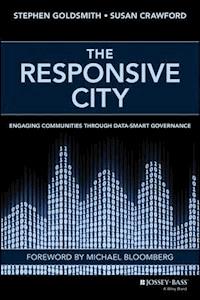
Leveraging Big Data and 21st century technology to renew cities and citizenship in America The Responsive City is a guide to civic engagement and governance in the digital age that will help leaders link important breakthroughs in technology and data analytics with age-old lessons of small-group community input to create more agile, competitive, and economically resilient cities. Featuring vivid case studies highlighting the work of pioneers in New York, Boston, Chicago and more, the book provides a compelling model for the future of governance. The book will help mayors, chief technology officers, city administrators, agency directors, civic groups and nonprofit leaders break out of current paradigms to collectively address civic problems. The Responsive City is the culmination of research originating from the Data-Smart City Solutions initiative, an ongoing project at Harvard Kennedy School working to catalyze adoption of data projects on the city level. The book is co-authored by Professor Stephen Goldsmith, director of Data-Smart City Solutions at Harvard Kennedy School, and Professor Susan Crawford, co-director of Harvard's Berkman Center for Internet and Society. Former New York City Mayor Michael Bloomberg penned the book's foreword. Based on the authors' experiences and extensive research, The Responsive City explores topics including: * Building trust in the public sector and fostering a sustained, collective voice among communities; * Using data-smart governance to preempt and predict problems while improving quality of life; * Creating efficiencies and saving taxpayer money with digital tools; and * Spearheading these new approaches to government with innovative leadership.
Sie lesen das E-Book in den Legimi-Apps auf:
Seitenzahl: 356
Veröffentlichungsjahr: 2014
Ähnliche


















Table of Contents
Title Page
Copyright
Foreword
Introduction
Saving Children with Tablets
Coordinated, Precision Crime Fighting
The Renewed Public Employee
The Digital Civic Switchboard
Leadership
Notes
Chapter One: The Return of Retail Governance
Customer Relationship Management Goes Public
Connecting Citizens via App
Connecting City Workers
The Next Step
Notes
Chapter Two: Networked Citizenship
Chicago
Rio de Janeiro
New York City
Austin
Chennai
The Future of Civic Voice
Notes
Chapter Three: The Interactive City
Digitally Enhanced Democracy
Supporting Engagement
Notes
Chapter Four: The City as Digital Platform
Epilogue: A Platform Built from Scratch
Notes
Chapter Five: The Responsive Employee
Retail Government
Working Smarter: Data-Driven Decision Making
Accountable Discretion
Open Source Empowerment
Accountable Discretion by Proxy
The Virtuous Circle of Motivated Workers and Satisfied Constituents
Notes
Chapter Six: The Data-Smart City
Selling an Idea
Identifying and Preventing Mortgage Fraud
A Joint Push from Top City Hall Officials
Preempting the Next Fire with Data
Success Goes Viral
Uncovering Efficiency across Fragmentation
Analytics Meets the Open Data Movement
Chapter Seven: Rethinking Government
The Story of HHS-Connect
Civil Service Obstacles to Empowering Employees
Employee Discretion and Creativity
Procurement as the Barrier to Innovation
Notes
Chapter Eight: Toward Responsive Cities
The Promise of Data Analytics: Indiana
The Promise of 311: New York City
Private Data Publicly Used: The Need for Thoughtful Public Policy
Notes
Acknowledgments
About the Authors
Index
End User License Agreement
Pages
v
vi
1
2
3
4
5
6
7
8
9
10
11
12
13
14
15
16
17
18
19
20
21
22
23
24
25
26
27
28
29
30
31
32
33
34
35
36
37
38
39
40
41
42
43
44
45
46
47
48
49
50
51
52
53
54
55
56
57
58
59
60
61
62
63
64
65
66
67
68
69
70
71
73
74
75
76
77
78
79
80
81
82
83
84
85
86
87
88
89
90
91
92
93
94
95
96
97
98
99
100
101
102
103
104
105
106
107
108
109
110
111
112
113
114
115
116
117
118
119
120
121
122
123
124
125
126
127
128
129
130
131
132
133
134
135
136
137
138
139
140
141
142
143
144
145
146
147
148
149
150
151
152
153
154
155
157
158
159
160
161
162
163
164
165
166
167
168
169
170
171
172
173
174
175
176
177
187
188
189
190
191
192
193
194
195
196
197
198
199
200
201
202
Guide
Cover
Table of Contents
Introduction
Begin Reading
The Responsive City
Engaging Communities Through Data-Smart Governance
Stephen Goldsmith
Susan Crawford
Copyright © 2014 by John Wiley & Sons, Inc. All rights reserved.
Published by Jossey-Bass
A Wiley Brand
One Montgomery Street, Suite 1200, San Francisco, CA 94104-4594\hb www.josseybass.com
No part of this publication may be reproduced, stored in a retrieval system, or transmitted in any form or by any means, electronic, mechanical, photocopying, recording, scanning, or otherwise, except as permitted under Section 107 or 108 of the 1976 United States Copyright Act, without either the prior written permission of the publisher, or authorization through payment of the appropriate per-copy fee to the Copyright Clearance Center, Inc., 222 Rosewood Drive, Danvers, MA 01923, 978-750-8400, fax 978-646-8600, or on the Web at www.copyright.com. Requests to the publisher for permission should be addressed to the Permissions Department, John Wiley & Sons, Inc., 111 River Street, Hoboken, NJ 07030, 201-748-6011, fax 201-748-6008, or online at www.wiley.com/go/permissions.
Limit of Liability/Disclaimer of Warranty: While the publisher and author have used their best efforts in preparing this book, they make no representations or warranties with respect to the accuracy or completeness of the contents of this book and specifically disclaim any implied warranties of merchantability or fitness for a particular purpose. No warranty may be created or extended by sales representatives or written sales materials. The advice and strategies contained herein may not be suitable for your situation. You should consult with a professional where appropriate. Neither the publisher nor author shall be liable for any loss of profit or any other commercial damages, including but not limited to special, incidental, consequential, or other damages. Readers should be aware that Internet Web sites offered as citations and/or sources for further information may have changed or disappeared between the time this was written and when it is read.
Jossey-Bass books and products are available through most bookstores. To contact Jossey-Bass directly call our Customer Care Department within the U.S. at 800-956-7739, outside the U.S. at 317-572-3986, or fax 317-572-4002.
Wiley publishes in a variety of print and electronic formats and by print-on-demand. Some material included with standard print versions of this book may not be included in e-books or in print-on-demand. If this book refers to media such as a CD or DVD that is not included in the version you purchased, you may download this material at http://booksupport.wiley.com. For more information about Wiley products, visit www.wiley.com.
Library of Congress Cataloging-in-Publication Data
Goldsmith, Stephen, 1946-
The responsive city : engaging communities through data-smart governance / Stephen Goldsmith and Susan Crawford.
pages com
Includes bibliographical references and index.
ISBN 978-1-118-91090-0 (hardback); ISBN 978-1-118-91121-1 (pdf); ISBN 978-1-118-91093-1 (epub)
1. Internet in public administration—United States. 2. Public-private sector cooperation—United States. 3. Cities and town—United States. 4. Digital media—United States I. Crawford, Susan, 1963-II. Title.
JK468.A8G63 2014
352.3'821602854678—dc23
2014019126
Foreword
There is no better way to improve the lives of billions of people around the world than to improve the way cities work. For the first time in human history, the majority of the world's people live in cities. By 2050, 75 percent will. As more and more people move to cities, more and more of the world's challenges—and solutions—will be concentrated there, too.
The rise of cities coincides with a technological revolution that is empowering local leaders to find innovative new ways to better serve the public. At the center of that revolution is our growing ability to use data to improve the services that government provides. Governments have long been in the business of keeping records, and increasingly they are using those records—billions of data points—to improve everything from emergency response to education to transportation.
I have a rule of thumb: if you can't measure it, you can't manage it. And I brought that approach with me from the private sector to New York's city hall. Our administration looked for ways to use data—and to collect more data—to help us better serve New Yorkers.
In 2003, we launched 311, a nonemergency government information and services hotline available to New Yorkers twenty-four hours a day, seven days a week. Not only did 311 make it easier for New Yorkers to get information from the city—and to file complaints—it also gave city government more information on what New Yorkers were concerned about and helped us keep track of how well we were doing at addressing those concerns.
We also created data systems to measure agency performance and hold ourselves accountable for results. And we took a page from the private sector and brought predictive analytics to local government, using city data to help foresee the challenges of the future—and took action to address them today.
Harnessing and understanding data helped us decide how to allocate resources more efficiently and effectively, which allowed us to improve the delivery of services—from protecting children and fighting crime to repairing potholes and inspecting buildings—while also saving taxpayer money.
Cities and mayors everywhere are recognizing the powerful role data can play in bringing more transparency, accountability, and efficiency to government—and Bloomberg Philanthropies is helping to support this work. For instance, in 2013 the city of Chicago was one of five winners of the Mayors Challenge, an ideas competition for cities, for its groundbreaking idea to use data to help city government prevent problems before they develop. Chicago is quickly setting a new standard, which other cities will surely follow.
Across so much of the work we do with cities—from our innovation delivery program helping New Orleans reduce gun violence to our work with cities around the world to reduce carbon emissions—we see data enabling new and creative approaches. Of course, driving change in cities requires more than just data. It also requires strong managers and creative problem solvers—and Stephen Goldsmith is both. I was lucky to have him join me at city hall as a deputy mayor during my third term in office, and he helped us take our efforts to improve city services to new levels.
In the chapters that follow, Goldsmith and his talented coauthor, Susan Crawford, demonstrate how local leaders are changing the way governments work. Through case studies from New York City, Boston, and Chicago, they explain how data mining, empowered public servants, mobile apps, wireless devices, technically supported citizens, and social media can produce a dramatically more responsive city. And they show how these tools can be used by both elected and community leaders to drive change and improve a neighborhood's quality of life.
Cities will increasingly define the future, in America and around the world. And cities that capitalize on the technology revolution will lead the way. This book helps point the way forward.
June 2014
Michael BloombergFormer mayor of New York City
Introduction
Urban government in the United States today is at a critical juncture. Never before over the last century has there been such a need to change the way city hall works. And never has there been such an opportunity to do it. The century-old framework of local government—centralized, compartmentalized bureaucracies that jealously guard information and adhere to strict work rules—is frustrating and disappointing its constituents, whose trust in government is at an all-time low. Residents in many cities despair of getting the services they need from city hall, especially in places where financial stresses are making governments even less responsive than in the past. Yet local government has the means to completely reverse this trend toward despair. That opportunity comes from digital technology: new ways of gathering, storing, and analyzing data; new modes of communication; and the new world of social networks. With these digital tools, citizens and their officials can revolutionize local government, making it more responsive, transparent, and cost-effective than it has ever been.
Lesen Sie weiter in der vollständigen Ausgabe!
Lesen Sie weiter in der vollständigen Ausgabe!
Lesen Sie weiter in der vollständigen Ausgabe!
Lesen Sie weiter in der vollständigen Ausgabe!
Lesen Sie weiter in der vollständigen Ausgabe!
Lesen Sie weiter in der vollständigen Ausgabe!
Lesen Sie weiter in der vollständigen Ausgabe!
Lesen Sie weiter in der vollständigen Ausgabe!
Lesen Sie weiter in der vollständigen Ausgabe!
Lesen Sie weiter in der vollständigen Ausgabe!
Lesen Sie weiter in der vollständigen Ausgabe!
Lesen Sie weiter in der vollständigen Ausgabe!




