


2,99 €
Mehr erfahren.
- Herausgeber: Edizioni Epoké
- Kategorie: Geisteswissenschaft
- Sprache: Englisch
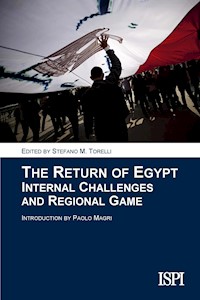
Egypt has reappeared again as a leading actor in the Middle East. After the fall of Mubarak, the rise to power of the Muslim Brotherhood and its ouster, the country has chosen its new ‘strongman’. Following the elections of al-Sisi, Egypt is back to pursuing a pro-active policy not only internally, but also in the neighbourhood. The restoration of the strategic axis with Saudi Arabia and the struggle against radical Islam are the two pillars of this new political phase. However, there are critical elements, too, from further deterioration of the political and civil liberties indexes, to the emergence of jihadist groups in the Sinai, to the enduring economic and financial difficulties. As a result of these changes, Europe and Italy should calibrate a new policy aimed at safeguarding their interests, especially from the points of view of security, stability and the fight against terrorism, also promoting more inclusive practices by the Cairo government vis-à-vis the opposition (including the Muslim Brotherhood) and developing policies which can help Egypt to respond to future challenges in terms of economic growth, poverty alleviation, demographic pressure and the creation of employment opportunities
Das E-Book können Sie in Legimi-Apps oder einer beliebigen App lesen, die das folgende Format unterstützen:
Veröffentlichungsjahr: 2015
Ähnliche




















Edited by Stefano M. Torelli
The Return of Egypt. Internal Challenges and Regional Game
ISBN ePub 978-88-98014-82-8
© 2015 Edizioni Epoké
Firs edition: 2015
Edizioni Epoké. Via N. Bixio, 5
15067, Novi Ligure (AL)
www.edizioniepoke.it
ISPI. Via Clerici, 5
20121, Milano
www.ispionline.it
Graphic project and layout: Edoardo Traverso
I edition.
All Rights reserved. No part of this book may be reprinted or reproduced or utilised in any form or by any electronic, mechanical, or other means, now known or hereafter invented, including photocopying and recording, or in any information storage or retrieval system, without permission in writing from the publisher.
The Italian Institute for International Political Studies (ISPI) is an independent think tank dedicated to being a resource for government officials, business executives, journalists, civil servants, students and the public at large wishing to better understand international issues. It monitors geopolitical areas as well as major trends in international affairs.
Founded in Milan in 1934, ISPI is the only Italian Institute – and one of the few in Europe – to place research activities side by side to training, organization of international conferences, and the analysis of the international environment for business-es.
Comprehensive interdisciplinary analysis is achieved through close collaboration with experts (academics and non-academics alike) in political, economic, legal, historical and strategic studies and through an ever-growing network of think tanks, research centers and Universities in Europe and beyond.
Contents
Introduction
1. Al-Sisi’s Egypt: The State Triumphant
2. What People Want: Egypt’s Domestic Challenges
3. Adding the Security Ingredient: The Jihadi Threat in the Sinai Peninsula
4. Egypt and the Middle East. A ‘New’ Regional Protagonist?
5. Cairo Between Washington and Moscow: A New Theatre for Global Confrontation?
6. Common Interests and Different Visions: Policy Implications for EU and Italy
About the Authors
Introduction
When Hosni Mubarak resigned his 30-year presidency, on February 11, 2011, Egypt seemed ready to seize the opportunity to enter a new era. After the revolutionary upheavals in Tunisia, the country was about to become the second theater of the so-called “Arab Spring”, thus contributing to spreading a sense of hope throughout the entire Middle East. Indeed, in those early stages Egypt went through a truly democratic process, despite all the troubles stemming from years of authoritarian ruling. For two years, Cairo was an important reference point in the Arab world for real policy change. Between 2011 and 2012, Egypt saw its first democratic parliamentary elections and, in June 2012, began an important experiment of political Islam government with the election of President Mohammed Morsi. At this stage, Egypt was still looking for a new identity, while popular opposition to the Muslim Brotherhood began to emerge. The Brotherhood, for its part, fully exploited its majoritarian mandate, seemingly ignoring the oppositions’ instances. Morsi paid a high price for this mistake when General al-Sisi deposed him in July 2013, an event that marked a real turning point in the country’s recent history. The army returned to power and put a grinding halt to the political change started in 2011. At the same time, Egypt relapsed into intense internal struggle, marked by the repressive measures of the new regime. This was justified by the threat of terrorism, as well as by a kind of “popular mandate” represented by the millions of Egyptians who had hoped for military intervention against the Brotherhood’s rule.
But what kind of Egypt has risen from the ashes of its post-Arab Spring turmoil? What stands out in the new course of Egypt’s ruling by President al-Sisi, elected as successor to Morsi in 2014? From a strictly internal point of view, the role of the military in the political process is definitely a key issue. The resignation of Mubarak itself was guided by the army and even throughout Morsi’s presidency the military continued to exert pressure on the political system. As a result, today’s Egypt is characterized by the security-driven approach led by the army. The Muslim Brotherhood has been ruthlessly repressed and the movement has been banned and declared a terrorist organization. The other oppositions have been severely limited and Morsi has even been sentenced to death. However, if Egypt’s internal affairs cast many shadows, from the regional and international perspective Cairo has made its comeback as a major regional actor. Egypt aims at nothing short of acting as head of the Middle Eastern world, especially for Sunni Arab countries, and this undoubtedly sends a message of change from Mubarak’s era. The region’s most solid and to some extent effective axis is indeed between Egypt and Saudi Arabia. Egypt’s direct interventions in Libya – alongside the government of Tobruk – and in Yemen – in support of Saudi Arabia and against the Houthi rebels supported by Iran – highlight Cairo’s efforts to shift the tide to its advantage. However, such new attitudes have paid their toll in terms of new regional fractures, as shown by the freezing of relations with two important countries like Qatar and Turkey.
Against this background, this report analyses the characteristics of the new Egypt, by addressing both the internal political evolution, and the regional and international impact of a rising Egypt. A final chapter is specially devoted to assess how and to what extent Europe and Italy can find new ways of collaboration with Cairo, despite some diverging interests, perceptions and values.
In the first chapter Marina Ottaway starts noting that al-Sisi’s Egypt has first of all put the bulky figure of the state at the center of public life. The transition to a new era for post-uprising Egypt is marked by the return of authoritarian practices, such as the leading role played by the military, the repression of organized dissent and the centralization of power and of religion itself. In this sense, there is a real risk that, over the next few years, the country will diverge from the reform path and opt for a strict conservatism safeguarding the very existence of the regime, which increasingly overlaps with the very idea of the state.
By the same token, the second chapter by Andrea Teti notes that internal opposition to the regime suffers from the same difficulties existing under President Mubarak. Opposition groups have no solid organization or funds, are not able to provide for a general mobilization in the country, and have problems in operating under the very restrictive conditions imposed by the Egyptian government. In this scenario, and with the Muslim Brotherhood ostracized, it is doubtful that the opposition will be able to deliver effective political action.
In this political context, in the third chapter, Zack Gold’s focuses on an analysis of the security threat coming from the operations of jihadist groups, especially in the Sinai, which now constitutes the greatest source of concern for al-Sisi. Despite the President’s iron fist approach, resulting in his war on terrorism, Egypt continues to suffer terrorist attacks, as a result of an increasing presence of the Islamic State (IS) in Egypt. In particular, Gold maintains that security-led approaches could turn out to be counterproductive, as the state’s response should also focus on new social policies and inclusion practices.
However, when shining the spotlight on regional relations – as Cecilia Zecchinelli puts it in the fourth chapter – al-Sisi’s Egypt has sought to rebuild its alliances. For a start, the center of Egyptian Middle East policy is currently the Gulf and especially Saudi Arabia and the United Arab Emirates. The strengthening of this Sunni Arab axis is a sort of a new fil-rouge in the region, but it also raises new tensions, as shown by the deteriorated relations with Turkey and Qatar and the frozen relations with Iran after slight openings under Morsi. The new course of Egyptian regional policy has also led to renewed cooperation with Israel, especially concerning the issues of security and control of the Sinai. Egypt’s regional activism is shown very clearly by the military actions in Libya in direct support of General Haftar and by support for the Saudi operations in Yemen against the Houthi rebels. Finally, al-Sisi has been playing an important new role in Africa, where he has reached an agreement with Ethiopia and Sudan for the management of the Nile’s waters, one of the strategic priorities for Cairo.
Even on the global level Egypt has partially revised its relations with major international actors. Charles Dunne in chapter five gives an interpretation of Egyptian international relations, debating whether or not one can speak of a new theater of confrontation between Russia and the United States. It goes without saying, Dunne writes, that with the rise of al-Sisi Egypt has partially turned away from Washington and returned to having very good relations with Russia, which had not occurred since the days of Nasser. Russia has carried out naval exercises with Egypt, has signed agreements for the sale of weapons to and for the installation of a nuclear power plant in Egypt and has a common interest in fighting terrorism. However, Egypt’s relations with the US remain crucial and it is difficult that Egypt will become a front line between the two powers.
An even more difficult task, however, is to outline European – and specifically Italian – policies able to combine common interests with the need to promote the values that the EU has historically espoused. This is the topic of discussion of the last chapter, jointly written by Hélène Michou and Stefano Torelli, which identifies areas and issues of common interest between Europe and Egypt and their policy implications. The fight against terrorism, Mediterranean security, Libya’s crisis and migration flows all constitute possible grounds of cooperation with Egypt. Indeed, the authors argue that Europe and Italy could initiate policies of regional integration in order to find solutions to common problems. At the same time, northern Mediterranean countries should push Cairo towards a process of internal reforms to ease current confrontations between the regime and oppositions. Only in this way could common policies be built and, above all, Italy and Europe be able to regain credibility with southern Mediterranean partners.
Paolo Magri ISPI Executive Vice President and Director
1. Al-Sisi’s Egypt:The State Triumphant
Marina Ottaway
There is no such thing as a regime. There is something called an Egyptian state. The Egyptian people elect a president who is able to stabilize the country. Not a regime that keeps changing, that is unacceptable. An Egyptian state with its institutions, courts, with its police, its army, all of its different elements working together collaboratively for Egypt and not for one individual on top. And in case this individual leaves, his successor will continue to build on what he started.
Lesen Sie weiter in der vollständigen Ausgabe!
Lesen Sie weiter in der vollständigen Ausgabe!
Lesen Sie weiter in der vollständigen Ausgabe!
Lesen Sie weiter in der vollständigen Ausgabe!
Lesen Sie weiter in der vollständigen Ausgabe!
Lesen Sie weiter in der vollständigen Ausgabe!




