


50,99 €
Mehr erfahren.
- Herausgeber: John Wiley & Sons
- Kategorie: Fachliteratur
- Sprache: Englisch
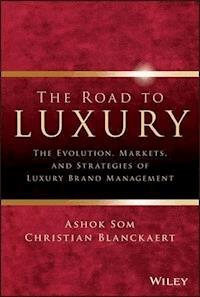
A thorough, comprehensive guide to the luxury goods industry for executives, entrepreneurs, and students interested to know about the luxury business As key new luxury markets like Asia, Latin America and Africa continue to expand, The Road to Luxury: The Evolution, Markets and Strategies of Luxury Brand Management gives professionals interested in the industry a holistic understanding of luxury market dynamics around the world using stories, experiences, relevant data and statistics on current market trends. For investors, the book offers valuable insight on where the industry is headed. For industry insiders and executives, it presents valuable data with which to craft successful business strategies. * The definitive insider's guide to the luxury sector by leading figures in the field * Includes rigorous academic data, including information on the business attractiveness and appropriateness of various country markets * Examines strategies and success factors of key players, and insight into the systems and operations, retail, distribution and e-commerce, emerging markets and emerging brands, as well as management styles For professionals in the luxury industry, as well as those studying it or investing in it, The Road to Luxury presents a complete and information-packed resource covering virtually every aspect of this growing sector.
Sie lesen das E-Book in den Legimi-Apps auf:
Seitenzahl: 742
Veröffentlichungsjahr: 2015
Ähnliche



















Table of Contents
Title Page
Copyright
Dedication
Acknowledgments
About the Authors
Prologue: The Pink Bag
Chapter 1: Introduction: Definition and Crisis of Luxury
Issues of Defining Luxury
Crisis
The Luxury Industry
Reaction to the Crisis of Global Markets
Effect of Crisis on the Luxury Industry
Strategic Response to Crisis
Conclusion
Chapter 2: Evolution of the Global Luxury Market
Evolution
How Has It Changed?
Luxury Industry Trends
Conclusion
Chapter 3: Who's Who of Luxury
The Consumers
The Actors
Chapter 4: Branding
Luxury Marketing: Highly Creative and Selective
Cobranding: Does It Enhance Branding or Selling?
Brand Extensions
Pricing
Storytelling: Culture, Event, and Communication
Digital Marketing
Discussion
Conclusion
Chapter 5: Brand Identity, Clients, and Ethos
Brand Identity
Ethos
Clients
Discussion
Conclusion
Chapter 6: Family Houses, Corporatization, and New Entrants
What Is a Family Business?
Family Business during Crisis
Family Businesses of the Future: Corporatization
Changes during Transition from Family Business to Corporation
Entrepreneurs and New Entrants
Trends and Discussion
Conclusion
Chapter 7: Management Styles in the Luxury Industry
Path Dependency: Management Styles
Managing Paradoxes
Examples of Styles
Analysis
Conclusion
Chapter 8: Skills
Historical Craftsmanship
Entrepreneurial Designers
The Sales Team
The Professional Managers
Skills Required
Managing Talent
Conclusion
Chapter 9: Services: The Point of Sale
Issues in Point-of-Sale
The Customer Dimension
The Service Dimension
Conclusion
Chapter 10: Systems and Operations in the Luxury Business
The Challenge
Global Supply Chain
Customer Relationship Management
Information Technology
Conclusion
Chapter 11: Retail, Distribution, and E-Commerce
Channels of Distribution
Travel Retail and Duty-Free Stores
Strategic Decisions in Geographic Expansion
Online Distribution and E-Commerce
Conclusion
Chapter 12: Intellectual Property Rights and Counterfeiting
Counterfeiting: Issues for Luxury Brands
The Issue of Legality
Is It an Emerging Market Phenomenon?
Effect on a Brand
Examples of Responses to Counterfeiting
What to Do to Prevent Counterfeiting?
Gray Market
Conclusion
Chapter 13: Emerging Markets and Emerging Market Luxury Brands
Brazil
Russia
India
China
Strategic Actions
Conclusion
Chapter 14: The Future and Questions to Ponder
Research Design, Methodology, and Data Collection
Methodology
Data Collection and Analysis
Bibliography
Index
End User License Agreement
Pages
5
6
7
8
9
10
11
12
13
14
15
16
17
18
19
20
21
22
23
24
25
26
27
29
30
31
32
33
34
35
36
37
38
39
40
41
42
43
44
45
47
48
49
50
51
52
53
54
55
56
57
58
59
60
61
62
63
64
65
66
67
68
69
70
71
72
73
74
75
76
77
78
79
80
81
82
83
84
85
88
86
87
89
90
91
92
93
94
95
96
97
98
99
100
101
102
103
104
105
106
107
108
109
110
111
112
113
114
115
116
117
118
119
120
121
122
123
124
125
126
127
128
129
130
131
132
133
134
135
136
137
138
139
140
141
142
143
144
145
146
147
148
149
150
151
152
153
154
155
156
157
158
159
160
161
162
163
164
165
166
167
168
169
170
171
172
173
174
175
176
177
178
179
180
181
182
183
184
185
186
187
188
189
190
191
192
193
194
195
196
197
198
199
200
201
202
203
204
205
206
207
208
209
210
211
212
213
214
215
216
217
218
219
220
221
222
223
224
225
226
227
228
229
230
231
232
233
235
236
237
238
239
240
241
242
243
244
245
246
247
248
249
250
251
252
253
254
255
256
257
258
259
260
261
262
263
264
265
266
267
268
269
270
271
272
273
274
275
276
277
278
279
280
281
282
283
284
285
286
287
288
289
290
291
292
293
294
295
296
297
298
299
300
301
302
303
304
305
307
308
309
310
311
312
313
314
315
316
317
318
319
320
321
322
323
324
325
326
327
328
329
330
331
332
333
334
335
336
337
338
339
340
341
342
343
344
345
346
347
348
349
350
351
352
353
354
355
356
357
358
359
360
361
362
363
364
365
366
367
368
369
370
371
372
373
374
375
376
377
378
379
380
381
382
383
384
385
386
387
388
389
390
391
392
393
394
395
396
397
398
399
400
401
402
403
404
405
406
407
408
409
411
412
413
414
415
416
417
418
419
420
433
434
435
436
437
438
439
440
441
442
443
444
445
446
447
448
449
450
Guide
Cover
Table of Contents
Begin Reading
List of Illustrations
Figure 1.1
Figure 1.2
Figure 1.3
Figure 1.4
Figure 1.5
Figure 2.1
Figure 2.2
Figure 2.3
Figure 4.1
Figure 4.2
Figure 4.4
Figure 5.1
Figure 5.2
Figure 5.3
Figure 5.4
Figure 5.5
Figure 6.1
Figure 6.2
Figure 6.3
Figure 6.4
Figure 6.5
Figure 6.6
Figure 7.1
Figure 7.2
Figure 7.3
Figure 8.1
Figure 8.2
Figure 8.3
Figure 9.1
Figure 9.2
Figure 9.3
Figure 9.4
Figure 10.1
Figure 10.2
Figure 11.1
Figure 11.2
Figure 11.3
Figure 12.1
Figure 12.2
Figure 13.1
Figure R.1
List of Tables
Table 3.1
Table 3.2
Table 3.3
Table 3.4
Table 3.5
Table 6.1
Table 8.1
Table 13.1
The Road to Luxury
The Evolution, Markets, and Strategies of Luxury Brand Management
Ashok Som
Christian Blanckaert
Cover image: iStock.com/Emilia_Szymanek
Cover design: Wiley
Copyright © 2015 by John Wiley & Sons Singapore Pte. Ltd.
Published by John Wiley & Sons Singapore Pte. Ltd.
1 Fusionopolis Walk, #07-01, Solaris South Tower, Singapore 138628
All rights reserved.
No part of this publication may be reproduced, stored in a retrieval system, or transmitted in any form or by any means, electronic, mechanical, photocopying, recording, scanning, or otherwise, except as expressly permitted by law, without either the prior written permission of the Publisher, or authorization through payment of the appropriate photocopy fee to the Copyright Clearance Center. Requests for permission should be addressed to the Publisher, John Wiley & Sons Singapore Pte. Ltd., 1 Fusionopolis Walk, #07-01, Solaris South Tower, Singapore 138628, tel: 65-6643-8000, fax: 65-6643-8008, e-mail: [email protected].
Limit of Liability/Disclaimer of Warranty: While the publisher and author have used their best efforts in preparing this book, they make no representations or warranties with respect to the accuracy or completeness of the contents of this book and specifically disclaim any implied warranties of merchantability or fitness for a particular purpose. No warranty may be created or extended by sales representatives or written sales materials. The advice and strategies contained herein may not be suitable for your situation. You should consult with a professional where appropriate. Neither the publisher nor the author shall be liable for any damages arising herefrom.
Other Wiley Editorial Offices
John Wiley & Sons, 111 River Street, Hoboken, NJ 07030, USA
John Wiley & Sons, The Atrium, Southern Gate, Chichester, West Sussex, P019 8SQ, United Kingdom
John Wiley & Sons (Canada) Ltd., 5353 Dundas Street West, Suite 400, Toronto, Ontario, M9B 6HB, Canada
John Wiley & Sons Australia Ltd., 42 McDougall Street, Milton, Queensland 4064, Australia
Wiley-VCH, Boschstrasse 12, D-69469 Weinheim, Germany
Library of Congress Cataloging-in-Publication Data is Available
ISBN 978-0-470-83002-4 (Hardcover)
ISBN 978-0-470-83004-8 (ePDF)
ISBN 978-0-470-83005-5 (ePub)
ISBN 978-1-118-81432-1 (oBook)
We dedicate this book to Elliot, Ines, Valentin, Victor, and Zoya
Acknowledgments
I taught the course on strategy in the program of MBA in International Luxury Brand Management from 2004 to 2012 at ESSEC Business School. The idea of the book crystallized during my interactions with the participants of the program. Prompted by my students, I started to create assignments such as case studies, which the students from the program wrote under my supervision. Those teaching materials were used in the program with great success and were adapted worldwide in other universities and business schools. I am grateful to the participants in this program for their insights and feedback. My work environment in a French grande ecole provided and sustained my interest in French and Italian luxury businesses. I appreciate the efforts of my colleague Simon Nyeck to involve me in the program and my friend Michel Phan to discuss and debate the world of fashion and luxury trends. My sincere thanks to Esther Boinville, Anthea Davis, Armelle Leduc, Denis Morisset and other members of the team managing the MBA in International Luxury Brand Management program for the last two decades.
I acknowledge the support of all my students, especially Yu Cao, Arushi Chopra, Sushanta Das, Rashi Gupta, Hannes Gurzki, Naja Pape, Shiva Pappu, and Milan Rabold who supported me in my research while writing this book. My sincere thanks to my students, Manuela Brische, Lilly Liu, Deepak Yachamaneni, Boris Gbahoué, Geraldine Carter, Stephanie Masson, Misha Gupta, Karyn Bell, Anna Nolting, Fernanda Harger, Nora Kato, Raghavendra Sheshamurthy, Nonika Vyas, Tina Huang, Sid Shetty, Priscilla Mark, Mario Sanz del Castillo, Lynn Chou, Lan Wu, Leonardo Banegas, Pajaree Kasemsant, Salman Bukhari who spend their time revising and integrating my comments multiple times to make their work publishable. Also my appreciation goes to Ruchi Shangari Dsouza, Debjani Roy, Daniel Tobar-Richter, Clara Gonzalez Goicoechea, Valerie Flexor, Jisook Anh, Mo Cheng, Wenjing Wang, Meng Li, Erik Lobatom Kanika Holloway, Sophia Redford, Alessandro Cannata, Hui Xu and many others worked diligently in my course on Managing the Global Corporation. My most sincere appreciation goes to Nathalie Delforge for administration and logistics, to our Department assistants Christiane, Alexandra & Nathalie, and to my editor Tracy Donhardt, who helped me shape the manuscript.
I unhesitatingly acknowledge the support and encouragement of Françoise Rey, who motivated me to try new concepts and creative ways of managing programs. I express my sincere thanks to Jean-Michel Blanquer, Vincenzo Esposito Vinzi, Radu Vranceanu, Marie-Laure Djelic, Gilles van Wijk, and all my colleagues who supported me in this endeavor.
I acknowledge the companies such as Bavaria; British American Tobacco; BMW; DFS; Ganjam; the Leela Palaces, Hotels, and Resorts; Van Cleef and Arpels; Chaumet; Pernod Ricard; Krug; Baccarat: Raketa and many others who enhanced our knowledge about the different sectors of the luxury business. I acknowledge the strong support of Piyush Kumar Sinha from IIM Ahmedabad, India, who codirected the Advanced Management Program in Luxury for the past four years.
Despite the best efforts of the contributors, I remain responsible for any shortcomings. Finally, I would like to acknowledge the efforts of my seven-year-old daughter, Mekhala-Zoya, who regularly reminded me not to waste my time on browsing Facebook but to complete my part of the chapters before the ever-extending deadlines.
Ashok Som
About the Authors
Ashok Som is Professor of Management Department at ESSEC Business School. Professor Som is one of the pioneering thought leaders in designing organizations and an expert in Global Strategy. His books Organization: Redesign and Innovative HRM was published by Oxford University Press (2008) and International Management: Managing the Global Corporation was published by McGrawHill, UK (2009). At ESSEC, he was the Founding Associate Dean of the full-time, one-year post experience, Global MBA program; the founder of the India Research Centre; and the founder and Director of the Global Management Programs on Luxury and Retail Management (in partnership with Indian Institute of Management [IIM] Ahmedabad). He received his PhD from IIM Ahmedabad; M.Sc and M.Tech from the Indian Institute of Technology, Kharagpur; and bachelor's degree from Presidency College, Calcutta, India. He is passionate about case-based research and teaching. He was the winner of the EFMD Case Writing Competition 2008 in the Indian Management category. He won the Case Centre Award 2014 in the Entrepreneurship category. He is Adjunct Faculty at IIM Ahmedabad (India) and Mannheim Business School (Germany), and Visiting Professor at IIM Calcutta (India), Auckland University of Technology (New Zealand), Graduate School of Business, Keio University (Tokyo), and Tamkang University (Taiwan). His current research is on creative industries, focusing on luxury industry. He is a regular speaker in international conferences and consults with European and Indian multinationals.
Christian Blanckaert's resume establishes him as a global leader in luxury. He is currently the nonexecutive Chairman of Petit-Bateau and Advisor to the Chairman of EPI Group (J.M. Weston, Alain Figaret, Bonpoint, Champagne Piper-Heidseick and Charles Heidseick), the family holding Descours. He is also Senior Advisor of Eurazeo and a board member of Moncler. From 1996 to 2009, Blanckaert was the Chairman and CEO of Hermès Sellier and Executive Vice President of Hermès International. From 1988 to 1996 he was President of Comité Colbert (a French organization that represents 70 French luxury companies). During his career, Christian has been a consultant with the Boston-based consulting firm Harbridge House. He was Managing Director of the do-it-yourself chain Bricorama, Chairman and CEO of Thomson-Distribution, and Managing Director of the SCAC group. Christian was also for many years Chairman of the Board of the French National School of Decorative Arts (ENSAD). Blanckaert was Mayor of Varengeville-sur-Mer for 21 years and is the author of six books: Les Chemins du luxe (Grasset, 1996), Portraits en Clair-Obscur (Balland, 2001), a biography of Roger Salengro (Balland, 2004), Luxe (Editions du Cherche-Midi, 2007), Luxe Trotter (2012 Editions du Cherche–Midi, 2012), and Les 100 mots du Luxe (Les Presses Universitaires de France PUF, 2012). He is a visiting professor at ESCP-PARIS. Blanckaert graduated from the Institut d'Etudes Politiques de Paris, the Faculty of Law of Paris, and has an MBA from INSEAD.
Prologue
The Pink Bag
It had been sitting there, on the shelf, for ages.
Two years, three years —nobody knew exactly, but it was surely a “depreciated asset,” as a slick city banker might say.
They could have hidden it away at the back of a store cupboard, but that would have been too sad, too harsh. The bag had become a fixture, a familiar friend of the store, and it sat there, doggedly, fixedly—probably for a long time.
This bag had personality. It was pink. Pink crocodile leather with a diamond clasp. Worth a small fortune. Yet still on the shelf.
From time to time, someone would move it to another spot.
It would be showcased, at the entrance, or to one side, or right in the middle, or at the back of the store.
It had attracted plenty of dust, watched thousands of customers pass by, as it waited in vain to catch someone's eye.
The pink crocodile bag filled the sales assistants with despair, but it was no use to think about it. They kept it, convinced that one day there would be a new turn of fate.
The pink bag had aged a little, the candy pink had begun to fade slightly, and the diamonds, which were polished every day, had lost some of their sparkle.
“We should take it off the shelf,” said the leather section manager. “We can't keep it on sale,” said the head sales manager. In short, the pink bag was a nuisance; its continual presence was annoying and it was beginning to stand out like a sore thumb.
The bag felt ashamed. What could be the reason for its failure? Its price, its color, its skin?
The sales assistants resorted to making jokes and calling it “unsellable,” which is of course the worst insult for a handbag.
One Monday morning, a customer came across the bag, high up on its perch. The bag seemed rather aloof, almost condescending, as it looked down on the crowd of customers.
“May I have a look at it?” inquired the lady.
Excited, the sales assistant took down the bag, taking care to don her white gloves, so as not to scratch the crocodile leather. She announced the price, one hundred and ten thousand francs, and said rather clumsily, almost apologetically: “Madam, just look at the magnificent diamonds.” The customer replied, “No, I think the bag itself is beautiful. The color is unique. I've never seen a pink quite like it.” Gilberte, the sales assistant, couldn't believe her ears when the lady added, “I'll take it.”
With a wave of her arms, a hand in the air, Gilberte did all she could to alert her colleagues.
“The pink bag has been sold!”
The news spread through the store like wildfire.
At the checkout, the bag was ready and waiting, all polished and packaged, magnificent in its superb orange box.
The sales assistant accompanied the customer to the checkout.
“How would you like to pay?” she asked.
“American Express,” replied the lady, confidently.
Normally, the transaction is accepted at the first try. But this time, the machine tried once, twice, three times …before the harassed cashier was obliged to announce, in hushed tones, “I'm sorry Madam, your card is refused.”
“The swine!” cried the customer. “It's my husband's doing, we're divorcing and he's blocked the account. I'll come back tomorrow and pay cash.”
A few shrugs and gesticulations later and the whole store heard the message that something was wrong.
The bag remained calmly in its box while its would-be owner stormed out.
Gilberte slowly removed the packaging, took the bag out of the orange box, and placed it back on the shelf.
At closing time, the bag was still there, shrouded in disappointment and surrounded by the sales team, who were muttering, “It's because of the color,” and “It will never sell.” In the end, the manager said, “We'll take it off sale tomorrow.”
The story of the pink bag should have ended there.
The next day, around 11 a.m., a man stopped at the store, asked to see the bag, examined it lovingly, and bought it.
This time, the American Express card was accepted, the bag was sold; a victory for candy pink and a relief for Gilberte. The pessimists and the gigglers were both left speechless.
The story of the pink bag should have ended there. It had been purchased by its very own knight in shining armor.
That afternoon, something extraordinary happened.
Nobody had believed the lady when she said she would come back for the bag and pay cash. They had sold it without as much as a second thought for her.
And who was going to believe that divorce story, anyway?
Well, she turned up, all happy and smiling, and proudly placed 110,000 francs in notes on the desk.
“I've come to pick up my dream,” she said.
The reactions among the sales assistants ranged from unease to sheer horror.
This was not going to be easy to explain. What could they say?
It was Gilberte who took the plunge. She explained the situation and promised to remedy it. And so a second and last bag was made, identical to the first.
They say crocodiles will wait a long time to catch their prey.
Chapter 1Introduction
Definition and Crisis of Luxury
Luxury has a long and fascinating history. It is apparent in artifacts from the Egyptian period of lavishness, from 1550 to 1070 b.c. Another great wave of luxurious lifestyle occurred during the Italian Renaissance, an era of great painters, sculptors, and architects during the fourteenth through sixteenth centuries a.d. This was followed by the reign of King Louis XIV of France (1638–1715), whose reign expressed an authentic French lifestyle. Then came Charles Frederick Worth (1825–1895) of Great Britain, a designer who created the concept of haute couture. Worth moved to Paris in 1846 to perfect and then commercialize his craft, holding the first fashion shows and launching the use of fashion labels. Coco Chanel (1883–1971) and Christian Dior (1905–1957) gave birth to modern fashions and ideals, marked by the rise of New York City as a luxury capital. The 1960s and 1970s then experienced the second Italian luxury revolution. Gucci and Bernard Arnault started applying the principles of strategic management to modern luxury by building the first multibrand conglomerate, Louis Vuitton Moët Hennessey (LVMH) group. The latest chapter to this fascinating tale of luxury and high fashion is the information technology revolution, in which news about a new product spreads like wildfire and opinions on brands, products, and companies are shared at the click of a button. The story of the evolution of luxury is really about the evolution of society.
Countries evolve through various phases of luxury consumption. The first stage is deprivation, in which a country is crushed by poverty, which builds in the populace the desire to consume. As soon as the country manages to free itself from the shackles of deprivation and witness economic progress, its citizens are lured into buying luxuries that have high functional utilities, like washing machines, cars, and practical appliances. Then the wealthy and elite start buying luxury products. The third stage of development is marked by the desire of citizens to show their wealth: Mere possession is insufficient when luxury goods become a symbol of social status and bestow their owners with an aura of divinity. Then comes a stage in which most people in the nation are well-off and have sufficient resources; however, they have a need to fit in with their group. If someone is not carrying or wearing an appropriate social marker, they might find it hard to fit in with a particular group. Finally, luxury becomes a way of life. When people become used to this lifestyle, it becomes difficult for them to go back to their previous habits. Here luxury is more and more associated with personal tastes and pleasure, and not necessarily with wealth or status.
Lesen Sie weiter in der vollständigen Ausgabe!
Lesen Sie weiter in der vollständigen Ausgabe!
Lesen Sie weiter in der vollständigen Ausgabe!
Lesen Sie weiter in der vollständigen Ausgabe!
Lesen Sie weiter in der vollständigen Ausgabe!
Lesen Sie weiter in der vollständigen Ausgabe!
Lesen Sie weiter in der vollständigen Ausgabe!
Lesen Sie weiter in der vollständigen Ausgabe!
Lesen Sie weiter in der vollständigen Ausgabe!
Lesen Sie weiter in der vollständigen Ausgabe!
Lesen Sie weiter in der vollständigen Ausgabe!
Lesen Sie weiter in der vollständigen Ausgabe!
Lesen Sie weiter in der vollständigen Ausgabe!
Lesen Sie weiter in der vollständigen Ausgabe!
Lesen Sie weiter in der vollständigen Ausgabe!
Lesen Sie weiter in der vollständigen Ausgabe!
Lesen Sie weiter in der vollständigen Ausgabe!




