Table of Contents
Title Page
Copyright Page
Dedication
Foreword
Preface
Acknowledgements
Chapter 1 - Principles of Prosperity
The First Principle: Property Rights—Ownership Is the Foundation of Markets
The Second Principle: Markets Work—Let Them!
The Third Principle: Taxes and Spending—The Lower the Better
The Seen Trumps the Unseen
The Fourth Principle: Stable Money
Where We Go From Here
Chapter 2 - Lessons from History
The Federal Reserve’s Great Deflation
Herbert Hoover Intervenes
Roosevelt’s Role in Prolonging the Depression
The Greatest Story Never Told
How Did This Happen?
Around the World—The Rise of the Celtic Tiger
What Can We Learn?
Chapter 3 - Tax Policy
How Much to Tax
Whom to Tax: The Distribution of the Tax Burden
How to Tax: Be Simple, Transparent, and Neutral
The Reform We Need
Freedom and Prosperity
Chapter 4 - Government Spending
Government Spending Balloons
Earmarks and Rancid Pork
Deficits
Controlling Spending
Chapter 5 - Free Trade Facilitates Economic Growth
Comparative Advantage
The Truth About Trade Deficits
The Problem with Protecting Certain Industries
The Siren Song of “Fair Trade”
Our Not-So-Hollow Economy
Trade Actually Helps Poor Foreign Workers
Free Trade Works
Chapter 6 - Transforming Social Security
Personal Accounts Mean Personal Prosperity
The Proof is in the Pudding
The Opposition
Chapter 7 - School Choice
The Problem: Monopoly Breeds Mediocrity
The Solution: A Competitive Education Market
Different Kinds of School Choice
Milwaukee Example—Design and Success
Arguments Against School Choice Refuted
Change We Can Believe In
Chapter 8 - The Crash of 2008
Monetary Policy
Greenspan’s Defense
The Legislation and Regulation that Contributed to the Crash
Mark-to-Market
Paulson and Bernanke—Contributing to the Crisis They Were Trying to Prevent?
Writing History Matters
Chapter 9 - The 2009 Lurch Left
Bailouts, Nationalizations, and Asset Purchases
Mark-to-Market Accounting
The Bankruptcy Alternative to Bailouts
Tighten the Federal Belt Instead
Tax Hikes
Cut Taxes Instead
Government-Dictated Industrial Policy Will Fail
Denying Workers’ Freedom
Slouching Toward Protectionism
Cap and Trade (or Cap and Tax)
Conclusion
Epilogue
Notes
About the Author
Index
Copyright © 2009 by Patrick J.Toomey. All rights reserved.
Published by John Wiley & Sons, Inc., Hoboken, New Jersey.
Published simultaneously in Canada.
No part of this publication may be reproduced, stored in a retrieval system, or transmitted in any form or by any means, electronic, mechanical, photocopying, recording, scanning, or otherwise, except as permitted under Section 107 or 108 of the 1976 United States Copyright Act, without either the prior written permission of the Publisher, or authorization through payment of the appropriate per-copy fee to the Copyright Clearance Center, Inc., 222 Rosewood Drive, Danvers, MA 01923, (978) 750-8400, fax (978) 750-4470, or on the web at www.copyright.com. Requests to the Publisher for permission should be addressed to the Permissions Department, John Wiley & Sons, Inc., 111 River Street, Hoboken, NJ 07030, (201) 748-6011, fax (201) 748-6008, or online at www.wiley.com/go/permissions.
Limit of Liability/Disclaimer of Warranty:While the publisher and author have used their best efforts in preparing this book, they make no representations or warranties with respect to the accuracy or completeness of the contents of this book and specifically disclaim any implied warranties of merchantability or fitness for a particular purpose. No warranty may be created or extended by sales representatives or written sales materials. The advice and strategies contained herein may not be suitable for your situation. You should consult with a professional where appropriate. Neither the publisher nor author shall be liable for any loss of profit or any other commercial damages, including but not limited to special, incidental, consequential, or other damages.
For general information on our other products and services or for technical support, please contact our Customer Care Department within the United States at (800) 762- 2974, outside the United States at (317) 572-3993 or fax (317) 572-4002.
Wiley also publishes its books in a variety of electronic formats. Some content that appears in print may not be available in electronic books. For more information about Wiley products, visit our web site at www.wiley.com.
Library of Congress Cataloging-in-Publication Data:
Toomey, Pat.
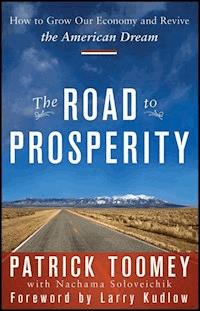
The road to prosperity : how to grow our economy and revive the American dream / Patrick J. Toomey, with Nachama Soloveichik.
p. cm.
Includes bibliographical references and index.
eISBN : 978-0-470-54319-1
1. United States--Economic policy--2001- 2. Fiscal policy--United States.
3. Monetary policy--United States. I. Soloveichik, Nachama. II.Title.
HC106.83.T66 2009
330.973--dc22
2009017154
To my wife Kris, whose love, encouragement and confidenceinspire me to dream great dreams;and to the sunshine of our lives,Bridget and Patrick, who have waited patiently for Daddyto have more time to play with them
Foreword
Barack Obama is moving American economic policy firmly away from democratic capitalism toward a big-government command-and-control philosophy. Obama is seeking nothing less than to undo the principles of the Reagan Revolution, which unleashed the private economy from the shackles of stagflation and malaise and created enormous wealth for a generation of Americans.
As I write this in May 2009, the Republican Party is searching for both a coherent message and a central spokesperson to counter Obama and the Democratic Congress. Polls indicate that the United States remains a center-right country and both the financial industry bailout and the economic stimulus package are unpopular with voters. Republicans have an opportunity to capitalize on public unease and articulate a strong, commonsense alternative to Obama’s government-driven, budget-busting policies.
The Road to Prosperity by Pat Toomey is an important salvo in the fight for traditional American free-market economics against the Obama-led, European-style collectivist policies. In a clear, eloquent fashion, Toomey explains the core principles under-girding prosperity and shows how those principles are systematically being ignored or violated by the Obama administration.
Ultimately, democratic capitalism is about ideas—simple, profound ideas about creating an economy that rewards hard work, investment, imagination, and risk taking. History proves that policies of low taxes, currency stability, free trade, and respect for property rights ignite individual ambition and creativity, stimulate economic growth, and increase overall prosperity.
Toomey rightly points out that the Obama administration’s policies threaten a repeat of Franklin Roosevelt’s New Deal, which unnecessarily prolonged the Great Depression.The massive government spending, along with the punitive, antibusiness rhetoric and protectionist trade measures promulgated by the Obama administration echo back to the 1930s. Those types of actions did not lead to a strong, sustained economic recovery in the 1930s; and they will not today.
We are witnessing more spending, deficits, and debt creation than anyone ever imagined. Bailout Nation has run amok. While this started under Bush, Obama has raised the stakes exponentially.
The latest federal budget would double the debt in 5 years and triple it in 10. For some perspective, that debt level is higher than the combined debt levels generated under every president from George Washington to George W. Bush. According to the Congressional Budget Office, federal debt held by the public as a percentage of gross domestic product (GDP) under Obama is projected to rise to 82 percent in 10 years. The budget deficit itself never drops below $670 billion and closes the period at $1.2 trillion. That’s nearly a 6 percent share of the economy.
All of this will certainly lead to large tax-rate hikes that will rob incentive power from entrepreneurs, investors, and small-business owners. Just look at Great Britain, where the top tax rate has been raised to 50 percent from 40 percent.The Thatcher revolution is being repealed over there. Unless current trends are reversed, the Reagan revolution will be repealed in the United States.
This is the wrong direction for economic growth. Instead, business tax rates should be slashed—which, by the way, would repatriate corporate earnings for domestic investment. We need a capital gains tax holiday. We should be flattening individual tax rates across the board. And all manner of loopholes and special-interest deductions should be repealed to broaden the taxable income base.
Nowhere is the Obama vision of government interference more evident than on the banking front. The White House and Treasury are using the Troubled Asset Relief Program (TARP) as a bullying club to force government control on the country’s financial institutions. Exactly how it will end is unclear, although it is near certain that major banks and corporations will remain subject to government control. This reminds one of François Mitterrand, the former socialist president of France. It’s way outside the American economic tradition.
According to Special Inspector General Neil Barofsky, the $700 billion TARP program—which has ballooned to more than $3 trillion in spending, loans, and loan guarantees—is “inherently vulnerable to fraud, waste and abuse.” Barofsky already has opened 20 separate TARP-related criminal investigations and six audits into whether taxpayer dollars are being stolen or wasted. Rest assured that they are.
In short, Obama is seeking to change the whole relationship between the government and the free-enterprise private sector. It looks very much like a war against investors, businesses, and entrepreneurs. Shareholder rights are being eviscerated. Political decisions are replacing the rule of law, the rule of bankruptcy courts, and free-market principles.
The Road to Prosperity is a much-needed reminder of the principles of prosperity and a warning against the dangerous course that we have embarked upon. It is hoped that people will listen before it’s too late.
—LARRY KUDLOW
Preface
It is ironic that economics is so widely seen as an obscure, complex, highly technical field best left to academics and financial experts. In fact, the most important truths of economics are easily grasped by most people, in part because they are repeatedly demonstrated in daily life.We all know intuitively, from a very early age, that, all else being equal, a shortage of something makes it more precious and an excess makes it less so. We understand without questioning that people respond to economic incentives because, as consumers, we are bombarded with and often take advantage of clearance sales, coupons, volume discounts, and the like. Even an esoteric-sounding idea such as the “time value” of money is universally understood, if not always by that name.We all prefer to be paid promptly for a service rendered rather than made to wait. Conversely, most of us take advantage of zero-percent financing when it is offered.
Despite the commonsense understanding of economics most of us demonstrate through our mundane, daily behavior, many myths and misconceptions are widely disseminated and too often believed. Special-interest groups and the politicians they support tell us that government subsidies of select industries are good for taxpayers, that wage controls are good for workers, that fewer imported products are good for consumers, that higher taxes won’t slow down economic growth. They peddle these and other pernicious myths by cloaking them in half-truths and populist rhetoric. These economic fallacies are believed by people who have not been guided to see through the smoke and mirrors obscuring the economic truth.The fallacies are promoted by policy makers who seek to ingratiate themselves with the special-interest groups who are seeking their own narrow gains at the cost of the general taxpayer or consumer.
The result is a muddled set of laws and regulations that restrain the American economy. We have the biggest, strongest economy in the world by far. But we still have fewer jobs, slower growth, and less prosperity than we could have if our policies better reflected the economic truths that, upon reflection, most of us know to be true.
This book does not present any new economic theories or novel mathematical proofs. Its purpose is to remind us of the simple economic truths and the corresponding policies that lead to prosperity. The ideas that underpin prosperity can be understood by noneconomists today just as they have been understood in the past.They were discovered centuries ago and have been thoroughly explained since at least the eighteenth century. They have been successfully demonstrated throughout the twentieth century. They are available to us today and, if pursued, would usher in an unprecedented era of economic growth and prosperity in the United States.
Patrick J.ToomeyMay 2009
Acknowledgments
Special thanks to the following people:
Gary Blank Kevin Commins Mike Ford JD Foster Meg Freeborn Dan Griswold Howard Hall Chris Jacobs David John David Keating Mary Ann Leonardo Jon Lerner George Mitchell Chuck Pike Jan Reardon Andy Roth Dan Smoker Kris Toomey Mary Ann Toomey Patrick Toomey, Sr. Richard Vetter Brian Wesbury Brian Wild
Chapter 1
Principles of Prosperity
Our Economy:The Sum ofMany Voluntary Transactions
On my way to the office each morning, I stop to buy a cup of coffee. The coffee costs me $1.49. I buy it for one reason: The cup of coffee is worth more to me than the $1.49 in my pocket. If this were not the case, I’d keep the $1.49 and forgo the coffee.The owner of the coffee shop has the opposite view.To him, the $1.49 is worth more than the cup of coffee, so he sells me the cup. The two of us have exactly opposite views regarding the value of the cup of coffee and therein lies the opportunity for our mutual gain from a single transaction. I gain the coffee that I value more, he gains the cash that he values more, and, most importantly, we are both better off for having made the trade.
This example may seem too ordinary to be noteworthy. In fact, it is exemplary of the most important principle of economics. That is, both parties to any voluntary exchange gain from the transaction. That is why they enter into it. No one is able to determine the value of a transaction better than the people engaged in it. No one knows better than I do how much I value the cup of coffee I buy each morning. No one knows better than the coffee shop owner how much he values producing and selling that cup of coffee in the morning.We each know our own self interest better than anyone else possibly could.
Thus, in a free society in which transactions are honest, purely voluntary, and absent fraud, every transaction is an economically good one1—benefiting both parties to it. Buying or selling a cup of coffee, a sweater, a stock, a movie ticket, or a life insurance policy; renting a car or a vacation home; or placing a deposit with a bank—every voluntary transaction between people, businesses, or any combination thereof, is an economically good transaction in that it benefits all parties involved. Otherwise they would choose not to be a party to it.
Lesen Sie weiter in der vollständigen Ausgabe!
Lesen Sie weiter in der vollständigen Ausgabe!
Lesen Sie weiter in der vollständigen Ausgabe!
Lesen Sie weiter in der vollständigen Ausgabe!
Lesen Sie weiter in der vollständigen Ausgabe!
Lesen Sie weiter in der vollständigen Ausgabe!
Lesen Sie weiter in der vollständigen Ausgabe!
Lesen Sie weiter in der vollständigen Ausgabe!
Lesen Sie weiter in der vollständigen Ausgabe!
Lesen Sie weiter in der vollständigen Ausgabe!
Lesen Sie weiter in der vollständigen Ausgabe!
Lesen Sie weiter in der vollständigen Ausgabe!