


Erhalten Sie Zugang zu diesem und mehr als 300000 Büchern ab EUR 5,99 monatlich.
- Herausgeber: Saqi Books
- Kategorie: Geisteswissenschaft
- Sprache: Englisch
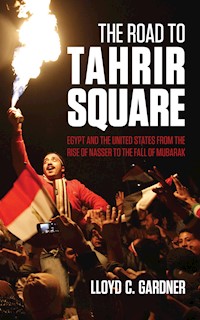
When protesters in Egypt began to fill Cairo's Tahrir Square on January 25, 2011 - and refused to leave until their demand that Hosni Mubarak step down was met - the politics of the region changed overnight. And the United States' long friendship with the man who had ruled under emergency law for thirty years came starkly into question. The Road to Tahrir Square is the first book to connect past and present - from Franklin D. Roosevelt's brief meeting with King Farouk near the end of World War II, to Barack Obama's 2009 speech in Cairo, and the recent fall of Mubarak - offering readers an understanding of the events and forces determining American policy in this important region. Making full use of the available records, including the controversial WikiLeaks archive, renowned historian Lloyd C. Gardner shows how the United States has sought to influence Egypt through economic aid, massive military assistance, and CIA manipulations - an effort that has immediate implications for how the current crisis will alter the balance of power in the Middle East. As millions around the world ponder how the Egyptian Revolution will change the face of the region and the world, here is both a fascinating story of past policies and an essential guide to possible futures.
Sie lesen das E-Book in den Legimi-Apps auf:
Seitenzahl: 433
Veröffentlichungsjahr: 2011
Das E-Book (TTS) können Sie hören im Abo „Legimi Premium” in Legimi-Apps auf:
Ähnliche




















The Road to Tahrir Square
Egypt and the United States from theRise of Nasser to the Fall of Mubarak
LLOYD C. GARDNER
SAQI
To the memory of four great teachers: Doris Evans,Dorothy Whitted, Ben Spencer, and Dave Jennings.In the past we are found.
*
eISBN 978-0-86356-880-0
This eBook edition published in the United Kingdom by Saqi Books 2011Published by arrangement with The New Press, New York
© Lloyd C. Gardner 2011
All rights reserved. No part of this book may be reproduced or transmitted in any form or by any means, electronic or mechanical, including photocopying, recording or by any information storage and retrieval system, without permission in writing from the publisher.
This book is sold subject to the condition that it shall not, by way of trade or otherwise, be lent, re-sold, hired out, or otherwise circulated without the publisher’s prior consent in any form of binding or cover other than that in which it is published and without a similar condition including this condition being imposed on the subsequent purchaser.
A full CIP record for this book is available from the British Library.
A full CIP record for this book is available from the Library of Congress.
Printed and bound by CPI Mackays, Chatham, Kent ME5 8TD
SAQI26 Westbourne Grove, London W2 5RHwww.saqibooks.com
CONTENTS
Introduction
1. Prelude: Searching for a Policy
2. The Nasser Gamble Fails
3. Eisenhower Doctrine to Six Days of War
4. Life with Anwar Sadat: Or a Story of Empire by Invitation
5. The $50 Billion Gamble: Thirty Years of Egyptian-American Co-Dependence
6. Arab Spring
Postscript
Notes
Index
INTRODUCTION
Clinton, in Cairo’s Tahrir Square, Embraces a Revolt She Once Discouraged
—Headline on a story by Steven Lee Myers,New York Times, March 16, 2011
Secretary of State Hillary Clinton was the first high-level Obama administration figure to go to Cairo after the popular uprising that toppled Hosni Mubarak, Washington’s most reliable ally in the Middle East for over a generation. “To see where this revolution happened,” she exulted on a walk through Tahrir Square, “and all that it has meant to the world, is extraordinary for me.” The New York Times headlined her “stroll,” however, as something more like catch-up with a racing series of events that had left the United States unsure of where it stood now that a pillar of its Middle East policy had disappeared.
The initial wavering in the Obama administration when the protests began on January 25, 2011, reflected uncertainty and fear about the future. Secretary Clinton said on that first day of protests, “Our assessment is that the Egyptian government is stable and is looking for ways to respond to the legitimate needs and interests of the Egyptian people.” One implication of that statement was that the United States felt able to judge what was legitimate and what was not. The president then spoke with Mubarak on the telephone, urging him not to resort to force, while Vice President Joe Biden, in an effort to encourage a peaceful solution, refused initially on American television to call the Egyptian president a dictator. Many more telephone calls over the next two weeks were made by Secretary of Defense Robert Gates and the chairman of the Joint Chiefs of Staff, Admiral Mike Mullen, to their Cairo counterparts, at first in an attempt to learn what the Egyptian armed forces believed about the protestors, and then, when it became clear that Mubarak would not step down, to prevent the military from taking sides.
While the Pentagon’s main concern was not to lose touch with an army in which it had invested over $50 billion since the time Mubarak had come to power, two of America’s other allies, Israel and Saudi Arabia, fretted about U.S. policy in “abandoning” the aging dictator who had controlled Egyptian politics with unquestioning support from the military. Americans had paid little attention, on the other hand, to the policies their government had followed during the Mubarak era, let alone to the background story of how Washington had finally developed such a close relationship after a series of missteps in the years since the 1952 Egyptian Revolution. Now more than ever, with the revolutionary spirit inspiring protestors in country after country, the debate over future policies required a historical grounding. This book opens a door on that past.
At first there had been Gamal Abdel Nasser, whose determination to lead the Arab world away from reliance on the United States and the West at the height of the Cold War forced an unhappy Eisenhower administration to make difficult choices opposed to its European allies during the 1956 Suez Crisis. Then there had been Anwar el-Sadat’s audacious initiatives beginning with the October War in 1973 that surprised Nixon and Kissinger as well as Jimmy Carter. Finally, after Sadat’s assassination, Hosni Mubarak had emerged, a man whose enormous ambition to rule matched perfectly Washington’s desire to make Egypt into what it had always wanted it to be: a loyal ally who held the line against radical nationalism in the Arab world.
Mubarak had kept Sadat’s peace with Israel (negotiated over the heads of other Arab countries) and provided public support for America’s policies elsewhere in the Middle East (especially Iran and Iraq). And, notably, Mubarak provided pivotal support to the George W. Bush administration’s War on Terror, cooperating with the CIA’s “rendition” program by accepting suspects sent to Egypt for “questioning” using methods that could not be approved elsewhere after they became known, including waterboarding and other forceful interrogation techniques.
Of course, Mubarak expected to be paid, and paid handsomely. In exchange for these “services,” the United States provided Egypt with military aid totaling nearly $1.5 billion a year—second only to Israel’s subsidy—and hoped for the best as far as Mubarak’s internal policies. Generally speaking, such hopes took the same form as the Clinton administration’s attitude toward gays in the U.S. military: “don’t ask, don’t tell.”
After the attacks of September 11, 2001, when the supposed weapons of mass destruction (WMDs) that Iraq’s Saddam Hussein had hidden away could not be discovered and indeed were found not to exist, the Bush administration turned to the rhetoric of spreading democracy as the motive for war against Saddam’s regime. Wilsonian idealism of this sort is often invoked to cover embarrassing gaps (like the missing WMDs) and to couch the protection of such material interests as oil wells on a higher plane of motivation. But it is a risky ploy, for ideas can take on their own momentum.
The events at Tahrir Square would likely have occurred without American rhetoric after 9/11, of course. Yet whether they would have occurred without years of unstinting American support to Mubarak is a far more interesting question. Would Mubarak have felt able to pursue his repressive policies had he not enjoyed full American backing across nearly three decades?
However one thinks about those questions, the history of U.S.–Egyptian relations provides the essential missing factor if we are to understand where and why the new government in Cairo, even in its interim form, has already departed significantly from Mubarak’s agenda of satisfying Washington above all other things. The new government has signaled its intention to reestablish diplomatic relations with Iran, to end cooperation with Israel in blocking the border with Gaza, and has already brokered an agreement between rival Palestinian factions, one of whom, Hamas, is regarded as a terrorist organization by Israel and the United States. Egypt, said a representative of the government, intends to keep its commitment to the peace treaty with Israel—adding a comment obviously directed at Mubarak’s cooperation on rendition, among other secret acts, that it also hoped to do a better job complying with some human rights protocols it had signed. “We are opening a new page,” said Ambassador Menha Bakhoum, spokeswoman for the Foreign Ministry. “Egypt is resuming its role that was once abdicated.”1
Without the proper historical background, it would be hard to understand what Ambassador Bakhoum was talking about—abdication to whom? And why? Hillary Clinton, in a bright red blazer, walked “the fine diplomatic line” on her stroll through Tahrir Square. She announced millions of dollars in economic aid for Egypt while being careful not to inject herself into other questions about whether the interim government was moving too fast, or not fast enough. She appeared to be enjoying the moment, greeting those who approached to take pictures with cell phones—a reminder of how the new revolution spread on Twitter inside and outside Egypt so fast it left American policymakers without time to draft position papers.
“Wonderful to be here,” Clinton said, waving and shaking hands. One of those she greeted shouted back, “Thank you for walking the streets of Tahrir.”2
In this book we walk back to 1952 in order to get to Tahrir Square in 2011.
*
Thanks to Rebecca, who pointed the way to some key sources; to Marc, who plotted this adventure; and to Nancy, for being there all the way.
1
PRELUDE: SEARCHING FOR A POLICY
Great Britain is endeavoring to use the Near Eastern Area as a great dam which serves both to hold back the flow of Russia toward the south and to maintain an avenue of communications with India and other British possessions. . . . The Soviet Union seems to be determined to break down the structure which Great Britain has maintained so that Russian power can sweep unimpeded across Turkey and through the Mediterranean. . . . The United States has been pursuing a policy of the open door in the Near East. It has taken the position that the independent countries of the Near East . . . should not be considered as lying within the sphere of influence of any Great Power.
—Loy Henderson, director of the Office of Near Eastern andAfrican Affairs, “The Present Situation in the Near East—A Danger to World Peace,” December 28, 1945
When President Roosevelt hosted King Farouk on board the USS Quincy anchored in the Great Bitter Lake of the Suez Canal on February 13, 1945, he offered the Egyptian monarch some advice. FDR suggested breaking up “many of the large landed estates in Egypt.” They should be made available, he said, “for ownership by the fellaheen [agricultural laborers] who worked them, and that at least 100,000 additional acres be placed under irrigation annually as a continuing program.”1 It was bold, even presumptuous, to offer such advice to a king who had come aboard an American warship for a friendly chat. But Roosevelt had similar things to say during the war about what other Middle Eastern rulers had to do to meet the postwar expectations of their peoples. At the 1943 Tehran Conference, for example, where the final plans for D-Day were agreed upon with Churchill and Stalin, the president had discussed reports from advisers about what American ingenuity could do to bring Iran’s economy into the modern world. He was “rather thrilled with the idea of using Iran as an example of what we could do by an unselfish American policy.” “Iran,” he wrote Secretary of State Cordell Hull, “is definitely a very, very backward nation.” It consisted of tribes with 99 percent of the population in bondage to the other 1 percent. “The real difficulty is to get the right kind of American experts who would be loyal to their ideals, not fight among themselves[,] and be absolutely honest financially.”2
American forces had entered Iran during the war to ensure that Lend-Lease supplies reached the Soviet Union. Along with the military came a corps of economic experts and others who had ideas about how to accelerate development of Iran’s economy after the war. In contrast, in Egypt the United States had neither a large troop presence nor the advisers on hand eager to take on the country’s very similar problems. But during his brief chat with Farouk two days after the close of the Yalta “Big Three” conference in the Crimea, the president enthused about prospects for increased trade between the countries. When peace came, he said, he hoped American purchases of long-staple cotton, a vital Egyptian export, would increase, along with trade in other commodities. Tourist travel to Egypt, he felt sure, was certain to become greater after the war. Thousands of Americans, Roosevelt predicted, would visit Egypt and the Nile region, both by ship and air.
Trade with Egypt had in fact increased eightfold during the war. The American minister in Cairo, Alexander Kirk, had advocated extending Lend-Lease aid in order to solidify the two nations’ relations after the war. After deliberation in Washington over possible ramifications in Anglo-American relations, such aid was granted, followed by diplomatic efforts to secure favorable investment laws to encourage joint-stock companies with American firms. Washington also sought permission for American commercial airliners to carry passengers from Cairo to the principal cities of Europe. As one policy planner put it, “Cairo is vital to air navigation, just as Suez is to shipping.”3
The implication here was that the wartime British occupation of Suez belonged to the passing era of European imperialism, now in an accelerated decline caused by the war, while the new age of commerce depended on secure air routes, just as the original industrial age had hit its peak with projects like the Suez Canal. “Freedom of the seas” had been the catchphrase of the dominant powers of the time; now it was all about “freedom of the air”—a phrase that well matched the postcolonial age.
Roosevelt’s New Deal–like ideas and his zeal for far-reaching land reform were not shared by many of his foreign policy advisers, but there was a consensus that the American mission in the postwar era would be to help the British “out”—in both senses of the word—from predicaments such as the vexed matter of Suez and similar situations elsewhere tied to a defunct colonial ideology. During the war Secretary of State Hull warned that the United States could not work with the colonial powers in Europe and against them in the rest of the world. But in the full blush of victory at war’s end, Washington imagined things would now go more smoothly as its influence would spread even to areas Joseph Conrad had called the “Heart of Darkness.” But Roosevelt’s successors found that “whittling down” the British Empire, as one policy adviser cautioned—complicated as it was by domestic politics on related issues like the contest over the future of the British mandate in Palestine—risked a disaster.
The Need for Commitment
Making a safe transition would depend, American policymakers agreed, on Washington’s ability to convince Farouk and other Middle Eastern leaders that the United States would not allow the old colonial powers, Great Britain and France, to reclaim the privileged positions they held before the war, and was, in fact, ready to offer economic and, if carefully managed, military aid to insure the independence and internal security of those countries. All this had to be handled so as to ease the transition from the old colonial order to a new global politics led by the United States, without permitting extreme nationalists or Communists to take advantage of the situation to gain a foothold in the area. In this regard, the onset of the Cold War presented both an opportunity to shift the subject to common defense against a military threat that obscured old arguments, and the challenge of Communist penetration of reform movements.
Roosevelt’s comments to the Egyptian king and his later guests, Emperor Haile Selassie of Ethiopia and, especially, King Ibn Saud of Saudi Arabia, were designed to promote a postwar vision of the Middle East following such a safe path to prosperity. Saud remained skeptical: “What am I to believe when the British tell me that my future is with them and not with America?” The British told him that America’s interest in his country was transitory. Once the wartime emergency was over, Lend-Lease aid would end and the Americans would return to the Western Hemisphere—leaving Saudi Arabia behind within the pound sterling area economically and defended by the Royal Navy and British army. “On the strength of this argument they seek a priority for Britain in Saudi Arabia,” Saud said. “What am I to believe?”
That was not going to be the future, insisted Roosevelt. America’s postwar plans envisaged “a decline of spheres of influence in favor of the Open Door.” He hoped the door of Saudi Arabia would be open to all nations, for only by free exchange of goods, services, and opportunities “can prosperity circulate to the advantage of free peoples.” That was all very well, replied Saud, but the British would continue as before to claim a sphere of influence around and over his country. Roosevelt’s adviser William Eddy warned the president that words would not be enough. Ibn Saud’s well-grounded fears could be dispelled only when the United States acted to implement a long-range plan to secure the Open Door.4
The American minister in Cairo, S. Pinckney Tuck, had escorted King Farouk to the meeting with Roosevelt—a small gesture that pleased the Egyptian ruler. Instead of going aboard the warship with the king, Tuck had stepped back and did not accompany him to where the president sat waiting. Farouk told the American diplomat afterward that the British ambassador, Lord Killearn, to his great annoyance, always insisted on being present when he met with Prime Minister Churchill. It was a little thing, but Farouk appreciated Tuck’s display of respect.
In the waning days of World War II, one of the key questions was whether or how the United States would supplant the United Kingdom in the British Empire’s former possessions. Egypt was never a formal colony, but the history of Anglo-Egyptian relations revolved around the issue of continued British control of the Suez Canal and the military base and garrison that had protected the canal since the late nineteenth century. Opened to shipping in 1869, the Suez Canal had been built by a French company operating under a concession granted by the Egyptian khedive, Sa‘id Pasha. The British had not even been in the picture originally and had, in fact, opposed the canal’s construction. When the canal revolutionized global commerce, however, and the Egyptian government sought to sell its shares of the company to pay off international debts for four million pounds, the British leapt in with both feet. Although the Constantinople Convention of 1888 declared the Suez Canal a neutral area, Sa‘id’s successor invited British troops in to suppress a rebellion against his government. There they stayed through World War I and World War II. During those years the British high commissioner became, in effect, a viceroy, who according to the 1936 Anglo-Egyptian Treaty of Friendship and Alliance had to be given preference at the Egyptian court over representatives of any other nation.
London regarded its Suez base as a strongpoint from which to defend all its interests in the Mediterranean and North Africa and was loath to give it up, even in the face of rising nationalist sentiments. These had manifested themselves in different ways. During World War II, King Farouk was known to be pro-Axis and had even written Hitler a letter saying he would welcome an invasion. Rommel’s Afrika Korps never got to Cairo, but the British demanded that Farouk dismiss pro-German ministers or be turned out of the palace. Born in 1920, Farouk was the great-grandson of the famous Muhammad Ali Pasha, Egypt’s longest-ruling figure until Hosni Mubarak. Farouk had gone to school in Britain and began his reign in 1937. He had been very popular at first, but his lavish lifestyle soon began to alienate not only ordinary Egyptians, but important figures in the so-called Free Officers Movement as well.
American policymakers were fully aware that undermining the British in the Middle East was not a way to achieve American objectives in the region. The head of the State Department’s policy planning staff, George F. Kennan, the author of the famous 1947 “X” article, “The Sources of Soviet Conduct,” which summarized the rationale for a Cold War “containment” policy, insisted it would be not desirable to attempt to duplicate British strategic facilities in the Middle East such as the base at Suez, because, for one thing, British facilities would be available to the United States in the event of a war with the Soviet Union. Any attempt to take bases away from the British was an even worse option to contemplate, involving a host of problems that would weaken Western influence and only embolden enemies. “This means that we must do what we can to support the maintenance of the British in their strategic position in that area.”5 Kennan had put his finger on a pressure point in emerging American policy toward Egypt: if supporting the Open Door policy meant straining British relations with Arab countries, where was the benefit for the United States? The United States still needed British military support to defend its strategic interests, and yet siding with a colonial power risked alienating powerful anticolonial forces stirring across Africa and Asia.
Kennan was quite clear about what America’s interests were in this regard, and they did not involve “sentimentality and day-dreaming”: “We have about 50% of the world’s wealth but only 6.3% of its population. . . . In this situation, we cannot fail to be the object of envy and resentment. Our real task in the coming period is to devise a pattern of relationships which will permit us to maintain this position of disparity without positive detriment to our national security.”6
Unfortunately, the U.S. government was now subject to pressures that “impel us toward a position where we would shoulder major responsibility for the maintenance, and even the expansion, of a Jewish state in Palestine,” Kennan wrote. To the extent that policy moves in this direction, the United States “will be operating directly counter to our major security interests” in the Arab world. Kennan had no real answer for dealing with this problem, nor did any of his successors find a way to get around the Arab-Israeli imbroglio.
At the time Kennan wrote, the Truman administration was trying to find a solution to please Congress and public opinion, and indeed was caught in a bind that brought it into precisely the sort of conflict with Great Britain that Kennan and many in the State Department feared would destroy the influence of the West across the whole region. Whenever envoys of Middle Eastern states—with the exception of Israel—appeared at the State Department to argue their grievances over American policy and Palestine’s fate, the Egyptian ambassador served as their spokesman. The Arab League was seated in Cairo, and King Farouk liked to think that his championing of resistance to Jewish plans for a state carved out of Palestine and his responsiveness to resentment at British military policy could be combined into a program that would save his monarchy.
But there was another distressing problem confronting U.S. policymakers as they attempted to act as a friend to both London and Cairo in resolving the growing disputes over the British military garrison at Suez and revision of the 1936 Anglo-Egyptian Treaty. Before the war these were matters that would not have involved the United States, but the war had changed the world—ideologically by the discrediting of European imperialism, and materially by the exhaustion of the military capabilities of the colonial powers. American policymakers saw themselves in a race, moreover, facing the challenge of what a later secretary of state, John Foster Dulles, would call “International Communism.”
In the spring of 1947, with the “Truman Doctrine” (which called for the support of the “free peoples” of the world against totalitarian regimes) in newspaper headlines, the Anglo-Egyptian dispute over continued British occupation of the Suez neared a flashpoint. Foreign Secretary Ernest Bevin called in the American ambassador, Lewis Douglas, to caution him against an American attempt to mediate the crisis. London had offered to withdraw all troops by September 1949, but that was apparently not enough for the Egyptians, who were seeking to take the dispute to the United Nations. This was an unwelcome development for London and Washington, obviously, quite a turnaround from the Anglo-American cheerleading when the Iranians had brought the issue of Russian troops to the Security Council a year earlier. While Bevin was prepared to negotiate changes to the 1936 treaty with Cairo, he would not countenance intervention by the United Nations, or by any country that attempted to compel his government “to breach the terms of a treaty entered into in good faith.”7
No one in Washington desired to force London into mediation, but neither did the administration expect to stand by and watch while the British risked losing everything. The most that could be done in the short term, it seemed, was to support London’s desire for a right of return in the case of an emergency at Suez, as well as its interests in establishing other military bases in nearby Libya to take the pressure off talks about revision of the treaty. Matters took a turn for the better in 1948 when the British proposed Anglo-Egyptian staff talks on military defense of the Suez Canal, and the Egyptians responded with suggestions that they would not oppose British military bases in Libya or the Sudan. These talks broke down, but there seemed to be a clue here for a possible way of meeting the Egyptian demands for arms aid by incorporating it within a political arrangement that would not be opposed by Israel and its friends in Congress—a powerful and, indeed, growing force in American domestic politics.
On the day before the United States recognized the new provisional government of Israel, on May 14, 1948, Ambassador Tuck reported from Cairo that Egypt was making a “determined effort” to obtain arms “from any source available, including Czechoslovakia.” Policymakers now had multiple worries, including fears that the Anglo-Egyptian dispute over Suez and Sudan’s future offered the Soviets an opportunity in the United Nations to drive a wedge deeper between the West and Middle Eastern countries as Moscow championed Cairo’s demands for a British evacuation from the military base and recognition of the Sudan as part of Egypt. Farouk complained bitterly to the new American ambassador, Jefferson Caffery, that Washington, by its Palestine policy and refusal to sell Egypt arms, was making good relations impossible. “You have refused everything we have asked for.”8
Farouk’s complaints anticipated and were hardly different from those of later Egyptian leaders over the years, until Anwar Sadat traveled from Cairo and made a separate peace with Israel. Then the arms flowed into Egypt in a steady stream, as Egypt became a regional stabilizing power for American policy and relieved at least part of the burden on Washington for having been Israel’s original sponsor and its most loyal backer over the years. But there was another aspect to Farouk’s failure that his successors did not overcome. Roosevelt had warned the king that he must move to relieve the conditions of the poor and landless fellaheen. While Egypt’s national pride was at stake in the Palestine and Suez questions, the underlying economic problem proved in the end to be the most corrosive challenge to leaders in Cairo.
Reporting on a conversation with a British diplomat in 1949, an American counterpart warned Washington that the feeling in London was that a revolution in Egypt was looming just ahead. It might be stopped by an “enlightened intervention by Farouk, but this young man appears to share the outlook of the reactionary landowners and other vested interests.” The situation was worse than in other Arab countries because of population pressure and land shortage. “The [British] official did not know how long the patient ‘have-not donkey’ would support the heavy burden of the unenlightened ‘haves’ but he ‘imagined that it would kick before long.’ ”9
The British diplomat added that he thought Farouk would go out feet first, after having been killed by revolutionaries. However, when the “revolution” came in 1952, the military simply escorted him out of the country. Otherwise the diplomat’s prediction came true, including his opinion that this time it would not lead to significant change for most Egyptians. Instead, political objectives would emerge, he said, “from the men who ‘took over’ the revolution and turned it to their own purposes.” The challenge for American policymakers was to make sure that those “objectives” meshed with Washington’s goals.
Palestine and Israel
In the 1944 U.S. presidential campaign, both political parties at their national conventions had offered encouragement to the Zionist movement. Against the background of mounting political pressure in Congress for a commitment to the idea of a “national homeland” for Jewish refugees in Palestine, the State Department hoisted warning signals about Saudi Arabia’s expected reactions. “The king is first a Moslem,” asserted a pre-Yalta State Department memo, “and secondarily an Arab. . . . He considers himself the world’s foremost Moslem and assumes the defense of Moslem rights. Hence his opposition to Zionism.” Any alteration in his position would involve a loss of the respect of his co-religionists, and possibly the overthrow of his dynasty. Secretary of State Edward R. Stettinius Jr., who succeeded Cordell Hull in 1944, added in a note to Roosevelt that the king could not be moved this side of the grave. “Ibn Saud’s statement that he regards himself as a champion of the Arabs of Palestine and would himself feel it an honor to die in battle in their cause is, of course, of the greatest significance.”10
When the king came aboard the Quincy, however, the day after Farouk’s visit, Roosevelt saw a man unlikely to fight anyone on the battlefield—at least not personally. Ibn Saud’s crippled condition gave the president a chance to commiserate about their mutual problems getting around—and to offer to send him one of his specially designed wheelchairs. But neither gifts nor Roosevelt’s sympathy could get Ibn Saud to change his position a single degree. The Jewish people had been driven from their homelands, began Roosevelt, and the world had a humanitarian obligation to these refugees. That might be so, Saud replied, but they should be given lands within the Axis countries, not lands belonging to the Arab peoples. Roosevelt tried other arguments—he argued up one side and down the other, he reported to his aides—but it was no use. Nothing for it, then, but to retreat to an old delaying tactic. In a mutually agreed memorandum of their talks, Roosevelt offered the standard formula. He promised the king “he would do nothing to assist the Jews against the Arabs and would make no move hostile to the Arab people.” Satisfied with the promise, the king thanked Roosevelt for his statement and indicated he would send an Arab mission to the United States and Great Britain “to expound the case of the Arabs and Palestine.” Whatever Roosevelt really thought about that proposal he kept to himself, saying only that would be a very good idea.11
As soon as Roosevelt returned to the White House from Yalta, Rabbi Steven S. Wise, chairman of the American Zionist Emergency Council, was on his doorstep. Wise emerged from a forty-five-minute meeting with an important announcement for waiting reporters. The president had assured him that he had not changed his position about favoring unrestricted immigration into a free and democratic Jewish commonwealth in Palestine. Wise then read a statement Roosevelt had approved: “I have made my position on Zionism clear. . . . I have not changed and shall continue to seek to bring about its earliest realization.”12
Now it was the Arab leaders who wanted to know where American policy was heading. Roosevelt maintained until the hour of his death a studied ambiguity. On the day of his fatal stroke in Warm Springs, Georgia, April 12, 1945, the president signed a letter to the prince regent of Iraq assuring him that “no decision affecting the basic situation in Palestine should be reached without full consultation with both Arabs and Jews.” Close readers of the minutes of his meeting with King Saud and this letter to the prince regent could, however, perceive shading toward the Zionist position.13
As in so many other questions, Roosevelt’s successor Harry S. Truman was left to deal with the dilemma of satisfying both sides, something that was beyond the reach even of an atomic-powered White House. Less than a week after Roosevelt’s death, Secretary of State Stettinius warned the new president of the peril presented by the Palestine question and any indications that the United States would succumb to Zionist pressures: “There is continual tenseness in the situation in the Near East largely as a result of the Palestine question and as we have interests in that area which are vital to the United States, we feel that this whole subject is one that should be handled with the greatest care and with a view to the long-range interests of this country.”14
Truman had just learned that scientists had been working on a weapon that could revolutionize warfare and put the United States in a dominant position amid the wave of postwar questions about to sweep across the world. He could not figure out, and no one could, how possessing an atomic bomb would help him with the Palestine problem, which, his advisers told him, threatened American interests in vital oil-producing areas and, they argued, the future peace of the Middle East and the world. On August 17, 1945, hardly more than a week after the United States dropped atomic bombs on Hiroshima and Nagasaki, Egypt’s chief representative in Washington, Mahmoud Fawzi, met with Loy Henderson, head of the Near Eastern desk in the State Department. Like other Arab diplomats in Washington, Fawzi pressed for information about the Palestine issue and a more concrete definition of what had been meant by Roosevelt’s assurances he would consult with both Arabs and Jews over the fate of Palestine, particularly in light of Truman’s pointed comment at a news conference the day before.
The comment had come after a reporter’s question about whether a Jewish national state had been discussed at Potsdam with Stalin and Churchill. Truman responded in what would soon become a characteristic prickly, self-confident attitude, with a generalization about not needing to consult with the Soviet Union—even about a potential problem that, in this case, could unravel relations with Moscow as well as Arab countries. He had discussed the question with Churchill, he said, and was still discussing it with Clement Attlee, the new British prime minister; but when the reporter pressed him on whether that discussion also included Stalin, Truman responded that it had not, but there was “nothing Stalin could do about it.” He went on to add, “We want to let as many Jews into Palestine as is possible.” Of course this would have to be worked out diplomatically with the Arabs and the British, but it would have to be on a peaceful basis, “as he had no desire to send half a million American soldiers to keep the peace in Palestine.”15
Truman’s disregard for Stalin’s help in solving the problem also had to do with the emerging debate with the British over how to end the mandate that had brought London into the position of a very troubled overseer of what would soon be an area in “civil war” as clashes between Palestinians and Jewish newcomers spread over the land. Fawzi told Henderson on October 1, 1945, that Egypt was “extremely anxious” to have close and friendly relations with the United States, but Cairo had an obligation to “discharge its responsibilities for assisting in maintaining peace in the Near East.” If Cairo was to be successful, he went on, it had to possess the confidence of the Arab nations. He hoped, therefore, that Washington would have consideration for the “delicate position of Egypt.” Under the apparently quiet surface of the Arab world, there was intense feeling regarding Palestine. As Henderson put it, “A sudden move on the part of the great powers prejudicial to Arab interests in Palestine, might well set the Arab world in motion and result in violence on a wide scale.”16
Henderson promised to bring Fawzi’s views to the attention “of the appropriate officials of the Department.” He needed no warning from Fawzi, however, or any other Arab representative to convince him that Truman was moving headlong down a very dangerous path. A month later Cairo and other Arab capitals were rocked with the news that Truman had pressed Attlee to allow one hundred thousand Jewish emigrants from displaced person camps in Europe to enter Palestine as soon as possible. Henderson made sure that Acting Secretary of State Dean Acheson knew about these repercussions, quoting an American diplomat’s question to Washington: “Press has featured the announcement sensationally. In view of this and the publicity given recent American Congressional visitors . . . does Department authorize me to make any statement to attenuate the shocking effect which the Presidential declaration is having in Arab countries?”
There was not much to be said, however, as Truman’s political advisers and the State Department were now at odds. Henderson added in his memo that the situation had become critical in terms of saving American prestige, so carefully built up over the years in order to offer protection to American material interests. Mere resentment that the United States had decided to disregard Arab opinion was bad enough, but it would be much more serious “if we should give them ground to believe that we do not live up to our firm promises already given . . . assurances . . . given in writing by both President Roosevelt and President Truman.”17
Two days later Fawzi and other Arab diplomats met with Acheson and Henderson. The Egyptian expressed astonishment that the United States was actually pressing Great Britain to open up Palestine to one hundred thousand Jewish immigrants, citing the promises given by the two American presidents that nothing would be done to change the situation without prior consultation with both concerned parties, the Arabs and the Jews. Fawzi said that Roosevelt had also told him personally at the time he met with King Farouk that he would do nothing without consultation with Egypt and other Arab states. Besides that, if the United States was urging Great Britain to make such a change, with such a great impact on the people of Palestine, it would be encouraging violation of international law, specifically the conditions of the Palestine mandate, which prohibited such action without the consent of the inhabitants. “Certainly,” he concluded, “a mandated country like Palestine was entitled to more rights than a protectorate.”18
In an effort to damp down the Arab protests, Truman’s new secretary of state, James F. Byrnes, met with the diplomats a few days later. He tried to assure them that no change had been made. “The United States continued to adhere to the policy that it would give no support to any changes in what it would consider to be the basic situation in Palestine until after such change had previously been fully discussed with Arabs and Jews.” This, of course, was like closing the barn door after the horses had already bolted.19
Over the next several weeks and months Truman dueled publicly and acrimoniously with British foreign secretary Ernest Bevin over the president’s insistence that one hundred thousand refugees be admitted to Palestine as soon as possible. On one occasion a reporter asked if perhaps we would “get along better with England if we made some gesture toward welcoming a few of these immigrants to the United States?” Truman made an irritable reply, as if to dismiss the matter; the reporter knew what the immigration laws were, didn’t he? “We have to comply with them.” But that opened him up to a follow-up question. Did the president intend recommending any change in the laws? “I do not.”20
Bevin—frustrated and angry at worldwide criticism of the British refusal to allow shiploads of Jewish immigrants to land—lashed out at a Labour Party conference, “I hope I will not be misunderstood in America if I say that this [one hundred thousand] was proposed with the purest of motives. They do not want too many Jews in New York.” Bevin’s Labour colleagues were embarrassed by this ugly display, but Truman somewhat surprisingly told a correspondent he understood the pressure on the foreign secretary, because he was often tempted to blow up himself at the pressure and agitation from New York, a remark it was not possible to misinterpret.21
Even so, Truman did not back down from his demand that one hundred thousand refugees be admitted to Palestine. And he knew what the game was. Bevin’s objective, the president always believed, was simply to draw the United States into joint responsibility for whatever happened, so that the Arabs would have someone else to blame. The Americans had used World War II to gain the upper hand and were now all over the Middle East, but they could ruin things for everyone. Truman’s affirmative statements about the refugees were picked up by the Saudi Arabian government, however, which promptly demanded the letters exchanged by Roosevelt and Ibn Saud be made public. The request left Secretary Byrnes in a quandary, forcing him to tell the British ambassador, on the one hand, that FDR was really too ill at that time to be transacting such important business, and reconfirm to the representatives of Middle Eastern countries, on the other, that American policy had not changed since Roosevelt’s letters. It was still the intention of the United States to “consult” with both Arabs and Jews before anything was done about Palestine’s future. “Consult” was obviously a weaker expression than the impression conveyed in FDR’s correspondence, especially his letter of April 5, 1945, which said that “no decision” would be taken without “full consultation” with both Arabs and Jews, and that he would “take no action . . . which might prove hostile to the Arab people.”22
Even though Roosevelt’s letters contained no binding commitment—as Truman rightly said—Arab leaders complained of being nuanced to death. It was not an unfair accusation. Secretary Byrnes tried to explain to the British ambassador, Lord Halifax, how Truman understood the situation. “The problem now,” he informed a nonplussed Halifax, “is . . . to determine the number that could be absorbed into the population. He could not join in a plan to divert from that.” William Eddy, Roosevelt’s specialist on Saudi Arabia, had returned home in the fall of 1945 for a chiefs-of-mission conference hoping to head off any action that would commit Washington to the Zionist cause. Ibn Saud had made it clear to him before he left, Eddy said, that promises of “consultation” were not enough. The king expected that the publication of Roosevelt’s correspondence would put an end to Zionist demands for unilateral action. If it did not, the implications for American policy in the Middle East were serious. The independence and survival of the Arab state of Palestine, the king said, was a matter for the nations of the region to determine, not one for Americans—Jew or gentile—living five thousand miles away. Saud had not said he would take retaliatory action against Aramco, the American oil company in his country, if Washington went ahead with plans to put Jewish refugees into Palestine, but there were other dangers, specifically to the future of the planned Dhahran air base. “The more fanatic” Arabs, reported Eddy, had already called Dhahran a “base for political aggression and foreign occupation.”23
The president agreed to meet those attending the chiefs-of-mission conference and hear their arguments—but only for half an hour, on November 10, 1945. The attendees made the case that the Arab world deserved the central place in foreign-policy thinking, not only as a “counterpoise” to Zionist ambitions, or because it was at the center of British strategic concerns, or athwart the great air routes of the future, or even because it happened to contain both “the two cradles of civilization and the greatest known undeveloped oil reserves of the world.” The Arabs deserved attention because of the revolutionary ferment spreading across the region, which posed the greatest challenge. “If the United States fails them, they will turn to Russia and will be lost to our civilization; of that we feel certain.” Above all, the diplomats asked, what could they tell these governments about American policy toward “political Zionism”? Truman smiled at his own nascent Cold War rhetoric being thrown back at him. “That is the sixty-four dollar question,” Truman quipped. It had caused him more trouble already, he admitted, than almost any issue facing the United States. He latched onto their phrase “political Zionism,” however, to fashion his answer. He hoped that admitting “some refugees from Europe” would “alleviate” the situation at least long enough to work on a compromise with “humanitarian” Zionists, but confessed he was not at all confident, because Palestine was a “burning issue” in domestic politics and would no doubt continue to be one in 1946 and 1948.24
Agreement of Sorts on Israel
Truman received support from another source, however: former prime minister Winston Churchill. A pro-Zionist from years past, Churchill was above all an advocate of Anglo-American teamwork—as Britain’s best and only way to maintain its position in the Middle East, particularly against nationalist challenges in Iran and Egypt. He spoke of the challenge in very similar ways to the outline George Kennan had given about sharing military facilities. As Churchill saw the situation, Great Britain was caught in a vise geographically and otherwise between Palestine and Egypt, with Suez squeezed from both sides. It can be argued, indeed, that protecting Suez and the military base was a major underlying theme of the famous “Iron Curtain” speech Churchill delivered at Westminster College in Fulton, Missouri, with Truman sitting on the stage behind him. Rightly enough, most attention has gone to his description of postwar Europe as divided between East and West by an Iron Curtain; but after that he turned to the Middle East and offered to share with Washington something that could prove invaluable as a counter to the Soviet Union—military bases to double the strength of the United States. Suez was certainly one of the most important in any such calculation.
“Turkey and Persia are both profoundly alarmed and disturbed at the claims which are being made upon them and at the pressure being exerted by the Moscow government,” Churchill noted. Confronted by these challenges, general and specific, the United States and Britain must develop a common strategy. “Would a special relationship between the United States and the British Commonwealth be inconsistent with our overriding loyalties to the World Organization? I reply that, on the contrary, it is probably the only means by which that organization will achieve its full stature and strength.” The British Empire had much to offer; it had bases all over the world. “This would perhaps double the mobility of the American Navy and Air Force. It would greatly expand that of the British Empire Forces and it might well lead, if and as the world calms down, to important financial savings. Already we use together a large number of islands; more may well be entrusted to our joint care in the near future.”
Churchill’s pro-Zionist stance, so out of tune with Labour, was his vision for saving the empire, or as much of it as possible, and yet it certainly helped Truman with critics. The British wartime leader and imperial defender-in-chief put his own government on the defensive on that issue, by implying that a united Anglo-American front would check the Arab “fanatics” so many talked about and who were, in any event, less of a problem than keeping the Russians out. While it was certainly possible that the Palestine issue could unravel the “special relationship” into separate threads, building up the Soviet threat as a way of encouraging Americans to take seriously the general situation in the Middle East had become a central concern of British policymakers. Churchill’s assertions were in tune with that objective, while taking a tack different from that of Attlee and Bevin on Palestine. The British purpose all along, wrote historian John Keay, was to draw the United States into defending the periphery, Greece and Turkey, as vital to their common purposes.25
In early summer 1946 a special Anglo-American committee reported favorably on the proposal to allow one hundred thousand immigrants into Palestine. The committee had been boycotted by the Arab nations invited to give their views, which gave the Truman administration an opening to say that the commitment to consult made by Roosevelt and Truman had been discharged. “However, we remain open for consultation by any and all interested parties whenever they desire.”26 After that disclaimer, American policy moved toward a plan for dividing Palestine between Arabs and Jews, with an attempt to set boundaries for a partitioned state. In Cairo the head of the Arab League, Abdul Rahman Azzam, flew into a rage denouncing American policy, but an Egyptian diplomat told an American embassy official privately that his government would accept an invitation to a London conference on the question of how to deal with the immigration question “without conditions.”27
Truman and his advisers had taken a British appeal in early 1947 for help in providing military and other aid to Greece and Turkey and transformed it into what was quickly labeled a “doctrine” for resisting supposed Soviet subversion anywhere. Once the so-called Truman Doctrine was put in place, and the Marshall Plan announced for rehabilitating European economies under American direction, “containment” became the general rubric under which all American policies were shaped, so as to define the Cold War as a struggle between the “free world” and the Soviet bloc. Inevitably, the Palestine question became a part of Cold War maneuvering, with the Soviet Union happy to increase tension between the United States and Great Britain by throwing its influence behind Egyptian demands that Suez be evacuated, and also supporting both sides in the emerging Arab-Israeli dispute.
Truman’s successors would keep expanding the doctrine to fit the needs of policy elsewhere, especially in the Middle East and the Far East. Long after the Soviet Union collapsed, moreover, the term “free world” was still used to explain American policies in the Second Gulf War (the Iraq War) and in Afghanistan. But all that was in the distant future. The immediate problem was to get around the argument with London over Palestine and Zionist aspirations. Finally, Foreign Secretary Bevin threw up his hands, delivered some very ugly comments about Truman’s political pandering, and tossed the question to the United Nations, as if to say to Washington, “You made the crisis, now you solve it.”
The United Nations actually tried pretty hard. It created a special committee, UNSCOP, to review all the proposals. As might be expected, the committee came back with a divided report. The majority favored partition—the division of Palestine into an Arab state and a Jewish state—and making Jerusalem a protected international city. Truman had privately favored this approach, and when the report came before the General Assembly in the fall of 1947, the United States voted for partition. Behind the scenes, however, the White House brought pressure on several governments to fall in line. It was no secret the State Department opposed these backdoor maneuvers, seeing them as a too-clever-by-half attempt by pro-Zionist aides in the presidential mansion to avoid sole responsibility for an imposed “solution” sure to alienate the Arab countries.
At the United Nations, Secretary of State George C. Marshall met with Arab diplomats to try to calm down their reactions to the vote for partition. Once again a bevy of Arab spokesmen took turns delivering the warnings. One said that the Zionist experiment would have failed at the beginning if it had not been for outside financial support; another argued that once lodged in Palestine, the Jewish immigrants would eventually try to gain more and more lands, that what was happening was only the beginning. “Faris Bey el-Khouri [of Syria] reinforced the thesis of failure by pointing out that although a thousand years ago the Crusaders had attempted to establish their dominance in the Holy Land, they had finally been ejected with disaster to themselves.” Marshall listened to these complaints without comment, keeping to himself his doubts about the White House determination to find a way out that would meet domestic demands on Truman without damning him forever in the Arab world.28
The British meanwhile continued to suffer the blame for keeping Jewish refugees from landing in Palestine, without gaining very much sympathy from the Arab countries. Contributing to the final decision of UNSCOP was the infamous Exodus




