


Erhalten Sie Zugang zu diesem und mehr als 300000 Büchern ab EUR 5,99 monatlich.
- Herausgeber: Crown House Publishing
- Kategorie: Ratgeber
- Sprache: Englisch
A collection of stories, analogies and metaphors that invite us to pause and consider what is really important in our lives, our work, and ourselves. Challenging us to re-connect different parts of our lives and recognise how easy it is to get distracted by contemporary culture and the pace of modern life.
Sie lesen das E-Book in den Legimi-Apps auf:
Seitenzahl: 456
Veröffentlichungsjahr: 2009
Das E-Book (TTS) können Sie hören im Abo „Legimi Premium” in Legimi-Apps auf:
Ähnliche








Praise for The Salmon of Knowledge
This book elegantly typifies a theme in Nick Owen’s work of not attempting to enforce change on others. Instead it mainly teaches through metaphor and story so that each reader can find deep meaning and significance for themselves. The use of metaphor enables people to access those hard-to-describe aspects of all human experience such as paradox, multiple perspectives and polarities, and to recognise how these influence decisions, choices, fears and desires. This kind of ‘inside’ knowing can create the conditions for our next developmental step and is self-learning at its finest. We heartily recommend this book.
Penny Tompkins and James Lawley, authors ofMetaphors in Mind: Transformation through Symbolic Modelling
This is a superb book from Nick Owen; it’s like no other book I have ever read. If the reader is ready, the stories and the insights from Nick will take them on a journey that holds a mirror to the genius, naivety and potential of the human spirit. For the mind that is open a gift of true knowledge and learning awaits within these pages.
Alex Maw, Assistant Director of Public Health, North East Lincolnshire CareTrust Plus
Nick Owen, in his wonderful book The Salmon of Knowledge, uses the power of ‘story’ to share the wisdom of ages in a language that has meaning and relevance in today’s reality. It is full of rich metaphors that allow the reader to challenge deeply held assumptions, and learn how to live more comfortably in a world of polarity and paradox. Nick provides us with recipes of simplicity for dealing with ever increasing levels of complexity!
Sabina Spencer PhD, author of The Heart of Leadership: Unlock your Inner Wisdom and Inspire Others
Another tour de force by life explorer Nick Owen, one of the most wide ranging and eclectic of cutting edge theorists and a man with a real eye for brilliant stories of more than one dimension.
Robert Twigger, British explorer, and award-winning author of Angry WhitePyjamas and Real Men Eat Puffer Fish
A bubbling stream of stories to refresh any traveller on a personal development journey.
Nick Owen cleverly combines the variety of diverse spiritual and storytelling traditions—ancient and modern—with universal human themes such as stuckness, fear, life direction, relationships and self-knowledge. A book to dip into, again and again.
Judy Rees, co-author of Clean Language: Revealing Metaphors and Opening Minds
The Salmon of Knowledge is the perfect book for these uncertain times. Whether you need a practical guide, creative inspiration or a philosophical companion, it’s all here. We’re going to have to define a new map of the world of business and Nick’s stories give clues and inspiration of how we might find our way. Are you sitting comfortably? Then begin the journey of TheSalmon of Knowledge.
Alex McKie, The Next Step
Nick Owen is a master of storytelling and metaphor. He inspires us to reflection and fresh discovery, particularly about ourselves. He invites us to wrestle with paradox—or transcend it. For example, in an opening story about a man digging a well to find water, the lessons he offers includes a series of do’s and don’ts, including, ‘Advice is cheap and often unreliable.’ I have to believe he also appreciates such irony. By drawing on the many rich wisdom traditions in the world, he even subtly offers a path to the discovery of our connections with each other—and with our often separated and disjointed ways of knowing and meaning making. Through his narratives he joins science and spirit, the individual with her community, the perspectives of self and society. He links us to our enduring cultures and the brevity of our own existence. And he challenges us to use his work to help us reshape our perspectives to engage the many aspects of life revealed to us. This is a book to which I can return again and again for both solace in the face of life’s challenges and stimulus to embrace the richness of life and living.
Russ Volckmann, PhD; publisher and editor, Integral Leadership Review
Are we much more than the stories we tell of ourselves? And do not the stories we hear make, shape, or break us? In which case we should choose our stories well. Nick Owen’s subtle and subversive retellings open a world of possibility for personal change and adventurous exploration.
Steve Carter, psychologist, consultant and author of The Road To Audacity
It took quite a while to read The Salmon of Knowledge: each story begged to be reflected on and learnt from—and there are a lot of stories!
This book of bite-sized stories, anecdotes and metaphors provides a wealth of material for self-reflection, leading to deep insights. You are sure to know yourself better long before you finish the book. The stories explore such universals as the shadow side, letting go, presence, mastery, and leadership, and entice you to step back from day-to-day life, take stock and return with more clarity about who you are, what is important and how to proceed.
Wendy Sullivan, co-author of Clean Language: Revealing Metaphors and Opening Minds
This little book is full of treasure; the kind of treasure that the folds of the earth and the folds of man’s mind have protected and yet searched for, for countless centuries. This book seeks to unpick the lock of fable, story and folklore. It saviours the beauty, magic, and depth of the human discourse with itself, through the happening of life. It is a remarkable book that whispers of infinity and eternal life. Take for example, the few simple words on separate self and extended self. Nick manages to treat the most esoteric and mystical aspects of human life with a wonderful depth and reality; he helps us name ‘it’, name that which eludes us. He makes the coin of man with its persistent two-sidedness finally stop hankering with the pursuit of what is not obtainable and settle, finally knowing itself as rare, rare metal. I loved this book, it is full of wisdom. It brought me joy, and quiet illumination; may it lighten your way.
Adrian Machon, Director, Executive and Leadership Development, Corporate Leadership and Organisation Development,GSK Pharmaceutical Company
From my point of view, being a professional storyteller for almost thirty years, I thought that I had seen it all, read it all, and heard it all. But with great happiness I found that Nick’s stories and examples could both move and surprise me. And in his bouquet of flowers there are samples that I will ask if I may ‘gently steal’. Both for my personal purpose and eventually to share with a future audience. May I Nick?
Anders Granström, actor and storyteller, member of the Swedish Actors Association
This is a book full of wonderful stories and deep insights which can be used by anyone who wants to inspire themselves and others. It gently, yet profoundly, challenges us to explore more deeply our relationship with ourselves and with the world: enabling us to become more insightful, resourceful, and creative. It is easy and compelling to read. I read it from cover to cover in a few hours. At the same time you can dip in and out of it to find what you are looking for since it is clearly and simply set out. The stories in themselves are wonderful and would be powerful enough on their own. The way Nick has grouped them and framed them with personal and honest commentaries deepens and enriches them enormously. This is a wonderful and generous book that, like the many stories it contains, is powerful and engaging.
Honest, generous and thought-provoking.
Barbara Houseman, voice, acting, and communication coach
Nick Owen has done us a favour. This generous book is essential for anyone who wonders why great stories survive, why we tell them, and how we can use them to create greater understanding of the world we live in.
Cilian Fennell, media consultant and TV producer
In this information-overloaded, mass mediated world, we resonate not with data but stories.
A collector of the world’s stories in the Joseph Campbell tradition, Nick Owen has assembled a treasury of the world’s great wisdom tales that delight, inspire, provoke, and awaken the reader.
Retold without a trace of folksiness, these tales engage us directly across the centuries, illuminating the dilemmas and paradoxes we often feel are new and unique to us; they leave us feeling ‘how did the storyteller know this about me or my organisation?’
Like a thoughtful curator Nick has shaped the collection into powerfully relevant themes which help direct our attention to the most illuminating tales. And make real use of them. Nick’s easy-going style makes it easy to browse or immerse yourself.
Highly recommended whether you want to apply this wisdom to yourself or offer it to clients.
David Pearl, creative coach to senior business leaders, CEO, David Pearl Group
Nick Owen’s latest book of stories brings together an eclectic international collection of tales ancient and modern, secular and non-secular. Some are familiar, others not so, yet, as with all good stories, they speak to themes we can recognise. Of course, that is the point. The stories here will challenge, amuse, entertain, and stretch, enabling the reader to explore him or herself and potentially gain a new perspective. Certainly reading these stories left me feeling refreshed and ready to look at the world differently. They provoked a few ‘ah-ha’ moments and initiated possibilities. Equally interesting is Nick’s own story, partly about the genesis of the book and partly about things/situations/ideas which have influenced him and hence the book, which is interwoven into the sections and towards the end of the book.
Nick has organised the stories according to seven sections or Chautauquas and four key themes. These classifications have provided a framework for Nick’s commentary—which sometimes seems a little didactic. You might choose to overlook the commentary and dive straight into the stories themselves taking out whatever they provoke in you or for you. However, for many, the commentary will prove useful at some point as it provides a guide to stories for certain situations and aids interpretation.
The book works well on a number of levels—for the individual looking for inspiration and stimulation as well as for professionals looking for stories to illustrate/aid their own work. For me, as an executive coach and trainer, the book will be a valuable source of stories to dip into. Taken as a whole the book also provides an informed look into the way stories are constructed and have, throughout history, helped us examine, and make sense of, ourselves and the world around us.
Fiona Eldridge, director of The Coaching and Communication Centre, co-author of The Seven Steps of Effective Executive Coaching
Nick really has a unique talent for finding and putting in a wider context some fascinating and pertinent stores. In these times of growing confusion in where we are heading as individuals, and also collectively as the human race, this book can indeed provide us all with some valuable material for re-evaluation, reflection, and inspiration. Sometimes we all need to sit down and look deeply before heading off again.
Iain McNay, conscious.tv
This work is amazing. It embodies the capacity to mirror wholeness. The reader can choose to see and interpret each reflection. As a physician, my focus in medical practice is on wholeness and its relationship to healing. Nick Owen provides the reader with multifaceted reflections of wholeness. This is a tool that can facilitate awareness as healing in our often fragmented lives.
Kamilla Buddemeier MD
All it takes are six little words to catch and hold an individual’s attention: ‘Let me tell you a story.’
No matter our age, from infant to nonagenarian, the thought of hearing or telling a story acts at the deepest level of our neural structures and prepares us for a shift in consciousness—sometimes slight, sometimes profound. Telling and listening to stories are acts that define and distinguish us from most of the animal kingdom. Our stories reflect our humanity and our sense of being. Without stories, we would not be sitting at the current pinnacle of our development.
Nobody understands this better than Nick Owen. A master storyteller in his own right, he seeks out stories and records them in his own inimitable style, sometimes remaining true to the original text, other times tweaking them to ensure that they resonate with a modern listener or reader. More importantly, his finely tuned radar is ever watchful for the stories that evolve out of everyday happenings in his life and in the lives of those that he interacts with. Like the Maggid, the travelling storyteller of Jewish Chassidic times, he captures these stories without any purpose or intent other than knowing that they are gifts that he will be able to use at some future point in time.
Nick understands better than most that stories are the most powerful of the tools available to him in his life’s work of helping individuals and organisations transform themselves. In The Salmon of Knowledge, he has brought together another fabulous collection of short stories that anybody who is serious about transforming their lives, workplaces, families, communities, or even the world should not be without. Some are old friends that we welcome back warmly, others are new or twists on a theme that take us, even momentarily, to some new place of thinking; a place where things will be different because that story is now part of our story.
Yet, if we are to make real change and real transformation we need to overcome a malaise that is upon us. In a world dominated by rational thinking, our stories strive to be factual with a mechanistic purpose and intent from the teller to the listener/reader. Important as rational thinking is, it pales into insignificance compared to the potential that can be unlocked by moving individuals into a post-rational consciousness. To achieve this through stories requires that we learn how to unpack the stories, to read between the lines to understand the intentions and wisdom that exist at multiple levels of consciousness.
The second gift that the Salmon delivers to us is a framework to help individuals to unpack the stories presented not only in the book but also in their everyday life. Enjoy the stories in this book by all means, but more importantly take the framework offered and start using it to view life differently. Adapt it, modify it, extend it, throw away parts that don’t work for you, in short make it your own. If you follow this path, you will notice that your stories grow richer, at the same time you will start to see greater depth in all the stories of those around you.
As Heraclitus said, ‘A man can never step into the same river twice—for it is never the same river, and he is not the same man.’ Similarly, with Nick Owen’s assistance and the Salmon’s Knowledge, you will never step into the same story twice. And that, my friends, can only be for the better.
Keith Bellamy, independent futurist
This splendid book is an invaluable tool with powerful insights and stories that enlighten and entertain the reader—written with great wisdom, humour, and love.
Leah Conway, managing director, 4humanKIND
In 2001 Nick Owen brought out The Magic of Metaphor with Crown House Publishing and three years later More Magic of Metaphor. This year, 2009, sees Nick offering us The Salmon of Knowledge and to quote his own words ‘one hundred stories on the themes of wholeness, integration, connection, awareness, oneness, wakefulness …’
Nick is a teacher, educator, and business trainer and uses metaphor and stories in his day-to-day work. My feeling is that his voice has changed over the nine years that these three books have taken to produce. The nimble-footed, brilliant and, yes, partly narcissistic younger man has given way to the Nick of today whose voice in The Salmon of Knowledge is deeper, more vibrant and I feel that in this last book, much older in the best sense of the word.
Somehow Nick seems to have found the right voice for retelling these wisdom tales from deep within them and I think I fully understand what he means when he writes: ‘wisdom stories offer us a remote vantage point from which to observe, evaluate, and engage with the world of human interaction’.
Enjoy his deep, whole, and vibrant voice.
Mario Rinvolucri, colleague and fellow storyteller
I’ve found I can always trust that the stories that Nick shares with me— interweaves and situates for me—will reach into those hidden and transformative places that my rational mind tries in vain to attain. He’s repaid that faith again with this latest treasure trove.
Matthew Kalman, MA, FRSA, founder of London Integral Circle and founder member of the Integral Institute
With The Salmon of Knowledge, Nick Owen gently compels us to explore our life and self with a series of fascinating and intriguing stories. He skilfully guides us to realise grander and grander perspectives on ever deepening satisfaction and by doing so we release a cacophony of as yet unknown potentials.
Mick Quinn and Debora Prieto, husband–wife team teaching conscious evolution and awakening potential
A wake-up call, an opportunity to stop, to consider and evaluate how we truly ‘be’ delivered through a series of insightful, timeless, and often humorous stories, anecdotes, and observations with hints of Nick’s own journey makes The Salmon of Knowledge a compelling reading both in its entirety or as a coaching, leadership development, and personal development aide.
Richard Coulthwaite, finance director, Underwriting, Brit Insurance
Through story, Nick engagingly sets out different angles on how we choose to live; whether we abide to a set of learned rules or whether we select to acknowledge, embrace, and reach beyond our confines and so experience more of ourselves. I enjoyed his fables and legends as they feel eternal—their wisdom reaches far back into our history and continues to make sense today. The Salmon of Knowledge is an enticing read; it reminds us that even if we are dealing with issues like cosmic consciousness we can remain childlike in our delight in learning from mystery and lore.
Elaine Herdman-Barker, Harthill associate and independent coach for leaders in organisation and consulting
The old and new truth—if you wish to know God, the Buddha, True Nature or Truth—first you must study yourself—speaks to us all, especially those of us in the ‘helping’ professions who seek to understand others’ emotional tribulations.
Through his stories, Work, Life, the Dark Shadow, and Oneself are all explored with a linking text that is like a conversation and a narrative that helps us make meaning from and link with profound, powerful and affecting themes.
The stories serve to remind us of our vulnerability—our all + one + ness that is the core of our links to both earth and heaven. We learn again of our spiritual quest through the many masters who teach us what we (somehow) feel we already know, but lose touch with in the ‘bisignis’ of life.
There is real richness in the excellent and illuminating stories from a huge variety of sources and different belief systems, past, present, mythic, psychological, literary, and personal to the author—slaying internal dragons. Story 5.13 is truly helpful and thought-provoking—how profoundly we must own our own demons, and Story 7.7 is a particular favourite of mine.
Angy Man, Dip. Counselling (Roehampton), Master of Psychodynamic Practice, Oxon, MBACP
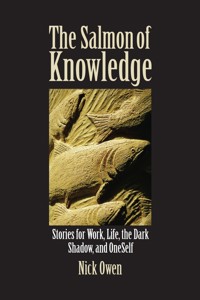
The Salmon of Knowledge
Stories for Work, Life, the Dark Shadow, and OneSelf
Nick Owen
Contents
Title Page
Foreword
Preface
Prologue
List of Stories by Theme
The Seven Chautauquas
Chautauqua 1: Finding One’s Own Path
Stories on the Themes of Awareness, Presence, and Direction
1.1 Mastery
1.2 Shake the Tree
1.3 Clear Vision
1.4 Detachment
1.5 Centredness
1.6 Unconventional Methods
1.7 Stop!
1.8 The Swine
1.9 Praxis
1.10 In Every Weakness, the Seeds of Strength
1.11 The Inner Voice
1.12 Non-Violent Communication
1.13 Uhuru (Freedom)
1.14 Tiny Frogs
1.15 Ringing the Changes
1.16 Wizards of Oz [1]
1.17 Wizards of Oz [2]
Chautauqua 2: Beyond the Surface of Things
Stories on the Themes of Appearance and Illusion
2.1 Right Value
2.2 The Limits of Reason
2.3 Busy-ness
2.4 Is That So?
2.5 The Coin
2.6 Perspicacity
2.7 Temptation
2.8 A Stunted Tree
2.9 Time and Place
2.10 The Genius of Simplicity
2.11 Perfect Partnerships
2.12 MBA
2.13 Beyond the Surface of Things
2.14 Dog Years
2.15 The Inner Gap
2.16 Optical Illusions
2.17 Fred
2.18 The Difference That Makes the Difference
2.19 Straight Talking
2.20 Qualities of Greatness
2.21 Passion
2.22 Life’s Value
Chautauqua 3: Flow
Stories on the Themes of Creativity, Complexity, Strategy, and Systems
3.1 Something Missing
3.2 Go with the Flow
3.3 Sustainability is Not a Cheap Option
3.4 The Blind Men and the Elephant
3.5 The Wise Fool
3.6 Giving for the Self
3.7 A Virtuous Circle
3.8 The Inner Teacher
3.9 Masculine Compassion (1)
3.10 Enthusiasm
3.11 Digging Deeper
3.12 Working with Complexity
3.13 Hearts and Heads
3.14 Going on a Bear Hunt
3.15 Management by Getting Out of the Way
3.16 Management Wisdom
3.17 The Post-Conventional Leader
Chautauqua 4: Difficult Conversations
Stories on the Themes of Mastery, Honesty, Leadership, and Personal Responsibility
4.1 The Tortoise and the Hare
4.2 Presentation is All
4.3 The Source
4.4 The Smuggler
4.5 St Kefyn
4.6 Alexander and the Turnips
4.7 Difficult Conversations
4.8 Competence or Excellence?
4.9 The Dreamer
4.10 The Lost Wallet
4.11 Taking Ownership
4.12 Rogoxin
4.13 Straight Talking
4.14 A Stitch in Time
4.15 Communication Blindspot
4.16 Don’t F**k with the Poodle
Chautauqua 5: Stuckness
Stories on the Themes of Attachment, Fear, Ego, Shadow, Death, and Other Dark Matters
5.1 Vast Emptiness; Nothing Holy
5.2 Tying Up the Cat
5.3 A Nice Cup of Tea
5.4 The Peace Maker
5.5 Imperfect Partnerships
5.6 The Shadow of Success
5.7 Stuckness
5.8 Tied to the Nest
5.9 Dutch Courage
5.10 Three Companions
5.11 The Wolf
5.12 Masculine Compassion (2)
5.13 Owning Our Shadow
5.14 The World’s Biggest Digger
5.15 The Subject Matter Expert
5.16 Irresistible Development
5.17 The Idea That Stuck
5.18 Coffee
Chautauqua 6: All Things Must Pass
Stories on the Themes of Impermanence, Acceptance, and Letting Go
6.1 It Will Pass
6.2 Enlightenment
6.3 Loquacity
6.4 Acceptance
6.5 The Teacher of Truth
6.6 Lotte’s Journey
6.7 The Wisdom of Solomon
6.8 Serenity
6.9 The Shattered Goblet
6.10 The Cardamom Seed
6.11 Sweet Darkness
6.12 Go for the Burn
6.13 Relativity
6.14 Wondrous Sounds
6.15 Rule Number Seven
Chautauqua 7: Not Knowing Mind
Stories on the Themes of Self, No-Self, and OneSelf
7.1 The Double Bind
7.2 I Do Not Know
7.3 A Taste of God
7.4 Silence
7.5 One Spirit
7.6 Who Am I?
7.7 Lost the Plot
7.8 Cathedrals of Clay
7.9 The Bowl
7.10 Float Like a Butterfly; Sting Like a Bee
7.11 The Master Potter
7.12 Embrace Everything
7.13 Mastery
7.14 Misery
7.15 The Lunatics are Running the Asylum
7.16 The Wave
7.17 Water, Sand, and Wind
7.18 Beyond Words
Epilogue: Pre-flections on Work, Life, the Dark Shadow, and OneSelf
Appendix A: Big Mind, Big Heart
Appendix B: Developmental Psychology
Sources
Notes
Bibliography
About the Author
Acknowledgements
Copyright
Foreword
Zen Master Dennis Genpo Merzel
All of us are on a journey, a journey that could be called returning home, to what we say in Zen is our original nature or our original heart-mind. We’re all engaged, whether we realise it or not, in an evolutionary process of waking up to who we really are and what we’re here to do. It’s a process we experience as individuals, but it has universal meanings and milestones.
On a universal level, for all of us, it’s about becoming more conscious, more realised, and finding out how to live this life in a more compassionate, more heartfelt, loving way towards our fellow beings—our families, our friends, the people we work with, the ones we work for or that work for us—trying, as Aldous Huxley once said, to be a little kinder to our neighbours.
On the individual level, it’s about finding our passion in this life, what it is that we love to do, and how to use this passion to serve others, how to be there for others, how to put our own self-interest off to the side, but not neglect it, to contribute and make a difference in the lives of others.
Discovering that there’s something greater than our ego-centred self—something that goes by many names including God, Reality, Truth—and that it is within each of us, gives us the key to finding and taking responsibility in our lives rather than being victims of circumstances. This process awakens what I call Big Heart, which is unconditional love and compassion for all beings and the ability to embrace all beings including the great earth, without being overwhelmed by this love and compassion towards others. Integration of the self with that which is greater than self is an important milestone on our journey.
If we look at our self, this body, mind, and spirit, and imagine that we’re sitting cross-legged on the floor, we look something like a triangle with our left and right knees forming the base, and our head at the top, the apex. Imagine that this triangle embraces our whole self. On one side, say the left knee, we have the human elements, the human components of our human beingness. So all those qualities of being human, the emotions, feelings, thoughts, ideas, concepts, behaviours, the five senses—all of these together are the human side. Here we have preferences, likes and dislikes, we want this, we don’t want that. On the other side of this triangle, let’s say the right knee, we have our awakeness. This is the part that most of us are not so familiar with, if we’re familiar with it at all. It’s the part that is at peace, at home, tranquil in a state of presence, awareness, awakeness, where everything in this present moment, here now, is seen as perfect, complete and whole. This is what we refer to in Zen as our True Nature, what I call Big Mind. This is the place where we lack nothing. We do not feel inadequate or insufficient at all. In fact, we are empowered; we are empowered in our beingness, where we don’t need to be doing anything to feel good about ourself. We don’t need to become anything to improve ourself, we are absolutely perfect as we are.
The third point of the triangle I call the apex, but really it includes the entire triangle; it bridges and integrates the seemingly fundamental differences between the other two points, the human and beingness. Here we see that we are all human beings, and from this place we consciously choose to be a human being and embody this transcendent place that includes all of our faults, all of our shortcomings, our ups and downs, our emotional upheavals and see all of these human qualities as perfect and complete and whole. This allows us to live our life as fully integrated human beings, the masters of our own lives who take full responsibility for action and reaction, for cause and effect.
In the Zen tradition we have always used stories to help us transcend our self, which means to go beyond, but not neglect, the self. We include and embrace our self, but go beyond it, to a level of awareness or awakening that allows us to cope with our lives in a much wiser and more compassionate way, to let go of our emotions more quickly, particularly anger, rage, hatred, defensiveness, and to feel empowered, or to be empowered to live as a fully integrated and free-functioning human being.
These stories, often in the form of dialogues between teacher and student, are what we call koans in Zen. They cannot be understood or grasped by our discursive and intellectual mind but move us beyond our dualistic way of thinking to a non-dual reality, allowing us to see the other as oneself and oneself as the other. They enable us to recognise our equality and sameness, and yet appreciate our uniqueness and differences. Much like if you build a bunch of snow people, and some of them are milkmen or milkpersons, mailpersons, whatever persons, and yet it’s all the same snow. These stories break down the barriers and the separations that divide each of us from one another, and enable us to come from a place where you are me and I am you, and yet you are you and I am I.
In this volume, Nick Owen, who is a student of mine, has gathered a wonderful treasury of stories, metaphors, koans, and anecdotes from spiritual and secular wisdom traditions spanning many eras and cultures to draw us directly into our human beingness, regardless of our background. The stories, engagingly told and wisely chosen, speak directly to our intuitive minds to show us what we do and what is important to us on a universal scale, helping us to reintegrate and make whole what has become separated.
Zen Master Dennis Genpo Merzel
Preface
A man fell into a deep hole in the middle of the road and a crowd quickly gathered. It was obvious that with a little help the man could be pulled out. ‘Give me your hand,’ onlookers cried as they reached down towards the man. He stood at the bottom of the hole with his arms tightly folded, shook his head and refused.
A storyteller came upon the scene and moving to the front of the crowd he looked at the man at the bottom of the hole. ‘Take my hand,’ he said. The man immediately reached up and grabbed the storyteller’s hand and was pulled to safety.
The crowd was perplexed. ‘Why did he accept your help and refuse ours?’ they asked. ‘Look at him,’ the storyteller replied. ‘He couldn’t give to save his life, but he can easily take.’
Nick Owen is like that storyteller. He has a discerning eye and able to read the character of those whom he meets. Like all great storytellers, he is able to communicate to each and every one of us in language appropriate to who we are and what we need.
The Salmon of Knowledge, Nick’s third book on metaphors, is deeper and darker than his earlier work. It explores the great themes: Work, Life, the Dark Shadow and the OneSelf.
Nick, the storyteller, weaves through these stories, laughing at his own foibles, embracing his own shadow, as the princess in the fairy story embraces the wet frog: loving it as it is.
Whatever its source, each story in this book has been touched and reworked by Nick. And in the touching, each story has reshaped Nick.
This collection has found you. The stories will change you and you will change them. They have a life of their own; they seek listeners, readers, recorders and retellers.
It doesn’t matter how you read this book, sequentially or pages opened randomly. Somewhere your story is waiting for you.
As Nick the storyteller reminds us, ‘It is written.’
Pete Lawry Leadership Mentor
Prologue
Beneath the Surface of Things
The land is parched and a man digs a well to find water for his gardens. After working for several hours in a place recommended by the water diviner he finds nothing and gives up in disgust. He has dug about four metres.
As he sits dejectedly on the great mound of soil he has dug, a traveller passes by. The traveller laughs at him for digging there, and indicates a much more likely spot. So the man starts a new well, but after digging for five or so metres, he has still found no sign of water.
Getting tired and despondent, he finally accepts some different advice from his old neighbour who assures him that he’ll find water in yet another place. After he’s given up on that one too, his wife comes out of the house and says, ‘Where are you, man? Have you lost your brains? This is no way to sink a well. Stay in one spot and go deeper and deeper there!’
The next day, having slept well and recovered his strength, the man returns to the first hole and spends all his time and concentration in that one place, and finds abundant water deep below the surface.
The more disarmingly simple a story, the more abundant and rich are the possible interpretations that lie beneath the surface. A brief inventory here might suggest the following incomplete list:
Follow your outcomes through to the end.Don’t give up too easily.Don’t get distracted.Don’t get dejected if things don’t work out at first.Don’t dissipate your energy on too many projects.Advice is cheap and often unreliable.Some people know what they’re talking about; find out who they are. Practical people make good partners.Pay attention to quality feedback.Trust your own judgement and stick to your guns.Take responsibility for your own actions.Meditation isn’t about losing yourself; it’s about focusing on and attending to one thing at a time in great depth. The richest jewels lie in the deepest seams.Wisdom is attained through struggle with yourself and the world you inhabit.The stories in this book, collected from storytelling and wisdom traditions around the world, offer deep wells of insight into ways in which we might consider how to live our lives with greater wisdom, understanding, intelligence, serenity, and success.
It is the central tenet of just about every major wisdom tradition in the world—whether spiritual, secular, pagan, or humanist—that if you wish to know God, The Buddha, True Nature, or the Truth then first you must study yourself. And that is what this book is about: studying ourselves and our human condition, on a planet inhabited by myriad other living systems, through the medium of story.
Between these covers are stories that embrace time and space. They are ancient and modern, spiritual and secular, short and long, spoken and written, and originate from all points of the compass. Some are based on lived experience; some are deeply metaphorical. All of them offer ways of looking at our ‘reality’ from different, unusual, or humorous perspectives and which may, if we are open to the possibilities of change and redirection, allow us to become more awake, more energised, and more connected to ourselves, other people, our work, and our planet.
I particularly resonate with stories that stretch the bounds of imagination, that offer challenging and provocative perspectives, that enquire into the conventional order of things, so that having read or heard such a story, I might feel a great desire to laugh out loud, or change something within, or see the world in a refreshingly new light, or be opened to something previously hidden within myself. In particular I’m attracted to stories that are irreverent, insightful, and which offer the hidden promise of wisdom to be uncovered at the bottom of the well.
Such stories are found everywhere, in all societies, within all cultures, among all traditions, across all time. Great stories have no boundaries, and in a sense belong to no one for it is the nature of stories to be told and shared. And in each new telling they assume a new shape, a new identity, a new meaning until in the end no one can tell whether it is the teller shaping the story or the story shaping the teller, or the context in which the story is given and received that shapes story, teller, and receiver too.
And that is exactly as it should be because each one of us has our truth to discover, our story to tell, and our pathway to tread.
Tir na n’Og
There is an old Celtic legend about a man who chooses eternal youth, the fullness of his heart’s desire, the love of a beautiful woman … and then lives to regret it. But the story also speaks of loyalty, comradeship, service and—the sting in the tale—the courage to defy convention by staying utterly true to what lies in the innermost depths of one’s heart and spirit.
The story tells of Oisin1, son of Fionn Mac Cumhail, leader of a band of the Fianna, warriors who roamed the length and breadth of ancient Ireland, doing good deeds for the common people, and doing whatever it was that warriors loved to do. He’s happy and he’s content and his fame is spreading far and wide …
But it’s one thing to be content, another to resist magic. For as he was sitting on the seashore one bright summer’s day minding his own business, Niamh of the Golden Hair saw him from far across the seas where she lived in Tir na n’Og, the land of Eternal Youth. And she made a resolve there and then that she would have him for her lover.
And so on her magical white mare she crossed the wide sea to Oisin in less time than it takes to blink an eye and made her proposal. She offered him not just herself, but all the things a warrior could desire: fighting a-plenty, gold and silver, feasting and drinking, music and good company, and—just as a clincher—eternal youth.
Yet still it was a difficult choice for Oisin to give up the companionship of his band of warriors, to let go of his deep attachment to his native land even for a beautiful woman and the gift of eternal youth. He agonised the whole night before making up his mind. And then he went with Niamh who whisked him up on her horse and off they went to Tir na n’Og in a blink of the other eye.
And it was all that he had been promised and more. He fought all day, feasted and danced each evening, and coupled all night with the resourceful Niamh. But after a few months Oisin began to grow distracted and more than anything he missed his friends and the great forests of ancient Eire.
‘Let me go back just for a day, just to see how they’re all getting on,’ he pleaded. At first Niamh refused, knowing that he hadn’t yet understood that time passes differently in Tir na n’Og than in the marketplace world that you and I inhabit. In fact the three months that had passed for Oisin in Tir na n’Og were exactly three hundred years here in the world of impermanence.
‘Oisin,’ said Niamh, ‘your friends are long dead, everything has changed. It can never be the same.’ But Oisin, not entirely believing her, pressed until Niamh relented. She gave him her white mare warning him in no uncertain terms that he should not dismount.
***
Oisin arrives in Ireland to find everything has changed. The forests have been replaced by pastures, and the people who live there are surprisingly small, scarce half the size of the men of his day. Searching for traces of his old life, he finds a group of men trying to move a huge stone. ‘Do you know where I can find Fionn Mac Cumhail and the Fianna?’ he asks. The men laugh, ‘He’s just a legend that our grandmothers used to tell us. It’s all ballox.’
Oisin is hurt but he still knows his duty. ‘Can I help you with that stone?’ ‘Sure,’ they scoff, ‘if you can.’ Oisin bends over, picks it up with one hand, and raises it high. And just at that moment with a loud snap, the girth of the saddle breaks and off he falls. No sooner does he touch the ground than his years in Tir na n’Og overcome him. His skin cracks, his hair greys, his teeth fall out. As for the mare, it skips back across the sea to the land of eternity.
‘What have I done?’ cries Oisin. ‘I had it all and gave it up just to see my homeland once again.’
Now news travels faster than the speed of lips in Ireland. Within a day or so St Patrick arrives to find out more about this triple centenarian with a magic horse. He orders his monks to write down Oisin’s story, and all the tales that Oisin can remember about Fionn Mac Cumhail and the Fianna. And a good thing too for in so doing the monks immortalised Fionn and the Fianna, keeping them in our memory eternally young.
But above all the good Saint Padraig’s going to save Oisin’s soul and convert him to Christianity before imminent death inevitably takes him. ‘I’m going to baptise you in the name of Christ,’ says the Patriarch, ‘so you can be saved and go to Heaven with all the Blessed Saints.’
Oisin thinks about this for a moment and then asks, ‘What happened to Fionn and all the warriors? Were they baptised in the name of Christ?’ ‘Indeed not,’ replies St Patrick loftily, ‘they were sinners all; they died unrepentant and went to Hell.’
‘Well in that case,’ retorts Oisin, ‘If Heaven’s not good enough for Fionn and the Fianna, then I’m damn sure it’s not good enough for me either.’ And with these words he died and went to join Fionn and the band of brothers. And whether he joined them in Hell or in Tir na n’Og no one can tell. At least not in this life.
Stories as Connectors
One of the attributes of good stories is that they are great connectors. They remind us that whoever we are, in whatever context we live, we’re not really so very different from people living in other cultures and even in eras other than our own. The issues that are addressed in the story of Oisin and Niamh, issues that were presumably hot in third century Ireland, are universal themes that each of us has probably considered and faced up to in some way or another at different stages of our own twenty-first century lives.
In fact, this story is particularly rich in archetypal themes, and demonstrates just how effective story can be in expressing complexity in simple and elegant ways. The story takes the heroic dream of Youth—that Death can be fought and overcome—and counterpoints it with the inevitability of Death that we must all accept in later years. It compares different ideas of Eternal Life from both pagan and religious perspectives. It warns us against the danger of wanting everything and not being content with the gifts we are given. And it also celebrates the quality of the person who can recognise and own what is really important in life and death, and stay true to those values whatever the consequences.
Like all great wisdom stories—whether from pagan, secular, or spiritual traditions—the story of Oisin and Niamh expresses deeply complex universal ideas with simplicity and elegance. It also includes some of the key themes that are explored in this book: Work, Life, the Dark Shadow, and OneSelf.
Four Key Themes
1. Work
For Oisin, at least before he meets Niamh, work is a deeply satisfying expression of what he loves to do, what he does well, and what gives him sufficient challenge to learn and grow. At the same time, his work allows him to make a significant and valuable contribution to the band of warriors he leads, and the community he serves. As a result he feels happy and fulfilled within himself, while others praise his actions and build his reputation.
People of our own time may spend upwards of forty years in work and many get nowhere near the satisfaction that Oisin enjoys during his time with the Fianna. The stories in this book do not offer answers, but they do put forward various perspectives for looking at the nature of work and the contribution it enables us to make to ourselves, others, and our world in a variety of different ways.
The stories explore possibilities for deepening the personal and professional satisfaction we can derive from our work, enhancing the level of contribution we can make at many different levels, and recognising that the more we notice the systemic and interconnected nature of the world we inhabit, the more we can make wiser and more mature decisions and choices.
Above all, the stories suggest that the more of ourselves, particularly our core values and beliefs, that we bring into the workplace the more we and our work are likely to thrive and flourish.
2. Life
It is sometimes said that there are two great adversaries golfers must face when playing: the course and ourself. That strikes me, a non-golfer, as a particularly good metaphor for life. Another way of saying it is that life is a dance between what happens to us, over which we have no control, and how we respond to what happens to us, over which we appear to at least have some control.
As with Oisin, life offers us a constant series of opportunities and challenges that we have to navigate as best we can. We make choices, some easy, some difficult, and then have to live with them. And even if we recognise that everything we do will have consequences, it’s very hard to see far enough ahead to predict what some of those consequences might be. This is Oisin’s reality and our own.
The great test for Oisin, which is primarily a test of his personal integrity, comes at the end of his life when he is required to choose between one set of values—salvation in Christ—and another set of values—salvation in kin, clan, and community. It is not important which he chooses for anyone else but himself; what is important is that he knows what his own values are and remains steadfastly true to them. This is an act of supreme courage and integrity.
The stories in this book on the theme of life raise important existential questions like: Who am I? Why am I here? What’s my purpose? What and whom do I serve? They also encourage us to laugh at ourselves, to treat ourselves and others with greater compassion, and to explore some of the great paradoxes of life—such as coming to terms with our twin and seemingly contradictory blessings of magnificence and insignificance, wisdom and foolishness, rationality and intuition, and many more besides. What wisdom might we gain, the stories enquire, through working to integrate these great opposing qualities that possess each one of us at different times in our lives?
3. The Dark Shadow
Symbolised by his escape to Tir na n’Og, the Land of Eternal Life, the great Dark Shadow for Oisin is Death. Oisin thinks he can cheat death and gain immortal life. He is even prepared to forsake what he holds most dear—kith, kin, clan, and community—to achieve his victory over death. But much as he feels at home in Tir na n’Og, the mortal world still calls to him; some deep part of Oisin feels incomplete, and he determines to return to the ordinary world ‘just for a day’.
The story itself is unusual in that it combines an archetypal Youthful Hero story with elements of mid-life and late-life stories.2 The first part of the tale is typical of a Youthful Hero story. In the first part of our lives we tend to be idealistic and think of ourselves as indestructible, even immortal. Death exists but as a distant figure, one that can be fought if necessary—especially in the service of a noble ideal—and conquered. I can think of several times in the earlier years of my own life when, having overcome serious illness or narrowly avoided a nasty accident, I arrogantly thought of myself as powerful and resourceful enough to cheat and overcome death. Why else would I have delayed paying into a pension fund till I was forty! Death was something that happened to others.
It was only in mid-life that I fully began to accept the truth of the graffiti I once saw painted on the side of an Austrian railway carriage: ‘Life is a near-death experience.’ Mid-life is the time when we stop counting the years since birth and begin wondering how much time remains till the exit strategy. Death is recognised at this point, indeed it is acknowledged as ever present, and can even seem attractive—a dancing partner that gives greater meaning and piquancy to life. And so at this stage in our personal development it is not uncommon to want to explore more deeply into ourselves; to start finally being more truthful with ourselves and about ourselves. It is time to face up to our own Dark Shadow.
The Swiss psychologist Carl Jung was the first to bring Western attention to the idea of our Shadow but its origins go way back. The story of Milarepa [Story 5.13], the Buddhist yogi, is one such example. Since Jung, the Shadow has been written about and explored extensively. It is central to archetype theory and psychotherapy, and it is essential in any approach to spiritual practice or in simply deepening awareness of oneself.
The ‘shadow’ consists of those parts of ourselves that we find hard to come to terms with, the bits we don’t much like about ourselves, the parts we suppress or ignore. In extreme cases, we refuse to even see these qualities in ourselves, no matter how much our friends and our enemies can! We can live in complete denial of them: ‘I’m not competitive.’ ‘I don’t do anger.’ ‘I’m not narcissistic.’3
Unless we fully own these parts of ourselves, parts we spend a huge amount of energy suppressing, and hiding from the judgement of convention, we cannot begin truly to know ourselves or liberate ourselves from the ‘stuckness’ of our pretence. It is only, for example, when I truly own the narcissist that exists within me that I can truly begin to love and appreciate myself just as I am, which in its turn frees me to love others unconditionally too. When I fully own this or any other shadow voice, it no longer runs me, and it no longer emerges covertly. That, I find, is both liberating and empowering.
Sometimes we even deny our most positive and most nurturing qualities. Fearing to be the nail that stands proud of the floorboard, we disown our unique perspective, our personal wisdom, our insight, our deep sensitivity—anxious as we can sometimes be not to be seen as ‘special’ or ‘clever’ or ‘powerful’ by others.
The stories in this book on the theme of the Dark Shadow invite us to take a step back, to a safer more contemplative space, and look at ourselves with greater serenity and compassion, to laugh at our ridiculousness, and to open ourselves to new possibilities of self-honesty and truth.
***
When Oisin falls back to earth and becomes mortal once again, the storyteller is offering us a simple truth: that as a human being Oisin has access to two separate yet interconnected worlds, the finite and the infinite, the relative and the absolute. When the girth of his saddle breaks, Oisin returns from the eternal, absolute world represented by Tir na n’Og, to the relative, messy, finite world of struggle and death.
But even now, at over three hundred years old he still remains reluctant to move on. He becomes temporarily as stuck in the material world as before he was getting stuck in the eternal world. It takes St Patrick to offer him a choice, a choice that reconnects him with what he truly values—his old comrades and the warrior codes—that finally allows Oisin to own his shadow and embrace death as a welcome friend, a gateway to absolute reconnection to that which he holds eternally enduring and important.
In finally owning the shadow with style and humour, Oisin validates the integrity of his own unique, separate, and mortal self, and at the same time becomes one with everything he holds sacred and good: not a denial of his individuality but an empowerment of it.
4. OneSelf
The idea of the One and the Self—OneSelf—has fascinated humankind way back to the beginnings of time. It is the notion that perhaps other worlds, or parallel worlds, or interior worlds exist as well as the one we so materially inhabit. This is a notion that exists not only in the spiritual, contemplative, and wisdom traditions, but also in a great deal of modern scientific thought: particularly in quantum physics, relativity, systems theory, and chaos theory. These post-rational scientific theories perceive the universe in terms of indivisible integration and interconnection—‘implicate order’ to use the terminology of theoretical physicist, David Bohm.
These ideas have come to fascinate me more and more in recent years. I’m not a physicist, I’m not religious, I’m not a philosopher, and I’m not an academic. And although I have an interest in wisdom and spiritual pathways, I’m not particularly affiliated or attached to any one of them.4 Rather, it is my own deepening and experiential awareness of a very tangible interior spaciousness opening up within me, which includes yet goes far beyond any sense of my individual self, that I want to explore through the stories that populate this book. This fascination started just a few years ago when I stopped being so busy being busy in my life; and what follows is my own personal take on it.
Drawing from a wide variety of traditions both spiritual and secular, the notion of OneSelf recognises the existence of two strands of human experience and awareness. The first is a separate individual self—an egoic, relative, rational, doing self—that feels alone and unique and which ends at the surface of our skin. It is the self we bring to our marketplace world. It is busy and practical and it gets things done. It is Oisin working hard to make third century Ireland a better place. The other is an extended self that has the effortless ability just to be, to flow and merge with—and into—all other things, material and non-material. This OneSelf has a sense of infinite connection. It is boundless, absolute, and at one with everything. In some traditions it is simply called No-Self, Beyond-Self, or the Absolute.
It is a space where the ‘I’ disappears; a space where there is no subject/object division.5 I prefer to call it the Awakened Self because it is a state of absolute presence, of living in the moment, here and now, fully attentive to whatever is happening inside or out.
In fact, this extended or awakened self goes under many names depending on the tradition: Empty Mind, Beginner’s Mind, Big Mind, Essence, Oneness, True Nature, the Source, the Non-Dual, and countless others. Whatever we call it, it’s a space where we can find inner space and time to contemplate, reflect, and experience a much vaster canvas of awareness than we are able to do when inhabiting the busy marketplace self of our everyday world. Whereas the individual




